 Quick View
A Level Geography — Paper 3 Synoptic Investigation | Student Preparation Guide | Edexcel 9GE0/03
A complete, copyright-free preparation guide for Edexcel A Level Geography Paper
(GE/) — the Synoptic Investigation.
This -page booklet contains entirely original teaching content. No past paper questions
or Pearson resource booklet pages are reproduced. It is fully copyright-free, safe to distribute to students, and designed to be used alongside the freely available past papers on the Edexcel website.
What is Paper ?
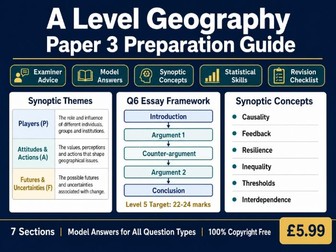
Paper is the Synoptic Investigation — worth % of the A Level. Students are given an unseen Resource Booklet about a specific place and geographical issue, and must answer six questions drawing on knowledge from across the whole course. This paper cannot be revised by topic — students must develop transferable skills in analysis, evaluation, and synoptic thinking. That is exactly what this guide teaches.
What is in this booklet?
Section — Understanding Paper
A clear explanation of the paper’s structure, the three synoptic themes (Players, Attitudes &
Actions, Futures & Uncertainties), the six-question format, and how marks are distributed
across the three Assessment Objectives (AO, AO, AO).
Section — Examiner Advice
Detailed, question-by-question guidance for Q through Q, including the most common
mistakes students make and how to avoid them. Covers how to read the Resource Booklet
effectively, how to move from description to analysis in Q/Q, how to structure a Q
evaluation essay, and how to write a Level synoptic essay for Q.
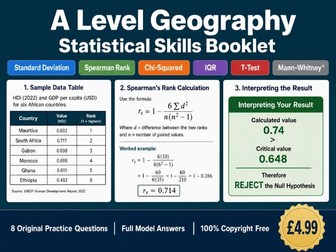
Section — Statistical Skills Revision
A concise revision guide to all statistical methods that have appeared in Paper Q,
including Spearman’s Rank, Chi-Squared, Mean, and IQR. Includes a four-step framework
for interpreting statistical results in a geographical context — the skill that separates high
and low scorers in Q.
Section — Model Answer Frameworks
Fully written model answers for Q, Q, Q, Q, and Q, drawn from a range of past paper
contexts (Haiti, SIDS, Latin America, Climate Change). Each model answer is annotated to
explain why it achieves the marks it does. Q and Q model answers include synoptic
theme mapping, essay plans, and Level descriptor tables so students can self-assess their
own writing.
Section — Synoptic Concepts Glossary
Definitions and exam application examples for all specialist geographical concepts
identified in the specification: causality, systems, feedback, inequality, identity,
globalisation, interdependence, mitigation, adaptation, sustainability, risk, and resilience.
Includes guidance on how to deploy these concepts analytically rather than just defining
them.
Section — Past Paper Themes Reference
A reference table summarising the region, context