Collecting Like Terms Year 7 Maths Lesson | Simplifying Algebraic ExpressionsQuick View
EduProGo

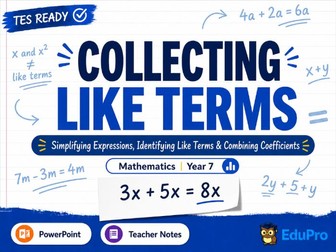
Collecting Like Terms Year 7 Maths Lesson | Simplifying Algebraic Expressions

(0)
A complete Year 7 Maths lesson on simplifying algebraic expressions by collecting like terms. This ready-to-use KS3 resource introduces pupils to identifying terms, coefficients, variables, constants and like terms before guiding them through worked examples, board practice, independent questions and a final understanding check. Designed for mixed-ability Year 7 classes, the lesson supports pupils in combining coefficients accurately, keeping variable parts unchanged, working with positive and negative terms, and avoiding common misconceptions such as combining unlike terms or changing letters into powers. Includes: Full PowerPoint lesson Teacher notes Retrieval warm-up Key vocabulary Worked examples Guided practice Independent practice questions Quick check assessment Lesson summary Ideal for KS3 algebra, Year 7 maths, introducing collecting like terms, or revising simplifying expressions. Based on the uploaded PowerPoint and teacher notes.
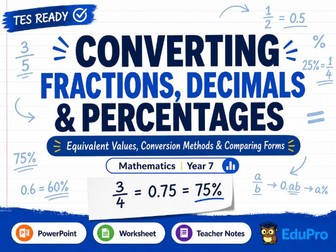
Converting Fractions, Decimals and Percentages | Year 7 Maths Lesson + WorksheetQuick View
EduProGo

Converting Fractions, Decimals and Percentages | Year 7 Maths Lesson + Worksheet

(1)
A complete Year 7 maths lesson on converting between fractions, decimals and percentages, designed for mixed-ability KS3 classes. This ready-to-use resource supports students in recognising equivalent values, converting fractions to decimals, decimals to percentages, and percentages to fractions and decimals. The lesson uses clear worked examples, guided practice, independent worksheet tasks, and a final check for understanding. Included: Full PowerPoint lesson Printable student worksheet Teacher notes Mark scheme Worked examples and guided practice Quick check questions Suitable for Year 7 / KS3 maths Students will practise: Common equivalents such as 1/2 = 0.5 = 50% Converting fractions to decimals Converting decimals to percentages Converting percentages to fractions and decimals Comparing fractions, decimals and percentages Ideal for KS3 revision, cover work, intervention, homework, or a full classroom lesson.
Finding Percentages of Amounts | Year 7 Maths Lesson, Worksheet & Teacher NotesQuick View
EduProGo

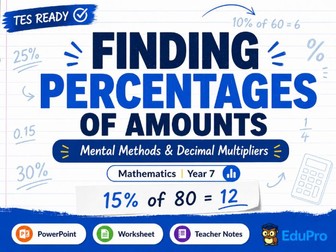
Finding Percentages of Amounts | Year 7 Maths Lesson, Worksheet & Teacher Notes

(0)
A complete Year 7 maths lesson on finding percentages of amounts using mental methods and decimal multipliers. This resource supports pupils in finding 10%, 5%, 1%, 20%, 25%, 30% and 50% of quantities, while encouraging them to choose efficient methods and check whether their answers are reasonable. The lesson is suitable for KS3 / Year 7 mixed-ability classes and is ideal for introducing or revising percentage calculations. Included: Full PowerPoint lesson Independent practice worksheet Teacher notes Mark scheme Retrieval warm-up Guided examples Quick check / exit questions Common misconception support Skills covered: Finding 10%, 5% and 1% of amounts Building percentages from known values Finding 20%, 25%, 30% and 50% Using decimal multipliers Checking answers by estimation Spotting common percentage mistakes This lesson is designed to be clear, structured and low-prep, with worked examples, guided practice, independent questions and teacher guidance included.
Solving One and Two-Step Equations | Year 8 Maths Lesson, Worksheet & Teacher NotesQuick View
EduProGo

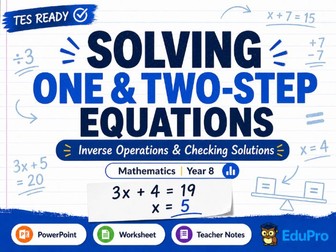
Solving One and Two-Step Equations | Year 8 Maths Lesson, Worksheet & Teacher Notes

(0)
A complete Year 8 maths lesson on solving one-step and two-step linear equations using inverse operations. This resource helps pupils understand how to keep equations balanced, isolate variables, solve accurately, and check answers by substitution. Suitable for KS3 mixed-ability classes, revision, cover work, or introducing equation-solving before more advanced algebra. Included: Full PowerPoint lesson Independent practice worksheet Teacher notes Mark scheme Retrieval warm-up Worked examples Guided practice Quick check / exit questions Common misconception support Skills covered: Understanding equations as balanced statements Using inverse operations Solving one-step equations Solving two-step equations Showing clear working Checking solutions by substitution Spotting and correcting common errors The lesson builds gradually from simple one-step equations such as x + 7 = 15 and 3a = 18 into two-step equations such as 2p + 3 = 11 and 5m - 7 = 18. It includes clear teacher guidance and diagnostic questions to support confident classroom delivery.
Year 8 Expanding Single Brackets Worksheet & PowerPoint | Negative Coefficients & Like TermsQuick View
EduProGo

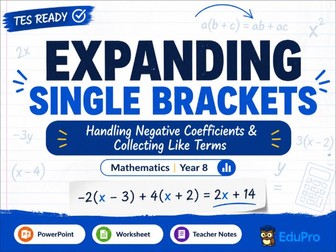
Year 8 Expanding Single Brackets Worksheet & PowerPoint | Negative Coefficients & Like Terms

(0)
A complete Year 8 algebra lesson on expanding single brackets, handling negative coefficients, and collecting like terms after expanding. This resource supports students as they move from basic bracket expansion to more secure GCSE-style algebra simplification. Includes: Full PowerPoint lesson presentation Independent practice worksheet Teacher notes with slide-by-slide guidance Retrieval warm-up Key vocabulary support Worked examples using the distributive law Negative coefficient examples Guided “I do, We do, You do” practice Quick check questions Full mark scheme The lesson is designed for mixed-ability Year 8 classes and follows a clear progression: identifying terms, applying the distributive law, checking signs, expanding fully, then collecting like terms. The worksheet contains 22 marks of independent practice plus an extension question. Teacher notes include common misconceptions, delivery guidance, and a full mark scheme for easy classroom use.