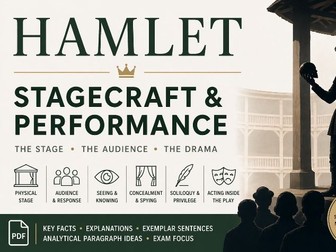
A clear, detailed PDF resource on stagecraft, performance and audience in HamletQuick View
HaydnWood15

A clear, detailed PDF resource on stagecraft, performance and audience in Hamlet

(0)
This teaching resource focuses on how Shakespeare uses the physical stage, audience response and theatrical method to shape meaning in Hamlet. It covers the open public theatre, visibility, surveillance, concealment, soliloquy, the Ghost, the arras scene, the Players, the Mousetrap, physical action, the duel, and the final collapse of the court. It also includes concise exemplar openings, model sentences and paragraph ideas that help students turn performance knowledge into strong analytical writing. Designed for Hamlet revision, essay planning, stagecraft questions, classroom teaching, homework, intervention, cover work, tutoring, and independent study, this resource is especially useful for lessons on dramatic method, Shakespearean theatre, Globe context, audience, soliloquy, spying, performance, spectacle, public vs private action, and exam technique. The file included is a PDF, ready to teach from, print, or upload to your school platform
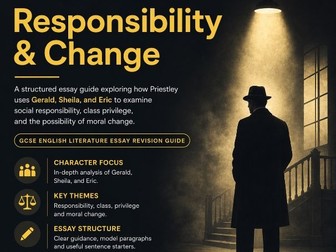
An Inspector Calls AQA Model Essay, Structure and Planning PDFQuick View
HaydnWood15

An Inspector Calls AQA Model Essay, Structure and Planning PDF

(0)
A focused PDF essay guide on responsibility and change in An Inspector Calls, with clear structure, model writing and revision support. This resource is built around two high-value essay areas in An Inspector Calls: how Priestley uses Gerald to explore responsibility, and how he presents the younger generation as more willing to change. It includes a structured question, introduction guidance, paragraph structure, model writing, key quotations, planning prompts and a clear line of argument throughout. The first half of the resource explores Gerald’s polished image, his treatment of Daisy Renton, and his relief at the possible ‘hoax’; the second half focuses on Sheila and Eric, moral growth, and Priestley’s contrast between younger and older generations.
Streetcar Named Desire Critics and Critical DebateQuick View
HaydnWood15

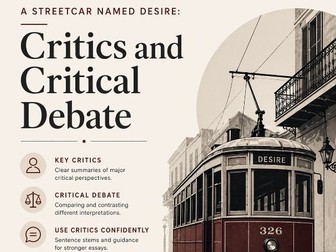
Streetcar Named Desire Critics and Critical Debate

(0)
A sharp, essay-focused PDF on A Streetcar Named Desire critics and critical debate, designed to help students use criticism with more precision in essays and revision. This resource gives students a clear, usable guide to some of the most important critical readings of A Streetcar Named Desire. It covers major debates around Blanche’s downfall, Stanley’s violence, Stella’s loyalties, gender, class, illusion and reality, dramatic method, rape, and the play’s blend of realism with theatricalism. It is built to help students move beyond plot summary into stronger interpretation, sharper argument, and more confident use of critical views. Included are concise explanations of key critics and approaches, including Joseph Wood Krutch, Mary Ann Corrigan, John T. von Szeliski, Kathleen Margaret Lant, Anca Vlasopolos, John S. Bak, Nicholas Grene, and Philip C. Kolin, alongside guidance on how to use criticism effectively in essays by making a point, using evidence, introducing a critic, and then agreeing, qualifying or challenging that view.
Hamlet Critics and Critical DebateQuick View
HaydnWood15

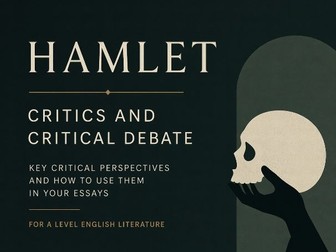
Hamlet Critics and Critical Debate

(0)
A clear, high-value PDF on Hamlet critics and critical debate, designed to help students use criticism with confidence in essays and revision. This resource gives a focused guide to some of the most useful critical readings of Hamlet, helping students move beyond plot summary into stronger interpretation and argument. It covers major debates around Hamlet’s delay, the Ghost, corruption, gender, religion, politics, uncertainty and performance, while also showing how criticism can be used properly in literary essays rather than dropped in mechanically. Included are concise, usable explanations of major critics and approaches, including A. C. Bradley, T. S. Eliot, G. Wilson Knight, Maynard Mack, Ernest Jones, Elaine Showalter, Stephen Greenblatt, and Jan Kott, along with clear guidance on what each reading is useful for in written analysis. The resource also includes a practical section on how to use criticism in essays, with a structure built around point, evidence and method, critic, and judgment. Designed mainly for A Level English Literature, this PDF is also useful for strong GCSE students, tutoring, revision, essay planning, intervention, homework, and independent study.
Much Ado Extract AnalysisQuick View
HaydnWood15

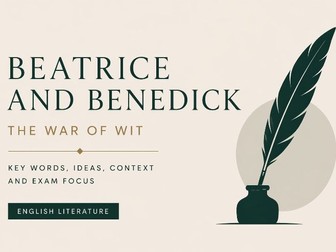
Much Ado Extract Analysis

(0)
A focused PDF of Much Ado About Nothing extract analysis, with key words, ideas, context and sharp exam-focused commentary. This resource offers a clear, useful set of extract-based analyses on some of the most teachable and examinable moments in Much Ado About Nothing. It includes Beatrice and Benedick’s ‘war of wit’, Benedick’s gulling scene, Beatrice’s response to being tricked into love, Hero’s public shaming, and the ‘Kill Claudio’ turning point, each paired with an exam-style question and concise support on language, ideas, context and interpretation. The play is built around the comic antagonism of Beatrice and Benedick, the deception of Hero and Claudio, and the sudden darkening of the action at the wedding scene, where Claudio denounces Hero publicly. Official Shakespeare summaries from the Shakespeare Birthplace Trust, the Royal Shakespeare Company, and Folger all outline these same central movements in the plot and show how the play moves between wit, deception, public shame and reconciliation.
Analytical Writing and Writer’s MethodsQuick View
HaydnWood15

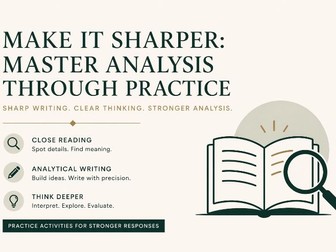
Analytical Writing and Writer’s Methods

(0)
A practical PDF on analytical writing and how writers create meaning, with short extracts, tasks and paragraph practice. This resource is built to improve the quality of students’ analytical writing through clear, manageable practice. It uses short extracts and focused activities to sharpen close reading, quotation selection, word analysis, interpretation, reader effect, and paragraph building. Across the booklet, students work on atmosphere, character, imagery, tension, contrast and multiple interpretations, with scaffolded tasks that move from spotting details to writing fuller analytical responses.