Cardboard Knight Armour Set — Wearable Cardboard Build Plan | Measuring & Engineering DesignQuick View
thehighend

Cardboard Knight Armour Set — Wearable Cardboard Build Plan | Measuring & Engineering Design

(0)
A measured build plan, not a print-and-cut sheet. Pupils read the dimensions off the page and mark them onto their own cardboard, so measuring is the work rather than a warm-up for it. WHY IT WORKS AS A LESSON Every piece is dimensioned in both centimetres and inches, so unit conversion is built into the task. The largest piece is 36 × 51 cm (14" × 20") — bigger than any classroom printer can output at real size, which is exactly why it is measured rather than printed. The engineering test is built in. It has to fit, the wearer has to be able to see and move in it, and it has to survive being worn. So pupils test it, find what failed, and revise — the design cycle, on something they actually want to work. WHAT YOU GET • All 8 pieces with exact cut sizes in cm and inches, quantities marked (11 to cut in total) • Cut, fold and score marks drawn on every piece • A 9-step illustrated build guide — each step shows thumbnails of the exact pieces it uses • Full materials list, with adult-assist flags on every step that needs one • The complete illustrated guide in English, Spanish, Portuguese, French, German and Dutch RUNNING IT Ages 4–12. Teams of 4–6 per build. About 1.5–2 hours. You supply the cardboard — 2 medium boxes (at least 18" × 24" each) — plus scissors, tape, a ruler and a pencil. An adult handles the cutting. Nothing is timed and the plan can be rebuilt as many times as you like, so it suits mixed-pace groups. Classrooms, home-educating families and co-ops, special-educational-needs and autism support groups, libraries, Scout and Guide groups, after-school clubs and holiday programmes can all run it the same way. Six languages are included, so bilingual and EAL groups can work from one plan across the whole room. WHAT THEY BUILD Build and wear a complete 8-piece knight armour set: helmet, chest, back, 2 shoulders, 2 arm guards, 2 shin guards, and a kite shield. TRY THIS AFTERWARDS Knightly quest: once fully armored, complete 5 tasks — rescue a stuffed animal, defend a pillow fort, slay a pillow dragon, carry a treasure, and bow to the king. ——— Tatum & Kash Cardboard Creations — High End Entertainment LLC. Buy once, print for your class for the year.

Cardboard Rocket Ship — Life-Size Cardboard Build Plan | Measuring & Engineering DesignQuick View
thehighend

Cardboard Rocket Ship — Life-Size Cardboard Build Plan | Measuring & Engineering Design

(0)
A measured build plan, not a print-and-cut sheet. Pupils read the dimensions off the page and mark them onto their own cardboard, so measuring is the work rather than a warm-up for it. WHY IT WORKS AS A LESSON Every piece is dimensioned in both centimetres and inches, so unit conversion is built into the task. The largest piece is 46 × 122 cm (18" × 48") — bigger than any classroom printer can output at real size, which is exactly why it is measured rather than printed. The engineering test is built in. It has to stand on its own, hold its shape when it is leaned on, and let a child get in and out safely. So pupils test it, find what failed, and revise — the design cycle, on something they actually want to work. Which way the corrugation runs decides whether a panel holds or buckles — something pupils can feel with their hands. WHAT YOU GET • All 5 pieces with exact cut sizes in cm and inches, quantities marked (14 to cut in total) • Cut, fold and score marks drawn on every piece • A 8-step illustrated build guide — each step shows thumbnails of the exact pieces it uses • Full materials list, with adult-assist flags on every step that needs one • The complete illustrated guide in English, Spanish, Portuguese, French, German and Dutch RUNNING IT Ages 3–10. Teams of 3–4 per build. About 1–2 hours. You supply the cardboard — 2–3 large boxes (at least 24" × 36" each) — plus scissors, tape, a ruler and a pencil. An adult handles the cutting. Nothing is timed and the plan can be rebuilt as many times as you like, so it suits mixed-pace groups. Classrooms, home-educating families and co-ops, special-educational-needs and autism support groups, libraries, Scout and Guide groups, after-school clubs and holiday programmes can all run it the same way. Six languages are included, so bilingual and EAL groups can work from one plan across the whole room. WHAT THEY BUILD Build a standing rocket ship the child stands inside: nose cone, 4 fins, cockpit cut-out, bold flames at base. TRY THIS AFTERWARDS Mission challenge: count down from 10 as a family. On blastoff — EVERYONE jumps! ——— Tatum & Kash Cardboard Creations — High End Entertainment LLC. Buy once, print for your class for the year.
Cardboard Beast Suit — Wearable Cardboard Build Plan | Measuring & Engineering DesignQuick View
thehighend

Cardboard Beast Suit — Wearable Cardboard Build Plan | Measuring & Engineering Design

(0)
A measured build plan, not a print-and-cut sheet. Pupils read the dimensions off the page and mark them onto their own cardboard, so measuring is the work rather than a warm-up for it. WHY IT WORKS AS A LESSON Every piece is dimensioned in both centimetres and inches, so unit conversion is built into the task. The largest piece is 30 × 38 cm (12" × 15") — bigger than any classroom printer can output at real size, which is exactly why it is measured rather than printed. The engineering test is built in. It has to fit, the wearer has to be able to see and move in it, and it has to survive being worn. So pupils test it, find what failed, and revise — the design cycle, on something they actually want to work. WHAT YOU GET • All 15 pieces with exact cut sizes in cm and inches, quantities marked (21 to cut in total) • Cut, fold and score marks drawn on every piece • A 13-step illustrated build guide — each step shows thumbnails of the exact pieces it uses • Full materials list, with adult-assist flags on every step that needs one • The complete illustrated guide in English, Spanish, Portuguese, French, German and Dutch RUNNING IT Ages 6–12. Teams of 4–6 per build. About 3–4 hours. You supply the cardboard — 3 large boxes (at least 24" × 36" each) — plus scissors, tape, a ruler and a pencil. An adult handles the cutting. Nothing is timed and the plan can be rebuilt as many times as you like, so it suits mixed-pace groups. Classrooms, home-educating families and co-ops, special-educational-needs and autism support groups, libraries, Scout and Guide groups, after-school clubs and holiday programmes can all run it the same way. Six languages are included, so bilingual and EAL groups can work from one plan across the whole room. WHAT THEY BUILD Build and wear a complete 15-piece beast suit: a faceted skull with snout and jaw, neck collar, chest, back, spine ridge, 2 shoulder plates, 2 claw cuffs, 2 thigh plates, 2 shin guards and a scuted tail. TRY THIS AFTERWARDS Beast challenge: work out how your creature moves, what it eats and what noise it makes when it is happy. Then stalk the hallway in character. ——— Tatum & Kash Cardboard Creations — High End Entertainment LLC. Buy once, print for your class for the year.

Cardboard Monster Mask — Wearable Cardboard Build Plan | Measuring & Engineering DesignQuick View
thehighend

Cardboard Monster Mask — Wearable Cardboard Build Plan | Measuring & Engineering Design

(0)
A measured build plan, not a print-and-cut sheet. Pupils read the dimensions off the page and mark them onto their own cardboard, so measuring is the work rather than a warm-up for it. WHY IT WORKS AS A LESSON Every piece is dimensioned in both centimetres and inches, so unit conversion is built into the task. The largest piece is 30 × 36 cm (12" × 14") — bigger than any classroom printer can output at real size, which is exactly why it is measured rather than printed. The engineering test is built in. It has to fit, the wearer has to be able to see and move in it, and it has to survive being worn. So pupils test it, find what failed, and revise — the design cycle, on something they actually want to work. WHAT YOU GET • All 7 pieces with exact cut sizes in cm and inches, quantities marked (9 to cut in total) • Cut, fold and score marks drawn on every piece • A 10-step illustrated build guide — each step shows thumbnails of the exact pieces it uses • Full materials list, with adult-assist flags on every step that needs one • The complete illustrated guide in English, Spanish, Portuguese, French, German and Dutch RUNNING IT Ages 4–12. Teams of 4–6 per build. About 45–60 minutes. You supply the cardboard — 1 large box (at least 24" × 36") — plus scissors, tape, a ruler and a pencil. An adult handles the cutting. Nothing is timed and the plan can be rebuilt as many times as you like, so it suits mixed-pace groups. Classrooms, home-educating families and co-ops, special-educational-needs and autism support groups, libraries, Scout and Guide groups, after-school clubs and holiday programmes can all run it the same way. Six languages are included, so bilingual and EAL groups can work from one plan across the whole room. WHAT THEY BUILD Build and wear a 7-piece creature mask: a face plate with wide eye holes, a boxed 3-part snout with upper and lower teeth, 2 rolled horns and a head strap. TRY THIS AFTERWARDS Creature challenge: give it a name, a sound and one thing it is afraid of. Then scare somebody in the kitchen. ——— Tatum & Kash Cardboard Creations — High End Entertainment LLC. Buy once, print for your class for the year.

Cardboard Wings — Wearable Cardboard Build Plan | Measuring & Engineering DesignQuick View
thehighend

Cardboard Wings — Wearable Cardboard Build Plan | Measuring & Engineering Design

(0)
A measured build plan, not a print-and-cut sheet. Pupils read the dimensions off the page and mark them onto their own cardboard, so measuring is the work rather than a warm-up for it. WHY IT WORKS AS A LESSON Every piece is dimensioned in both centimetres and inches, so unit conversion is built into the task. The largest piece is 61 × 41 cm (24" × 16") — bigger than any classroom printer can output at real size, which is exactly why it is measured rather than printed. The engineering test is built in. It has to fit, the wearer has to be able to see and move in it, and it has to survive being worn. So pupils test it, find what failed, and revise — the design cycle, on something they actually want to work. WHAT YOU GET • All 5 pieces with exact cut sizes in cm and inches, quantities marked (9 to cut in total) • Cut, fold and score marks drawn on every piece • A 7-step illustrated build guide — each step shows thumbnails of the exact pieces it uses • Full materials list, with adult-assist flags on every step that needs one • The complete illustrated guide in English, Spanish, Portuguese, French, German and Dutch RUNNING IT Ages 4–12. Teams of 3–4 per build. About 45–90 minutes. You supply the cardboard — 2 medium boxes (at least 18" × 24" each) — plus scissors, tape, a ruler and a pencil. An adult handles the cutting. Nothing is timed and the plan can be rebuilt as many times as you like, so it suits mixed-pace groups. Classrooms, home-educating families and co-ops, special-educational-needs and autism support groups, libraries, Scout and Guide groups, after-school clubs and holiday programmes can all run it the same way. Six languages are included, so bilingual and EAL groups can work from one plan across the whole room. WHAT THEY BUILD Build and wear a 5-piece wing set: 2 strutted wing panels on a shared back plate, held with crossed shoulder straps. TRY THIS AFTERWARDS Paint challenge: feathers make an owl or an angel, smooth panels make a bat, overlapping scallops make a dragon. Same wings, three creatures. ——— Tatum & Kash Cardboard Creations — High End Entertainment LLC. Buy once, print for your class for the year.

Cardboard Creations Starter Kit — Life-Size Cardboard Build Plan | Measuring & Engineering DesignQuick View
thehighend

Cardboard Creations Starter Kit — Life-Size Cardboard Build Plan | Measuring & Engineering Design

(0)
A measured build plan, not a print-and-cut sheet. Pupils read the dimensions off the page and mark them onto their own cardboard, so measuring is the work rather than a warm-up for it. WHY IT WORKS AS A LESSON Every piece is dimensioned in both centimetres and inches, so unit conversion is built into the task. The largest piece is 61 × 61 cm (24" × 24") — bigger than any classroom printer can output at real size, which is exactly why it is measured rather than printed. The engineering test is built in. It has to stand on its own, hold its shape when it is leaned on, and let a child get in and out safely. So pupils test it, find what failed, and revise — the design cycle, on something they actually want to work. Which way the corrugation runs decides whether a panel holds or buckles — something pupils can feel with their hands. WHAT YOU GET • All 3 pieces with exact cut sizes in cm and inches, quantities marked (6 to cut in total) • Cut, fold and score marks drawn on every piece • A 8-step illustrated build guide — each step shows thumbnails of the exact pieces it uses • Full materials list, with adult-assist flags on every step that needs one • The complete illustrated guide in English, Spanish, Portuguese, French, German and Dutch RUNNING IT Ages 4+. Teams of 3–4 per build. About 45 minutes. You supply the cardboard — 1 large box (any size works) — plus scissors, tape, a ruler and a pencil. An adult handles the cutting. Nothing is timed and the plan can be rebuilt as many times as you like, so it suits mixed-pace groups. Classrooms, home-educating families and co-ops, special-educational-needs and autism support groups, libraries, Scout and Guide groups, after-school clubs and holiday programmes can all run it the same way. Six languages are included, so bilingual and EAL groups can work from one plan across the whole room. WHAT THEY BUILD Complete your first Cardboard Creations build. Learn the 3 tools, the door cut, the window cut, and wall reinforcement. TRY THIS AFTERWARDS Original build challenge: once you’ve done the door and window, build something inside no one else would think of. Not a house. Not a car. Something only YOU would build. ——— Tatum & Kash Cardboard Creations — High End Entertainment LLC. Buy once, print for your class for the year.
Giant Cracked Dino Egg — Life-Size Cardboard Build Plan | Measuring & Engineering DesignQuick View
thehighend

Giant Cracked Dino Egg — Life-Size Cardboard Build Plan | Measuring & Engineering Design

(0)
A measured build plan, not a print-and-cut sheet. Pupils read the dimensions off the page and mark them onto their own cardboard, so measuring is the work rather than a warm-up for it. WHY IT WORKS AS A LESSON Every piece is dimensioned in both centimetres and inches, so unit conversion is built into the task. The largest piece is 61 × 91 cm (24" × 36") — bigger than any classroom printer can output at real size, which is exactly why it is measured rather than printed. The engineering test is built in. It has to stand on its own, hold its shape when it is leaned on, and let a child get in and out safely. So pupils test it, find what failed, and revise — the design cycle, on something they actually want to work. Which way the corrugation runs decides whether a panel holds or buckles — something pupils can feel with their hands. WHAT YOU GET • All 4 pieces with exact cut sizes in cm and inches, quantities marked (15 to cut in total) • Cut, fold and score marks drawn on every piece • A 10-step illustrated build guide — each step shows thumbnails of the exact pieces it uses • Full materials list, with adult-assist flags on every step that needs one • The complete illustrated guide in English, Spanish, Portuguese, French, German and Dutch RUNNING IT Ages 3–10. Teams of 3–4 per build. About 1.5–2 hours. You supply the cardboard — 3 large boxes (at least 24" × 36" each) — plus scissors, tape, a ruler and a pencil. An adult handles the cutting. Nothing is timed and the plan can be rebuilt as many times as you like, so it suits mixed-pace groups. Classrooms, home-educating families and co-ops, special-educational-needs and autism support groups, libraries, Scout and Guide groups, after-school clubs and holiday programmes can all run it the same way. Six languages are included, so bilingual and EAL groups can work from one plan across the whole room. WHAT THEY BUILD Build a 4-foot hatching dinosaur egg: crack opening at top third, pointed shell shards, green spots, orange zigzag band, fossil details. TRY THIS AFTERWARDS Hatch sequence: child climbs inside. Family counts: 3… 2… 1… HATCH! Pop up through the crack with your best dinosaur roar. Who wins? ——— Tatum & Kash Cardboard Creations — High End Entertainment LLC. Buy once, print for your class for the year.

Castle Fortress Alpha — Life-Size Cardboard Build Plan | Measuring & Engineering DesignQuick View
thehighend

Castle Fortress Alpha — Life-Size Cardboard Build Plan | Measuring & Engineering Design

(0)
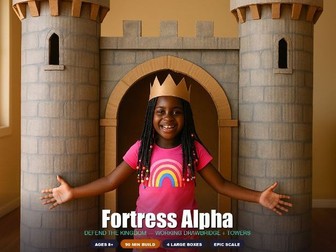
A measured build plan, not a print-and-cut sheet. Pupils read the dimensions off the page and mark them onto their own cardboard, so measuring is the work rather than a warm-up for it. WHY IT WORKS AS A LESSON Every piece is dimensioned in both centimetres and inches, so unit conversion is built into the task. The largest piece is 46 × 76 cm (18" × 30") — bigger than any classroom printer can output at real size, which is exactly why it is measured rather than printed. The engineering test is built in. It has to stand on its own, hold its shape when it is leaned on, and let a child get in and out safely. So pupils test it, find what failed, and revise — the design cycle, on something they actually want to work. Which way the corrugation runs decides whether a panel holds or buckles — something pupils can feel with their hands. WHAT YOU GET • All 5 pieces with exact cut sizes in cm and inches, quantities marked (19 to cut in total) • Cut, fold and score marks drawn on every piece • A 9-step illustrated build guide — each step shows thumbnails of the exact pieces it uses • Full materials list, with adult-assist flags on every step that needs one • The complete illustrated guide in English, Spanish, Portuguese, French, German and Dutch RUNNING IT Ages 4–12. Teams of 3–4 per build. About 3–4 hours. You supply the cardboard — 5–7 large boxes (at least 24" × 36" each) — plus scissors, tape, a ruler and a pencil. An adult handles the cutting. Nothing is timed and the plan can be rebuilt as many times as you like, so it suits mixed-pace groups. Classrooms, home-educating families and co-ops, special-educational-needs and autism support groups, libraries, Scout and Guide groups, after-school clubs and holiday programmes can all run it the same way. Six languages are included, so bilingual and EAL groups can work from one plan across the whole room. WHAT THEY BUILD Build a castle: walk-through gatehouse arch, 2 gatehouse towers, 2 corner towers, side walls, crenellated battlements on all surfaces. TRY THIS AFTERWARDS Siege time! One defender inside with foam balls to throw, attackers outside. Castle must survive 3 rounds. ——— Tatum & Kash Cardboard Creations — High End Entertainment LLC. Buy once, print for your class for the year.
Cardboard Playhouse — Life-Size Cardboard Build Plan | Measuring & Engineering DesignQuick View
thehighend

Cardboard Playhouse — Life-Size Cardboard Build Plan | Measuring & Engineering Design

(0)
A measured build plan, not a print-and-cut sheet. Pupils read the dimensions off the page and mark them onto their own cardboard, so measuring is the work rather than a warm-up for it. WHY IT WORKS AS A LESSON Every piece is dimensioned in both centimetres and inches, so unit conversion is built into the task. The largest piece is 91 × 122 cm (36" × 48") — bigger than any classroom printer can output at real size, which is exactly why it is measured rather than printed. The engineering test is built in. It has to stand on its own, hold its shape when it is leaned on, and let a child get in and out safely. So pupils test it, find what failed, and revise — the design cycle, on something they actually want to work. Which way the corrugation runs decides whether a panel holds or buckles — something pupils can feel with their hands. WHAT YOU GET • All 4 pieces with exact cut sizes in cm and inches, quantities marked (12 to cut in total) • Cut, fold and score marks drawn on every piece • A 9-step illustrated build guide — each step shows thumbnails of the exact pieces it uses • Full materials list, with adult-assist flags on every step that needs one • The complete illustrated guide in English, Spanish, Portuguese, French, German and Dutch RUNNING IT Ages 3–8. Teams of 3–4 per build. About 2–3 hours. You supply the cardboard — 4–6 large boxes (at least 24" × 36" each) — plus scissors, tape, a ruler and a pencil. An adult handles the cutting. Nothing is timed and the plan can be rebuilt as many times as you like, so it suits mixed-pace groups. Classrooms, home-educating families and co-ops, special-educational-needs and autism support groups, libraries, Scout and Guide groups, after-school clubs and holiday programmes can all run it the same way. Six languages are included, so bilingual and EAL groups can work from one plan across the whole room. WHAT THEY BUILD Build a full-size walk-in playhouse: 4 walls, working door, 2 windows, peaked roof, chimney. TRY THIS AFTERWARDS Housewarming party! Once built, set a table inside, invite stuffed animals, have a snack. What’s the most people you can fit? ——— Tatum & Kash Cardboard Creations — High End Entertainment LLC. Buy once, print for your class for the year.
Cardboard Pirate Ship — Life-Size Cardboard Build Plan | Measuring & Engineering DesignQuick View
thehighend

Cardboard Pirate Ship — Life-Size Cardboard Build Plan | Measuring & Engineering Design

(0)
A measured build plan, not a print-and-cut sheet. Pupils read the dimensions off the page and mark them onto their own cardboard, so measuring is the work rather than a warm-up for it. WHY IT WORKS AS A LESSON Every piece is dimensioned in both centimetres and inches, so unit conversion is built into the task. The largest piece is 91 × 61 cm (36" × 24") — bigger than any classroom printer can output at real size, which is exactly why it is measured rather than printed. The engineering test is built in. It has to stand on its own, hold its shape when it is leaned on, and let a child get in and out safely. So pupils test it, find what failed, and revise — the design cycle, on something they actually want to work. Which way the corrugation runs decides whether a panel holds or buckles — something pupils can feel with their hands. WHAT YOU GET • All 9 pieces with exact cut sizes in cm and inches, quantities marked (12 to cut in total) • Cut, fold and score marks drawn on every piece • A 10-step illustrated build guide — each step shows thumbnails of the exact pieces it uses • Full materials list, with adult-assist flags on every step that needs one • The complete illustrated guide in English, Spanish, Portuguese, French, German and Dutch RUNNING IT Ages 4–12. Teams of 4–6 per build. About 2–3 hours. You supply the cardboard — 4–5 large boxes (at least 24" × 36" each) — plus scissors, tape, a ruler and a pencil. An adult handles the cutting. Nothing is timed and the plan can be rebuilt as many times as you like, so it suits mixed-pace groups. Classrooms, home-educating families and co-ops, special-educational-needs and autism support groups, libraries, Scout and Guide groups, after-school clubs and holiday programmes can all run it the same way. Six languages are included, so bilingual and EAL groups can work from one plan across the whole room. WHAT THEY BUILD Build a pirate ship hull large enough for a child to sit inside, with a standing mast, 2 sails, 2 cannons, and rope rigging. TRY THIS AFTERWARDS Crew challenge: add a working drawbridge! Cut the front of the hull so it folds down like a real gangplank. ——— Tatum & Kash Cardboard Creations — High End Entertainment LLC. Buy once, print for your class for the year.
HEE-BOT Mark 1 — Wearable Robot Suit — Wearable Cardboard Build Plan | Measuring & EngineeringQuick View
thehighend

HEE-BOT Mark 1 — Wearable Robot Suit — Wearable Cardboard Build Plan | Measuring & Engineering

(0)
A measured build plan, not a print-and-cut sheet. Pupils read the dimensions off the page and mark them onto their own cardboard, so measuring is the work rather than a warm-up for it. WHY IT WORKS AS A LESSON Every piece is dimensioned in both centimetres and inches, so unit conversion is built into the task. The largest piece is 30 × 41 cm (12" × 16") — bigger than any classroom printer can output at real size, which is exactly why it is measured rather than printed. The engineering test is built in. It has to fit, the wearer has to be able to see and move in it, and it has to survive being worn. So pupils test it, find what failed, and revise — the design cycle, on something they actually want to work. WHAT YOU GET • All 7 pieces with exact cut sizes in cm and inches, quantities marked (10 to cut in total) • Cut, fold and score marks drawn on every piece • A 7-step illustrated build guide — each step shows thumbnails of the exact pieces it uses • Full materials list, with adult-assist flags on every step that needs one • The complete illustrated guide in English, Spanish, Portuguese, French, German and Dutch RUNNING IT Ages 5–12. Teams of 4–6 per build. About 2–2.5 hours. You supply the cardboard — 3–4 medium boxes (at least 18" × 24" each) — plus scissors, tape, a ruler and a pencil. An adult handles the cutting. Nothing is timed and the plan can be rebuilt as many times as you like, so it suits mixed-pace groups. Classrooms, home-educating families and co-ops, special-educational-needs and autism support groups, libraries, Scout and Guide groups, after-school clubs and holiday programmes can all run it the same way. Six languages are included, so bilingual and EAL groups can work from one plan across the whole room. WHAT THEY BUILD Build and wear a complete 7-piece robot suit: head, chest, back, 2 arm tubes, 2 claw hands, 2 shin guards, antenna. ALL SILVER. TRY THIS AFTERWARDS Robot activation! Once dressed: walk in a straight line, spin once, pick up an object using only claw hands, state your mission. ——— Tatum & Kash Cardboard Creations — High End Entertainment LLC. Buy once, print for your class for the year.
Cardboard Fire Truck Cab — Life-Size Cardboard Build Plan | Measuring & Engineering DesignQuick View
thehighend

Cardboard Fire Truck Cab — Life-Size Cardboard Build Plan | Measuring & Engineering Design

(0)
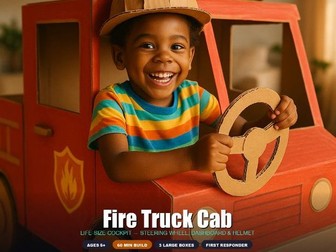
A measured build plan, not a print-and-cut sheet. Pupils read the dimensions off the page and mark them onto their own cardboard, so measuring is the work rather than a warm-up for it. WHY IT WORKS AS A LESSON Every piece is dimensioned in both centimetres and inches, so unit conversion is built into the task. The largest piece is 61 × 46 cm (24" × 18") — bigger than any classroom printer can output at real size, which is exactly why it is measured rather than printed. The engineering test is built in. It has to stand on its own, hold its shape when it is leaned on, and let a child get in and out safely. So pupils test it, find what failed, and revise — the design cycle, on something they actually want to work. Which way the corrugation runs decides whether a panel holds or buckles — something pupils can feel with their hands. WHAT YOU GET • All 10 pieces with exact cut sizes in cm and inches, quantities marked (13 to cut in total) • Cut, fold and score marks drawn on every piece • A 10-step illustrated build guide — each step shows thumbnails of the exact pieces it uses • Full materials list, with adult-assist flags on every step that needs one • The complete illustrated guide in English, Spanish, Portuguese, French, German and Dutch RUNNING IT Ages 4+. Teams of 4–6 per build. About 90 minutes. You supply the cardboard — 2–3 large boxes (at least 24" × 36" each) — plus scissors, tape, a ruler and a pencil. An adult handles the cutting. Nothing is timed and the plan can be rebuilt as many times as you like, so it suits mixed-pace groups. Classrooms, home-educating families and co-ops, special-educational-needs and autism support groups, libraries, Scout and Guide groups, after-school clubs and holiday programmes can all run it the same way. Six languages are included, so bilingual and EAL groups can work from one plan across the whole room. WHAT THEY BUILD Build a sit-in fire truck cab with windshield, steering wheel, dashboard, light bar, hood — plus a wearable firefighter helmet. All exterior painted fire engine red. TRY THIS AFTERWARDS Fire drill! Set a 60-second timer. Can the whole family get to the fire truck and buckle in before the alarm goes off? ——— Tatum & Kash Cardboard Creations — High End Entertainment LLC. Buy once, print for your class for the year.
Cardboard Race Car Cockpit — Life-Size Cardboard Build Plan | Measuring & Engineering DesignQuick View
thehighend

Cardboard Race Car Cockpit — Life-Size Cardboard Build Plan | Measuring & Engineering Design

(0)
A measured build plan, not a print-and-cut sheet. Pupils read the dimensions off the page and mark them onto their own cardboard, so measuring is the work rather than a warm-up for it. WHY IT WORKS AS A LESSON Every piece is dimensioned in both centimetres and inches, so unit conversion is built into the task. The largest piece is 91 × 61 cm (36" × 24") — bigger than any classroom printer can output at real size, which is exactly why it is measured rather than printed. The engineering test is built in. It has to stand on its own, hold its shape when it is leaned on, and let a child get in and out safely. So pupils test it, find what failed, and revise — the design cycle, on something they actually want to work. Which way the corrugation runs decides whether a panel holds or buckles — something pupils can feel with their hands. WHAT YOU GET • All 6 pieces with exact cut sizes in cm and inches, quantities marked (9 to cut in total) • Cut, fold and score marks drawn on every piece • A 8-step illustrated build guide — each step shows thumbnails of the exact pieces it uses • Full materials list, with adult-assist flags on every step that needs one • The complete illustrated guide in English, Spanish, Portuguese, French, German and Dutch RUNNING IT Ages 4–12. Teams of 4–6 per build. About 1.5–2 hours. You supply the cardboard — 2–3 large boxes (at least 24" × 36" each) — plus scissors, tape, a ruler and a pencil. An adult handles the cutting. Nothing is timed and the plan can be rebuilt as many times as you like, so it suits mixed-pace groups. Classrooms, home-educating families and co-ops, special-educational-needs and autism support groups, libraries, Scout and Guide groups, after-school clubs and holiday programmes can all run it the same way. Six languages are included, so bilingual and EAL groups can work from one plan across the whole room. WHAT THEY BUILD Build a low, wide F1 cockpit: extended nose cone, front + rear wings, steering wheel. Child sits low inside. TRY THIS AFTERWARDS Race day: two kids, two cardboard cars. Decorate differently. Who has the fastest-looking car? Race on 3… 2… 1… GO! ——— Tatum & Kash Cardboard Creations — High End Entertainment LLC. Buy once, print for your class for the year.
HEE-1 Interstellar Cockpit — Life-Size Cardboard Build Plan | Measuring & Engineering DesignQuick View
thehighend

HEE-1 Interstellar Cockpit — Life-Size Cardboard Build Plan | Measuring & Engineering Design

(0)
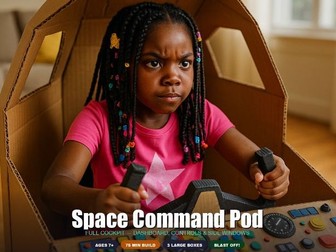
A measured build plan, not a print-and-cut sheet. Pupils read the dimensions off the page and mark them onto their own cardboard, so measuring is the work rather than a warm-up for it. WHY IT WORKS AS A LESSON Every piece is dimensioned in both centimetres and inches, so unit conversion is built into the task. The largest piece is 61 × 61 cm (24" × 24") — bigger than any classroom printer can output at real size, which is exactly why it is measured rather than printed. The engineering test is built in. It has to stand on its own, hold its shape when it is leaned on, and let a child get in and out safely. So pupils test it, find what failed, and revise — the design cycle, on something they actually want to work. Which way the corrugation runs decides whether a panel holds or buckles — something pupils can feel with their hands. WHAT YOU GET • All 6 pieces with exact cut sizes in cm and inches, quantities marked (12 to cut in total) • Cut, fold and score marks drawn on every piece • A 7-step illustrated build guide — each step shows thumbnails of the exact pieces it uses • Full materials list, with adult-assist flags on every step that needs one • The complete illustrated guide in English, Spanish, Portuguese, French, German and Dutch RUNNING IT Ages 4–12. Teams of 4–6 per build. About 2 hours. You supply the cardboard — 3–4 large boxes (at least 24" × 36" each) — plus scissors, tape, a ruler and a pencil. An adult handles the cutting. Nothing is timed and the plan can be rebuilt as many times as you like, so it suits mixed-pace groups. Classrooms, home-educating families and co-ops, special-educational-needs and autism support groups, libraries, Scout and Guide groups, after-school clubs and holiday programmes can all run it the same way. Six languages are included, so bilingual and EAL groups can work from one plan across the whole room. WHAT THEY BUILD Build a fully enclosed cockpit: U-shaped console, command seat, main screen, control panels on all surfaces. TRY THIS AFTERWARDS Mission debrief! Once seated, the pilot gives a 30-second report: Where are we going? What’s the mission? What’s the crew name? ——— Tatum & Kash Cardboard Creations — High End Entertainment LLC. Buy once, print for your class for the year.
FREE Cardboard Creature Mask — Wearable Cardboard Build Plan | Measuring & Engineering DesignQuick View
thehighend

FREE Cardboard Creature Mask — Wearable Cardboard Build Plan | Measuring & Engineering Design

(0)
A measured build plan, not a print-and-cut sheet. Pupils read the dimensions off the page and mark them onto their own cardboard, so measuring is the work rather than a warm-up for it. WHY IT WORKS AS A LESSON Every piece is dimensioned in both centimetres and inches, so unit conversion is built into the task. The largest piece is 25 × 30 cm (10" × 12") — bigger than any classroom printer can output at real size, which is exactly why it is measured rather than printed. The engineering test is built in. It has to fit, the wearer has to be able to see and move in it, and it has to survive being worn. So pupils test it, find what failed, and revise — the design cycle, on something they actually want to work. WHAT YOU GET • All 3 pieces with exact cut sizes in cm and inches, quantities marked (4 to cut in total) • Cut, fold and score marks drawn on every piece • A 6-step illustrated build guide — each step shows thumbnails of the exact pieces it uses • Full materials list, with adult-assist flags on every step that needs one • The complete illustrated build guide in English RUNNING IT Ages 4–12. Teams of 3–4 per build. About 20 minutes. You supply the cardboard — 1 medium box (at least 18" × 24") — plus scissors, tape, a ruler and a pencil. An adult handles the cutting. Nothing is timed and the plan can be rebuilt as many times as you like, so it suits mixed-pace groups. Classrooms, home-educating families and co-ops, special-educational-needs and autism support groups, libraries, Scout and Guide groups, after-school clubs and holiday programmes can all run it the same way. WHAT THEY BUILD Build and wear a 3-piece creature mask: a face plate with wide eye holes, 2 rolled horns and a head strap. Twenty minutes, one box, no cost. TRY THIS AFTERWARDS Creature challenge: give it a name and a sound. Then scare somebody in the kitchen. ——— Tatum & Kash Cardboard Creations — High End Entertainment LLC. Buy once, print for your class for the year.