Ancient Americas – Society and Daily Life (Year 7 History) Lessons and ActivitiesQuick View
BeyondTime

Ancient Americas – Society and Daily Life (Year 7 History) Lessons and Activities

(0)
This 15 slide Year 7 History lesson sequence introduces students to the social structure and daily life of the Ancient Americas. The resource helps students analyse who held power, how different groups lived, and whose experiences are visible or missing in the historical record. The first section (slides 1–8) opens with an inquiry question asking how social structure shaped daily life in early American societies. Students examine farmers, artisans, merchants, nobles, warriors, religious specialists, women, and children through roles, lived experience, and surviving evidence. A dedicated slide addresses whose voices are missing and why. The section closes with a synthesis slide drawing together what the evidence reveals about inequality, identity, and daily experience. The second section (slides 9–15) provides a flexible activity bank including source analysis, discussion, creative thinking, structured writing, ranking tasks, retrieval starters, and exit tickets. The transferable skill is social structure analysis; the Ancient Americas are the vehicle. This resource is provided as non‑editable PDFs and is not designed as editable PowerPoints. Teachers can upload slides to their LMS, print selected pages for classroom use, display them to support discussion, analysis, and writing, or upload them to presentation or design platforms if they wish to adapt the material (formatting may vary depending on the program).
Ancient Americas – Geography, Context and Chronology (Year 7 History) Lessons and ActivitiesQuick View
BeyondTime

Ancient Americas – Geography, Context and Chronology (Year 7 History) Lessons and Activities

(0)
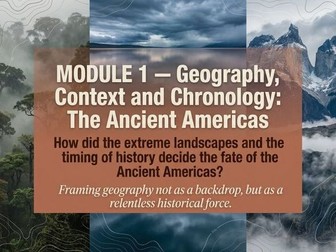
This 15 slide Year 7 History lesson sequence introduces students to the geographical and chronological context of the Ancient Americas. The resource helps students read landscape and time period as historical forces, showing how mountains, forests, plains, and climate zones shaped settlement, agriculture, belief, and political development. The first section (slides 1–8) opens with an inquiry question asking how geography and time shaped early American civilisations. Students examine the Andes, Mesoamerican lowlands, North American river systems, and regional diversity, each linked to movement, trade, conflict, and cultural growth. A clear timeline sets out major periods of Ancient American history using simple visual logic. The section closes with a synthesis slide drawing together geographical and chronological threads while previewing the inquiry ahead. The second section (slides 9–15) provides a flexible activity bank including source analysis, discussion and debate, creative and divergent thinking, structured writing, map annotation, retrieval starters, and consolidation checks. The transferable skill is historical context‑setting; the Ancient Americas are the vehicle. This resource is provided as non‑editable PDFs and is not designed as editable PowerPoints. Teachers can upload slides to their LMS, print selected pages for classroom use, display them to support discussion, analysis, and writing, or upload them to presentation or design platforms if they wish to adapt the material (formatting may vary depending on the program).
Ancient Americas – Leadership, Power and Case Studies (Year 7 History) Lessons and ActivitiesQuick View
BeyondTime

Ancient Americas – Leadership, Power and Case Studies (Year 7 History) Lessons and Activities

(0)
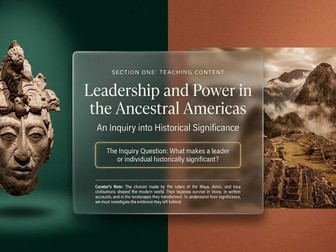
This 15 slide Year 7 History lesson sequence introduces students to leadership and power in the Ancient Americas through structured case studies of significant individuals. The resource helps students understand what makes a leader historically significant and how individuals shaped and reflected wider political, social, and cultural forces. The first section (slides 1–8) opens with an inquiry question asking what makes an individual historically significant. Students examine political leadership, military command, religious authority, and administrative power before moving into two to three case studies. Each case study follows the same structure: who they were, what they did, what evidence survives, and why they matter historically. The section closes with a synthesis slide identifying patterns across the case studies and connecting individual leadership to broader historical forces. The second section (slides 9–15) provides a flexible activity bank including source analysis, debate preparation, creative thinking, structured writing, significance ranking, pattern recognition, retrieval starters, and exit tickets. The transferable skill is case‑study method; the Ancient Americas are the vehicle. This resource is provided as non‑editable PDFs and is not designed as editable PowerPoints. Teachers can upload slides to their LMS, print selected pages for classroom use, display them to support discussion, analysis, and writing, or upload them to presentation or design platforms if they wish to adapt the material (formatting may vary depending on the program).
Ancient Americas – Beliefs, Culture and Knowledge Systems (Year 7 History) Lessons and ActivitiesQuick View
BeyondTime

Ancient Americas – Beliefs, Culture and Knowledge Systems (Year 7 History) Lessons and Activities

(0)
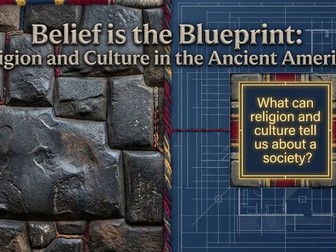
This 15 slide Year 7 History lesson sequence introduces students to the belief systems, cultural practices, and knowledge traditions of the Ancient Americas. The resource helps students read cultural knowledge as historical evidence, showing how ideas, rituals, and institutions shaped society and expressed its values. The first section (slides 1–8) opens with an inquiry question asking what belief systems and cultural traditions can reveal about a society. Students examine polytheism, ritual practice, temples, astronomy, calendars, mythology, and cultural institutions, each connected to a social or political function. The section closes with a synthesis slide drawing together what these beliefs reveal about values, priorities, and understandings of power and identity. The second section (slides 9–15) provides a flexible activity bank including source analysis, discussion, creative thinking, structured writing, comparison prompts, connection tasks, retrieval starters, and consolidation checks. The transferable skill is reading belief systems as historical evidence; the Ancient Americas are the vehicle. This resource is provided as non‑editable PDFs and is not designed as editable PowerPoints. Teachers can upload slides to their LMS, print selected pages for classroom use, display them to support discussion, analysis, and writing, or upload them to presentation or design platforms if they wish to adapt the material (formatting may vary depending on the program).
Ancient Americas – The Caddo Mounds & Mississippian World View 800 to 1300 AD (Year 7 History)Quick View
BeyondTime

Ancient Americas – The Caddo Mounds & Mississippian World View 800 to 1300 AD (Year 7 History)

(0)
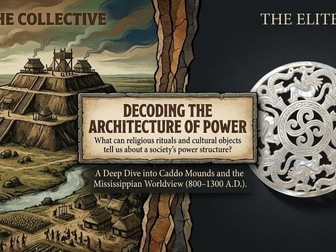
This 15 slide Year 7 History lesson sequence introduces students to the belief systems, cultural practices, and knowledge traditions of the Ancient Americas, paying particular attention to the Caddo Mounds & Mississippian World View - 800 to 1300 AD. The resource helps students read cultural knowledge as historical evidence, showing how ideas, rituals, and institutions shaped society and expressed its values. The first section (slides 1–8) opens with an inquiry question asking what belief systems and cultural traditions can reveal about a society. Students examine polytheism, ritual practice, temples, astronomy, calendars, mythology, and cultural institutions, each connected to a social or political function. The section closes with a synthesis slide drawing together what these beliefs reveal about values, priorities, and understandings of power and identity. The second section (slides 9–15) provides a flexible activity bank including source analysis, discussion, creative thinking, structured writing, comparison prompts, connection tasks, retrieval starters, and consolidation checks. The transferable skill is reading belief systems as historical evidence; the Ancient Americas are the vehicle. This resource is provided as non‑editable PDFs and is not designed as editable PowerPoints. Teachers can upload slides to their LMS, print selected pages for classroom use, display them to support discussion, analysis, and writing, or upload them to presentation or design platforms if they wish to adapt the material (formatting may vary depending on the program).
Ancient Americas – Artefacts, Sources and Archaeological Evidence (Year 7 History)Quick View
BeyondTime

Ancient Americas – Artefacts, Sources and Archaeological Evidence (Year 7 History)

(0)
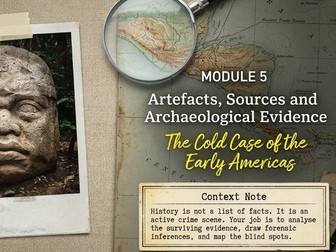
This 15 slide Year 7 History lesson sequence introduces students to the material and archaeological evidence of the Ancient Americas. The resource helps students analyse artefacts, architecture, inscriptions, and written sources using a consistent framework, showing how evidence is interpreted, what it reveals, and what its limitations are. The first section (slides 1–8) opens with an inquiry question asking how we know what life was like in the Ancient Americas. Students examine pottery, pyramids, textiles, carvings, environmental evidence, and written accounts, each explored for what it shows, what historians infer, and what it cannot tell us. The section closes with a synthesis slide drawing together how different forms of evidence combine to build historical understanding. The second section (slides 9–15) provides a flexible activity bank including source analysis, annotation tasks, creative thinking, structured writing, sequencing evidence, retrieval starters, and consolidation checks. The transferable skill is source analysis; the Ancient Americas are the vehicle. This resource is provided as non‑editable PDFs and is not designed as editable PowerPoints. Teachers can upload slides to their LMS, print selected pages for classroom use, display them to support discussion, analysis, and writing, or upload them to presentation or design platforms if they wish to adapt the material (formatting may vary depending on the program).
Ancient Americas – Legacy, Significance and Historical Inquiry (Year 7 History) Lessons & ActivitiesQuick View
BeyondTime

Ancient Americas – Legacy, Significance and Historical Inquiry (Year 7 History) Lessons & Activities

(0)
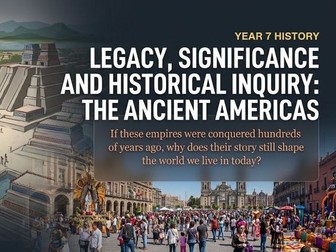
This 15 slide Year 7 History lesson sequence introduces students to the legacy and significance of the Ancient Americas. The resource helps students understand why early American civilisations matter today, how interpretations have changed over time, and how historical significance is constructed. The first section (slides 1–8) opens with an inquiry question asking why the Ancient Americas remain significant in the present. Students explore engineering achievements, agricultural innovation, scientific developments, cultural influence, and shifting interpretations by historians. The section closes with a synthesis slide drawing together patterns of significance and preparing students for inquiry work. The second section (slides 9–15) provides a flexible activity bank including source analysis, debate prompts, creative thinking, structured writing, ranking significance factors, connection tasks, retrieval starters, and exit tickets. The transferable skill is evaluating historical significance; the Ancient Americas are the vehicle. This resource is provided as non‑editable PDFs and is not designed as editable PowerPoints. Teachers can upload slides to their LMS, print selected pages for classroom use, display them to support discussion, analysis, and writing, or upload them to presentation or design platforms if they wish to adapt the material (formatting may vary depending on the program).
Ancient Americas – Assessment, Writing and Feedback (Year 7 History) Lessons and ActivitiesQuick View
BeyondTime

Ancient Americas – Assessment, Writing and Feedback (Year 7 History) Lessons and Activities

(0)
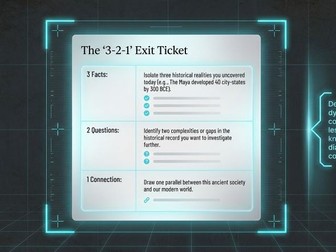
This 15 slide Year 7 History lesson sequence prepares students for a summative historical inquiry on the Ancient Americas. The resource supports structured research, analytical writing, and evidence‑based argument through clear scaffolds, exemplars, and feedback tools. The first section (slides 1–8) opens with an inquiry question asking how historians construct arguments about the past. Students examine the components of historical inquiry: question, research, evidence, interpretation, and argument. The sequence includes explicit writing instruction, model paragraphs, and guidance on selecting and evaluating evidence. The section closes with a synthesis slide outlining expectations for the summative task. The second section (slides 9–15) provides a flexible activity bank including source analysis, peer feedback protocols, creative thinking, structured writing, self‑assessment frames, retrieval starters, and consolidation checks. The transferable skill is historical inquiry and analytical writing; the Ancient Americas are the vehicle. This resource is provided as non‑editable PDFs and is not designed as editable PowerPoints. Teachers can upload slides to their LMS, print selected pages for classroom use, display them to support discussion, analysis, and writing, or upload them to presentation or design platforms if they wish to adapt the material (formatting may vary depending on the program).
Ancient Americas – Activity and Project Bank (Year 7 History) Lessons and ActivitiesQuick View
BeyondTime

Ancient Americas – Activity and Project Bank (Year 7 History) Lessons and Activities

(0)
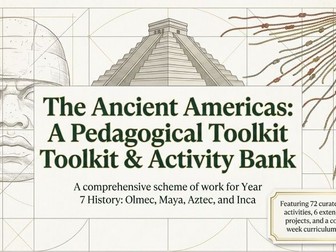
This 15 slide Year 7 History lesson sequence provides a flexible bank of learning activities and extended projects for use across the Ancient Americas unit. The resource gives teachers adaptable tasks that reinforce core skills including source analysis, inquiry, creative thinking, and structured writing. The first section (slides 1–8) opens with an inquiry question asking how varied tasks help historians build understanding of the past. Students examine short‑form tasks, extended projects, and inquiry‑based investigations, each connected to a specific historical skill. The section closes with a synthesis slide showing how varied tasks deepen understanding of the Ancient Americas. The second section (slides 9–15) provides a flexible activity bank including source analysis, multi‑lesson research projects, creative thinking, structured writing, retrieval starters, comparison prompts, and exit tickets. The transferable skill is applying historical methods through varied tasks; the Ancient Americas are the vehicle. This resource is provided as non‑editable PDFs and is not designed as editable PowerPoints. Teachers can upload slides to their LMS, print selected pages for classroom use, display them to support discussion, analysis, and writing, or upload them to presentation or design platforms if they wish to adapt the material (formatting may vary depending on the program).
Deep Time Australia – Assessment, Writing and Feedback (Year 7 History)Quick View
BeyondTime

Deep Time Australia – Assessment, Writing and Feedback (Year 7 History)

(0)
This 15 slide Year 7 History lesson sequence prepares students for a summative historical inquiry on Deep Time Australia. The resource supports structured research, analytical writing, and evidence‑based argument through clear scaffolds, exemplars, and feedback tools. The first section (slides 1–8) builds core knowledge. It opens with an inquiry question asking how historians construct arguments about the past. Students examine the components of historical inquiry: question, research, evidence, interpretation, and argument. The sequence includes explicit writing instruction, model paragraphs, and guidance on selecting and evaluating evidence. The section closes with a synthesis slide outlining expectations for the summative task. The second section (slides 9–15) provides a bank of learning activities for teachers to use across multiple lessons. Each activity slide includes a clear student task, a suggested timeframe, and a brief teacher note on purpose and differentiation. The activity bank includes source analysis, discussion and debate, creative and divergent thinking, structured writing, and additional tasks such as self‑assessment frames, peer feedback protocols, retrieval starters, and consolidation checks. The transferable skill is historical inquiry and analytical writing; Deep Time Australia is the vehicle. This resource is provided as non‑editable PDFs and is not designed as editable PowerPoints. Teachers can upload slides to their LMS, print selected pages for classroom use, display them to support discussion, analysis, and writing, or upload them to presentation or design platforms if they wish to adapt the material (formatting may vary depending on the program).
Deep Time Australia – Beliefs, Culture and Knowledge Systems (Year 7 History)Quick View
BeyondTime

Deep Time Australia – Beliefs, Culture and Knowledge Systems (Year 7 History)

(0)
This 15 slide Year 7 History lesson sequence introduces students to the belief systems, cultural practices, and knowledge traditions of Deep Time Australia. The resource helps students read cultural knowledge as historical evidence, showing how ideas, rituals, and connections to Country shaped early societies and expressed their values. The first section (slides 1–8) builds core knowledge. It opens with an inquiry question asking what belief systems and cultural traditions can reveal about a society. Students examine cultural practices, stories, and knowledge systems, each connected to a social, environmental, or political function. The sequence explores how cultural institutions operated as centres of authority, how belief shaped daily life, and how later historians have interpreted Indigenous knowledge systems. The section closes with a synthesis slide drawing together what these beliefs reveal about values, priorities, and understandings of power and Country. The second section (slides 9–15) provides a bank of learning activities for teachers to use across multiple lessons. Each activity slide includes a clear student task, a suggested timeframe, and a brief teacher note on purpose and differentiation. The activity bank includes source analysis, discussion and debate, creative and divergent thinking, structured writing, and additional tasks such as comparison prompts, connection tasks, retrieval starters, and consolidation checks. The transferable skill is reading belief systems as historical evidence; Deep Time Australia is the vehicle. This resource is provided as non‑editable PDFs and is not designed as editable PowerPoints. Teachers can upload slides to their LMS, print selected pages for classroom use, display them to support discussion, analysis, and writing, or upload them to presentation or design platforms if they wish to adapt the material (formatting may vary depending on the program).
Deep Time Australia – Activity and Project Bank (Year 7 History)Quick View
BeyondTime

Deep Time Australia – Activity and Project Bank (Year 7 History)

(0)
This 15 slide Year 7 History lesson sequence provides a flexible bank of learning activities and extended projects for use across the Deep Time Australia unit. The resource gives teachers adaptable tasks that reinforce core skills including source analysis, inquiry, creative thinking, and structured writing. The first section (slides 1–8) builds core knowledge. It opens with an inquiry question asking how historians use different types of tasks to build understanding of the past. Students examine short‑form tasks, extended projects, and inquiry‑based investigations, each connected to a specific historical skill. The section closes with a synthesis slide showing how varied tasks deepen understanding of Deep Time Australia. The second section (slides 9–15) provides a bank of learning activities for teachers to use across multiple lessons. Each activity slide includes a clear student task, a suggested timeframe, and a brief teacher note on purpose and differentiation. The activity bank includes source analysis, discussion and debate, creative and divergent thinking, structured writing, and additional tasks such as multi‑lesson research projects, retrieval starters, comparison prompts, and exit tickets. The transferable skill is applying historical methods through varied tasks; Deep Time Australia is the vehicle. This resource is provided as non‑editable PDFs and is not designed as editable PowerPoints. Teachers can upload slides to their LMS, print selected pages for classroom use, display them to support discussion, analysis, and writing, or upload them to presentation or design platforms if they wish to adapt the material (formatting may vary depending on the program).
Deep Time Australia – Society and Daily Life (Year 7 History) + ActivitiesQuick View
BeyondTime

Deep Time Australia – Society and Daily Life (Year 7 History) + Activities

(0)
This 15 slide Year 7 History lesson sequence introduces students to the social structures and daily life of early human societies across Deep Time Australia. The resource helps students analyse who held knowledge and authority, how different groups lived, and whose experiences are visible or missing in the archaeological and oral record. The first section (slides 1–8) builds core knowledge. It opens with an inquiry question asking who held power or knowledge in early Australian societies and how we know. Students examine kinship, community roles, gendered responsibilities, and lived experience, each connected to the types of evidence that survive. The sequence goes beyond leaders and knowledge holders to focus on ordinary people, children, and marginalised groups, and includes a slide addressing whose voices are missing and why. The section closes with a synthesis slide drawing together what the evidence reveals about power, inequality, and daily experience in Deep Time Australia. The second section (slides 9–15) provides a bank of learning activities for teachers to use across multiple lessons. Each activity slide includes a clear student task, a suggested timeframe, and a brief teacher note on purpose and differentiation. The activity bank includes source analysis, discussion and debate, creative and divergent thinking, structured writing, and additional tasks such as ranking social roles, perspective‑taking, retrieval starters, self‑assessment prompts, and exit tickets. The transferable skill is social structure analysis; Deep Time Australia is the vehicle. This resource is provided as non‑editable PDFs and is not designed as editable PowerPoints. Teachers can upload slides to their LMS, print selected pages for classroom use, display them to support discussion, analysis, and writing, or upload them to presentation or design platforms if they wish to adapt the material (formatting may vary depending on the program).
Deep Time Australia – Legacy, Significance and Historical Inquiry (Year 7)Quick View
BeyondTime

Deep Time Australia – Legacy, Significance and Historical Inquiry (Year 7)

(0)
This 15 slide Year 7 History lesson sequence introduces students to the legacy and significance of Deep Time Australia. The resource helps students understand why early Australian histories matter today, how interpretations have changed over time, and how historical significance is constructed. The first section (slides 1–8) builds core knowledge. It opens with an inquiry question asking why Deep Time Australia remains significant in the present. Students explore cultural continuity, environmental knowledge, modern influence, and shifting interpretations by historians and communities. The sequence examines how early histories shape identity, land management, and contemporary debates. The section closes with a synthesis slide drawing together patterns of significance and preparing students for inquiry work. The second section (slides 9–15) provides a bank of learning activities for teachers to use across multiple lessons. Each activity slide includes a clear student task, a suggested timeframe, and a brief teacher note on purpose and differentiation. The activity bank includes source analysis, discussion and debate, creative and divergent thinking, structured writing, and additional tasks such as ranking significance factors, connection tasks, retrieval starters, and exit tickets. The transferable skill is evaluating historical significance; Deep Time Australia is the vehicle. This resource is provided as non‑editable PDFs and is not designed as editable PowerPoints. Teachers can upload slides to their LMS, print selected pages for classroom use, display them to support discussion, analysis, and writing, or upload them to presentation or design platforms if they wish to adapt the material (formatting may vary depending on the program).
Deep Time Australia – Leadership, Power and Case Studies (Year 7 History)Quick View
BeyondTime

Deep Time Australia – Leadership, Power and Case Studies (Year 7 History)

(0)
This 15 slide Year 7 History lesson sequence introduces students to leadership and power in early Australian societies through structured case studies of significant individuals or knowledge holders. The resource helps students understand what makes an individual historically significant and how leaders shaped and reflected broader cultural and environmental forces. The first section (slides 1–8) builds core knowledge. It opens with an inquiry question asking what makes a leader or knowledge holder historically significant. Students examine the nature of leadership, authority, and cultural responsibility before moving into two to three case studies. Each follows the same structure: who they were, what they did, what evidence survives, and why they matter historically. The sequence includes a slide showing how historians and communities have interpreted one figure differently, introducing contested history. The section closes with a synthesis slide identifying patterns across the case studies and connecting individual leadership to broader cultural, environmental, and social forces. The second section (slides 9–15) provides a bank of learning activities for teachers to use across multiple lessons. Each activity slide includes a clear student task, a suggested timeframe, and a brief teacher note on purpose and differentiation. The activity bank includes source analysis, discussion and debate, creative and divergent thinking, structured writing, and additional tasks such as significance ranking, pattern recognition, retrieval starters, self‑assessment prompts, and exit tickets. The transferable skill is case study method; Deep Time Australia is the vehicle. This resource is provided as non‑editable PDFs and is not designed as editable PowerPoints. Teachers can upload slides to their LMS, print selected pages for classroom use, display them to support discussion, analysis, and writing, or upload them to presentation or design platforms if they wish to adapt the material (formatting may vary depending on the program).
Deep Time Australia – Artefacts, Sources and Archaeological Evidence (Year 7)Quick View
BeyondTime

Deep Time Australia – Artefacts, Sources and Archaeological Evidence (Year 7)

(0)
This 15 slide Year 7 History lesson sequence introduces students to the material and archaeological evidence of Deep Time Australia. The resource helps students analyse artefacts, sites, and oral histories using a consistent source‑analysis framework, showing how evidence is interpreted, what it reveals, and what its limitations are. The first section (slides 1–8) builds core knowledge. It opens with an inquiry question asking how we know what life was like in Deep Time Australia. Students examine rock art, tools, archaeological sites, environmental data, and oral histories, each explored for what it shows, what historians infer, and what it cannot tell us. The sequence includes a slide addressing reliability and limitations and closes with a synthesis slide drawing together how different forms of evidence combine to build historical understanding. The second section (slides 9–15) provides a bank of learning activities for teachers to use across multiple lessons. Each activity slide includes a clear student task, a suggested timeframe, and a brief teacher note on purpose and differentiation. The activity bank includes source analysis, discussion and debate, creative and divergent thinking, structured writing, and additional tasks such as sequencing evidence, annotation tasks, retrieval starters, and consolidation checks. The transferable skill is source analysis; Deep Time Australia is the vehicle. This resource is provided as non‑editable PDFs and is not designed as editable PowerPoints. Teachers can upload slides to their LMS, print selected pages for classroom use, display them to support discussion, analysis, and writing, or upload them to presentation or design platforms if they wish to adapt the material (formatting may vary depending on the program).
Ancient Africa (Beyond Egypt) – Year 7 History Full Teaching Unit (10 Weeks) Complete LessonsQuick View
BeyondTime

Ancient Africa (Beyond Egypt) – Year 7 History Full Teaching Unit (10 Weeks) Complete Lessons

(0)
This 10‑week Year 7 History unit introduces students to Ancient Africa beyond Egypt through clear explanations, structured lesson sequences, and purposeful learning tasks. The program is built around eight modules that develop historical thinking skills progressively across the term. Students examine African geography, societies, leadership, belief systems, archaeological evidence, legacy, and historical inquiry, focusing on civilisations such as Kush, Aksum, Nok, Great Zimbabwe, and the empires of West Africa. The unit culminates in a summative research task supported by explicit writing instruction and exemplars. Teaching Approach This unit uses a flexible learning‑activity approach rather than a scripted, lesson‑by‑lesson format. Students work with the content through close reading, discussion, inquiry, source analysis, and analytical writing. Teachers can adapt, rearrange, or extend the learning activities to suit their classes, teaching programs, and preferred pacing. Each module builds a specific historical skill while contributing to a coherent understanding of Ancient Africa. What’s Included A complete 10‑week teaching sequence built from eight structured modules, each containing a 15‑slide lesson presentation and a bank of learning activities. • Module 1: Geography, Context and Chronology Students examine Africa’s diverse landscapes, climatic zones, and trade routes, exploring how environment shaped settlement, agriculture, and cultural development. Includes timeline work, geographical reasoning, and learning activities connecting environment to power, conflict, and daily life. • Module 2: Society and Daily Life Students investigate social structures, community roles, gender expectations, and lived experience across African civilisations. Includes learning activities on social organisation, evidence interpretation, perspective writing, and whose voices survive in the historical record. • Module 3: Leadership, Power and Case Studies Students study significant African leaders and influential individuals using a consistent case‑study method. Includes learning activities on political authority, military leadership, cultural influence, contested interpretations, historical significance, and evidence‑based argument. • Module 4: Beliefs, Religion and Culture Students explore African belief systems, ritual practices, oral traditions, and cultural expressions as historical evidence. Includes learning activities on symbolism, values, cultural institutions, and how later historians have interpreted African belief systems. • Module 5: Artefacts, Sources and Archaeological Evidence Students analyse physical and written evidence using a clear source‑analysis framework. Includes learning activities on artefacts, architecture, oral histories, inscriptions, reliability, limitations, and historical inference.
Deep Time Australia – Geography, Context and Chronology (Year 7 History)Quick View
BeyondTime

Deep Time Australia – Geography, Context and Chronology (Year 7 History)

(0)
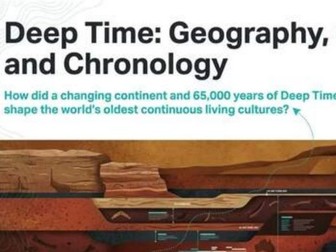
This 15 slide Year 7 History lesson sequence introduces students to the geographical and chronological context of Deep Time Australia. The resource helps students read landscape and time period as historical forces, showing how climate, environment, and movement shaped early societies rather than sitting as background detail. The first section (slides 1–8) builds core knowledge. It opens with an inquiry question asking how geography and time shaped the earliest human histories of Australia. Students examine deserts, coasts, river systems, and climatic patterns, each linked to movement, settlement, food systems, and cultural development. A clear timeline sets out major phases of Deep Time Australia using simple visual logic. The sequence includes attention to how environment shaped the daily lives of ordinary people and closes with a synthesis slide drawing together geographical and chronological threads while previewing the inquiry ahead. The second section (slides 9–15) provides a bank of learning activities for teachers to use across multiple lessons. Each activity slide includes a clear student task, a suggested timeframe, and a brief teacher note on purpose and differentiation. The activity bank includes source analysis, discussion and debate, creative and divergent thinking, structured writing, and additional tasks such as timeline sequencing, map annotation, retrieval starters, and short consolidation checks. The transferable skill is historical context‑setting; Deep Time Australia is the vehicle. This resource is provided as non‑editable PDFs and is not designed as editable PowerPoints. Teachers can upload slides to their LMS, print selected pages for classroom use, display them to support discussion, analysis, and writing, or upload them to presentation or design platforms if they wish to adapt the material (formatting may vary depending on the program).

Ancient Africa – Assessment, Writing and Feedback (Year 7 History) Lessons and ActivitiesQuick View
BeyondTime

Ancient Africa – Assessment, Writing and Feedback (Year 7 History) Lessons and Activities

(0)
This 15 slide Year 7 History lesson sequence prepares students for a summative historical inquiry on Ancient Africa. The resource supports structured research, analytical writing, and evidence‑based argument through clear scaffolds, exemplars, and feedback tools. The first section (slides 1–8) opens with an inquiry question asking how historians construct arguments about the past. Students examine the components of historical inquiry: question, research, evidence, interpretation, and argument. The sequence includes explicit writing instruction, model paragraphs, and guidance on selecting and evaluating evidence. The section closes with a synthesis slide outlining expectations for the summative task. The second section (slides 9–15) provides a flexible activity bank including source analysis, peer feedback protocols, creative thinking, structured writing, self‑assessment frames, retrieval starters, and consolidation checks. The transferable skill is historical inquiry and analytical writing; Ancient Africa is the vehicle. This resource is provided as non‑editable PDFs and is not designed as editable PowerPoints. Teachers can upload slides to their LMS, print selected pages for classroom use, display them to support discussion, analysis, and writing, or upload them to presentation or design platforms if they wish to adapt the material (formatting may vary depending on the program).
Ancient Africa – Activity and Project Bank (Year 7 History) Lessons and ActivitiesQuick View
BeyondTime

Ancient Africa – Activity and Project Bank (Year 7 History) Lessons and Activities

(0)
This 15 slide Year 7 History lesson sequence provides a flexible bank of learning activities and extended projects for use across the Ancient Africa unit. The resource gives teachers adaptable tasks that reinforce core skills including source analysis, inquiry, creative thinking, and structured writing. The first section (slides 1–8) opens with an inquiry question asking how varied tasks help historians build understanding of the past. Students examine short form tasks, extended projects, and inquiry based investigations, each connected to a specific historical skill. The section closes with a synthesis slide showing how varied tasks deepen understanding of Ancient Africa. The second section (slides 9–15) provides a flexible activity bank including source analysis, multi lesson research projects, creative thinking, structured writing, retrieval starters, comparison prompts, and exit tickets. The transferable skill is applying historical methods through varied tasks; Ancient Africa is the vehicle. This resource is provided as non editable PDFs and is not designed as editable PowerPoints. Teachers can upload slides to their LMS, print selected pages for classroom use, display them to support discussion, analysis, and writing, or upload them to presentation or design platforms if they wish to adapt the material (formatting may vary depending on the program).