Applications of Derivatives Practice & KeyQuick View
Aviljerto

Applications of Derivatives Practice & Key

(0)
Master rate of change analysis, graphical behaviors, optimization problems, related rates, and kinematic models with this secondary school and advanced mathematics worksheet! Covers tangents and normals, increasing and decreasing intervals, local extrema and points of inflection, real-world optimization, related rates using the chain rule, particle motion, and answer key. What is Included: Section A: Concept Check: Evaluates foundational understanding of first and second derivatives, identifying intervals where functions increase or decrease, classifying local maximums, minimums, and points of inflection, and understanding geometric properties of tangent and normal lines. Section B: Tangents and Normals: Focuses on finding gradients of curves at specific coordinate points, constructing equations of tangent lines, and determining perpendicular normal line equations. Section C: Increasing Behavior and Stationary Points: Guides students through identifying stationary points, using the second derivative test to classify local extrema, determining intervals of concavity, and sketching polynomial curves. Section D: Optimization: Covers constructing single-variable functions to model real-world constraints, such as finding maximum enclosed areas with fixed fencing parameters and optimizing physical dimensions. Section E: Related Rates: Focuses on connecting rates of change using the chain rule, including rates of volume increase in expanding spheres, sliding ladders, and changing surface areas over time. Section F: Kinematics and Challenge: Features real-world motion applications, evaluating displacement, velocity, and acceleration functions, determining when moving particles are at rest, and analyzing projectile height models. Teacher Benefits: SAT & UK Curriculum Aligned: Perfect for secondary school and advanced mathematics courses! Aligns directly with UK A-Level, AP Calculus AB/BC, and Precalculus curricula while reinforcing advanced problem-solving techniques for competitive college entrance exams. Ready to Print & Go: Zero prep required. Ideal for classroom lectures, targeted homework assignments, independent revision, sub plans, or AP calculus review sessions. Complete Solutions Included: Comes with a fully worked answer key detailing step-by-step derivative calculations, line-by-line algebraic steps, stationary point classifications, and contextual setups. Scaffolded & Comprehensive: Progresses logically from fundamental derivative interpretations to geometric tangents, curve sketching, real-world optimization models, related rates, and kinematic motion analysis.
Constructions and Loci Practice & KeyQuick View
Aviljerto

Constructions and Loci Practice & Key

(0)
Master straightedge and compass constructions, standard geometric loci, and compound region shading with this comprehensive 6-page secondary school mathematics worksheet! Covers perpendicular bisectors, angle bisectors, perpendicular lines from external and lying points, constructed angles, triangle constructions, standard loci, overlapping inequality regions, real-world geometric modeling, and answer key. What is Included: Section A: Concept Check: Evaluates foundational understanding of the four standard loci, defining loci in plain language, and geometric justifications for why compass constructions produce perpendicular bisectors. Section B: Basic Constructions: Focuses on step-by-step compass and straightedge constructions for perpendicular bisectors of line segments, angle bisectors, perpendicular lines dropping from an external point to a line, and perpendicular lines erected at a point on a line. Section C: Constructing Angles and Triangles: Guides students through constructing exact 60-degree and 45-degree angles without a protractor, as well as constructing full triangles from given side lengths and angle measurements. Section D: Loci: Covers drawing and describing the four fundamental loci, including circles around fixed points, perpendicular bisectors between two points, parallel lines at fixed distances from a line, and angle bisectors between intersecting lines. Section E: Regions and Intersecting Loci: Focuses on shading boundary regions defined by multiple distance conditions simultaneously, including overlapping circles, split-line boundaries, and internal path clearances. Section F: Applications and Challenge: Features real-world geometric modeling tasks, such as calculating the exact grazing area for a tethered animal around a barn corner, analyzing overlapping signal coverage between radio masts, and locating circumcenters equidistant from three non-collinear points. Teacher Benefits: 6-Page Comprehensive Worksheet: Includes 6 structured pages of targeted student practice problems followed by a complete worked answer key. SAT & UK Curriculum Aligned: Perfect for secondary school students! Directly supports Key Stage 3 and GCSE requirements in the UK curriculum while reinforcing geometric logic required for SAT math preparation. Ready to Print & Go: Zero prep required. Excellent for structured classroom lessons, targeted homework assignments, independent practice, sub plans, or geometry unit assessment preparation. Complete Solutions Included: Comes with a fully worked answer key detailing written construction steps, arc placement descriptions, shaded region boundary classifications, and exact area calculations. Scaffolded & Comprehensive: Progresses logically from basic definitions and core constructions to constructed angles, single-condition loci, compound region shading, and multi-step real-world challenge problems.
Derivatives: Definition and Rules Practice & KeyQuick View
Aviljerto

Derivatives: Definition and Rules Practice & Key

(0)
Master core calculus differentiation, limit definitions, derivative rules, transcendental functions, higher-order derivatives, and implicit differentiation with this comprehensive 5-page secondary school and advanced mathematics worksheet! Covers differentiating from first principles, the power rule, product rule, quotient rule, chain rule, trigonometric, exponential, and logarithmic derivatives, implicit differentiation, tangent line equations, logarithmic differentiation, and answer key. What is Included: Section A: Concept Check: Evaluates foundational understanding of limit definitions of derivatives, standard power and product rule formulas, basic trigonometric derivatives, and interpreting derivatives geometrically and physically. Section B: First Principles: Focuses on deriving derivatives from first principles using limit definitions for power, polynomial, reciprocal, and square root functions. Section C: Standard Rules: Guides students through applying standard differentiation techniques, including the power rule, product rule, quotient rule, and chain rule across composite functions. Section D: Trigonometric, Exponential, and Logarithmic Functions: Covers differentiating standard transcendental functions, including trigonometric terms, natural exponentials, natural logarithms, and composite products. Section E: Higher Derivatives and Implicit Differentiation: Focuses on finding second-order derivatives as well as applying implicit differentiation to circle and multi-variable equations. Section F: Applications and Challenge: Features contextual application problems, including finding tangent line equations at specific points and applying logarithmic differentiation to functions with variable exponents. Teacher Benefits: 5-Page Comprehensive Worksheet: Includes 5 structured pages of targeted student practice problems followed by a complete worked answer key. SAT & UK Curriculum Aligned: Perfect for secondary school and advanced mathematics courses! Directly supports UK A-Level, AP Calculus AB/BC, and Precalculus requirements while reinforcing core algebraic and calculus reasoning needed for SAT Math and university entry tests. Ready to Print & Go: Zero prep required. Excellent for structured classroom instruction, targeted homework assignments, independent revision, sub plans, or calculus assessment preparation. Complete Solutions Included: Comes with a fully worked answer key detailing conceptual checks, line-by-line algebraic derivative steps, limit derivations, and tangent line equations. Scaffolded & Comprehensive: Progresses logically from basic definition checks and first principles to core rules, transcendental functions, implicit relations, and advanced logarithmic differentiation.
Calculus Practice Worksheets BundleQuick View
Aviljerto

Calculus Practice Worksheets Bundle

6 Resources
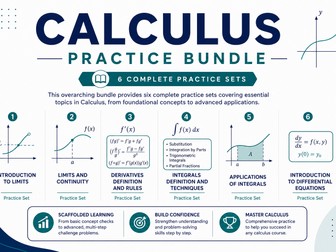
Master essential single-variable calculus topics with this comprehensive collection of six high school and university preparatory math resources! This bundle covers limits and continuity, derivative definitions and rules, integration techniques, applications of integrals, and introductory differential equations. What is Included: This overarching bundle provides six complete practice sets: Introduction to Limits, Limits and Continuity, Derivatives Definition and Rules, Integrals Definition and Techniques, Applications of Integrals, and Introduction to Differential Equations. Each individual resource features carefully scaffolded sections that progress from basic concept checks to advanced, multi-step challenge problems. Teacher Benefits: Fully aligned with AP Calculus, A-Level, and advanced mathematics curricula, these ready-to-print worksheets require zero preparation. They are perfect for classroom instruction, homework, or exam revision. Every practice set includes a complete, fully worked answer key detailing all algebraic steps, integral setups, and calculus proofs to support easy grading and independent student learning.
Limits and Continuity Practice & KeyQuick View
Aviljerto

Limits and Continuity Practice & Key

(0)
Master limit laws, algebraic evaluation techniques, one-sided limits, vertical and horizontal asymptotes, continuity classifications, the Intermediate Value Theorem, and formal epsilon-delta proofs with this comprehensive 5-page secondary school and advanced mathematics worksheet! Covers limit properties, factoring and rationalizing methods, infinite behavior, continuous function conditions, root location using IVT, challenge proofs, and answer key. What is Included: Section A: Concept Check: Evaluates foundational understanding of fundamental limit laws, conditions for valid quotient limits, vertical asymptote definitions, Intermediate Value Theorem indicators, direct substitution, and the formal epsilon-delta limit definition. Section B: Evaluating Limits: Focuses on applying core algebraic techniques to resolve indeterminate forms, including factoring quadratic polynomials, rationalizing radical expressions, simplifying complex fractions, and evaluating standard trigonometric limits. Section C: One-Sided and Infinite Limits: Guides students through analyzing left-hand and right-hand limits, evaluating functions that grow without bound, determining limit existence from opposing directions, and identifying vertical and horizontal asymptotes. Section D: Continuity: Covers stating the three formal conditions for continuity at a point, classifying removable and infinite discontinuities, solving for unknown parameters in piecewise functions, and determining continuous intervals. Section E: The Intermediate Value Theorem: Focuses on applying the Intermediate Value Theorem precisely to verify the existence of real roots and solutions within bounded intervals for polynomial and trigonometric functions. Section F: Formal Definition and Challenge: Features rigorous formal epsilon-delta proofs for linear functions and challenge questions contrasting oscillating behavior without a limit against squeezed functions. Teacher Benefits: 5-Page Comprehensive Worksheet: Includes 5 structured pages of targeted student practice problems followed by a complete worked answer key. SAT & UK Curriculum Aligned: Perfect for secondary school and advanced mathematics courses! Directly supports UK A-Level, AP Calculus AB/BC, and Precalculus curricula while reinforcing limit reasoning essential for college entrance examinations. Ready to Print & Go: Zero prep required. Excellent for structured classroom instruction, targeted homework assignments, independent revision, sub plans, or calculus unit assessment preparation. Complete Solutions Included: Comes with a fully worked answer key detailing conceptual checks, step-by-step algebraic limit evaluations, continuity tests, and formal epsilon-delta proofs. Scaffolded & Comprehensive: Progresses logically from basic limit concepts and algebraic evaluations to one-sided behavior, continuity conditions, IVT applications, and formal challenge proofs.
Integrals: Definition and Techniques Practice & KeyQuick View
Aviljerto

Integrals: Definition and Techniques Practice & Key

(0)
Master fundamental integration concepts, antiderivatives, Riemann sums, definite integrals, and advanced integration techniques with this comprehensive 6-page secondary school and advanced mathematics worksheet! Covers indefinite integration rules, estimating areas with rectangular approximations, evaluating definite integrals using the Fundamental Theorem of Calculus, integration by substitution, integration by parts, and answer key. What is Included: Section A: Concept Check: Evaluates foundational understanding of integration as the reverse of differentiation, the Fundamental Theorem of Calculus, signed area representations, reciprocal power integration rules, and the geometric significance of the constant of integration. Section B: Indefinite Integrals: Focuses on applying standard antiderivative rules to evaluate indefinite integrals involving polynomial terms, radical functions, trigonometric expressions, exponential powers, and rational logarithmic forms. Section C: Riemann Sums and the Definite Integral: Guides students through estimating areas under curves using left-endpoint and right-endpoint rectangular sum approximations, comparing estimations to exact values, and understanding limits as the number of subintervals approaches infinity. Section D: Definite Integrals: Covers evaluating exact definite integrals using antiderivatives, integrating trigonometric and exponential terms over fixed limits, and interpreting geometric symmetry properties for odd functions over symmetric intervals. Section E: Substitution: Focuses on applying the algebraic substitution method (the reverse chain rule) to evaluate both indefinite and definite integrals, including transforming integration limits. Section F: Integration by Parts and Challenge: Features advanced integration techniques using integration by parts, evaluating product integrals of algebraic, exponential, trigonometric, and logarithmic functions. Teacher Benefits: 6-Page Comprehensive Worksheet: Includes 6 structured pages of targeted student practice problems followed by a complete worked answer key. SAT & UK Curriculum Aligned: Perfect for secondary school and advanced mathematics courses! Directly supports UK A-Level, AP Calculus AB/BC, and Precalculus curricula while building the core algebraic and integral reasoning needed for university entrance examinations. Ready to Print & Go: Zero prep required. Ideal for classroom instruction, targeted homework assignments, independent revision, sub plans, or calculus unit revision. Complete Solutions Included: Comes with a fully worked answer key detailing step-by-step antiderivative steps, Riemann sum table setups, algebraic substitution transformations, and integration-by-parts expansions. Scaffolded & Comprehensive: Progresses logically from basic antiderivative rules and conceptual checks to Riemann sums, definite integration, substitution, and integration by parts.
Number Cumulative Assessment 1 & KeyQuick View
Aviljerto

Number Cumulative Assessment 1 & Key

(0)
Master fundamental arithmetic and number operations with this comprehensive cumulative assessment worksheet! This resource covers integers, order of operations, factors and primes, fractions and percentages, powers and roots, and ratio calculations. What is Included: Section A: Short Answer Evaluates quick recall of core concepts, including negative integer arithmetic, basic order of operations, decimal/fraction/percentage conversions, and finding simple highest common factors and lowest common multiples. Section B: Methods Focuses on executing standard mathematical procedures, such as expressing numbers as products of prime factors, calculating fraction arithmetic, finding percentage increases, and dividing amounts into given ratios. Section C: Problem Solving Guides students through multi-step real-world scenarios, including calculating successive percentage discounts, using lowest common multiples for synchronized flashing lighthouses, scaling recipes, and tracking bank account overdraft balances. Section D: Reasoning Requires students to justify and explain their mathematical thinking. Features challenges like finding the smallest number with exactly 12 factors, explaining the difference in bracket placement for negative exponents, and showing step-by-step methods for adding mixed numbers. Teacher Benefits: Comprehensive Assessment: Includes structured questions progressing from basic recall to complex problem-solving and mathematical reasoning. Curriculum Aligned: Perfect for secondary school and middle school mathematics courses! Directly supports standard number strand requirements for GCSE, Key Stage 3, and foundational high school math curricula. Ready to Print and Go: Zero prep required. Excellent for structured classroom testing, end-of-unit assessments, targeted homework assignments, or independent revision. Scaffolded Progression: Moves logically from quick one-mark short answer questions to intensive four- and five-mark problem-solving and reasoning tasks, allowing for precise tracking of student capability.
Number Cumulative Assessment 2 & KeyQuick View
Aviljerto

Number Cumulative Assessment 2 & Key

(0)
Master higher-tier arithmetic and complex number operations with this advanced cumulative assessment worksheet! Following on from the first assessment, this challenging 64-mark resource tests fluent recall, multi-step problem solving, and mathematical reasoning across integers, prime factorization, percentages, and ratios. What is Included: Section A: Short Answer Evaluates fluent recall of harder numerical facts without the use of a calculator. This includes arithmetic with negative powers, dividing fractions, and determining the total number of factors directly from prime index form. Section B: Methods Focuses on executing standard higher-tier procedures. Students must calculate the lowest common multiple of three separate numbers, find original prices after percentage increases (reverse percentages), determine multipliers for perfect cubes, and work out successive sequential percentage reductions. Section C: Problem Solving Guides students through intensive, multi-step scenarios requiring planned solutions. Challenges involve algebraic proofs that sequential percentage gains and losses cancel out, optimizing identical groups of items using highest common factors, and calculating original class sizes after dynamic ratio shifts. Section D: Reasoning Requires students to provide clear, written mathematical justifications rather than just numerical answers. Topics include explaining the rule for multiplying multiple negative integers, justifying exactly why the number 1 is excluded from being a prime number, and proving the smallest whole number that contains exactly 12 factors. Teacher Benefits: Comprehensive Higher-Tier Assessment: Includes structured questions designed specifically to test advanced numerical fluency and rigorous logical reasoning without the use of a calculator. Curriculum Aligned: Perfect for secondary school mathematics courses preparing for higher-level examinations. Directly supports advanced number strand requirements for GCSE Higher tier and equivalent rigorous high school math curricula. Ready to Print and Go: Zero preparation required. Excellent for structured classroom testing, summative end-of-unit assessments, targeted homework assignments, or independent revision for top-set students. Scaffolded Complexity: Progresses logically from quick recall of advanced numerical facts to deep, five-mark reasoning tasks, allowing educators to precisely track the capabilities of high-achieving students.
Algebra Cumulative Assessment 2 & KeyQuick View
Aviljerto

Algebra Cumulative Assessment 2 & Key

(0)
Master higher-tier algebraic manipulation, complex equations with unknowns on both sides, formula rearrangement, advanced inequalities, and simultaneous linear word problems with this challenging cumulative assessment worksheet! Following on from the first algebra assessment, this 52-mark resource tests higher-level proficiency without relying on a calculator. What is Included: Section A: Short Answer Evaluates harder core skills and formula evaluation. This includes expanding and simplifying nested brackets with negative coefficient tracking, solving linear equations with brackets on both sides, evaluating kinematic formulas under deceleration, and converting temperatures using fractional formulas. Section B: Inequalities Focuses on executing standard higher-tier inequality procedures. Students must solve inequalities with negative coefficients (including reversing inequality signs correctly), solve linear inequalities with unknowns on both sides, and work through double inequalities. Section C: Problem Solving Guides students through intensive, multi-step algebraic word problems. Challenges involve finding unknown coefficients in algebraic expressions where perimeter conditions match, solving taxi fare scenarios to determine fixed booking fees and per-kilometre rates, calculating maximum allowable loads for goods lifts carrying operators and crates, and setting up double inequalities for rectangle perimeters. Section D: Reasoning Requires students to provide clear algebraic justifications. Topics include solving inequalities involving brackets and explaining why gathering variable terms on the right-hand side avoids the need to reverse the inequality sign, alongside multi-step algebraic proofs. Teacher Benefits: Comprehensive Higher-Tier Assessment: Includes structured questions specifically designed to test advanced algebraic manipulation, inequality boundary rules, and rigorous logical reasoning without the use of a calculator. Curriculum Aligned: Perfect for secondary school mathematics courses preparing for higher-tier examinations. Directly supports advanced algebra strand requirements for GCSE Higher tier and equivalent rigorous high school math curricula. Ready to Print and Go: Zero preparation required. Excellent for structured classroom testing, summative end-of-unit assessments, targeted homework assignments, or independent revision for top-set students. Scaffolded Complexity: Progresses logically from advanced bracket expansion to complex double inequalities and open-ended mathematical explanations, allowing educators to precisely evaluate higher-order analytical capabilities.
Geometry Cumulative Assessment 1 & KeyQuick View
Aviljerto

Geometry Cumulative Assessment 1 & Key

(0)
Master foundational geometry and spatial reasoning with this comprehensive cumulative assessment worksheet! This resource covers angle facts and parallel lines, coordinate geometry, midpoints, lengths of line segments, area, perimeter, and volume of standard shapes, and basic transformations on a grid including reflections and translations. What is Included: Section A: Short Answer Evaluates quick recall of core geometric facts. This includes finding missing angles using straight line rules, calculating angles in triangles, finding the area and perimeter of rectangles, locating the midpoints of coordinate line segments, and determining missing angles in quadrilaterals. Section B: Angles and Coordinates Focuses on executing standard geometrical procedures and coordinate work. Students must identify angles formed by parallel lines with corresponding reasons, calculate the volume of cuboids, reflect triangles across coordinate axes, find lengths of horizontal line segments, and explain why specific lines are horizontal. Section C: Mensuration and Transformations Guides students through standard measurement and transformation tasks. Challenges involve calculating the area and circumference of circles using fractional pi values, translating triangles by specific vector steps, finding base angles of isosceles triangles from given apex angles, and determining both the area and perimeter of complex L-shaped compound figures. Section D: Problem Solving and Reasoning Requires students to apply geometric concepts to multi-step problems and coordinate proofs. Topics include analyzing triangle vertices on coordinate grids, proving geometric properties of shapes, and providing clear logical reasoning for multi-stage angle and coordinate calculations. Teacher Benefits: Comprehensive Foundational Assessment: Includes structured questions progressing from basic recall of angle rules to multi-step coordinate geometry and shape transformations. Curriculum Aligned: Perfect for secondary school and middle school mathematics courses! Directly supports standard geometry and measure strand requirements for Key Stage 3, foundational GCSE, and introductory high school geometry curricula. Ready to Print and Go: Zero prep required. Excellent for structured classroom testing, end-of-unit geometry assessments, targeted homework assignments, or independent revision. Scaffolded Progression: Moves logically from single-mark angle recall to complex compound area mensuration and vector transformations, allowing educators to precisely track student capability in foundational geometry skills.
GCSE Mathematics Cumulative Assessments BundleQuick View
Aviljerto

GCSE Mathematics Cumulative Assessments Bundle

8 Resources
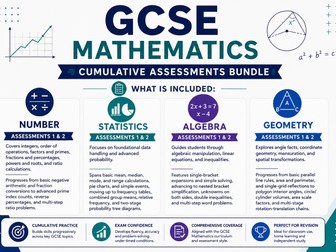
Master the complete secondary school mathematics curriculum with this comprehensive collection of eight higher and foundation tier cumulative assessment resources! Perfectly aligned with the GCSE and Key Stage 3 standards, this ultimate bundle covers number theory, statistics, algebra, and geometry through carefully structured, progressive practice papers. What is Included: Number Assessments 1 and 2 Covers integers, order of operations, factors and primes, fractions and percentages, powers and roots, and ratio calculations. Progresses from basic negative arithmetic and fraction conversions to advanced prime index counts, reverse percentages, and multi-step ratio problems. Statistics Assessments 1 and 2 Focuses on foundational data handling and advanced probability. Spans basic mean, median, mode, and range calculations, pie charts, and simple events, moving up to frequency tables, combined group means, relative frequency, and two-stage probability tree diagrams. Algebra Assessments 1 and 2 Guides students through algebraic manipulation, linear equations, and inequalities. Features single-bracket expansions and simple solving, advancing to nested bracket simplification, unknowns on both sides, double inequalities, and multi-step word problems. Geometry Assessments 1 and 2 Explores angle facts, coordinate geometry, mensuration, and spatial transformations. Progresses from basic parallel line rules, area and perimeter, and single-grid reflections to polygon interior angles, circle/cylinder volumes, area scale factors, and multi-stage rotation-translation chains. Teacher Benefits: Comprehensive GCSE Coverage: Includes eight robust, scaffolded assessment papers spanning all four core mathematical strands, providing complete diagnostic testing across the secondary school curriculum. Curriculum Aligned: Expertly designed to match UK GCSE (Foundation and Higher tiers), Key Stage 3, and equivalent international secondary school standards, ensuring targeted preparation for high-stakes examinations. Ready to Print and Go: Zero preparation required. Perfect for summative end-of-unit tests, mock exam practice, targeted intervention groups, structured homework assignments, or comprehensive student revision. Complete Progressional Tracking: Each assessment is thoughtfully structured into distinct sections covering short-answer recall, standard procedural methods, multi-step problem solving, and rigorous mathematical reasoning.
Geometry Cumulative Assessment 2 & KeyQuick View
Aviljerto

Geometry Cumulative Assessment 2 & Key

(0)
Master higher-tier polygon angles, advanced coordinate geometry, circles and cylinders, area-scale factor relationships for enlargements, and multi-stage transformations (rotations and translations) with this challenging cumulative assessment worksheet! Following on from the first geometry assessment, this 50-mark resource tests rigorous spatial reasoning and geometric proof without relying on a calculator. What is Included: Section A: Short Answer Evaluates harder core geometric facts. This includes finding the sum of interior angles and individual interior angles of regular polygons, determining the number of sides of a regular polygon from its exterior angle, calculating the area of a trapezium, and finding the area of a coordinate triangle defined by vertex coordinates. Section B: Angles, Circles and Solids Focuses on executing standard higher-tier procedures involving parallel line angle reasoning, circle circumference and area calculations using exact pi terms, cylinder volume and surface area evaluations, and complex pool-filling rate problems linking cubic meters to litres and minutes. Section C: Mensuration and Transformations Guides students through intensive measurement and multi-stage transformation tasks. Challenges involve determining side lengths of squares from area values, analyzing how area scales with linear scale factors for enlargements, and tracking coordinate vertices through a 90-degree anticlockwise rotation followed by a vector translation while verifying congruence. Section D: Reasoning Requires students to provide clear, written geometric justifications and angle proofs. Topics include analyzing composite shapes formed by regular polygons sharing edges (such as a pentagon and a square) and calculating remaining interior or exterior angles at shared vertices with full mathematical reasoning. Teacher Benefits: Comprehensive Higher-Tier Assessment: Includes structured questions specifically designed to test advanced spatial reasoning, multi-stage coordinate transformations, and rigorous geometric proof. Curriculum Aligned: Perfect for secondary school mathematics courses preparing for higher-tier examinations. Directly supports advanced geometry and measure strand requirements for GCSE Higher tier and equivalent rigorous high school geometry curricula. Ready to Print and Go: Zero preparation required. Excellent for structured classroom testing, summative end-of-unit assessments, targeted homework assignments, or independent revision for top-set students. Scaffolded Complexity: Progresses logically from advanced polygon and circle rules to complex transformation chains and open-ended geometric reasoning tasks, allowing educators to precisely evaluate higher-order spatial capabilities.
Statistics Cumulative Assessment 1 & KeyQuick View
Aviljerto

Statistics Cumulative Assessment 1 & Key

(0)
Master foundational data handling and simple probability with this comprehensive cumulative assessment worksheet! This resource covers calculating the mean, median, mode, and range, reading data from pie charts, and evaluating the probability of simple and combined events. What is Included: Section A: Short Answer Evaluates quick recall of fundamental statistical measures. This includes single-mark questions on calculating the mean, finding the median from an unordered list, identifying the mode and range, and determining simple probabilities using fair coins and dice. Section B: Averages Focuses on executing standard data calculations. Students must calculate all four primary measures for a single data set, use algebra to find missing data points when the mean is given, and explain practically why a shop would rely on the mode rather than the mean for shoe sizes. Section C: Probability Guides students through standard probability scenarios. Challenges involve extracting probabilities from colored counters in a bag, determining complementary events (the probability of not selecting a specific color), calculating expected frequencies from 300 dice rolls, and listing the sample space for tossing two coins to find the chance of getting exactly one head and one tail. Section D: Problem Solving and Reasoning Requires students to apply statistical ideas to fuller, multi-step problems. Topics include interpreting percentages and sector angles from a pie chart representing 200 visitors, and calculating how a changing data set (a person leaving a group) shifts the overall mean, alongside a written justification for the change. Teacher Benefits: Comprehensive Foundational Assessment: Includes structured questions progressing from basic one-mark recall to multi-step four-mark data reasoning tasks. Curriculum Aligned: Perfect for secondary school and middle school mathematics courses! Directly supports standard data and probability strand requirements for Key Stage 3, foundational GCSE, and introductory high school statistics curricula. Ready to Print and Go: Zero prep required. Excellent for structured classroom testing, end-of-unit data handling assessments, targeted homework assignments, or independent revision. Scaffolded Progression: Moves logically from simple lists to algebraic mean calculations and expected frequency expectations, allowing educators to precisely track student capability in foundational data skills.
Calculus Cumulative Assessment 1 & KeyQuick View
Aviljerto

Calculus Cumulative Assessment 1 & Key

(0)
Master foundational differentiation, integration, limits, and rates of change with this comprehensive cumulative assessment worksheet! Complete with a full answer key and mark scheme, this 46-mark paper tests fluent recall of the power rule, tangent equations, definite integrals, and continuous function reasoning. What is Included: Section A: Short Answer Evaluates basic procedural recall across core calculus rules. Questions cover single-term differentiation using the power rule, evaluating straightforward polynomial limits, finding limits of rational functions via factorisation, and computing simple indefinite integrals. Section B: Differentiation Focuses on gradient functions, tangents, and real-world rates of change. Students must calculate curve gradients at specified points, find full linear equations of tangents in y = mx + c form, evaluate particle velocity from height equations in kinematic scenarios, and explain the geometric meaning of the derivative and stationary points where dy/dx = 0. Section C: Integration Guides students through indefinite and definite integration. Tasks involve integrating multi-term polynomial functions, evaluating definite integrals between numerical bounds, and calculating the exact area under a curve. Section D: Limits and Reasoning Requires students to analyze asymptotic behavior and continuity conditions. Topics include evaluating limits at infinity to describe long-term graph behavior, explaining why specific rational expressions cannot be directly evaluated at removable discontinuities, and determining how to redefine functions to make them continuous. Teacher Benefits: Includes Full Answer Key: Comes complete with a comprehensive answer key and step-by-step mark scheme to streamline grading, save preparation time, and support self-assessment. Comprehensive Foundational Assessment: Features 46 marks of scaffolded questions progressing from basic differentiation recall to conceptual limits and curve analysis. Curriculum Aligned: Expertly designed to support secondary and high school introductory calculus curricula, reinforcing core concepts in differential and integral calculus. Ready to Print and Go: Zero preparation required. Excellent for end-of-unit assessments, structured homework tasks, exam revision, or diagnostic testing. Scaffolded Progression: Moves logically from fundamental power-rule practice to complex tangent equations and mathematical justifications of continuity, allowing teachers to effectively measure student understanding.
Calculus Cumulative Assessment 2 & KeyQuick View
Aviljerto

Calculus Cumulative Assessment 2 & Key

(0)
Master higher-tier differentiation rules, optimization, definite integration applications, and differential equations with this advanced cumulative assessment worksheet! Complete with a full answer key and mark scheme, this 51-mark paper tests fluent execution of calculus techniques, multi-step optimization, spatial volume calculations, and differential equations. What is Included: Section A: Short Answer Evaluates core differentiation and integration rules. Includes applying the chain rule to composite functions, using the product rule for products of algebraic and trigonometric terms, executing the quotient rule, and evaluating definite linear integrals. Section B: Differentiation and Its Applications Focuses on advanced derivative rules, stationary points, and optimization problems. Students must differentiate trigonometric terms, calculate second derivatives, find and classify stationary points using second derivative tests, show area optimization for given perimeters, and maximize open-box volumes formed by cutting square corners from metal sheets. Section C: Integration and Its Applications Guides students through the Fundamental Theorem of Calculus, geometric area, and volumes of revolution. Tasks involve integrating exponential and reciprocal functions, finding enclosed areas between curves and lines, calculating 3D volumes generated by rotating regions about the x-axis, and determining the average (mean) value of a function over a given interval. Section D: Differential Equations and Reasoning Requires students to solve initial-value differential equations and analyze curve properties. Challenges include finding particular solutions with constants of integration, reconstructing original curve equations from gradient functions passing through the origin, and classifying stationary points to determine minimum values. Teacher Benefits: Includes Full Answer Key: Comes complete with a comprehensive answer key and step-by-step mark scheme to streamline grading, save preparation time, and support self-assessment. Comprehensive Higher-Tier Assessment: Features 51 marks of scaffolded questions progressing from core procedural rules to multi-step optimization, volume calculations, and differential equation modeling. Curriculum Aligned: Perfectly supports secondary school advanced mathematics, AP Calculus, A-Level Mathematics, and introductory high school/college calculus curricula. Ready to Print and Go: Zero preparation required. Excellent for end-of-unit summative assessments, structured homework assignments, exam revision, or diagnostic testing for top-set students. Scaffolded Complexity: Moves logically from fundamental product and quotient rule practice to complex 3D volumes of revolution and mathematical derivations, allowing teachers to accurately measure student mastery.
Algebra Cumulative Assessment 1 & KeyQuick View
Aviljerto

Algebra Cumulative Assessment 1 & Key

(0)
Master foundational algebraic manipulation, linear equations, and inequalities with this comprehensive cumulative assessment worksheet! This resource covers simplifying expressions by collecting like terms, expanding and factorising linear terms, substituting values into algebraic expressions, solving one-step and multi-step linear equations, and solving and representing linear inequalities. What is Included: Section A: Short Answer Evaluates quick recall of basic algebraic skills. This includes simplifying expressions by collecting like terms, finding the value of linear expressions through substitution, expanding single brackets, solving simple linear equations, and factorising expressions completely. Section B: Expressions and Equations Focuses on executing standard algebraic procedures. Students must expand and simplify multiple brackets, solve linear equations involving fractions and negative coefficients, evaluate expressions given positive and negative integer variable inputs, and solve linear equations with variables on both sides. Section C: Inequalities Guides students through solving and representing inequalities. Challenges involve solving simple and two-step inequalities, listing every integer that satisfies a given compound inequality range, and solving linear inequalities with coefficients greater than or equal to values while showing the resulting solution range clearly on a number line. Section D: Problem Solving and Reasoning Requires students to apply algebraic thinking to structured word problems and geometric reasoning tasks. Topics include setting up and solving linear equations from perimeter formulas of geometric shapes, expressing unknown lengths algebraically, and explaining the logical steps required to solve multi-stage linear equations. Teacher Benefits: Comprehensive Foundational Assessment: Includes structured questions progressing from basic one-mark recall to multi-step algebraic word problems and inequality number-line representations. Curriculum Aligned: Perfect for secondary school and middle school mathematics courses! Directly supports standard algebra strand requirements for Key Stage 3, foundational GCSE, and introductory high school algebra curricula. Ready to Print and Go: Zero prep required. Excellent for structured classroom testing, end-of-unit algebra assessments, targeted homework assignments, or independent revision. Scaffolded Progression: Moves logically from single-term simplification to variable-on-both-sides equations and inequality number line graphing, allowing educators to precisely track student capability in foundational algebra skills.
Trigonometry Cumulative Assessment 1 & KeyQuick View
Aviljerto

Trigonometry Cumulative Assessment 1 & Key

(0)
Master right-triangle trigonometry, exact values, unit circle coordinates, radians, arc lengths, sector areas, and angle-of-elevation applications with this comprehensive cumulative assessment worksheet! Designed for secondary mathematics students, this 42-mark paper tests fluent recall, procedural calculations, multi-step problem solving, and mathematical reasoning. What is Included: Section A: Short Answer Evaluates quick recall of exact trigonometric values and basic conversions. Includes recall of exact values for sin 30°, cos 60°, and tan 45°, converting between degrees and radians (such as 90° and pi/3 radians), finding sine ratios, and applying the Pythagorean theorem to find hypotenuse lengths. Section B: Right-Triangle Trigonometry Focuses on executing standard trigonometric calculations in right-angled triangles. Students must calculate missing opposite and hypotenuse side lengths, determine acute angles using inverse tangent functions, solve practical ladder-against-a-wall problems, and state exact coordinate values on the unit circle at 120°. Section C: Radians, Arcs and Sectors Guides students through working with radians, circular arcs, and sector areas. Questions involve calculating arc lengths and sector areas from given radian center angles, explaining why 1 radian is slightly under 60°, and converting 1 radian to degrees. Section D: Applications and Reasoning Requires students to apply trigonometric principles to real-world scenarios and provide clear written justifications. Challenges include calculating angles of elevation to towers, explaining why increasing distance decreases the angle of elevation, and using multi-step trigonometry to find cliff heights and line-of-sight distance. Teacher Benefits: Comprehensive Assessment: Includes 42 marks of scaffolded questions progressing from core value recall to real-world geometric applications and written reasoning. Curriculum Aligned: Directly supports GCSE Higher tier, Key Stage 4, and high school trigonometry requirements, reinforcing essential skills in right triangles, unit circles, and radian measure. Ready to Print and Go: Zero preparation required. Perfect for end-of-unit tests, classroom revision, homework assignments, or diagnostic assessment. Scaffolded Progression: Moves logically from fundamental ratio recall to complex multi-step angle-of-elevation problem solving, allowing teachers to effectively track student understanding.
Trigonometry Cumulative Assessment 2 & KeyQuick View
Aviljerto

Trigonometry Cumulative Assessment 2 & Key

(0)
Master higher-tier non-right triangle trigonometry, exact values, trigonometric identities, and trigonometric equations with this challenging cumulative assessment worksheet! Following on from the first trigonometry assessment, this 45-mark paper tests fluent recall, procedural methods, multi-step problem solving, and rigorous mathematical reasoning. What is Included: Section A: Short Answer Evaluates recall of higher-tier core facts and fundamental trig equations. Questions include recalling exact values for sin 60° and tan 60°, stating the sine and cosine rules for general triangles, and finding all solutions for sin x = 1/2 and cos x = -1/2 in the interval from 0° to 360°. Section B: The Sine and Cosine Rules Focuses on executing standard non-right triangle procedures. Students must use the sine rule to find missing side lengths and acute angles, apply the cosine rule given two sides and an included angle, calculate triangle areas using the sine area formula (1/2 a b sin C), and determine the largest angle of a triangle given all three sides. Section C: Identities and Equations Guides students through proving trigonometric identities and solving equations. Tasks involve proving the Pythagorean identity sin^2 x + cos^2 x = 1, solving equations such as 2 sin x - 1 = 0 and tan x = 1, and deriving 1 + tan^2 x = 1 / cos^2 x while verifying results numerically. Section D: Applications and Reasoning Requires students to apply trigonometric rules to real-world geometric navigation and multi-step scenarios. Challenges include calculating a ship’s direct straight-line distance from its origin after sailing along two legs with a 110° turn, as well as combined side length and area solutions for arbitrary triangles. Teacher Benefits: Comprehensive Higher-Tier Assessment: Features 45 marks of scaffolded questions progressing from exact value recall to complex non-right triangle applications and identity proofs. Curriculum Aligned: Perfectly supports GCSE Higher tier, A-Level foundational entry, and advanced high school trigonometry requirements, reinforcing critical skills in sine/cosine rules and trigonometric identity manipulation. Ready to Print and Go: Zero preparation required. Excellent for end-of-unit tests, classroom revision, homework assignments, or diagnostic testing for high-achieving students. Scaffolded Progression: Moves logically from basic ratio recall to multi-stage real-world navigation problems and algebraic identity derivations, allowing teachers to accurately measure student mastery.
Statistics Cumulative Assessment 2 & KeyQuick View
Aviljerto

Statistics Cumulative Assessment 2 & Key

(0)
Master higher-tier data handling, combined means, and advanced probability with this challenging cumulative assessment worksheet! Following on from the first statistics assessment, this resource covers frequency tables, combined group means, complex sample spaces, expected and relative frequency, two-stage probability tree diagrams, and constructing data sets to fit strict criteria. What is Included: Section A: Short Answer Evaluates harder core skills without relying on standard lists. This includes finding unknown values when a mean shifts with the addition of a new data point, calculating sample space probabilities for rolling two dice, working out missing probabilities from spinners, and computing expected frequencies from fractional probabilities. Section B: Frequency Tables and Combined Data Focuses on executing standard higher-tier procedures involving grouped or discrete frequency data. Students must calculate estimates of the mean from frequency tables, combine two separate data sets and their respective means into a single overall mean, and evaluate probabilities involving compound outcomes (such as unions of mutually exclusive events or combined sets). Section C: Problem Solving Guides students through intensive, multi-step statistical scenarios. Challenges involve estimating probabilities from quality control sample sizes, working backward from daily mean takings to find a missing day’s value, analyzing relative frequency data from repeated trials to comment on the fairness of a die, and constructing two-stage probability tree diagrams where a coin flip determines which bag of colored balls is sampled. Section D: Reasoning Requires students to provide clear statistical justifications and construct data sets from scratch. Topics include explaining the distinct information provided by the range versus the interquartile range when two data sets share the same mean, and constructing a complete set of numbers that satisfy multiple simultaneous constraints (such as a specific number of items, mode, median, range, and mean). Teacher Benefits: Comprehensive Higher-Tier Assessment: Includes structured questions specifically designed to test advanced data handling fluency, multi-stage tree diagrams, and rigorous statistical reasoning. Curriculum Aligned: Perfect for secondary school mathematics courses preparing for higher-tier examinations. Directly supports advanced statistics and probability strand requirements for GCSE Higher tier and equivalent rigorous high school math curricula. Ready to Print and Go: Zero preparation required. Excellent for structured classroom testing, summative end-of-unit assessments, targeted homework assignments, or independent revision for top-set students. Scaffolded Complexity: Progresses logically from advanced core skills to complex two-stage probability trees and open-ended data construction tasks, allowing educators to precisely evaluate higher-order analytical capabilities.
Angle Relationships and Parallel Lines Practice & KeyQuick View
Aviljerto

Angle Relationships and Parallel Lines Practice & Key

(0)
Master angle relationships and parallel lines with this Geometry worksheet! Covers angle pairs, transversals, algebraic solving, supplementary & complementary angles, triangle angle sum theorems, applications, & key. This comprehensive 7-page worksheet is designed to help Geometry students master angle relationships and parallel lines cut by a transversal. It guides learners step-by-step from core conceptual vocabulary to non-algebraic angle tracking, multi-step algebraic equation setups, supplementary and complementary relationships, triangle sum theorems, and real-world parallel line applications. What is Included: Section A: Concept Check. Evaluates foundational understanding of transversal angle pairs, including corresponding, alternate interior, co-interior (same-side interior), vertical angles, linear pairs, and proving vertical angle equality. Section B: Identifying Angle Pairs. Focuses on identifying congruent and supplementary angle relationships without algebra, calculating missing angle values directly from given measurements, and proving lines parallel. Section C: Solving for x with Transversals. Covers setting up algebraic equations based on transversal relationships—such as equating corresponding/alternate interior angles or setting co-interior angles equal to 180 degrees—to solve for unknown variables and angle measures. Section D: Supplementary and Complementary Angles. Guides students through applying 90 degrees complementary and 180 degrees supplementary/linear pair properties to form and solve linear equations. Section E: Triangle Angle Relationships. Explores interior angle sums (180 degrees) and exterior angle properties in triangles, using both direct computation and algebraic angle setups. Section F: Applications. Challenges students to apply parallel line and transversal angle relationships to practical scenarios, such as railway crossings and ladders leaning against walls. Teacher Benefits: Ready to Print & Go – Zero prep required. Excellent for structured classroom instruction, targeted homework, review sessions, or assessment preparation. Complete Solutions Included – Comes with a fully worked answer key detailing conceptual proofs, step-by-step algebraic setups, complete angle measurements, and real-world application explanations.
Applications of Integrals Practice & KeyQuick View
Aviljerto

Applications of Integrals Practice & Key

(0)
Master definite integrals, geometric interpretations, solids of revolution, and physical applications with this secondary school and advanced mathematics worksheet! Covers areas under and between curves, volumes of revolution, average value of functions, kinematics, rate-of-flow accumulation, formal proofs for geometric volumes, and answer key. What is Included: Section A: Concept Check: Evaluates foundational understanding of definite integrals as net accumulation, conceptual definitions for areas, volumes, average values, and kinematic displacement, as well as handling negative integrand values when curves cross the axis. Section B: Area Under a Curve: Focuses on evaluating definite integrals for polynomial, rational, trigonometric, and exponential functions, including accounting for sign changes when regions lie below the horizontal axis. Section C: Area Between Curves: Guides students through finding points of intersection and setting up upper-minus-lower curve integrals for enclosed plane regions. Section D: Volumes of Revolution: Covers calculating volumes formed by rotating functional regions fully around the horizontal axis, featuring a formal geometric proof deriving the volume formula for a cone. Section E: Average Value and Kinematics: Connects calculus concepts to real-world models by evaluating mean function values, calculating particle displacement versus total distance traveled, and measuring rate-of-flow volume accumulation. Section F: Applications and Challenge: Features multi-step rotational volume calculations, parabolic enclosed area analysis, and a classic calculus proof deriving the volume formula for a sphere. Teacher Benefits: SAT & UK Curriculum Aligned: Excellent for secondary school and advanced mathematics courses! Aligns directly with UK A-Level, AP Calculus, and university preparation curricula, while reinforcing key calculus logic for SAT Subject Tests and university entry assessments. Ready to Print & Go: Zero prep required. Ideal for classroom lectures, targeted homework assignments, independent revision, sub plans, or exam preparation. Complete Solutions Included: Comes with a fully worked answer key detailing step-by-step integral evaluations, algebraic setups, bounding limits, and full geometric proofs. Scaffolded & Comprehensive: Progresses logically from conceptual recognition to single-curve integration, multi-curve bounds, rotational geometry, and real-world kinematic applications.