Statistical Thinking for A/B TestingQuick View
sggvesigio

Statistical Thinking for A/B Testing

(0)
Master Hypothesis Testing, p-Values, Confidence Intervals & Experiment Design Through Real Business Cases Turn A/B testing from a confusing spreadsheet exercise into a defensible business decision. Statistical Thinking for A/B Testing is a case-based practical course that teaches statistical experimentation through realistic product and marketing scenarios — including pricing pages, checkout buttons, homepage headlines, email subject lines, and onboarding funnels. Rather than starting with abstract mathematical examples, every major concept is introduced through a real-world experiment and connected directly to the decision a business needs to make. You’ll learn not only how to calculate statistical results, but also how to determine when a test is trustworthy, when a result is inconclusive, and when a statistically significant result actually matters to the business.
Algorithmic Trading & Financial Math with PythonQuick View
sggvesigio

Algorithmic Trading & Financial Math with Python

(0)
Build, Backtest & Evaluate Trading Strategies with Real Mathematical Discipline Stop treating trading strategies as black boxes. Algorithmic Trading & Financial Math with Python is an intermediate-level, self-paced course designed to teach the mathematics, statistics, Python techniques, and backtesting discipline needed to rigorously evaluate algorithmic trading strategies. Instead of promising a “secret” profitable indicator, this course focuses on what actually matters: returns, risk, Sharpe Ratio, Maximum Drawdown, Monte Carlo simulations, realistic transaction costs, and unbiased backtesting. You’ll progressively build and evaluate strategies using Python, pandas, NumPy, and backtesting tools while learning how to identify the biases that can make historical results look much better than they really are.
The Visual Automation EngineQuick View
sggvesigio

The Visual Automation Engine

(0)
Scaling Midjourney & DALL-E with Python Stop generating one image at a time. Build an automated visual-content engine. The Visual Automation Engine is an intermediate-to-advanced practical course for agencies, e-commerce brands, creators, and indie hackers who need to produce large volumes of consistent, on-brand visual content. You’ll learn how to transform AI image generation from a manual creative task into a structured pipeline capable of processing data, creating prompts, generating visuals, detecting duplicates, writing captions, scheduling content, and distributing finished assets across multiple channels. The central workflow is: Scrape → Prompt → Generate → Deduplicate → Caption → Post
The Visual Automation EngineQuick View
sggvesigio

The Visual Automation Engine

(0)
Scaling Midjourney & DALL-E with Python Stop generating one image at a time. Build an automated visual-content engine. The Visual Automation Engine is an intermediate-to-advanced practical course for agencies, e-commerce brands, creators, and indie hackers who need to produce large volumes of consistent, on-brand visual content. You’ll learn how to transform AI image generation from a manual creative task into a structured pipeline capable of processing data, creating prompts, generating visuals, detecting duplicates, writing captions, scheduling content, and distributing finished assets across multiple channels. The central workflow is: Scrape → Prompt → Generate → Deduplicate → Caption → Post
Python Automation Cheat Sheets & Playbooks: Automate Repetitive Work with Ready-to-Use ScriptsQuick View
sggvesigio

Python Automation Cheat Sheets & Playbooks: Automate Repetitive Work with Ready-to-Use Scripts

(0)
If you repeatedly perform the same task by hand, there’s a good chance you can automate it. This practical playbook gives you a collection of complete, commented Python scripts for common workplace and personal automation tasks — from web scraping and Excel reporting to email, Telegram bots, file organization, and scheduling. Instead of spending weeks learning Python syntax before building anything useful, you’ll start from working scripts and learn how to adapt them to your own workflows. Real-world considerations such as pagination, retries, rate limits, logging, errors, and scheduling are included so your automation can work beyond a one-time demonstration.
Regex Visual Masterclass: Master Regular Expressions Through Patterns & State MachinesQuick View
sggvesigio

Regex Visual Masterclass: Master Regular Expressions Through Patterns & State Machines

(0)
Regular expressions often look like meaningless symbols. This masterclass makes them visual and understandable. Instead of simply giving you regex patterns to memorize, the course shows how regex constructs behave as state machines and teaches you how to build, read, debug, and optimize patterns. You’ll learn practical techniques for validation, log parsing, data extraction, lookaheads, lookbehinds, and performance optimization. You’ll also build a reusable pattern library organized around real tasks. The result is a practical mental model that lets you understand why a regex works — instead of repeatedly searching for one that happens to work.
Quantum Computing Fundamentals for Programmers: Qubits, Gates, Entanglement & QiskitQuick View
sggvesigio

Quantum Computing Fundamentals for Programmers: Qubits, Gates, Entanglement & Qiskit

(0)
Quantum computing doesn’t have to start with metaphors. If you already understand vectors and matrices, you already have much of the mathematical foundation needed to begin understanding quantum computing. This course uses linear algebra as the starting point, showing quantum concepts through explicit state vectors and matrix operations. You’ll explore qubits, superposition, quantum gates, multi-qubit systems, entanglement, measurement, and introductory quantum algorithms — with runnable Qiskit code throughout. Every major mathematical operation is worked through before its equivalent implementation, making the connection between theory and code clear.
he Visual Guide to 15 Essential Coding Interview PatternsQuick View
sggvesigio

he Visual Guide to 15 Essential Coding Interview Patterns

(0)
You don’t need to memorize 500 solutions. You need to recognize the patterns underneath them. This visual guide focuses on 15 recurring problem-solving patterns that appear throughout coding interviews, including Sliding Window, Two Pointers, Binary Search, DFS/BFS, Backtracking, Dynamic Programming, Heaps, Tries, Greedy algorithms, and more. Each pattern is introduced visually before the code, helping you recognize the signals that indicate which technique to use. You’ll work through examples in Python and Java, with practice problems designed to turn pattern recognition into an instinct you can apply to unfamiliar questions.
Data Engineering Pipelines & ETL Blueprint: Airflow, dbt, Snowflake & KafkaQuick View
sggvesigio

Data Engineering Pipelines & ETL Blueprint: Airflow, dbt, Snowflake & Kafka

(0)
A data pipeline that works once isn’t enough. This intermediate blueprint focuses on the part of data engineering that matters most in production: reliability. You’ll learn how to design pipelines that remain safe when jobs run twice, schemas change, sources fail, and datasets grow. Using Airflow, dbt, Snowflake, and Kafka as practical examples, you’ll work through idempotency, orchestration, transformation, streaming, partitioning, query optimization, and end-to-end architecture. Instead of simply showing how to move data from A to B, this course teaches you how to make failures visible, recoverable, and predictable.
Data Visualization Masterclass: Build Better Dashboards in Python, Tableau & Power BIQuick View
sggvesigio

Data Visualization Masterclass: Build Better Dashboards in Python, Tableau & Power BI

(0)
A chart isn’t just decoration — it’s a claim about your data. This practical masterclass teaches you how to choose charts based on the relationship you’re trying to communicate, design dashboards with clear visual hierarchy, use color intentionally, and identify the mistakes that can make a visualization misleading. You’ll build dashboards using the same datasets across Python, Tableau, and Power BI, allowing you to understand which visualization principles transfer across tools and which techniques are platform-specific. The goal isn’t to memorize buttons. It’s to develop a repeatable system for turning data into clear, credible, stakeholder-ready visualizations.
Discrete Mathematics for Computer Science: Logic, Combinatorics & Graph TheoryQuick View
sggvesigio

Discrete Mathematics for Computer Science: Logic, Combinatorics & Graph Theory

(0)
Discrete mathematics is not just a prerequisite for computer science — it is one of the languages that computer science is built on. This CS-focused study guide connects mathematical concepts directly to programming, algorithms, and data structures. Instead of learning abstract mathematics in isolation, you’ll see how logic supports correctness proofs, combinatorics explains search spaces, graph theory connects to BFS and DFS, modular arithmetic relates to hash tables, and recurrence relations help derive algorithmic complexity. Each module combines explanations, fully worked problems, and practice exercises designed to make you solve rather than simply memorize.
API Integration Handbook for Non-Developers: REST, GraphQL & Webhooks Without the JargonQuick View
sggvesigio

API Integration Handbook for Non-Developers: REST, GraphQL & Webhooks Without the Jargon

(0)
Stop treating APIs like something only developers can understand. This beginner-friendly visual handbook teaches you how modern applications communicate and how to connect existing services without becoming a programmer. You’ll learn REST, GraphQL, webhooks, authentication, API requests, and responses through clear diagrams and practical examples. The course moves from API fundamentals to hands-on automation with Zapier, Make, Postman, and cURL, helping you understand what’s happening behind your integrations instead of blindly copying templates. By the end, you’ll be able to read API documentation, understand requests and responses, build no-code integrations, and troubleshoot common API errors with much more confidence.
Beyond Chat: Build Autonomous AI Agents with Function Calling & Code ExecutionQuick View
sggvesigio

Beyond Chat: Build Autonomous AI Agents with Function Calling & Code Execution

(0)
Chatbots answer questions. Autonomous agents can plan, use tools, execute code, analyze information, and deliver results. This hands-on course teaches Python developers how to build multi-step AI agents using function calling, tool use, sandboxed code execution, memory, planning, real-world APIs, and Telegram delivery. You’ll work across OpenAI, Anthropic, and Gemini SDKs, learning the common architecture behind tool-using agents rather than becoming locked into a single provider. Security is a core part of the course. You’ll learn how to defend agents against prompt injection, restrict tool access, prevent runaway loops, handle failures, and introduce human approval before high-risk actions. The final outcome is a practical, security-conscious agent capable of going from research → execution → analysis → delivery.
Applied Cryptography & Zero-Knowledge Proofs: RSA, ECC, Hashes & ZK-SNARKsQuick View
sggvesigio

Applied Cryptography & Zero-Knowledge Proofs: RSA, ECC, Hashes & ZK-SNARKs

(0)
Cryptography can feel impossible when it’s presented as pages of abstract mathematics. This course takes a different approach: make the mathematics visible. You’ll work through concrete numerical examples to understand the mechanisms behind RSA, hash functions, elliptic curve cryptography, zero-knowledge proofs, and ZK-SNARKs. Instead of simply memorizing algorithms, you’ll see how the underlying ideas work and why they matter for technologies such as HTTPS, Bitcoin, Zcash, Web3, and privacy engineering. The course is designed for learners who want an applied and intuitive understanding rather than a purely theoretical cryptography treatment.
The 1-Hour AI Content Machine - Automate Your Marketing with ChatGPT & Simple ToolsQuick View
sggvesigio

The 1-Hour AI Content Machine - Automate Your Marketing with ChatGPT & Simple Tools

(0)
The 1-Hour AI Content Machine is a practical, outcome-driven course for small business owners, beginner marketers, bloggers. Set up a simple content pipeline that turns source material into ready-to-publish posts and sends them to Telegram on a schedule—with no coding required. The curriculum focuses on repeatable workflows, applied exercises and production-minded decision making rather than tool hype. Course Goal Replace the blank ChatGPT box and manual posting routine with one simple, repeatable content machine. What You’ll Learn • Use fill-in-the-blank prompt templates that reliably produce usable posts. • Connect ChatGPT output to Telegram with a pre-built bridge or no-code automation. • Add simple retry logic so temporary failures recover automatically. • Schedule content to publish consistently without remembering each post. • Extend the same pipeline to tips, FAQs, product content and other formats.
The AI Router - Build Multi-Model Systems with OpenAI, Anthropic & Google GeminiQuick View
sggvesigio

The AI Router - Build Multi-Model Systems with OpenAI, Anthropic & Google Gemini

(0)
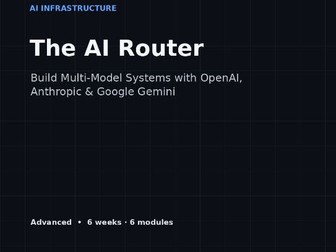
The AI Router is a practical, outcome-driven course for backend developers, ai engineers, technical founders. Build a fault-tolerant multi-model gateway that routes requests by capability and cost, fails over automatically, validates outputs, and alerts you when the system needs attention. The curriculum focuses on repeatable workflows, applied exercises and production-minded decision making rather than tool hype. Course Goal Replace fragile single-provider AI integrations with an observable, provider-agnostic architecture built for production. What You’ll Learn • Benchmark models by context, tool use, latency, price and reasoning quality. • Normalize OpenAI, Anthropic and Gemini behind one Pydantic interface. • Route requests by task complexity and live budget pressure. • Build fallback chains, rate limits, circuit breakers and validation retries. • Track provider spend, latency, routing decisions and fallback rates. • Deploy a standalone gateway with health checks and Telegram alerting.
Automated Wealth - Build Your Personal Financial Command Center with PythonQuick View
sggvesigio

Automated Wealth - Build Your Personal Financial Command Center with Python

(0)
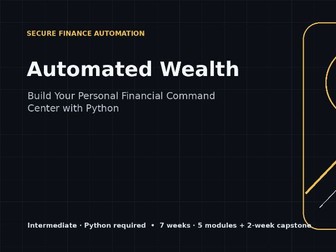
Automated Wealth is a practical, outcome-driven course for tech-savvy professionals, freelancers, retail investors. Build a self-hosted financial data system that ingests transactions, validates money correctly, stores data securely, and proactively reports what needs attention. The curriculum focuses on repeatable workflows, applied exercises and production-minded decision making rather than tool hype. Course Goal Give technically capable learners control over their financial-data pipeline without handing credentials and transaction history to a third-party budgeting app. What You’ll Learn • Ingest financial data through official APIs and resilient browser automation where necessary. • Model monetary values with Decimal and strict Pydantic validation. • Handle currencies, categorization and idempotent transaction identifiers correctly. • Design secret management and security controls for sensitive financial data. • Build resilient scheduling, alerts and failure handling. • Deliver a fault-tolerant self-hosted financial dashboard with Telegram reporting.
The AI Creator - Build a One-Person Media EmpireQuick View
sggvesigio

The AI Creator - Build a One-Person Media Empire

(0)
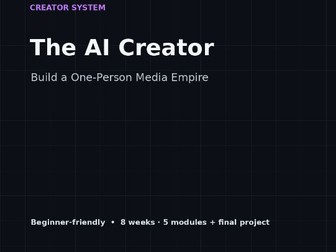
The AI Creator is a practical, outcome-driven course for freelancers, content creators, solo entrepreneurs. Build a professional, repeatable AI-assisted content system—from idea and script to voice, video, editing, publishing and repurposing—without losing your human voice. The curriculum focuses on repeatable workflows, applied exercises and production-minded decision making rather than tool hype. Course Goal Help one creator produce at the quality and pace that used to require a small team, while keeping originality, consent and disclosure at the center. What You’ll Learn • Map an AI production stack by category instead of chasing tool trends. • Use AI for high-volume ideation while keeping human judgment in control. • Preserve a recognizable personal voice in AI-assisted scripts. • Build voice-cloning workflows with consent and clear disclosure practices. • Create reusable prompt libraries and a repeatable production system. • Complete and publish a real five-episode video series.
The Automated Content Factory - Scale Visual Production with Canva, AI & PythonQuick View
sggvesigio

The Automated Content Factory - Scale Visual Production with Canva, AI & Python

(0)
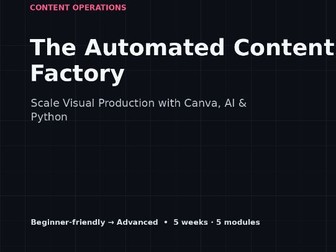
The Automated Content Factory is a practical, outcome-driven course for agencies, social media managers, solo creators. Turn raw data into hundreds of on-brand visual assets through templates, bulk generation, Python automation, scheduling, approvals and monitoring. The curriculum focuses on repeatable workflows, applied exercises and production-minded decision making rather than tool hype. Course Goal Make content volume a scheduling and systems problem—not a headcount problem. What You’ll Learn • Build scalable Canva Brand Kits and master templates. • Generate large batches of on-brand assets from CSV data. • Pull and clean RSS/API data with Python and pandas. • Connect AI summarization to a Canva generation pipeline. • Schedule publishing with retries, backoff and idempotency. • Add approvals, monitoring, cost controls and multi-client configuration.
The AI Media Empire - Automate Voice, Video & Music Production with PythonQuick View
sggvesigio

The AI Media Empire - Automate Voice, Video & Music Production with Python

(0)
The AI Media Empire is a practical, outcome-driven course for creators, podcasters, video producers, agencies. Build a scheduled AI media pipeline that turns a script into narration, video, music, a finished episode, and a published upload. The curriculum focuses on repeatable workflows, applied exercises and production-minded decision making rather than tool hype. Course Goal Turn studio-style media production into a reliable, repeatable pipeline that one person can operate at scale. What You’ll Learn • Create consent-cleared AI narration and multilingual voice workflows. • Generate consistent B-roll with text-to-video and image-to-video workflows. • Create reusable AI music identities and episode variants. • Orchestrate voice, video, music, editing and publishing with Python. • Add retries, quotas, structured cost logging and Telegram alerts. • Schedule daily production with APScheduler or Celery. Course Marketplace Pack Page 3 Tools & Technologies ElevenLabs · Runway Gen-3 · Suno/Udio · Python · ffmpeg · Celery/APScheduler · YouTube API · Telegram