Normalization Through Case Studies: 5 Critical-Thinking Case StudiesQuick View
DrARaza

Normalization Through Case Studies: 5 Critical-Thinking Case Studies

(0)
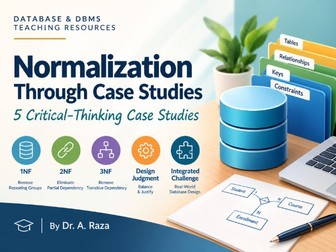
Help students develop a deeper understanding of database normalization through 5 realistic, critical-thinking case studies. Rather than simply asking students to define 1NF, 2NF, and 3NF, these activities require students to examine flawed database designs, identify dependencies and anomalies, evaluate decomposition choices, and justify their reasoning. Students explore: • Identifying repeating groups and normalization problems • Recognizing update, insertion, and deletion anomalies • Understanding partial dependencies and 2NF • Identifying transitive dependencies and 3NF • Evaluating normalization and database-design trade-offs • Applying normalization concepts to a realistic hospital appointment database • Explaining why a valid primary key does not automatically mean a table is well normalized The resource includes: • 5 student case studies with realistic scenarios • Critical-thinking questions requiring students to explain and justify their decisions • A concise instructor guide with suggested answers and key teaching points • Activities designed to develop logical reasoning rather than memorization or SQL implementation The cases progress from 1NF and repeating groups through 2NF and 3NF, before moving into broader design judgment and an integrated real-world challenge. Suitable for Computer Science, Computing, Database Systems, DBMS, and introductory Database Design courses.
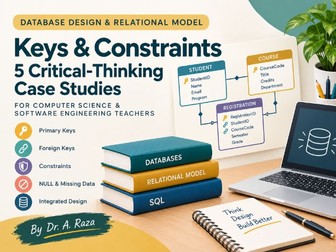
Relational Model, Keys & Constraints: 5 Critical-Thinking Case StudiesQuick View
DrARaza

Relational Model, Keys & Constraints: 5 Critical-Thinking Case Studies

(0)
Help students develop deeper understanding of the relational model, keys, and database constraints through 5 realistic, critical-thinking case studies. Rather than simply asking students to define database terminology, these activities require them to examine realistic scenarios, identify design problems, evaluate alternatives, and justify their database-design decisions. Students explore: • Choosing appropriate primary and composite keys • Understanding candidate keys and uniqueness • Using foreign keys and maintaining referential integrity • Identifying and applying database constraints • Reasoning about NULL values and missing data • Distinguishing primary-key requirements from additional business rules • Evaluating database designs and explaining why a proposed solution may fail The 5 case studies cover different contexts, including university course registration, course databases, student records, and a university library borrowing system. The resource includes: • 5 student case studies with realistic scenarios and critical-thinking questions • Critical-thinking challenges that require students to justify their reasoning • A concise instructor guide with suggested answers and key teaching points • Activities designed to encourage logical reasoning and database-design thinking rather than SQL implementation Suitable for Computer Science, Computing, Database Systems, DBMS, and introductory Database Design courses.
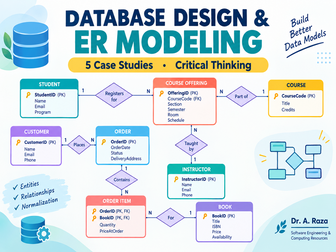
Database Design & ER Modeling: 5 Critical-Thinking Case StudiesQuick View
DrARaza

Database Design & ER Modeling: 5 Critical-Thinking Case Studies

(0)
Help students move beyond simply drawing ER diagrams with these 5 realistic, critical-thinking database design case studies. Students work through different database-design challenges, including: • Identifying entities, attributes, relationships, and cardinalities • Distinguishing a course from a course offering • Finding and correcting problems in a flawed database design • Handling many-to-many relationships and associative entities • Deciding whether information should be an entity, attribute, or relationship • Applying business rules and time-dependent data to database design • Making and justifying design decisions in a more complex food-delivery scenario The resource includes 5 student case studies covering University Course Registration, Online Bookstore, Hospital Appointment System, Hotel Reservations, and Food Delivery. Also included is a concise instructor guide with suggested models, key answers, and teaching notes. Designed for database, DBMS, ER modeling, or introductory database-design courses. The activities emphasize logical reasoning and design decisions rather than coding implementation.
Software Testing Test-Case Design ActivitiesQuick View
DrARaza

Software Testing Test-Case Design Activities

(0)
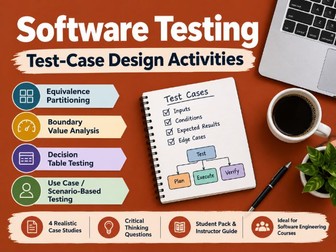
Turn software testing concepts into practical decision-making exercises with 4 realistic, critical-thinking activities. Students apply four essential testing techniques to realistic scenarios: Equivalence Partitioning Boundary Value Analysis Decision Table Testing Use Case/Scenario-Based Testing Rather than simply defining testing techniques, students must analyze situations, determine appropriate test cases, and explain their reasoning. Includes: 4 ready-to-use testing activities Concise instructor guide Sample answers Critical-thinking questions Practical test-case design exercises Ideal for undergraduate Software Engineering, Software Testing, and Quality Assurance courses. No programming implementation is required.
Software Architectural Patterns Case StudiesQuick View
DrARaza

Software Architectural Patterns Case Studies

(0)
Put students in the role of a software architect. Each case presents a system-level situation in which an architectural approach must be selected based on factors such as scalability, maintainability, communication, deployment, and system complexity. Students evaluate the situation, weigh architectural trade-offs, and defend the approach they believe best fits the project’s needs. Students practice: Evaluating architectural alternatives Connecting architecture to system requirements Analyzing trade-offs Recognizing architectural consequences Defending an architectural decision Suitable for undergraduate Software Architecture and Software Engineering courses. No programming implementation is required. The emphasis is on architectural judgment and trade-off analysis.
Software Design PatternsQuick View
DrARaza

Software Design Patterns

(0)
Challenge students to move beyond memorizing design patterns and decide which design approach makes sense for a particular software problem. Across 5 realistic scenarios, students examine the problem, identify a suitable Design Pattern, consider alternatives, and defend their choice with clear reasoning. Students practice: Recognizing recurring design problems Selecting an appropriate Design Pattern Comparing possible solutions Explaining the consequences of a design choice Justifying decisions based on the scenario Suitable for undergraduate Software Engineering, Object-Oriented Design, and Design Patterns courses. No programming implementation is required. The emphasis is on design reasoning and decision-making.
Software Requirements Case Studies.Quick View
DrARaza

Software Requirements Case Studies.

(0)
Turn requirements engineering into a decision-making exercise with 5 realistic software project scenarios. Students are placed in situations where requirements are unclear, stakeholders disagree, priorities shift, or proposed requirements need to be validated. For each case, students must determine what should happen, explain the reasoning behind their decision, and consider the consequences. Topics include: Resolving ambiguous requirements Managing conflicting stakeholder needs Responding to changing requirements Prioritizing competing requirements Evaluating and validating requirements Designed for undergraduate Software Engineering, Requirements Engineering, and Systems Analysis courses. Focus: critical thinking, analysis, and justified decision-making, not programming implementation.