Lesson 4: The Hertzsprung–Russell (H-R) DiagramQuick View
axisstem

Lesson 4: The Hertzsprung–Russell (H-R) Diagram

(0)
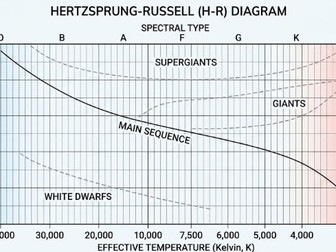
Looking for a classroom-ready, explicit instruction resource to teach the Hertzsprung–Russell (H-R) Diagram? This comprehensive lesson package gives senior physics teachers everything needed to guide students through plotting, interpreting, and classifying stars into major evolutionary stages. Designed around explicit instruction principles, this pack moves students seamlessly from conceptual warm-ups to multi-star data analysis, applying Wien’s Displacement Law and the Stefan-Boltzmann Law. Deliver an engaging, mathematically rigorous lesson on H-R diagrams with zero prep required! This complete resource includes a structured PowerPoint presentation, a printable student worksheet with real astronomical datasets, and a full Teacher Answer Key with detailed worked solutions. Written in Australian English and fully aligned with VCE Physics Unit 2 AOS 2 (Option 2.13 Astronomy)

Lesson 5: Nuclear Fusion Phenomena in StarsQuick View
axisstem

Lesson 5: Nuclear Fusion Phenomena in Stars

(0)
Deliver an engaging, rigorous lesson on stellar nucleosynthesis with zero prep required! This complete package explores mass-energy equivalence ($E = mc^2$), Coulomb repulsion, the p-p chain versus the CNO cycle, advanced onion-skin shell burning, and the Iron-56 limit. Written in Australian English and fully aligned with VCE Physics Unit 2 AOS 2 (Option 2.13 Astronomy). Looking for a comprehensive, classroom-ready explicit instruction resource to teach Nuclear Fusion Phenomena in Stars? This complete lesson pack gives senior physics and astronomy teachers everything needed to guide students through the complex nuclear engines that power stars across their lifecycles. Designed around explicit direct instruction principles, this pack seamlessly moves students from relativistic mass-energy calculations to comparative core physics and advanced multi-stage nucleosynthesis.
Lesson 2: Starlight, Temperature and Spectral ClassificationQuick View
axisstem

Lesson 2: Starlight, Temperature and Spectral Classification

(0)
This comprehensive, explicit instruction lesson explores how astrophysicists determine a star’s surface temperature, color, and chemical makeup using Wien’s Law, blackbody radiation curves, and the OBAFGKM spectral classification sequence. Designed in alignment with senior high school physics curricula (e.g., VCE Physics Unit 2 AOS 2 / Astrophysics option topics), this unit uses an Explicit Direct Instruction (EDI) model structured around learning intentions, worked examples, student activities, and assessment checkpoints. Target Audience: Senior High School Physics / Astronomy (Ages 16–18) File Types: Presentation Slides & Activity Notes Author: Axis STEM Curriculum
Lesson 1: Stellar Distance and ParallaxQuick View
axisstem

Lesson 1: Stellar Distance and Parallax

(0)
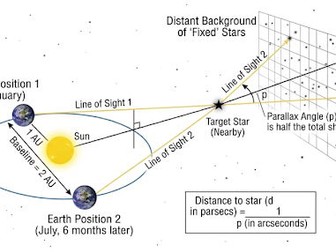
Looking for a fully structured, ready-to-teach slide deck for stellar parallax and cosmic distance calculations? This comprehensive lesson utilizes an Explicit Direct Instruction (EDI) framework aligned with the VIctorian Department of Education IMPACT model to guide students step-by-step through complex astronomical calculations. Resource Overview: Subject/Course: Physics / Astronomy (VCE Physics Unit 2 AOS 2 / General Senior Astrophysics) Topic: Stellar Parallax, Distance Formulas, and Units of Measurement (AU, Parsecs, Light-Years) Pedagogical Model: Explicit Direct Instruction (I Do, We Do, You Do) What’s Included? Hook & Conceptual Visualisation: An interactive “arm’s length” parallax activity to build intuitive understanding. Retrieval Practice & Knowledge Checks: Embedded warm-ups and CFU (Check for Understanding) checkpoints. Explicit Content Coverage:Definitions and conversions for Astronomical Units (AU), Parsecs (pc), and Light-Years (ly). Stellar Parallax Angle § and baseline geometry. The Distance Formula: d =1/p. Worked Examples: Clear calculations using real-world astronomical data (e.g., Proxima Centauri and Solar System scales). Guided & Independent Practice: Teacher-led examples paired with student exercises and an Exit Ticket for assessment.
Lesson 3: Luminosity, Radius & Stefan-Boltzmann LawQuick View
axisstem

Lesson 3: Luminosity, Radius & Stefan-Boltzmann Law

(0)
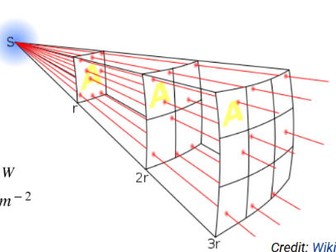
Looking for a high-quality, fully prepared lesson to teach the Hertzsprung–Russell (H-R) Diagram and Stellar Evolution? This complete lesson package gives senior Physics teachers everything needed to deliver an engaging, mathematically rigorous, and curriculum-aligned lesson with zero prep required! Designed around explicit direct instruction principles, this pack seamlessly guides students from basic temperature and luminosity concepts to analyzing complex stellar datasets and applying the Stefan-Boltzmann Law. Engage your senior Physics and Astronomy students with this comprehensive, classroom-ready explicit instruction package! Fully aligned with the VCE Physics curriculum (Unit 2 AOS 2 Option 2.13), this resource includes a slick PowerPoint presentation and a printable student worksheet complete with worked examples, independent data analysis tasks, and a full Teacher Answer Key.