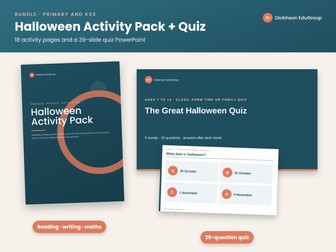
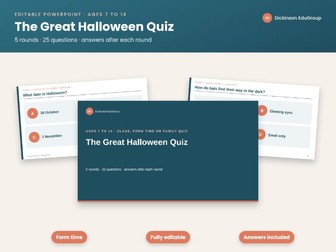
The Great Halloween Quiz: a ready-to-play, fully editable PowerPoint quiz for class, form time, clubs or a family quiz night. Ideal for ages 7 to 14.
Five rounds of five multiple-choice questions, with the answers revealed after each round, so you can mark as you go. It mixes history, science and geography, so pupils learn something while having fun.
Rounds:
• History of Halloween
• Spooky animals
• Pumpkins and food
• Around the world
• Autumn science
Includes a how-to-play slide, answer slides after every round, answers in the speaker notes, a final scores slide and a tie-breaker. 39 editable slides, 16:9. Allow about 30 to 40 minutes, or delete a round to fit your time.
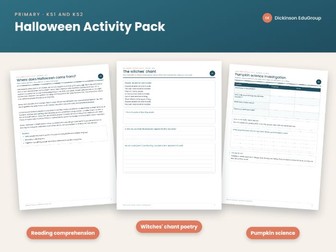
A complete, editable Halloween activity pack for primary schools, with reading, writing, poetry, maths, science, PSHE and puzzles for KS1 and KS2. Ready to print for the week before October half-term.
Halloween is a great hook for learning. This pack keeps it fun rather than frightening, covers the real history of the festival, and includes an autumn alternative page so every pupil can take part, including those whose families don’t celebrate Halloween.
What’s included (18 pages, editable Word and PDF):
• Teacher notes, 2026 dates and guidance on an inclusive approach
• Knowledge organiser: Samhain, All Hallows’ Eve, turnip lanterns and guising, with key vocabulary
• KS1 reading: The pumpkin lantern, with questions
• KS2 reading comprehension: Where does Halloween come from? (retrieval, vocabulary and inference)
• Spooky story planner (story mountain) with sentence openers
• The haunted house: descriptive writing with a senses grid and word bank
• Poetry: the witches’ chant from Macbeth, then write your own spell poem
• Pumpkin maths (KS1) and spooky maths problems (KS2), including money and time
• Pumpkin science investigation: weigh, measure, float or sink, count the seeds
• Halloween wordsearch
• Design a pumpkin and a costume
• Staying safe at Halloween (PSHE)
• Halloween around the world: Day of the Dead, guising, Samhain and Undas
• Autumn alternative page
• Full answers
Suitable for Years 1 to 6. Every page is editable, so you can adapt it to your class and your school’s approach to celebrations.
Everything you need for Halloween week: the editable Halloween Activity Pack for KS1 and KS2 (18 pages, Word and PDF) plus the Great Halloween Quiz PowerPoint (5 rounds, 25 questions, 39 editable slides).
Reading, writing, poetry, maths, science, PSHE, puzzles, an autumn alternative for inclusive classrooms, and a fun quiz to finish the half-term.
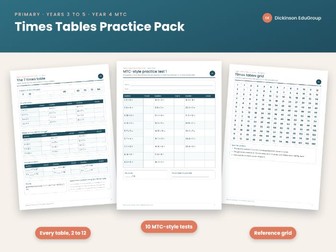
Times tables practice for every table from 2 to 12, with ten Multiplication Tables Check (MTC) style timed tests to build speed and confidence before June. Ideal for Year 4, and just as useful for Years 3 and 5, intervention groups and homework.
Quick, confident recall of times tables underpins almost everything in upper Key Stage 2 maths. This pack gives you a structured, little-and-often approach: learn each table, mix the facts up, then practise against the clock in the same format as the Year 4 check (25 questions, about 6 seconds each, weighted towards the 6, 7, 8, 9 and 12 times tables, with no reversed pairs in the same test).
What’s included (35 pages, editable Word and PDF):
• Teacher notes: what the Year 4 MTC involves, and a 12-week teaching plan
• Times tables strategies page, including the trickiest facts
• Reference times tables grid (12 × 12) and a blank grid challenge
• A practice page for every table from 2 to 12: count in steps, fill in the facts, mixed-up recall, missing numbers, a top tip and a word problem
• 10 MTC-style practice tests with 25 questions each
• Answers for every test, plus a full answer grid
• Pupil tracker and class tracker
• Certificates to celebrate progress
• A parent guide to send home
Everything is editable, so you can change the numbers, add your class name or adapt pages for different groups. Not produced or endorsed by the Standards and Testing Agency: check the latest MTC guidance and dates on GOV.UK.
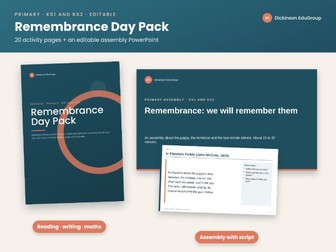
A complete Remembrance Day pack for primary schools, with editable activities for KS1 and KS2 and a ready-to-use assembly PowerPoint. Everything you need for Remembrance Sunday (8 November 2026) and Armistice Day (Wednesday 11 November 2026) in one download.
Help pupils understand why we remember, through reading, writing, poetry, history, maths and quiet reflection. The activities are written to be age-appropriate and sensitive: the teacher notes include guidance for pupils with family in the armed forces or experience of conflict, and the poppy is presented as a symbol of remembrance and hope for peace.
What’s included (20 activity pages, editable Word and PDF):
• Teacher notes, 2026 dates and guidance on teaching Remembrance sensitively
• Knowledge organiser with key facts and vocabulary (KS1/KS2)
• KS1 reading: Why do we wear poppies? with questions
• KS2 reading comprehension: The story of the poppy, with retrieval, vocabulary and inference questions
• Timeline sort from 1914 to 1945, with a challenge question
• In Flanders Fields by John McCrae, with poetry questions
• My Remembrance poem: acrostic frame with word banks
• Unsung heroes cards: Walter Tull, Khudadad Khan, Noor Inayat Khan, women on the home front and animals in war, plus a research fact file
• A postcard home: a historical writing task
• Poppy maths (KS1) and Remembrance maths problems (KS2)
• Remembrance wordsearch
• Make a poppy wreath: step-by-step craft instructions
• Two-minute silence script, including the Exhortation
• Doves of peace reflection activity
• Full answers, including the wordsearch grid
Plus an editable 13-slide assembly PowerPoint (about 15 to 20 minutes), with a full script in the speaker notes, the Exhortation and a slide for the two-minute silence.
Suitable for Years 1 to 6. Every page can be edited in Word to suit your class, and the PDF is ready to print.
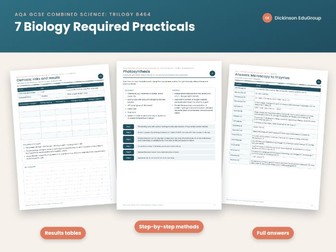
All 7 biology required practicals for AQA GCSE Combined Science: Trilogy (8464) in one editable pack, ready for the lab, homework and mock revision.
What’s included:
• Overview of the 7 biology practicals
• Key practical terms, maths skills and graph-drawing guidance
• How to write a good method and risk assessment
• For each practical: aim, equipment, variables, step-by-step method, risk assessment, results table, processing and evaluation prompts
• 28 exam-style questions with full mark-scheme answers
• Student and class practical trackers
• Editable Word file and PDF (30 pages)
Practicals covered:
• Microscopy
• Osmosis
• Food tests
• Enzymes
• Photosynthesis
• Reaction time
• Field investigations
Suitable for Years 9 to 11. Not produced or endorsed by AQA. Methods are suggestions: always follow your school’s risk assessments and CLEAPSS guidance.
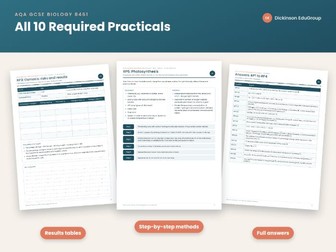
All 10 AQA GCSE Biology (8461) required practicals in one editable pack, ready for the lab, homework and mock revision. Practicals that are also in Combined Science: Trilogy are clearly marked.
What’s included:
• Overview of all 10 practicals with paper and Combined Science labels
• Key practical terms, maths skills and graph-drawing guidance
• How to write a good method and risk assessment
• For each practical: aim, equipment, variables, step-by-step method, risk assessment, results table, processing and evaluation prompts
• 40 exam-style questions with full mark-scheme answers
• Student and class practical trackers
• Editable Word file and PDF (40 pages)
Practicals covered:
• RP1: Microscopy
• RP2: Microbiology (Biology only)
• RP3: Osmosis
• RP4: Food tests
• RP5: Enzymes
• RP6: Photosynthesis
• RP7: Reaction time
• RP8: Plant responses (Biology only)
• RP9: Field investigations
• RP10: Decay (Biology only)
Suitable for Years 9 to 11. Not produced or endorsed by AQA. Methods are suggestions: always follow your school’s risk assessments and CLEAPSS guidance.
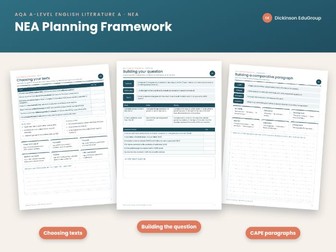
A complete planning framework for the AQA A-level English Literature A NEA. It takes students from choosing texts to a fully referenced final draft, with clear guidance on all five assessment objectives. Everything is general guidance for the whole class, so it sits comfortably within AQA’s rules on NEA support.
What’s included:
• The NEA at a glance and a six-stage route
• The five assessment objectives and the mark bands in plain English
• Choosing texts: checklist and theme ideas
• Building the question: formula, examples and question checker
• Reading critically: sources, types of reading, sentence stems and critic log
• Context that does a job: weak, better and strong examples
• Planning with a word budget and CAPE comparative paragraphs
• Word count, redrafting, quotations, referencing and bibliography formats
• Final checklist
• Editable Word file and PDF (12 pages)
Suitable for Year 12 and Year 13 A-level English Literature (AQA 7712). Not produced or endorsed by AQA. Summaries of the requirements and mark bands are in our own words: check the current AQA 7712 specification and NEA guidance.
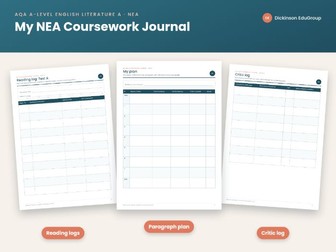
A student coursework journal for the AQA A-level English Literature A NEA. Students log their reading, critics and context, develop their question, plan and record each draft. It also gives teachers a clear record of each student’s independent process.
What’s included:
• Milestones and deadlines
• Choosing texts reflections
• Reading logs for both texts
• Critic log and context log
• Question development and checker
• Comparative paragraph plan
• Drafting record and general feedback log
• Self-review by assessment objective
• Bibliography builder
• Editable Word file and PDF (11 pages)
Suitable for Year 12 and Year 13 A-level English Literature (AQA 7712). Not produced or endorsed by AQA. Summaries of the requirements and mark bands are in our own words: check the current AQA 7712 specification and NEA guidance.
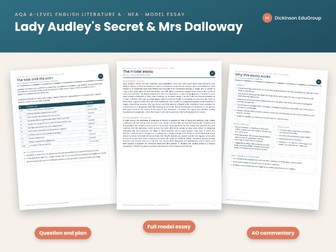
An original model comparative critical study for the AQA A-level English Literature A NEA, comparing Mary Elizabeth Braddon, Lady Audley’s Secret (1862) and Virginia Woolf, Mrs Dalloway (1925). Question: Compare and contrast the presentation of madness in Braddon’s Lady Audley’s Secret and Woolf’s Mrs Dalloway, in the light of the view that madness in both novels is less a medical condition than a judgement passed by those with power. Both texts are out of copyright, and every paragraph is labelled by assessment objective.
What’s included:
• Teacher notes on using model essays within AQA’s NEA rules
• The question, why it works, and a paragraph plan mapped to the AOs
• Full model essay (about 1,999 words, under the 2,500-word limit)
• Bibliography and referencing guide
• Commentary: strengths by AO, critics and context used
• Common mistakes and other angles for discussion
• Skills tasks using class texts
• Mark bands in plain English
• Editable Word file and PDF (11 pages)
Suitable for Year 12 and Year 13 A-level English Literature (AQA 7712). Not produced or endorsed by AQA. Summaries of the requirements and mark bands are in our own words: check the current AQA 7712 specification and NEA guidance.
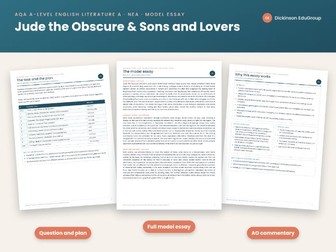
An original model comparative critical study for the AQA A-level English Literature A NEA, comparing Thomas Hardy, Jude the Obscure (1895) and D. H. Lawrence, Sons and Lovers (1913). Question: Compare and contrast the ways in which Hardy in Jude the Obscure and Lawrence in Sons and Lovers present the conflict between aspiration and the constraints of class, in the light of the view that both novels blame society more than the individual. Both texts are out of copyright, and every paragraph is labelled by assessment objective.
What’s included:
• Teacher notes on using model essays within AQA’s NEA rules
• The question, why it works, and a paragraph plan mapped to the AOs
• Full model essay (about 2,002 words, under the 2,500-word limit)
• Bibliography and referencing guide
• Commentary: strengths by AO, critics and context used
• Common mistakes and other angles for discussion
• Skills tasks using class texts
• Mark bands in plain English
• Editable Word file and PDF (11 pages)
Suitable for Year 12 and Year 13 A-level English Literature (AQA 7712). Not produced or endorsed by AQA. Summaries of the requirements and mark bands are in our own words: check the current AQA 7712 specification and NEA guidance.
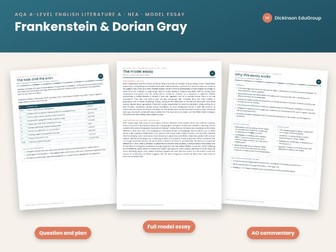
An original model comparative critical study for the AQA A-level English Literature A NEA, comparing Mary Shelley, Frankenstein (1818) and Oscar Wilde, The Picture of Dorian Gray (1891). Question: Compare the ways in which Shelley in Frankenstein and Wilde in The Picture of Dorian Gray present the creation of monstrosity, in the light of the view that both novels are less concerned with monsters than with the men who make them. Both texts are out of copyright, and every paragraph is labelled by assessment objective.
What’s included:
• Teacher notes on using model essays within AQA’s NEA rules
• The question, why it works, and a paragraph plan mapped to the AOs
• Full model essay (about 2,116 words, under the 2,500-word limit)
• Bibliography and referencing guide
• Commentary: strengths by AO, critics and context used
• Common mistakes and other angles for discussion
• Skills tasks using class texts
• Mark bands in plain English
• Editable Word file and PDF (11 pages)
Suitable for Year 12 and Year 13 A-level English Literature (AQA 7712). Not produced or endorsed by AQA. Summaries of the requirements and mark bands are in our own words: check the current AQA 7712 specification and NEA guidance.
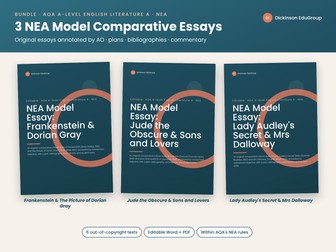
Three original model comparative essays for the AQA A-level English Literature A coursework (NEA). Each one shows students how to build a sustained comparative argument across a pre-1900 and a later text. The essays weave in close analysis, critical views and context, and every paragraph is labelled by assessment objective. All six texts are out of copyright and none is on AQA’s list of excluded texts. Teacher notes explain how to use the models within AQA’s rules on coursework support.
The three essays:
Frankenstein (Mary Shelley) and The Picture of Dorian Gray (Oscar Wilde): creation, responsibility and the monstrous self
Jude the Obscure (Thomas Hardy) and Sons and Lovers (D. H. Lawrence): aspiration, class and the cost of desire
Lady Audley’s Secret (Mary Elizabeth Braddon) and Mrs Dalloway (Virginia Woolf): madness, power and who gets to decide
Each essay includes:
Teacher notes on using model essays within AQA’s coursework rules
The question, why it works, and a paragraph plan with the assessment objectives for each paragraph
The full model essay, about 2,000 words (under the 2,500-word limit)
A bibliography and referencing guide
Commentary: strengths by assessment objective, and the critics and context used
Common mistakes and discussion questions
Skills tasks using class texts
The mark bands in plain English
Editable Word file and PDF (11 pages each)
Suitable for: Year 12 and Year 13, AQA A-level English Literature A (7712). Not produced or endorsed by AQA.
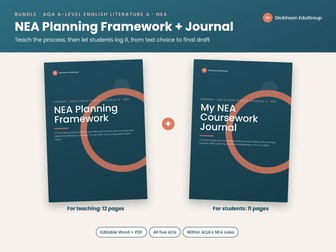
Teach the AQA A-level English Literature A coursework (NEA) process, then give students a journal to record their own. The Planning Framework takes the class from choosing texts to a fully referenced final draft. The Student Journal gives each student a matching place to log their reading, critics, context, question drafts, plan and drafts. Everything is general, whole-class guidance, so it fits within AQA’s rules on coursework support. The journal also gives teachers a clear record of each student’s independent work.
What’s included:
NEA Planning Framework (12 pages):
The NEA at a glance and a six-stage route through it
The five assessment objectives and the mark bands in plain English
Choosing texts: checklist and theme ideas
Building the question: formula, examples and question checker
Reading critically: sources, types of reading, sentence stems and critic log
Context that does a job, with weak, better and strong examples
Planning with a word budget, and CAPE comparative paragraphs (claim, analysis, perspective, evaluation)
Word count, redrafting, quotations, referencing and a final checklist
Student Coursework Journal (11 pages):
Milestones and deadlines
Reading logs for both texts
Critic log and context log
Question development and checker
Comparative paragraph plan
Drafting record and general feedback log
Self-review by assessment objective
Bibliography builder
Editable Word files and PDFs for both.
Suitable for: Year 12 and Year 13, AQA A-level English Literature A (7712). Not produced or endorsed by AQA.
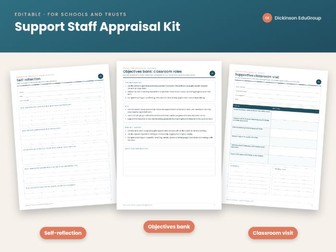
Everything you need for a fair, supportive appraisal year for teaching assistants, HLTAs and all school support staff. Includes reviewer guidance and coaching questions, an annual cycle planner, a summary of the Professional Standards for Teaching Assistants, self-reflection and role-check forms, objective-setting forms and an objectives bank with 27 examples across nine roles: TA, HLTA, SEND, office, site, lunchtime, pastoral, technicians, and finance and HR. There are also training and mandatory training records, a supportive classroom visit form, a wellbeing check-in, mid-year and end-of-year reviews, and a line manager tracker. Fully editable Word and PDF, 20 pages. Use it alongside your own appraisal policy.
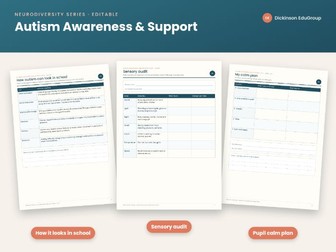
Everything teachers, TAs and SENCOs need to understand and support autistic pupils, for use all year round or during World Autism Acceptance Week in spring.
What’s included:
What autism is, myths and facts, and how it can look in school, including pupils who mask
An observation checklist, an autism-friendly classroom checklist and a sensory audit
Strategies for communication, predictability, social understanding, interests and wellbeing
Understanding meltdowns and shutdowns
Support for transitions, unstructured times and exams, and reasonable adjustments under the Equality Act
An “All about me” pupil profile, a one-page support plan and a guide to talking with families
Pupil tools: a five-point calm plan and a visual timetable
A 15-minute staff briefing, a ready-made awareness lesson, and a myth-or-fact quiz with answers
Two class posters and a SENCO tracker
Designed in a clear, accessible style. Fully editable Word and PDF, 26 pages. Supports awareness and good practice. It is not a diagnostic or medical resource.
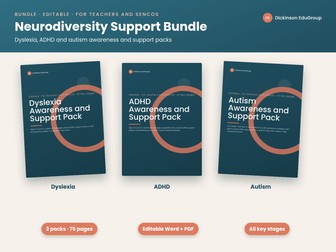
Three complete awareness and support packs in one bundle, for teachers, TAs and SENCOs who want to make every classroom work for neurodivergent pupils. Each pack follows the same clear structure, so staff quickly know where to find what they need: understand, notice, adapt, plan and raise awareness.
What’s included:
Dyslexia Awareness and Support Pack (24 pages): signs to look for by age, an observation checklist, a classroom checklist and resource style guide, and strategies for reading, spelling, writing, maths and organisation. It also covers assistive technology and exam access, and has a pupil profile and support plan.
ADHD Awareness and Support Pack (25 pages): how ADHD can look in class, including pupils who are easy to miss, and strategies for attention, organisation, movement and regulation. It also covers reasonable adjustments and calm responses when things escalate, and includes a focus toolkit and a task planner.
Autism Awareness and Support Pack (26 pages): how autism can look in school, including masking, a sensory audit, and strategies for communication and predictability. It also covers understanding meltdowns and shutdowns, and includes a calm plan and a visual timetable.
Every pack also includes:
myths and facts
an observation checklist and a one-page support plan
a guide to talking with families
a 15-minute staff briefing and a ready-made awareness lesson
a pupil quiz with answers
two class posters and a SENCO tracker
Designed in a clear, accessible style. Fully editable Word and PDF, 75 pages in total. These packs support awareness and good practice. They are not diagnostic or medical resources.
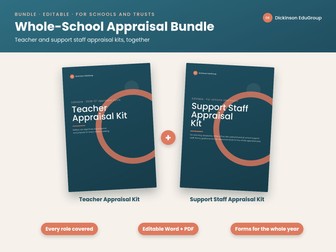
Everything you need to run a fair, supportive appraisal year for every member of staff, in one bundle. It combines our Teacher Appraisal Kit and Support Staff Appraisal Kit, so teachers, teaching assistants, HLTAs, office, site, pastoral and all support staff can use consistent, editable paperwork.
What’s included:
Teacher Appraisal Kit:
self-reflection
guidance on writing objectives, with objective forms
an evidence log
a Teachers’ Standards evidence map and a CPD record
preparation for mid-year and end-of-year reviews, with meeting notes and tips
Support Staff Appraisal Kit:
reviewer guidance with coaching questions
an appraisal year planner and a summary of the Professional Standards for Teaching Assistants
self-reflection and a role check
objective forms with an objectives bank of 27 examples across nine roles
a training plan and a mandatory training record
a supportive classroom visit form and a wellbeing check-in
mid-year and end-of-year reviews, and a line manager tracker
Fully editable Word and PDF. Use alongside your school or trust’s appraisal policy.
Save 25% on buying resources separately.
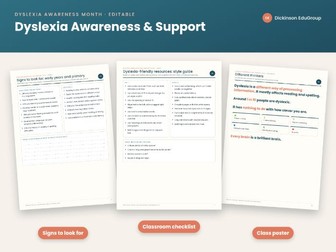
Everything teachers, TAs and SENCOs need to understand and support dyslexic learners, ready for Dyslexia Awareness Month and useful all year round.
What’s included:
What dyslexia is, myths and facts, and signs to look for from early years to secondary
An observation checklist to share with your SENCO
A dyslexia-friendly classroom checklist and a resource style guide
Strategies for reading, spelling, writing, maths, memory and organisation
Assistive technology and exam access arrangements
An “All about me” pupil profile, a one-page support plan and a guide to talking with families
A 15-minute staff briefing and a ready-made 25-minute awareness lesson
A myth-or-fact pupil quiz with teacher answers
A “My brilliant brain” pupil reflection
Two class posters: Different Thinkers and Our Class Promise
A SENCO tracker
Designed in a dyslexia-friendly style: clear font, generous spacing and a cream background. Fully editable Word and PDF, 24 pages. This pack supports awareness and good practice. It is not a diagnostic tool.
Suitable for all key stages.
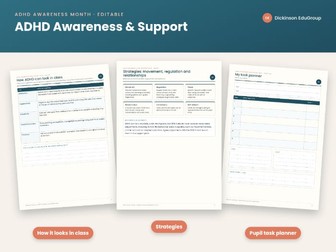
Everything teachers, TAs and SENCOs need to understand and support pupils with ADHD, ready for ADHD Awareness Month in October and useful all year round.
What’s included:
What ADHD is, myths and facts, and how it can look in class, including quiet, inattentive pupils and girls who are easy to miss
An observation checklist and an ADHD-friendly classroom checklist
Strategies for attention, organisation, movement, regulation and relationships
Reasonable adjustments under the Equality Act, and calm responses when things escalate
Support for transitions, unstructured times, homework and exams
An “All about me” pupil profile, a one-page support plan and a guide to talking with families
Pupil tools: a focus toolkit and a “now and next” task planner
A 15-minute staff briefing and a ready-made 25-minute awareness lesson
A myth-or-fact pupil quiz with teacher answers
Two class posters and a SENCO tracker
Designed in a clear, accessible style. Fully editable Word and PDF, 25 pages. Supports awareness and good practice. It is not a diagnostic or medical resource.
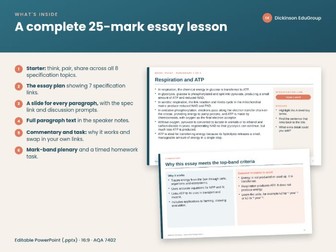
A 25-mark synoptic model essay for AQA A-level Biology (7402) Paper 3: “The importance of energy transfers in living organisms”. Written to top-band criteria, it draws on 7 areas of the specification across Topics 1, 2, 3, 5 and 6.
What’s included:
• Essay plan showing every specification link
• Full model essay (about 839 words)
• Examiner-style commentary on why it works
• Other links students could use, and common mistakes to avoid
• Plan-your-own-version template and essay checklist
• Mark bands summarised in plain English
• Editable lesson PowerPoint, Word file and print-ready PDF (8 pages)
Suitable for Year 12 and Year 13 A-level Biology (AQA 7402). Not produced or endorsed by AQA. Mark-band summaries are in our own words.


 Quick View