Rainforest Animals Worksheets | Jungle | Ages 4-7 | Toucan Sloth Jaguar | PDFQuick View
LexAndFoxPress

Rainforest Animals Worksheets | Jungle | Ages 4-7 | Toucan Sloth Jaguar | PDF

(0)
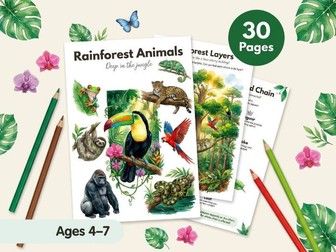
Rainforest habitat pack for KS1 and lower KS2. 30 pages on jungle ecology - forest layers, food chains, camouflage and eight animals, in vivid watercolour. What children will explore Rainforest layers - canopy, understorey and forest floor, and which animals live where Food chains - a five-link chain from plant to top predator Camouflage and warning colours - why a tree frog is bright and a jaguar is spotted Day and night - diurnal and nocturnal animals, and how the jungle changes after dark Meet eight rainforest animals Each gets a full spotlight page with a watercolour portrait, facts, habitat layer and diet. Toucan - the enormous rainbow beak Red-eyed tree frog - bright colours that warn predators off Jaguar - the jungle’s top predator Scarlet macaw - brilliant red, blue and yellow feathers Sloth - the world’s slowest mammal Chameleon - the colour-changing master Monkey - swinging through the canopy Anaconda - the giant of the river What’s inside - 30 pages Eight animal spotlight pages Rainforest layers diagram - sort animals by where they live Rainforest food chain with arrows Sounds matching - match animals to the sounds they make Day or night? Diurnal and nocturnal sorting Shadow matching, and a camouflage spotting activity I Spy jungle scene - count hidden animals in dense forest Collector flashcards - 8 cut-out animal cards Build-a-scene - cut out animals and build your own jungle Jungle explorer scavenger hunt - 10 challenges Colour by number, counting and pattern activities Word tracing - vine, leaf, roar, rain Jungle journal writing prompt Colouring page and Jungle Explorer certificate Why teachers and parents love this pack Real rainforest ecology - vertical layers, food chains, camouflage and nocturnal behaviour The layers diagram does the thing most habitat packs miss, which is teaching the rainforest as a vertical system Eleven activity types across science, geography, reading, writing, maths and art Print and go - no prep and no extra materials The most saturated watercolour palette in the range - deep greens, brilliant reds, electric blues Works well for vocabulary, sorting and fine motor in SEN settings Instant PDF download, 30 pages, US Letter. Print as many copies as you need for your class or family.
Gem Hunter Rock & Mineral Worksheets | Geology Activities Ages 4-7Quick View
LexAndFoxPress

Gem Hunter Rock & Mineral Worksheets | Geology Activities Ages 4-7

(0)
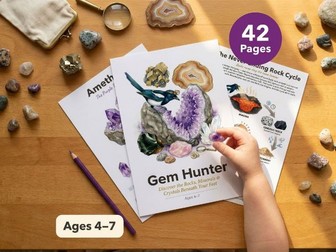
Rocks and minerals topic pack for KS1 and lower KS2. 42 pages of real geology - classification, the rock cycle, crystal structure, and a scavenger hunt that goes outdoors. Meet the minerals Amethyst - the purple crystal born from iron and heat Pyrite - the golden trickster they call fool’s gold Obsidian - volcanic glass, cooled faster than a blink Quartz - the second most common mineral on Earth Agate - banded rings built one layer per thousand years Flint - the ancient spark that lit the first fires Granite - three minerals squeezed into one speckled stone Marble - limestone transformed by the Earth’s own pressure What’s inside - 42 pages Eight collector-card spotlight pages with mineral portraits and facts Label the parts of a crystal on a scientific diagram Classify rocks as igneous, sedimentary or metamorphic Complete the rock cycle - trace the journey from magma to mountain Geological cross-section poster to colour, surface down to magma Mistake inspector - hunt for errors in a busy gem show scene Spot the difference between two cave scenes Geology word search, counting and tally challenge Reading passage about finding a crystal by a stream Guided writing prompts about your own rock collection Gem Hunter journal for recording finds 12-item rock hunting scavenger hunt to take outdoors Sensory gem dig set-up, with step-by-step instructions Junior Gem Hunter certificate and 2-page answer key Why teachers and parents love this pack Igneous, sedimentary and metamorphic are taught as the real scientific categories they are, not simplified away The scavenger hunt and journal turn any walk, playground or beach into a field trip The gem dig gives you a complete hands-on activity with household materials Pairs with a real rock collection or a museum visit Beautiful naturalist watercolour illustrations - not clipart, not cartoon Answer key included for every activity Instant PDF download, 42 pages, US Letter. Print as many copies as you need for your class or family.
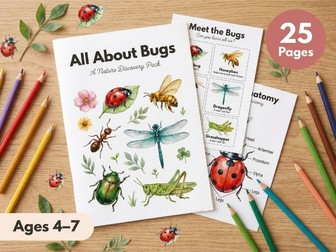
All About Bugs Worksheets | Insects | Ages 4-7 | Ladybug Bee Ant | Science PDFQuick View
LexAndFoxPress

All About Bugs Worksheets | Insects | Ages 4-7 | Ladybug Bee Ant | Science PDF

(0)
Minibeasts topic pack for KS1 and EYFS. 25 pages of real insect science - anatomy, classification and habitats, through hand-painted watercolour pages. Meet the minibeasts Ladybird - hidden wings, a taste for aphids, and no two spot patterns quite alike Honeybee - pollinator, honey-maker, and dancer of the waggle Ant - small but mighty, lifting fifty times its own weight Dragonfly - thirty miles an hour, with 360-degree vision Beetle - one insect family, four hundred thousand species Grasshopper - jumps twenty times its body length and makes music with its legs What’s inside - 25 pages Six spotlight pages, one per minibeast, each with four facts Label the parts of an insect using a word bank What makes an insect an insect - six legs, three body parts, two antennae Sort creatures by leg count, to tell insects from spiders and worms Sort creatures by flight - which of these can really fly Garden habitat page with an underground cross-section Trace six minibeast words, with letter B stroke guidance Short story about a honeybee’s busy day, with reading practice Counting, addition and pattern activities Match each minibeast to its name Find and colour six hidden minibeasts in a garden scene Botanical wreath completion certificate Why teachers and parents love this pack Real entomology - accurate anatomy, correct classification, honest science Two classification activities build the same skill different ways, by legs then by flight Each insect gets a proper spotlight page rather than a footnote The garden habitat page becomes a real minibeast hunt once it goes outside Hand-painted watercolour throughout, in the naturalist field-guide tradition, not clipart Instant PDF download, 25 pages. Fits A4 and US Letter. Print as many copies as you need for your class or family.
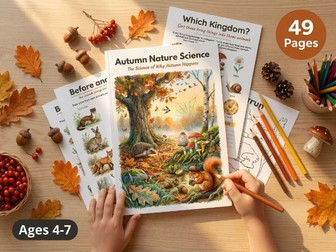
Autumn Nature Science Activities — Leaves, Hibernation, Migration, Ages 4-7Quick View
LexAndFoxPress

Autumn Nature Science Activities — Leaves, Hibernation, Migration, Ages 4-7

(0)
Autumn science for KS1 and EYFS. 49 pages on leaf colour, seed dispersal, hibernation, migration and frost - real seasonal science, not autumn-themed filler. What children will explore Leaf pigments - the hidden colours revealed when chlorophyll breaks down Seed dispersal - how acorns, sycamore helicopters and burdock hooks travel Migration and hibernation - the journeys birds make, and how hedgehogs, dormice and bats survive the cold The mushroom kingdom - the fungal network beneath the forest floor Shadows and sunlight - why days shorten and shadows grow longer Frost, spider silk, acorns and winter coats - each with its own spotlight page What’s inside - 49 pages Ten spotlight pages, each on one piece of autumn science Leaf pigment chemistry matching, and a leaf colour progression pattern Seed dispersal five-way matching, plus a paper helicopter craft and flight test Migration map drawing, and a three-way sort - migrates, hibernates or stays active Hedgehog autumn prep sequencing, and design a hibernation den Parts of a mushroom labelling, identification chart and three-way sort Spider web types matching Shadow measurement weekly log Frost crystal observation drawing Acorn to oak sequencing, with an acorn-to-oak scale comparison Before and after - animal coats through the season Autumn evidence detective, and ephemeral land art design Odd one out, true or false, zoom in, speed ladder, spot the difference, mistake inspector, I Spy, counting Reading passage on why trees lose their leaves Word tracing - hibernate, migrate, deciduous, chlorophyll Guided writing journal, colouring page, certificate, answer key Why teachers and parents love this pack Every page teaches real science, with proper vocabulary - chlorophyll, deciduous, dispersal The shadow log and frost observation run across days, so children collect their own data Connects screen-free learning to what is actually happening outside this term Hand-painted botanical watercolour illustrations throughout, not clipart A red squirrel hides on every page in a different pose Answer key included Instant PDF download, 49 pages. Both A4 and US Letter included. Print as many copies as you need for your class or family.
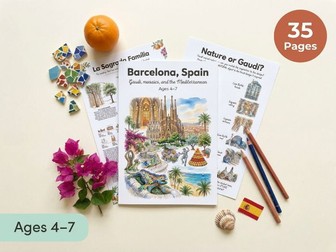
Barcelona Spain Worksheets | Gaudi Mosaic Architecture | Ages 4-7 | PDFQuick View
LexAndFoxPress

Barcelona Spain Worksheets | Gaudi Mosaic Architecture | Ages 4-7 | PDF

(0)
Barcelona topic pack for KS1 and EYFS. 35 pages on Gaudi, mosaics and Catalan culture - six landmarks, a mosaic craft, and the architect who copied nature. What children will explore Gaudi and nature - his columns are trees, his ceilings are honeycombs, his facades are waves La Sagrada Familia - started in 1882 and still unfinished, crane included Trencadis mosaic - the broken-tile technique, made by tearing paper with no straight edges A city between mountain and sea - and a beach that did not exist before the 1992 Olympics Catalan food and culture - pa amb tomaquet, crema catalana, and why paella is Valencian Park Guell, Casa Batllo, La Rambla and Montjuic, each with their own spotlight page What’s inside - 35 pages Six landmark spotlight pages, each with fun facts and a Try This At Home challenge Sagrada Familia anatomy - label 8 architectural features with a word bank Nature or Gaudi? Match 6 natural objects to the designs they inspired Barcelona city map - connect 6 landmarks to their locations Mountain or beach? Sort 12 items by where they belong Catalan or not? Sort 12 foods How tall is that building? Sagrada Familia, Eiffel Tower and Burj Khalifa to scale Design a Gaudi building to five rules, including no straight lines Trencadis mosaic craft on a salamander template Postcard from Barcelona to write and illustrate Zoom in, mistake inspector, I Spy on La Rambla, Would You Rather, odd one out Counting, patterns, word tracing, reading, writing, fun facts Build La Rambla street scene with 10 cut-outs Colouring page, explorer scavenger hunt, certificate, answer key Why teachers and parents love this pack Teaches architecture through nature, so it works as art, design and geography at once The mosaic craft is real technique simplified for small hands - tear, do not cut, and irregular is the point Real Catalan food and language, not tourist-postcard shorthand Beautiful naturalist watercolour illustrations - bougainvillea, palms and olive branches, not clipart Answer key included for every sorting and comprehension activity Instant PDF download, 35 pages, US Letter. Print as many copies as you need for your class or family.
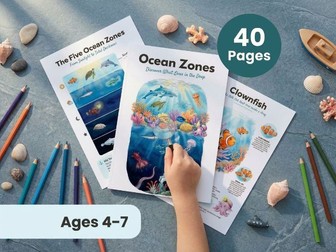
Ocean Zones Deep Sea Science Worksheets | Anglerfish Squid | Ages 4-7 PrintableQuick View
LexAndFoxPress

Ocean Zones Deep Sea Science Worksheets | Anglerfish Squid | Ages 4-7 Printable

(0)
Ocean zones nature study for KS1 and EYFS. 40 pages of layered marine science - depth, pressure, light gradients, bioluminescence and deep-sea adaptations. What children will explore The five zones - from the sunlit surface to the crushing dark of the Mariana Trench Pressure and light - why creatures change shape, colour and behaviour the deeper you go Bioluminescence - living light, and the animals that hunt and hide with it Adaptation - matching each survival feature to the problem it solves Real depth numbers - which is deeper, 200m or 4,000m, and what that means Meet the deep-sea creatures Clownfish - the little fish that lives inside a sting Lanternfish - the most common fish on Earth that nobody has heard of Anglerfish - the deep-sea hunter with a lantern on its head Giant Squid - the legendary sea monster that turned out to be real Vampire Squid - the gentle living fossil with a vampire’s cape Giant Isopod - a woodlouse the size of a football Mariana Snailfish - the deepest fish on Earth Sperm Whale - the champion diver who connects every zone What’s inside - 40 pages Label all five ocean zones on a cross-section diagram Sort 10 creatures into their correct depth zone Match deep-sea adaptations to their survival purpose Colour a gradient from sunlit blue to pitch black Build your own ocean - cut and stick creatures into the right zone Design a deep-sea submarine within real science constraints Two at-home experiments - ocean density jar and water pressure bottle Spot 6 deliberate mistakes in an ocean zones diagram Vertical I Spy scene with hidden creatures Compare real ocean depth numbers Separate ocean myths from real science Story passage journeying through all five zones Ocean journal page, zone name tracing, word search Cut-out Zone Explorer flashcards Answer key included Why teachers and parents love this pack Teaches vertical thinking - depth, pressure, light and adaptation as one connected system, not a list of sea animals Two real experiments using everyday materials, for hands-on science at the table Beautiful naturalist watercolour illustrations - field-guide quality, not clipart A nervous dumbo octopus with a headlamp turns up throughout, which keeps children looking Covers science, literacy, numeracy, art and critical thinking No prep - print and go Instant PDF download, 40 pages. Prints on US Letter or A4, as many copies as you need for your class or family.
Rome Explorer | Colosseum Gladiators Pizza Roman Numerals Mosaics | Ages 4-7Quick View
LexAndFoxPress

Rome Explorer | Colosseum Gladiators Pizza Roman Numerals Mosaics | Ages 4-7

(0)
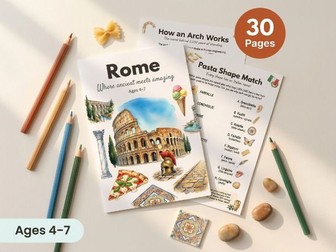
Ancient Rome topic pack for KS1 and lower KS2. 30 pages on the Colosseum, Roman engineering, numerals and Italian food - with recipe maths and mosaic patterns. What children will explore The Colosseum - 50,000 spectators, 80 arched entrances, underground lifts, and a retractable sunshade worked by 1,000 sailors Roads and engineering - 400,000km of road, aqueducts running on gravity alone, and the concrete that has held the Pantheon dome up for 1,900 years Why the arch works - a flat beam cracks, an arch turns weight outward, and the keystone locks it all Gladiators - trained athletes with referees, rules and diets, not only fights to the death Italian food and language - Margherita made for a queen, pasta named after what it looks like, and the Italian words children already know What’s inside - 30 pages Five theme spotlight pages, each with a Try This At Home challenge Inside the Colosseum - architecture cross-section with arena, tunnels, tiers and sunshade poles How an arch works - keystone, voussoirs and thrust explained Roman or not Roman? History sorting - what existed 2,000 years ago Roman mosaic patterns - repeat, three-colour, diamond, growing and mirror symmetry Pasta shape match - 8 shapes to their Italian names Roman numerals - decode, encode, and write your own age Roman numeral decoder - a secret message cipher Mistake inspector - find 6 anachronisms in an ancient scene Recipe maths - double and halve a pizza recipe Rome treasure map - navigate by compass from Forum to Trevi Fountain Rome explorer cards - 6 landmarks with their Italian names Postcard to draw and write I Spy, counting, Italian word tracing, reading, writing, fun facts Build Rome piazza scene with 8 cut-outs Explorer safari - 10 challenges, from spotting arches to making pizza Rome Explorer certificate Why teachers and parents love this pack Spotting anachronisms is a real historian’s skill, taught as a puzzle Recipe maths does doubling and halving with something children actually want to make The arch page is genuine structural engineering, and works with blocks at home Roman numerals give children a whole alternative number system, still visible on clocks and film credits Beautiful watercolour illustrations - terracotta, sandstone and Mediterranean light, not clipart Covers history, maths, art, design and language in one pack Instant PDF download, 30 pages, US Letter. Print as many copies as you need for your class or family.
All About Birds | Feathers Nests Migration Dinosaurs Beak Matching | Ages 4-7Quick View
LexAndFoxPress

All About Birds | Feathers Nests Migration Dinosaurs Beak Matching | Ages 4-7

(0)
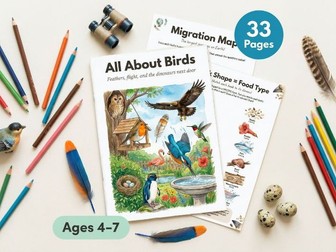
Bird nature study for KS1 and EYFS. 33 pages on feathers, flight, beaks, nests and migration - and the fact that every bird alive is a living dinosaur. Explore six bird themes Feathers and flight - barbs, barbules and hooklets form a biological zip, 150 million years before humans invented Velcro Beaks and food - every beak shape tells you what is for dinner, the insight that led Darwin to evolution Nests and eggs - built without hands or tools, from a 1cm hummingbird egg to a two-tonne eagle nest Migration - the Arctic tern flies pole to pole, 70,000km a year, navigating by magnetic compass and star maps Owls - serrated feathers for silent flight, a face like a satellite dish, hunting by sound in total darkness Birds are dinosaurs - not descended from them, they are them. A T-Rex’s closest living relative is a chicken What’s inside - 33 pages Six theme spotlight pages, each with a Try This At Home activity Inside a feather - microscopic anatomy at three magnification levels Beak shape equals food type - match 6 beaks to 6 foods Can it fly? Three-way sort - penguins, ostriches and kiwis traded flight for something better Migration map - four flight paths plotted on a world map How big is that bird? Hummingbird to ostrich, drawn to the same scale Bird detective - identify birds from feathers, nests, eggs and footprints Zoom in close-ups - feather barbs, a bird’s eye, a talon, an eggshell, a nest weave Bird watching log - a 5-day observation table, then analyse your own data Odd one out, Would You Rather, mistake inspector, I Spy, counting Reading passage, word tracing, writing prompts, fun facts, colouring Bird collector cards - six species with their real superpowers Bird postcard - write as a migrating swallow Build the garden scene with 8 cut-outs Bird explorer safari - 10 challenges you can do from a window Bird Explorer certificate Why teachers and parents love this pack Real ornithology - anatomy, adaptation, evolution and migration, taught through observation rather than colouring The bird watching log is genuine multi-day data collection, the same method professional bird scientists use The safari needs nothing but a window, which makes it work for any classroom or home Beautiful naturalist watercolour illustrations - field-guide quality, not clipart The most colourful pack in the range - robin orange, kingfisher blue, flamingo pink, hummingbird emerald Covers science, literacy, numeracy, geography and critical thinking Instant PDF download, 33 pages, US Letter. Print as many copies as you need for your class or family.
Mushroom & Fungi Nature Study | Ages 4-7 | Spore Print Experiment | 44 PagesQuick View
LexAndFoxPress

Mushroom & Fungi Nature Study | Ages 4-7 | Spore Print Experiment | 44 Pages

(0)
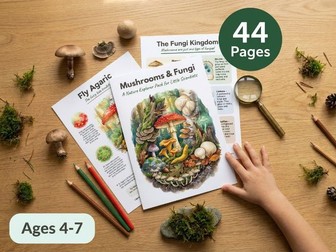
Mushroom and fungi nature study for KS1 and EYFS. 44 pages of real mycology - anatomy, life cycles, the Wood Wide Web, and two hands-on experiments. Meet the fungi Fly Agaric - the fairy-tale toadstool with its scarlet cap and white spots Chanterelle - the golden trumpet of the forest, prized by foragers Giant Puffball - bigger than a football and packed with billions of spores Ghost Fungus - nature’s own fairy light that glows green in the dark Honey Fungus - the largest living organism on Earth, stretching for kilometres underground Turkey Tail - the rainbow bracket fungus that grows in layered fans Stinkhorn - the smelliest fungus on the planet Cordyceps - the zombie-ant fungus that takes over insect brains What’s inside - 44 pages Label the six parts of a mushroom using a word bank The five types in the Fungi Kingdom - mushrooms, moulds, yeasts, lichens and truffles Sequence the mushroom life cycle from spore to fruiting body The Wood Wide Web - how trees talk through underground fungal networks Sort mushrooms by cap shape, and fungi by habitat Spot the warning signs that a mushroom might be dangerous Investigate a real fairy ring and work out why mushrooms grow in circles Compare sizes from tiny Fairy Bonnets to enormous Giant Puffballs Bust 8 common mushroom myths - fact or fiction Spore print experiment using a shop-bought mushroom Mushroom stamp art - printing with a real sliced mushroom Mushroom hunt spotter page to take outdoors after rain Nature journal page for recording a real observation Design your own mushroom species with a field guide card Build-a-scene forest floor with 10 cut-out mushrooms and creatures Odd one out, zoom-in close-ups, spot the difference, mistake hunt, I Spy Would You Rather dilemmas, counting challenges, word search Reading passage with questions, word tracing, creative writing prompts Colouring page, Fungi Explorer certificate, 2-page answer key Why teachers and parents love this pack Teaches real mycology - anatomy, taxonomy, life cycles, symbiosis and ecology, not just colouring toadstools Safety-first throughout - every page involving poisonous species carries a clear reminder to look but never touch or eat wild mushrooms Two real experiments using grocery-store mushrooms, for genuine hands-on science at the table Beautiful naturalist watercolour illustrations - field-guide quality, not clipart A banana slug hides on every page in a different pose, which keeps children hunting Works in black and white as well as colour Instant PDF download, 44 pages, US Letter. Print as many copies as you need for your class or family.
All About Trees — Leaf Identification, Bark Rubbing, Nature Science Ages 4-7Quick View
LexAndFoxPress

All About Trees — Leaf Identification, Bark Rubbing, Nature Science Ages 4-7

(0)
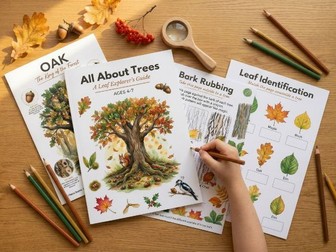
Rustle. Can your child name 10 trees by their leaves, bark, and seeds? After this pack, they will, and they will prove it at the park with real bark rubbings, pressed leaves, and leaf land art. Meet the trees Oak - the 500-year king of the forest Maple - the autumn colour champion Birch - the pioneer tree that grows first after fire Beech - the cathedral tree with smooth silver bark Horse Chestnut - conkers, sticky buds, and candle flowers Sycamore - the helicopter seed champion Rowan - the tree of protection, beloved by birds Ash - the tree in trouble, fighting dieback disease Hazel - the tree that keeps on growing through coppicing Wild Cherry - from spring blossom to autumn berries What’s inside - 47 pages 10 tree spotlight pages with real science, fun facts, and Try This challenges Leaf silhouette matching - identify 10 trees by leaf shape Bark texture matching - match close-up bark patterns to species Seed-to-tree sorting - which tree does each seed come from Tree shadow matching - recognise trees by their overall silhouette Deciduous or evergreen sorting - classify 10 trees Cross-section labelling - bark, cambium, sapwood, heartwood, rings Tree height comparison - all 10 trees drawn to scale Seasonal change 4-panel - one oak across spring, summer, autumn, winter Tree detective - read clues left by animals living in a tree Spot the difference - summer vs autumn woodland I Spy woodland floor - count hidden objects Zoom In close-ups - guess what these tiny textures are Odd one out, Mistake Inspector, True or Myth, Speed Ladder Bark rubbing templates - take outside and rub with a crayon Pressed leaf frames - collect, press, and tape real leaves Tree ring sequencing - read a tree’s life story in its rings Leaf land art - create art from fallen leaves and photograph it My Tree Diary - visit the same tree every week for 4 weeks Reading passage, word tracing, guided writing, counting Design your own treehouse Build-a-Scene woodland floor with 12 cut-out creatures Colouring page, Tree Explorer Certificate, 2-page answer key Why teachers and parents love this pack Takes learning outside - bark rubbings, leaf pressing, tree diary, and land art all happen at a real tree Teaches real identification skills children use in the park, garden, or woods Beautiful naturalist watercolour illustrations - field-guide quality, not clipart 10 spotlight pages packed with genuine science, not just colouring sheets Works year-round - autumn is best, but nature study happens in every season Covers science, literacy, maths, observation, and creative thinking Full answer key included Instant PDF download, 47 pages. Print on A4 or US Letter, as many copies as you need for your class or family.
Classroom Posters IB Learner Profile Character Education Display Kit Ages 5-12Quick View
LexAndFoxPress

Classroom Posters IB Learner Profile Character Education Display Kit Ages 5-12

(0)
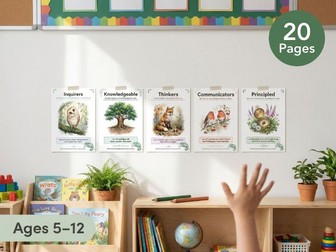
IB Learner Profile posters and activity kit for PYP classrooms, ages 5-12. 20 pages pairing each of the ten traits with a nature metaphor in botanical watercolour. The ten traits Inquirer - the barn owl, curious eyes that never stop searching Knowledgeable - the oak tree, deep roots growing stronger with every discovery Thinker - the fox, a clever mind seeing the world from every angle Communicator - two robins, sharing ideas in harmony Principled - the compass, a steady guide pointing toward what is right Open-minded - the butterfly, wings unfolding to welcome something new Caring - the wren, a gentle heart feeding kindness every day Risk-taker - the hawk, a brave spirit soaring above the mountain Balanced - stacked stones, calm strength in body, mind and heart Reflective - a birch pool, still water showing how far you have grown What’s inside - 20 pages Ten character posters, each with its watercolour metaphor, an affirmation and a reflection prompt Our Learner Profile header poster showing all ten traits together All About Me self-assessment page with colour-in faces and writing prompts My Reflection Strips - cut-out strips for all ten traits with checkboxes Trait of the Week planners covering all ten Trait Spotter Journal with five observation entries My Growth Goal page with self-assessment circles Certificate of achievement Why teachers use this kit The nature metaphors make abstract qualities concrete - children remember the owl long after they would have forgotten the word inquirer A complete display-and-activity kit in one download: posters for the wall, journal pages for the desk The Trait Spotter Journal asks children to notice traits in others, not only in themselves Built for the PYP Learner Profile, but the qualities work in any classroom running a character or values curriculum A chameleon mascot runs throughout, adapting and growing alongside each child Calm botanical watercolour rather than clipart, so it can stay on the wall all year Instant PDF download, 20 pages. Fits A4 and US Letter. Print as many copies as you need for your class.
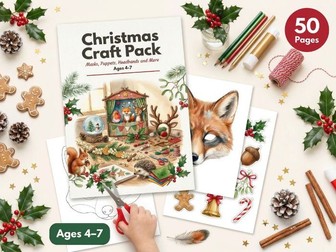
Christmas Craft Pack | Masks Puppets Headbands Garland Snow Globe Gift TagsQuick View
LexAndFoxPress

Christmas Craft Pack | Masks Puppets Headbands Garland Snow Globe Gift Tags

(0)
Christmas craft pack for EYFS and KS1. 50 pages of printable masks, puppets, garlands, cards and construction crafts, in botanical watercolour. No prep beyond scissors and glue. What children will make Masks and wearables - four full-colour woodland animal masks, two colour-your-own in line art, reindeer antler and elf ear headbands, and a winter crown Finger puppets and theatre - four woodland puppets, a fold-out stage, eight story starter cards, a story dice and a guided writing page Decorations - twelve garland shapes, two sheets of bunting, an evergreen wreath, window silhouettes, and a 25-day countdown chain Paper construction - a snow globe, a fold-and-build gingerbread house with measured tabs, place cards, napkin rings, door hangers, snowflake cut-outs and two fortune tellers Cards and gifts - twelve gift tags, two sheets of wrapping paper, and a fold-and-write card with envelope Colour your own - six ornament shapes, six winter animals, and a full-page woodland scene Why teachers and parents love this pack Nature-led Christmas - robins, foxes, deer, hedgehogs, holly and pinecones rather than branded characters, so it sits comfortably in any classroom Works for a single wet afternoon or across the whole final fortnight of term Pre-coloured and line-art versions of the same crafts - full colour when time is short, line art when you want the colouring to be the activity The countdown chain, theatre and story dice turn craft into writing and speaking without extra planning Everything prints on standard paper. Card stock helps for masks and puppets but is not required Botanical watercolour illustrations throughout, not clipart What you need Scissors, glue stick, colouring pencils, and string. Elastic and a hole punch are useful for the masks. Instant PDF download, 50 pages. Both A4 and US Letter. Print as many copies as you need for your class or family.
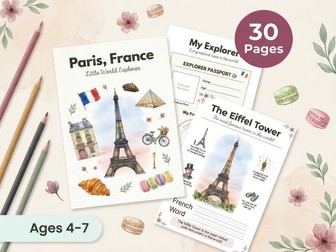
Paris France Worksheets | Kids Travel | Ages 4-7 | Eiffel Tower | French WordsQuick View
LexAndFoxPress

Paris France Worksheets | Kids Travel | Ages 4-7 | Eiffel Tower | French Words

(0)
Paris topic pack for KS1 and EYFS. 30 pages on French landmarks, food and culture - with real French vocabulary, pronunciation guides and a city map. What children will explore Five Paris landmarks - the Eiffel Tower and its 20,000 lights, the Louvre and the Mona Lisa, Notre-Dame, the Seine, and Montmartre Six French words - bonjour, merci, oui, non, s’il vous plait and au revoir, each with a pronunciation guide and tracing practice French food and animals - croissants, baguettes, crepes, macarons and cheese; the rooster, poodle and French bulldog Where France is - a world map with a Europe zoom, and a bird’s-eye map of Paris with all five landmarks placed What’s inside - 30 pages Five landmark discovery pages, four facts each, with watercolour illustrations Colour the French flag in the correct colours French word tracing with pronunciation Find France on a world map, then zoom to Europe Bird’s-eye city map of Paris Match six famous landmarks to their names Sort eight foods - is a croissant French? Is sushi? I Spy - find 10 hidden things on a Parisian street Design a postcard - draw the front, write a message, design the stamp Eight cut-out Paris Explorer flashcards Build a Parisian street scene with 10 cut-outs Collectible French passport stamp to colour Counting to 8, and AB and ABC patterns with Parisian icons Colour by number revealing the Eiffel Tower at sunset Word tracing - Paris, croissant, bonjour, merci and more Reading passage with three comprehension questions Guided writing - if I visited Paris, I would see Detailed Eiffel Tower colouring scene Paris Explorer certificate Why teachers and parents love this pack Real French vocabulary with pronunciation, so it supports primary MFL as well as geography The city map shows where the landmarks actually sit, building real map skills rather than naming buildings The postcard page works as creative writing and goes home as a keepsake Facts that make children stop - spend 30 seconds at each artwork in the Louvre and you would be there four months Thirty pages with no filler, covering geography, language, reading, writing, maths and art Instant PDF download, 30 pages, US Letter. Print as many copies as you need for your class or family.
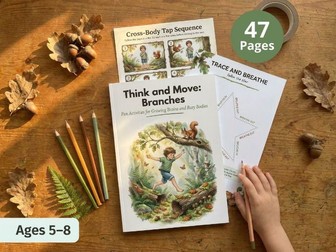
Think and Move — Brain Body Coordination Activities Printable Ages 5-8Quick View
LexAndFoxPress

Think and Move — Brain Body Coordination Activities Printable Ages 5-8

(0)
Brain breaks and movement activities for KS1 and KS2. 47 pages of cross-lateral, bilateral, balance, memory and breathing activities, with trackers and cut-out cards. Five kinds of activity Cross-lateral - cross-crawl march cards, nature path tracing, cross-body tap sequences, and an opposite commands game Bilateral - mirror drawing, double doodle, bilateral tracing paths, finger gym warm-up and rhythm cards Balance - balance poses, heel-to-toe walking, spin and spell, freeze dance, a challenge ladder and a yoga sequence Working memory - cut and sort, matching pairs, Kim’s game, sequence recall, story sequence jumble, listen and draw, pattern continuation Breathing - trace and breathe along a star, spiral and waves, square breathing, 5-4-3-2-1 grounding and a body scan What’s inside - 47 pages Cross-crawl cards for marching while counting and spelling Mirror drawings of a butterfly, a sunflower and an oak leaf Double doodle - both hands drawing matching shapes at once Six-exercise finger gym for hands and wrists Eight rhythm cards using clap, tap and drum patterns Four balance poses - tree, flamingo, eagle arms and eyes closed Cut and sort twelve animals into water, land and air Kim’s game, sequence recall cards, story sequence jumble, remember and draw Trace-and-breathe paths, square breathing and a grounding exercise Body scan to colour, noticing where energy, tension and calm sit Brain Fitness Passport - a stamp for each category completed Brain Fitness Tracker - a four-week chart across six activity areas Brain Break Mini-Cards - six quick cards to cut out and keep Parent and educator guide explaining what each category trains Answer key and certificate Why teachers use this pack Built around cross-lateral, bilateral and vestibular movement, the categories used in classrooms and OT settings Works as a two-minute reset between lessons or as a full session The mini-cards live on a lanyard or in a drawer for the moment a class needs moving Genuinely useful for wiggly learners, wet playtimes, transitions and nurture groups No screens and no equipment - print, grab a pencil, and move The passport and tracker let children see their own progress across four weeks Watercolour illustrated with a red squirrel guide throughout This is an educational activity pack. It is not intended to diagnose, treat or replace professional assessment or therapy. Instant PDF download, 47 pages. Print as many copies as you need for your class or family.
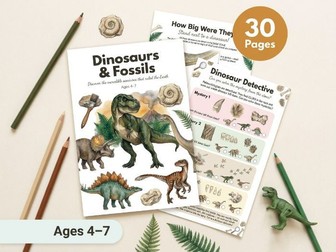
Dinosaurs & Fossils | T-Rex Triceratops Stegosaurus | Ages 4-7 | Make a FossilQuick View
LexAndFoxPress

Dinosaurs & Fossils | T-Rex Triceratops Stegosaurus | Ages 4-7 | Make a Fossil

(0)
Dinosaur and fossil pack for KS1 and lower KS2. 30 pages of real palaeontology - five dinosaurs, how fossils form, dental evidence, and a fossil-making craft with clay. What children will explore How fossils form - the four stages from death to discovery, and the difference between body fossils, trace fossils and amber Reading the evidence - sharp serrated teeth mean meat, flat grinding teeth mean plants, and footprints tell you whether an animal walked or ran Mary Anning - who found an ichthyosaur at the age of twelve Deep time - Stegosaurus lived eighty million years before T-Rex. You are closer in time to T-Rex than Stegosaurus was Birds are dinosaurs - the robin on the feeder is a direct descendant of Velociraptor Meet five dinosaurs Tyrannosaurus rex - the strongest bite of any land animal, and tiny arms that still lifted 200kg each Triceratops - three horns a metre long, and T-Rex tooth marks found in the frills Stegosaurus - back plates pumped with blood for temperature control, and a brain the size of a walnut Diplodocus - twenty-five metres long, with a tail that cracked like a whip Velociraptor - turkey-sized, feathered, and the ancestor of every bird alive What’s inside - 30 pages Five dinosaur pages plus a fossil science page, four facts each Follow the four-stage fossil formation process Sort dinosaurs by diet using dental evidence, with Oviraptor as the tricky omnivore Fossil-making craft - press a shell into clay, remove it, and see the impression Scale comparison - stand beside dinosaurs drawn to scale, with Diplodocus running off the page Four detective mysteries solved with tooth, footprint and diet evidence Study footprint patterns - two legs or four, walking or running, tracking a herd Complete fossil layer patterns following geological time Six dinosaur stat cards comparing bite force, length, brain size and speed Design a dinosaur with biological reasoning, then name it using real Latin roots Dig site I Spy, counting, word tracing, reading passage, writing Build a geological cliff-face dig site from eight cut-outs Fossil Hunter Safari - find fossils in walls, gravel paths and pebble beaches Journal page and Dinosaur Explorer certificate Why teachers and parents love this pack Children reason like palaeontologists - clues, evidence, deduction - rather than memorising names The clay fossil craft compresses millions of years into ten minutes The safari needs no dig site, only a wall or a path, so it works anywhere Deep time is handled properly, which most dinosaur resources skip entirely Hand-painted botanical watercolour - dinosaurs as real animals with accurate anatomy and feather texture Instant PDF download, 30 pages. Fits A4 and US Letter. Print as many copies as you need for your class or family.
Constellations | Stars Moon Night Sky Orion Big Dipper Star Map | Ages 4-7Quick View
LexAndFoxPress

Constellations | Stars Moon Night Sky Orion Big Dipper Star Map | Ages 4-7

(0)
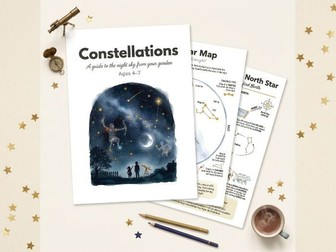
Night sky pack for KS1 and KS2. 34 pages on stars, constellations and the Moon - with a printable star map to take outside and a 7-night moon phase tracker. 91% printer-friendly. What children will explore What stars are - burning balls of gas, not twinkling diamonds, and our Sun is one of them Star colour is temperature - blue is hottest at 30,000 degrees, red is coolest. The opposite of what everyone expects Constellations - 88 official patterns humans imagined in random stars, and how five cultures saw them completely differently The Moon - a mirror not a lamp, eight phases in 29.5 days, and footprints still there with no wind to disturb them Stargazing - twenty minutes for your eyes to adapt, why a red torch helps, and why a city shows 20 stars and the countryside 2,500 Six constellations to find The Plough and the North Star - follow the pointer stars to Polaris and you can find north anywhere Orion the Hunter - Betelgeuse could explode any day, and the nebula is making new stars right now Cassiopeia - the W that flips to an M between evening and midnight Leo the Lion Scorpius - who killed Orion, and was placed on the opposite side of the sky so they can never meet The Southern Cross - which guided Polynesian navigators across the Pacific What’s inside - 34 pages Five night sky spotlight pages, each with a Try This At Home challenge Six constellation pages - connect the stars, the mythology, and how to find it Printable star map to take outside and hold above your head Seven-night moon phase tracker to draw each evening Star colour and temperature scale with real named stars Star or not? Sort eight sky objects Design your own constellation - place stars, connect them, name it, write its myth How big is that star? Earth to Sun to Betelgeuse to UY Scuti Star stories from five cultures - Greek, Aboriginal Australian, Polynesian, Chinese and Native American Zoom in, mistake inspector, I Spy, Would You Rather, odd one out Counting, word tracing, reading, writing, fun facts Build the night sky with constellation cut-outs Night sky safari - 10 challenges that need real darkness Star Explorer certificate Why teachers and parents love this pack The star map is a tool, not a worksheet - it goes outside and gets used Orion and Scorpius can never share the sky, and a child can go out and verify a 3,000-year-old myth for themselves The moon tracker turns a window and a pencil into a week of real observation Designing a constellation asks children to invent a mythology rather than copy one Five cultures, same stars, completely different stories 91% printer-friendly - only 3 of 34 pages use dark backgrounds Instant PDF download, 34 pages, US Letter. Print as many copies as you need for your class or family.
Feelings Worksheets Bundle SEL Activities Ages 4-8 Emotions Kindness MindsetQuick View
LexAndFoxPress

Feelings Worksheets Bundle SEL Activities Ages 4-8 Emotions Kindness Mindset

(0)
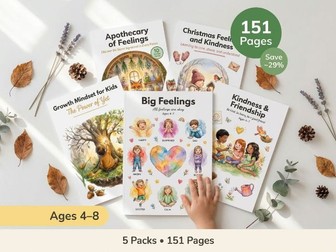
PSHE and emotional learning bundle for EYFS, KS1 and lower KS2. Five complete packs, 151 pages - feelings, kindness, growth mindset and a festive kindness tracker. What’s in the bundle Big Feelings (35 pages) - eight core emotions, a feelings thermometer, a body map, breathing exercises and face matching Kindness and Friendship (30 pages) - empathy scenarios, compliment cards, the toothpaste experiment, and a kindness scavenger hunt Growth Mindset (41 pages) - brain science for young learners, the power of yet, self-talk flip cards, comfort zone circles and a 7-day effort tracker Apothecary of Feelings (10 potion cards) - botanical cards where big feelings become ingredients: Courage Brew, Calm Tea, Kindness Elixir, Worry Wash and six more Christmas Feelings and Kindness (27 pages) - gratitude, giving, managing excitement, and an advent kindness tracker What children will do Name and explore eight core emotions across full discovery pages Build a five-level feelings thermometer to use every day Colour where emotions sit on a body map Draw their brain making new connections when they practise something Sort fixed and growth mindset statements, then flip self-talk cards from one to the other Brew botanical potions for courage, calm, kindness and worry Practise empathy with the toothpaste experiment, which children remember for years Navigate a growth mindset maze by following growth phrases Track daily effort across a week Carry out a kindness scavenger hunt where the acts are real, not written Explore three kinds of giving - things, time and kindness Sort eight items into want and need Why teachers and parents love this collection Covers the full arc: understanding feelings, being kind, building resilience The feelings thermometer and body map give children language for what they are feeling before they can explain it Works for whole-class PSHE, small group work, calm corners and one-to-one sessions The kindness scavenger hunt asks for action rather than worksheets Botanical watercolour throughout, calm enough to leave out on display Growth Mindset pack includes answer keys Instant PDF download, 151 pages across five packs. Both A4 and US Letter. Print as many copies as you need for your class or family.
All About Spiders Worksheets | Web Silk Arachnid Anatomy | Ages 4-7 | PDFQuick View
LexAndFoxPress

All About Spiders Worksheets | Web Silk Arachnid Anatomy | Ages 4-7 | PDF

(0)
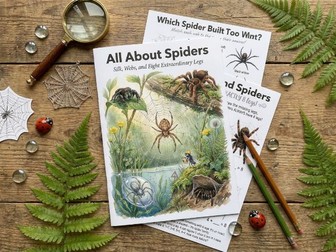
Spider study pack for KS1 and lower KS2. 35 pages of real arachnid science - anatomy, web engineering, seven types of silk, and the difference between spiders and insects. What children will explore Web engineering - six web types matched to their builders, and the six steps of building an orb web Seven kinds of silk from one animal - dragline, sticky spiral, egg sac, wrapping, ballooning, attachment and scaffolding Spider or insect? - eight legs and two body parts, and why scorpions and ticks count as arachnids too Hunters and builders - not every spider spins a web, and the trapdoor spider does both Hydraulics - a jumping spider has no leg muscles for jumping, and leaps fifty times its body length on blood pressure alone Meet six spiders Garden spider - builds a new web every morning in thirty minutes, eating the old one first to recycle the silk Jumping spider - the same engineering as heavy machinery, in an animal the size of a rice grain Tarantula - the gentle giant, throwing tiny barbed hairs rather than biting Black widow - the hourglass is a warning label, and the spider is extremely shy Diving bell spider - lives underwater in a silk dome of trapped air that works as a gill Trapdoor spider - a hinged door of soil and silk, with trip lines like a burglar alarm What’s inside - 35 pages Six spotlight pages with facts for each spider Label spider anatomy - cephalothorax, abdomen, eight eyes, spinnerets and dragline Match six web types to six builders Sort twelve creatures into spider or insect Sort ten spiders into web builders or hunters Size comparison from a 2mm money spider to a 30cm goliath birdeater Design a spider trap to five real engineering constraints Number bond spiders - every spider needs eight legs, draw the missing ones and write the equation Sequence the six steps of building an orb web Study the seven types of silk and what each is for Zoom in, mistake inspector, I Spy, Would You Rather, odd one out Counting, patterns, word tracing, reading passage, writing Build a garden scene with ten cut-out spiders, fence, wildflowers and mossy log Scavenger hunt, colouring page and Spider Expert certificate Why teachers and parents love this pack Real arachnid science - anatomy, classification and engineering, not a Halloween theme The number bond page makes biology do the maths: eight legs, every time Children finish able to tell a spider from an insect and name what they find outside A housefly in a tiny hard hat inspects the webs for safety violations throughout, gets stuck, and files a complaint Hand-painted botanical watercolour - hair texture, species-specific eye arrangements, webs with dewdrops Instant PDF download, 35 pages. Fits A4 and US Letter. Print as many copies as you need for your class or family.
All About Bats Worksheets | Echolocation Nocturnal Animals | Ages 4-7 | PDFQuick View
LexAndFoxPress

All About Bats Worksheets | Echolocation Nocturnal Animals | Ages 4-7 | PDF

(0)
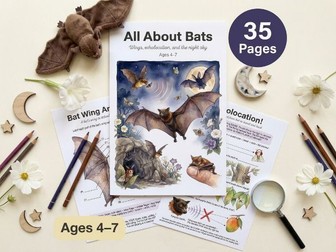
Bat study pack for KS1 and lower KS2. 35 pages on six bat species - wing anatomy, echolocation, pollination and why the only flying mammal is the most misunderstood. What children will explore The hand that learned to fly - a bat wing and a child’s hand side by side at the same scale, five finger bones in each Echolocation - trace the sound from bat to insect to echo to catch, across four scenarios Bat or bird? - fur, teeth and finger-bone wings against feathers, beaks and arm-bone wings Pollination - without flying foxes there would be no bananas, mangoes or avocados Hanging upside down - tendons lock the claws when weight pulls, so it costs no energy at all Meet six bats Common pipistrelle - Britain’s commonest bat, lighter than a 20p coin, eats 3,000 insects a night Flying fox - the largest bat, a 1.7 metre wingspan, navigating by sight not sound Vampire bat - only three species of 1,400, sharing food with colony mates and remembering who shared back Greater horseshoe bat - a nose shaped like a satellite dish, with a heart dropping to 10 beats a minute in hibernation Long-eared bat - ears nearly as long as its body, able to switch echolocation off and hunt by listening Bumblebee bat - the world’s smallest mammal, 2cm and 2 grams, critically endangered What’s inside - 35 pages Six spotlight pages, each with facts and a hands-on challenge Bat wing anatomy against a child’s own hand Echolocation path tracing across four scenarios Fruit bat or insect bat? Sort 12 characteristics Bat or bird? sorting activity Size comparison from bumblebee bat to flying fox - an 85-fold difference Design a bat box to five real specifications Fly away bats - visual subtraction from a cave roost at dusk Inside the bat roost - cave cross-section with colony, pup, guano and entrance Postcard from the night sky - write as a bat Zoom in, mistake inspector, I Spy, Would You Rather, odd one out Counting, patterns, word tracing, reading, writing, fun facts Build the bat cave with 10 cut-out species Colouring page, scavenger hunt, certificate, answer key Why teachers and parents love this pack The wing-and-hand page makes anatomy personal - children hold up their own hand and see a bat wing Framed as wonder rather than horror, so it works year-round rather than only at Halloween Includes British species children might genuinely see, alongside the spectacular ones A moth in tiny knitted earmuffs hides on every page, trying to block the echolocation Naturalist botanical watercolour - fur texture, wing membrane, visible finger bones, not cartoon bats Answer key included Instant PDF download, 35 pages, US Letter. Print as many copies as you need for your class or family.
Owl Worksheets Pack | Barn Snowy Eagle Owl | Pellet Science | Ages 4-7Quick View
LexAndFoxPress

Owl Worksheets Pack | Barn Snowy Eagle Owl | Pellet Science | Ages 4-7

(0)
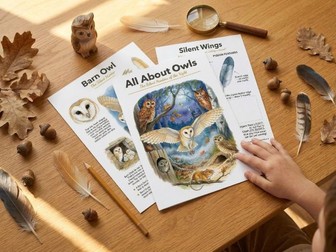
Owl study pack for KS1 and lower KS2. 39 pages on eight owl species - with a real pellet dissection guide, bone identification chart, and the science of silent flight. What children will explore Silent flight - compare owl feathers to pigeon feathers and find out why one makes no sound Pellet dissection - a step-by-step guide with a bone identification chart, then work out what the owl ate Hearing in 3D - asymmetric ears and the facial disc that works like a satellite dish Owl superpowers - test head rotation and eye size against your own Owls in culture - what they mean in Greece, Japan, Australia and North America Meet eight owls Barn owl - the silent hunter with a heart-shaped face Snowy owl - the Arctic ghost, hunting in daylight on the tundra Great horned owl - a grip five times stronger than yours Burrowing owl - lives underground in prairie dog burrows Elf owl - the tiniest in the world, nesting inside a cactus Eagle owl - large enough to catch foxes Tawny owl - the twit-twoo is actually two owls calling Short-eared owl - the one that breaks the nocturnal rules What’s inside - 39 pages Eight spotlight species pages Label owl anatomy - facial disc, talons, serrated flight feathers Owl pellet dissection guide and pellet detective bone identification Sequence the pellet cycle from hunting to dissection Build a nocturnal food chain and find out why owls are apex predators Place eight species on a world map, and sort owls by habitat Compare all eight by size, from elf owl to eagle owl Match five species to their calls - hoots, screeches and barks Copy real feather patterns - speckled, barred and bark camouflage Woodland I Spy with five camouflaged owls True or myth quiz, mistake inspector, odd one out across five rounds Design a new owl species from real adaptations Build a barn owl’s barn with owlets, moths, mice and a barn cat Counting, word tracing, comprehension passage on how owls digest Eight cut-out field ID cards, full-page colouring poster, certificate, answer key Why teachers and parents love this pack The pellet dissection guide is proper hands-on science, with the bone chart to make sense of what children find Pairs directly with a classroom pellet kit, which most packs leave teachers to figure out alone Eight species with facts that surprise adults as well as children A harvest mouse hides on every page as a nervous companion Naturalist botanical watercolour, field-guide quality rather than clipart Answer key included Instant PDF download, 39 pages. Both A4 and US Letter. Print as many copies as you need for your class or family.
Human Skeleton Poster - Anatomy Wall Chart - Bones Diagram Ages 5-10Quick View
LexAndFoxPress

Human Skeleton Poster - Anatomy Wall Chart - Bones Diagram Ages 5-10

(0)
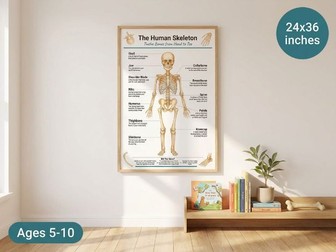
Human skeleton display poster for KS1 and KS2. Twelve bones labelled from skull to shinbone, each with a function line children can actually read, in botanical watercolour. The twelve bones Skull, jaw, collarbone, shoulder blade, breastbone, ribs, spine, humerus, pelvis, thighbone, kneecap and shinbone. Each is correctly positioned and labelled with a one-line description of what it does, plus three Did You Know facts at the base. Why teachers and parents love this poster Reference-accurate, so it holds up when a child asks a follow-up question Function lines rather than labels alone - children learn why a bone matters, not just its name Works across a wide age range: a five-year-old can have it read aloud, a ten-year-old reads it independently Botanical watercolour rather than a medical chart - warm enough that children want it on the wall One file, any size. A4 or US Letter at home, or take it to a copy shop for 16x24 or 24x36 inches Supports the animals including humans unit in Years 1 and 4. Instant PDF download. One high-resolution file. Frame it, pin it or laminate it.