 Quick View
Online Safety & Phishing Investigation | Digital Literacy, Scam Messages, KS3 KS4 PSHE
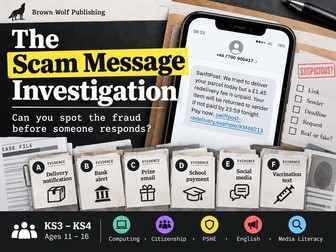
The Scam Message Investigation is a complete KS3 and KS4 online safety, phishing and digital literacy teaching resource for pupils aged 11 to 16. This classroom-ready investigation helps students identify online scams, analyse suspicious messages, recognise social engineering techniques and make safer decisions online.
Students become digital fraud investigators and examine six realistic fictional messages involving a parcel delivery fee, bank security alert, prize email, school payment request, social media opportunity and vaccination consent message. They must distinguish warning signs from reliable evidence, identify manipulation tactics and recommend safe actions.
The resource includes seven engaging activities: Initial Incident Report, Message Evidence Examination, Manipulation Map, Credibility Test, Decision Point Scenarios, Evidence Hearing and Final Investigation Report.
Pupils use the Claim, Evidence, Verify and Decide framework to develop critical thinking, source evaluation, persuasive language analysis and digital citizenship skills. Three differentiated routes, Supported, Core and Challenge, make the activities accessible to a range of learners.
Included are three PDF editions: a 28-page Complete Edition, an 18-page Student Edition without answers and a 12-page Teacher Edition with lesson plans, answer keys, model responses, assessment rubric and differentiation guidance.
Suitable for Computing, Citizenship, PSHE, online safety, cyber security, media literacy and financial education. Designed for Years 7 to 11, ages 11 to 16. Teaching time is two to three lessons of 50 to 60 minutes. Printable A4 format, black-and-white friendly, with no student internet access required.
All messages and organisations are fictional. Published by Brown Wolf Publishing as part of the Real-World Decision Files series.