Level 1 Methods & Procedures Revision Notes – Electrical InstallationQuick View
MrEricB

Level 1 Methods & Procedures Revision Notes – Electrical Installation

(0)
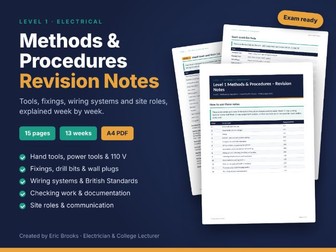
Level 1 Methods & Procedures revision notes for electrical learners. 15 pages on tools, fixings, wiring systems, BS 7671, site roles and quick-fire facts. These notes cover the Level 1 Methods & Procedures course one week at a time. They’re written in plain language with clear tables and step-by-step methods, and each week is linked to the LO1–LO3 assignment outcomes. They were written by a practising electrician and college lecturer, so everything is grounded in real site practice. What’s covered: Week 1 – Hand tools: choosing the right tool, 1000 V insulated tools, safety rules, damaged tools and tool paperwork Week 2 – Power tools and site voltages: why 110 V is used on site, plug colours, cordless and battery safety, user checks, EAWR and PUWER Week 3 – Fixings: matching fixings to masonry, plasterboard and timber; checking for hidden services before drilling; wall plug colours and sizes Week 4 – Drill bits and tool care: drill modes (rotary, hammer, SDS), fitting bits safely, maintaining tools and a five-step method for fixing problems Week 5 – Components and British Standards: cables, accessories and protective devices, IP ratings, conductor colours, and BS vs BS EN Weeks 6 and 8 – Wiring systems: recognising, choosing and installing twin and earth, conduit, trunking, SWA, MICC and tray Week 7 – Accessories, protection and earthing: consumer units, overload vs fault current, wiring a plug, switching arrangements and bonding Week 9 – Checking completed work: safe isolation, why joints must be tight, common faults and who is affected by poor work Week 10 – Documentation and regulations: why records matter, plus EAWR, CDM 2015 and BS 7671 Weeks 12–14 – Working on site: roles and responsibilities, communication, managing conflict and the cost of poor communication It finishes with an Exam quick-fire facts page covering the key points for the LO1–LO3 assignment, for last-minute revision. It’s an A4 PDF, ready to print or read on screen.
Level 1  Health & Safety Revision Notes – Electrical InstallationQuick View
MrEricB

Level 1 Health & Safety Revision Notes – Electrical Installation

(0)
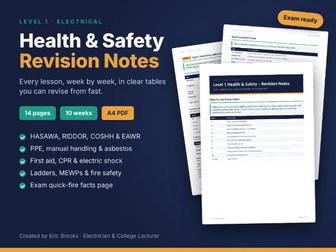
Level 1 Health & Safety revision notes for electrical learners. 14 pages covering HASAWA, RIDDOR, PPE, asbestos, fire, ladders and exam quick-fire facts. These notes follow the Level 1 Health & Safety course one week at a time. They’re written in plain language and set out in clear tables, so learners can read a section, cover it up and test themselves. They were written by a practising electrician and college lecturer, so every topic is tied to real site work. What’s covered: Week 1 – Legislation: HASAWA 1974 (sections 2, 3 and 7), what “reasonably practicable” means, HSE notices, the five steps of risk assessment, and a quick-reference table of the 10 key regulations (EAWR, COSHH, PUWER, LOLER, WAHR and more) Week 2 – The workplace: hazard vs risk, the hierarchy of control, RAMS, near misses and what to do with defective equipment Week 3 – Signs, COSHH and asbestos: the five safety sign types, hazard pictograms and labels, where asbestos is found and what to do if you find it Week 4 – PPE and manual handling: PPE matched to each task, noise action levels, TILE, the HSE guideline weights table and kinetic lifting Week 5 – Accidents and emergencies: calling 999/112, evacuation, first aid, electric shock, DRABC, the recovery position and CPR Week 6 – Recording and reporting: the accident book, writing a factual report, and RIDDOR (what to report and by when) Week 7 – Electrical safety on site: 110 V CTE, plug colours, user checks, PAT labels, and overhead and buried cables Week 8 – Working at height: step ladders vs leaning ladders, the 1-in-4 rule, MEWPs, podiums and towers Week 9 – Practical skills: step-by-step guides to the step ladder, manual handling and sack trolley assessment tasks Week 10 – Fire safety: the fire triangle, fire classes, extinguisher colours, PASS and hot works It finishes with an Exam quick-fire facts page that puts the most-tested facts on a single page for last-minute revision. It’s an A4 PDF, ready to print or read on screen.
Level 1 Electrical Science Revision Notes – Electrical InstallationQuick View
MrEricB

Level 1 Electrical Science Revision Notes – Electrical Installation

(0)
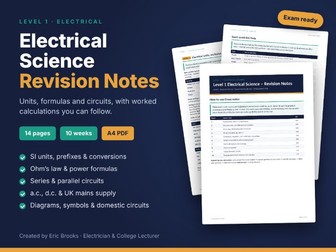
Level 1 Electrical Science revision notes for electrical learners. 14 pages on SI units, Ohm’s law, power formulas, circuits, symbols and quick-fire facts. These notes cover the Level 1 Electrical Science course one week at a time. They’re written in plain language with clear tables and worked examples, so learners can follow every calculation step by step. They were written by a practising electrician and college lecturer, so the science is always linked to real electrical work. What’s covered: Week 1 – Units of measurement: SI units, area, volume, density, mass vs weight, and temperature in kelvin Week 2 – Electrical units: volts, amps, ohms and watts, plus prefixes (mega, kilo, milli, micro) and how to convert between them Week 3 – Ohm’s law and power: V = I × R, the power formulas, and the heating, magnetic and chemical effects of current Week 4 – Circuit principles: electron flow vs conventional current, d.c. and a.c., and UK mains at 230 V / 400 V, 50 Hz Week 5 – Conductors and insulators: copper, aluminium and steel, PVC and XLPE insulation, sources of e.m.f., and measuring voltage Week 6 – Series and parallel circuits: working out total resistance, current and voltage, and using meters correctly Week 7 – Diagrams and drawings: block, circuit, wiring and layout diagrams, and what each one is used for Week 8 – Graphical symbols: the standard symbols you need to recognise Week 9 – Typical domestic circuits: lighting, ring final and radial circuits Week 10 – Practical assessment: worked examples of measuring and calculating
Level 1 Environmental Technology Revision Notes – Electrical InstallationQuick View
MrEricB

Level 1 Environmental Technology Revision Notes – Electrical Installation

(0)
Level 1 Environmental Technology revision notes for electrical learners. 15 pages on renewables, net zero, waste, recycling, water and quick-fire facts. These notes cover the Level 1 environmental lessons one week at a time, from Week 1 to Week 11. Each week opens with the big idea, then gives the key facts and real examples in plain language and clear tables. They were written by a practising electrician and college lecturer, so every topic is tied to real work in building services. What’s covered: Week 1 – Energy sources: high, low and zero carbon sources, the carbon ladder, and choosing the right source for a property Week 2 – Reducing carbon emissions: why buildings matter, net zero by 2050, retrofitting, EPCs and where to find guidance Week 3 – Environmental technologies: solar thermal, solar PV, wind turbines and heat pumps, how they work and where to site them, plus PV safety Week 4 – Protecting the environment: preventing and responding to spills, oil storage, protecting watercourses, and being a good neighbour on site Week 5 – Planning and measuring: reading drawings, calculating quantities, cutting lists, and “measure twice, cut once” Week 6 – Reusing off-cuts: reducing waste and sorting materials as you work Week 7 – Safe waste disposal: the duty of care, the waste hierarchy, hazardous waste and WEEE Week 8 – Recycling materials: how copper cable, metals and rubble are recycled, and what needs special handling Week 9 – Environmental hazards: asbestos, spills and contamination, and how to respond and report Week 10 – Water conservation: water-saving fittings, maintenance routines and raising user awareness Week 11 – Rainwater harvesting: how rainwater is collected, filtered, stored and reused It finishes with an Exam quick-fire facts page of the points most likely to come up in the assessment, for last-minute revision. It’s an A4 PDF, ready to print or read on screen.

Electrical Installation Test Result SheetQuick View
MrEricB

Electrical Installation Test Result Sheet

(0)
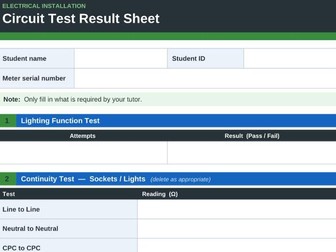
Printable one-page circuit test result sheet for electrical installation learners: record function, continuity and insulation resistance tests. This A4 test result sheet gives learners a clear, structured place to record their results when testing a circuit they have installed. It works well in practical workshops, wiring bays and assessed practical tasks. Tutors can hand it out with any socket or lighting circuit installation exercise. The sheet is laid out in five numbered sections, following the order learners carry out and sign off their work: Lighting Function Test: record the number of attempts and the result (Pass / Fail). Continuity Test (Sockets / Lights): readings in ohms (Ω) for Line to Line, Neutral to Neutral and CPC to CPC. Insulation Resistance Test (Sockets / Lights): record the test voltage used (250 V / 500 V), then readings in megohms (MΩ) for Phase to Neutral, Phase to CPC and Neutral to CPC. Outcome: a simple YES / NO for whether the test results are satisfactory. Declaration: signature and date boxes for the candidate and the assessor. The top of the sheet has space for the student’s name, student ID and the serial number of the test meter used. That helps with traceability and good recording practice. A note on the sheet tells learners to fill in only what their tutor asks for. This means one sheet can be used for a lighting-only task, a socket-only task, or a full test sequence. Where a section can apply to either circuit type, “delete as appropriate” prompts are included. Key features: Clean, modern design in charcoal, blue and green, with clear section headings that are easy to follow on the workshop floor Large write-in boxes, so it’s practical to fill in by hand Correct units are printed for each reading (Ω and MΩ), which reinforces good habits Fits on a single A4 page and prints well in colour or greyscale Supplied as a PDF, ready to print and use Suitable for Level 2 electrical installation learners, apprentices, and anyone teaching basic inspection and testing. It’s also useful for tutors who want a consistent recording format across a group, and as evidence of practical testing in learner portfolios.