Real economic-impact reports for London and Munich games, multipliers, time-zone TV scheduling and fan travel math. 11 pages, with a teacher guide and sources page. Real facts are cited; made-up scenarios are labeled IMAGINE.
Differentiated math crafts: solve problems on a pennant or football, then color, cut and hang them for a spirit-week bulletin board. 12 pages, with a teacher guide and sources page. Real facts are cited; made-up scenarios are labeled IMAGINE.
Research and argument essay on gender equity in sports with a verified fact sheet and process-graded, AI-resistant drafting steps. 12 pages, with a teacher guide and sources page. Real facts are cited; made-up scenarios are labeled IMAGINE.
Easy soccer and Brazil reading passages, goal counting, addition, world and Brazil map coloring, and sight-word soccer. 11 pages, with answer keys, a teacher guide and a sources page. Real facts are cited; made-up scenarios are labeled IMAGINE.
Real city populations, stadium seats per capita, a date-stamped ECB exchange rate, travel cost per km and a soccer-trip budget. 11 pages, with answer keys, a teacher guide and a sources page. Real facts are cited; made-up scenarios are labeled IMAGINE.
Perfect-bracket odds, 41 years of real seed-vs-win data, binomial models, simulation and a z-test on the 12-vs-5 upset. 11 pages, with answer keys, a teacher guide and a sources page. Real facts are cited; made-up scenarios are labeled IMAGINE.
Color the US map, learn a compass rose, find 10 pro football cities, match cities to states and draw my team’s city. 10 pages, with answer keys, a teacher guide and a sources page. Real facts are cited; made-up scenarios are labeled IMAGINE.
Basketball bracket themed early math: compare numbers, seeds that add to 17, tally charts, bar graphs and a dice bracket game. 11 pages, with answer keys, a teacher guide and a sources page. Real facts are cited; made-up scenarios are labeled IMAGINE.
Pro football themed early math and reading: count footballs, add within 20, shapes, patterns, picture word problems and a simple Big Game passage. 12 pages, with answer keys, a teacher guide and a sources page. Real facts are cited; made-up scenarios are labeled IMAGINE.
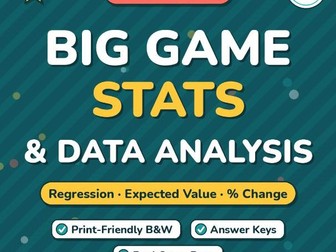
Real championship-game scores 2007–2026 for regression and residuals, expected value of play decisions, and real ad-cost percent change. 11 pages, with answer keys, a teacher guide and a sources page. Real facts are cited; made-up scenarios are labeled IMAGINE.
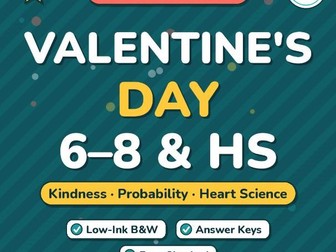
A kind, rigorous, romance-free Valentine’s Day for older students. They argue whether small acts of kindness matter most, design an inclusive kindness week, compute simple and compound probabilities from a pretend candy heart bag, build a percent circle graph, compare card-making unit rates, use scientific notation to estimate a lifetime of heartbeats, analyze heart-rate data (mean, median, percent increase) and model heartbeats as a linear function.
Low-ink B&W print PDF (primary) plus a color version.
What’s inside (14 pages)
Teacher guide with standards
Kindness essay planner + campaign plan with rubric
4 math pages: probability, percents & circle graph, unit rates, linear functions
2 heart science pages: heartbeats by the numbers and a data lab
Answer keys (checked by computer)
Sources page
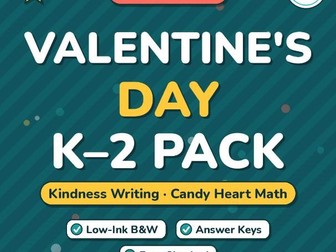
A kind, friendship-focused Valentine’s Day with real learning. Students draw and write a kind act, write a note to a friend, sort and tally a pretend bag of candy hearts, build a picture graph, add hearts, extend patterns, learn that their heart is a fist-sized pump and feel their pulse before and after moving. Picture counters mean no candy is needed.
No romance; notes can go to classmates, family or school staff. Low-ink black-and-white print file plus a color version.
What’s inside (15 pages)
Teacher guide with standards
2 kindness writing pages
5 math pages (tally, picture graph, addition, patterns, counting kind acts)
2 heart science pages
Answer keys
Sources page
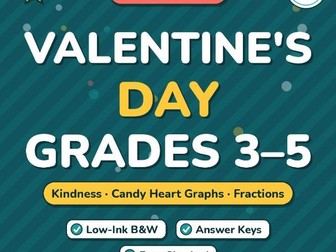
Keep February 14 kind, inclusive and full of real math. Students write a kindness journal and plan a friendship letter, graph a pretend bag of candy hearts with a scale of 2, write each color as a fraction in simplest form, build a line plot of hearts per bag, share hearts fairly with fractions of a set, discover that a heart beats about 100,000 times a day and run a pulse lab. A class kindness challenge wraps up with multi-step multiplication.
No romance and no candy needed. Low-ink black-and-white print file (primary) plus a color version.
What’s inside (15 pages)
Teacher guide with standards
Kindness journal + friendship letter planner
5 math pages: bar graph, fractions, line plot, sharing, multi-step
Heart science reading + pulse lab
Answer keys (checked by computer)
Sources page
Celebrate 100 days of learning with a math-first, no-prep pack. Students fix a hundred chart, count 10 groups of 10, skip count to 100 by 10s, 5s and 2s, make 100 cents with real coin values, find ways to make 100, add up a picture-counter snack mix, compare numbers to 100, write about being “100 days smarter” and estimate what they can do in 100 seconds.
No real food needed. Low-ink black-and-white print file plus a color version.
What’s inside (15 pages)
Teacher guide with standards
7 math pages (hundred chart, tens, skip counting, coins, make 100, adding tens, comparing)
100th Day writing page
100-seconds estimation activity
Answer keys
Sources page
Make the 100th Day meaningful math for upper elementary. Students shade hundredths grids, turn fractions into percents, multiply and divide by 100 with place value, convert centimeters and meters, build organized lists of ways to make $1, convert 100 minutes, hours, days and years, read about 100 in science and history (Celsius, centi-, century) and write an exactly-100-word story.
Low-ink black-and-white print file (primary) plus a color version.
What’s inside (15 pages)
Teacher guide with standards
6 math pages: hundredths, percents, ×100/÷100, metric, money combinations, time
Informational reading: 100 in science & history
100-word story + reflection writing
Answer keys (checked by computer)
Sources page
A rigorous January restart for older students. They plan a reflective goal essay and an if-then habit plan, treat 2027 as a set of rates and percents, write and test the Gregorian leap-year algorithm, use real ice and water densities to explain why icebergs float and bottles crack, evaluate the “10:1” snow rule with data, explain freezing-point depression with a CER and design an experiment, then model temperature conversions as linear functions.
Low-ink B&W print PDF (primary) plus a color version.
What’s inside (14 pages)
Teacher guide with standards
Reflective goal essay planner + habit plan with rubric
4 math pages: rates, leap-year algorithm, snow ratio data, temperature functions
2 science pages: ice density lab and freezing-point CER
Answer keys (checked by computer)
Sources page
Kick off January with purpose and real math. Students plan a 2027 goal with steps and check-ins, write a letter to their future selves, find the weeks, hours and minutes in 2027, use divisibility to test leap years, solve January 2027 calendar problems, explore six-fold snowflake symmetry, build a freezing-week line plot and learn why ice floats. A salt-and-ice lab sheet ends the week with a fair-test conclusion.
Low-ink black-and-white print file (primary) plus a color version.
What’s inside (15 pages)
Teacher guide with standards
Goal planner + letter to future self
5 math pages: year in numbers, leap years, calendar, symmetry, line plot
Ice science reading + salt & ice lab sheet
Answer keys (checked by computer)
Sources page
Start January with a cheerful, no-prep pack that mixes goal setting, number sense and winter science. Students draw and write a New Year goal and its steps, fill in countdown number lines, learn the 12 months, add snowballs, count mittens by 2s, sort freeze-or-melt cards, discover why many snowflakes have six sides and test whether ice floats.
Goals focus on learning, helping and kindness. Print the low-ink black-and-white version (line art kids can color) or use the full-color file.
What’s inside (15 pages)
Teacher guide with standards
2 goal-writing pages
4 math pages (counting back, months, addition within 20, counting by 2s)
3 snow & ice science pages
Answer keys
Sources page (every fact checked in 2+ sources)
A rigorous, respectful cross-curricular study of winter traditions for older students. Students locate nine capitals with latitude and longitude, read concise fact files on Hanukkah, Christmas, Kwanzaa, Las Posadas, St. Lucia Day, Three Kings Day, Dongzhi, Yalda Night and Lunar New Year, explain why some holidays move (solar vs. lunar vs. lunisolar calendars), model the noon Sun height at the December solstice for each capital, convert the solstice instant across real time zones, write a claim-evidence-reasoning response on opposite seasons and plan a synthesis essay on light in the dark season. Every fact is double-sourced; traditions are described factually and never ranked.
Low-ink black-and-white print file (primary) plus color.
What’s inside (15 pages):
Teacher guide with standards
Coordinates map
2 fact-file reading pages (9 traditions)
Calendar systems math
Noon Sun-angle math
Time zone conversion
CER, synthesis essay planner and research brief
Answer keys (checked by computer)
Sources page
Perfect for dual-language, ESL/ELD and Spanish classrooms. Every English page has a matching Spanish-only page: a world map with capitals, three reading pages covering nine winter traditions (Hanukkah, Christmas, Kwanzaa, Las Posadas, St. Lucia Day, Three Kings Day, Dongzhi, Yalda Night and Lunar New Year), calendar math and “Why is it summer in Australia?” seasons science. Includes a bilingual glossary and answer keys in English and Spanish. Facts are double-sourced; traditions are presented factually and never ranked.
Low-ink black-and-white print file (primary) plus color.
What’s inside (19 pages):
Bilingual teacher guide
World map (EN + ES)
3 reading pages × 2 languages (9 traditions)
Calendar math (EN + ES)
Seasons science (EN + ES)
Bilingual glossary
Answer keys in English and Spanish
Sources page
A balanced, fact-checked tour of nine winter traditions: Hanukkah, Christmas (including summer Christmas in Australia), Kwanzaa, Las Posadas, St. Lucia Day, Three Kings Day, Dongzhi, Yalda Night and Lunar New Year. Students label a world map with countries and capitals, use latitude and longitude to find hemispheres, read short informational passages, fill a compare-and-contrast chart, solve calendar and candle-pattern math, explain why it is summer in Australia in December and research a tradition with two sources. Traditions are described factually and in no ranked order.
Low-ink black-and-white print file (primary) plus color.
What’s inside (16 pages):
Teacher guide with standards
World map & capitals + hemisphere detective
3 reading pages (9 traditions) with questions
Compare & contrast chart
Calendar math + candle pattern math
Solstice/seasons science
Research organizer
Answer keys (checked by computer)
Sources page


 Quick View