Beehive 1 Unit 2 Lessons 3–4 | My ThingsQuick View
NatureschoolDarzeliai

Beehive 1 Unit 2 Lessons 3–4 | My Things

(0)
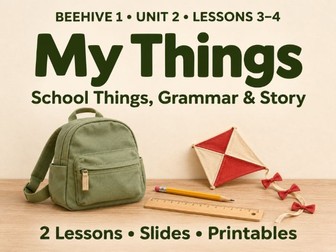
Teach school things, possession and story sequencing in two 45-minute primary English lessons for beginner learners aged 7–11. This supplementary pack accompanies Beehive 1, Unit 2, Lessons 3–4. Lesson 3 – Words and Grammar. Pupils name six school objects and practise I’ve got, I haven’t got, my and your. They use real objects or pictures to make clues for a mystery desk game. Lesson 4 – Story. Pupils learn four toy words and listen to the teacher read The Kite on the Bench, an original short story. In pairs, they put four events in order and act out a short scene. What’s included 17 editable PowerPoint slides, plus a PDF for viewing An editable teacher guide with timings, classroom language, the story script, a preparation checklist and answer keys 12 A4 printable pages in PDF and editable Word formats, including Support, Core and Challenge tasks, two adapted worksheets with reduced reading and writing, scaffolding cards, story sequencing cards and exit tickets A separate cut-and-paste glossary with 10 English words, British IPA and a space for translations Use the slides for whole-class teaching, the cards for pair work and the worksheets for individual practice. Each lesson includes learning goals, a two-minute sensory break and an exit ticket. The main teaching materials are in English, and the glossary is bilingual.
Nature’s Superpowers: Rainproof Roof STEM Challenge | Ages 7–11 | Differentiated & SEN WorksheetsQuick View
NatureschoolDarzeliai

Nature’s Superpowers: Rainproof Roof STEM Challenge | Ages 7–11 | Differentiated & SEN Worksheets

(0)
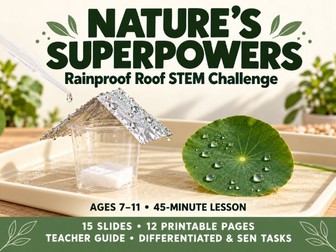
Turn a few drops of water into a hands-on engineering challenge! In this complete 45-minute STEM lesson, children aged 7–11 explore how water behaves on different materials, then design, build, test and improve a miniature rainproof roof. Inspired by the water-repellent surface of a lotus leaf, pupils discover how observations from nature can spark design ideas. Using everyday classroom materials, children compare paper towel, waxed paper and aluminum foil, record their observations and choose a roof material using evidence. They test their shelter, change one feature and investigate whether their improvement helps keep the tissue inside dry. What’s included: 15-slide presentation in editable PowerPoint and PDF formats. 12 A4 printable pages, supplied as PDF and editable PowerPoint. 8-page teacher guide in editable Word and PDF formats, with learning objectives, success criteria, exact timings, teaching scripts, preparation checklist and suggested answers. Support, Core and Challenge worksheets for differentiated learning. Two accessible SEN/SEND worksheets with large material illustrations, tracing, matching, coloring and choices between two answers. Picture vocabulary cards, sentence starters and team role cards. Roof planning sheets, test records, an evidence-check extension and four exit tickets per page. Skills developed: observation, prediction, fair testing, material comparison, evidence-based reasoning, collaboration and iterative design. You will need: water, droppers, trays, clear plastic cups, paper towel, waxed paper, aluminum foil, tape, tissue, pencils and a timer. Teacher preparation is required to cut material samples and organize trays. All teaching and pupil text is in English. The resource uses a consistent nature-inspired design with realistic illustrations. Text and layout elements are editable in the supplied source files; illustrations are separate image objects. Suitable for primary science, STEM enrichment, homeschool learning and an introduction to biomimicry. No internet connection is needed during the lesson.
Was and Were – Adapted English Worksheets | SEN / SEND | Trace and CircleQuick View
NatureschoolDarzeliai

Was and Were – Adapted English Worksheets | SEN / SEND | Trace and Circle

(0)
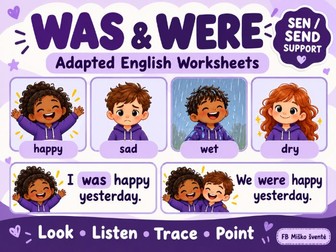
Introduce “I was” and “we were” with visual English worksheets adapted for learners who need extra reading and writing support. This small-step resource combines picture prompts, word tracing and simple choices. Learners can point, circle, repeat or trace, with optional copying when appropriate. WHAT IS INCLUDED? • 1 cover page • 2 pupil worksheets • 1 teacher guidance page with answers and optional extension sentences WORKSHEET 1 – MY WORD WORK Practise four words: happy, sad, wet and dry. Learners look at each picture, listen to the word and trace it. A separate column provides space for optional copying. WORKSHEET 2 – I WAS / WE WERE Introduce “I was happy yesterday” and “We were happy yesterday”. Learners trace was and were, then point to or circle the correct form. SEN / SEND SUPPORT • Clear picture prompts • A small vocabulary set • Short, repeated instructions • Reduced writing demands • Flexible ways to respond • Guidance for adult-supported practice Useful for supported beginner English practice, individual work and small-group teaching. Select activities according to each learner’s needs. FORMAT 4-page printable PDF in English. This is a focused introduction to “I was” and “we were”, rather than a complete past-tense grammar unit.
Halloween Grammar Mystery | Was & Were, Some & Any | FF2 Unit 14-15 | ESL Detective ActivitiesQuick View
NatureschoolDarzeliai

Halloween Grammar Mystery | Was & Were, Some & Any | FF2 Unit 14-15 | ESL Detective Activities

(0)
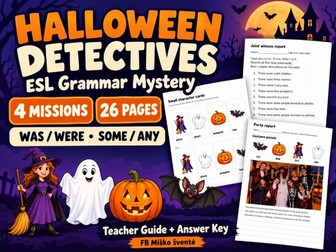
Practice was/were, some/any, irregular plurals and ordinal numbers with a Halloween detective mystery! Includes four missions and a teacher guide. Make grammar review an investigation! Students reconstruct a costume parade, exchange information about party pictures, correct a detective’s mistakes and write a short report. This printable resource combines partner speaking, reading, visual clues and independent writing. After completing and correcting each mission, students collect a letter. The four letters spell BATS! LANGUAGE TARGETS • Was, were, wasn’t and weren’t • There were some… / There weren’t any… • There was some rubbish… • Irregular plurals: man–men, woman–women, child–children • Ordinal numbers: first, second, third and fourth • Describing rooms with tidy, untidy, floor and rubbish • Halloween vocabulary: witch, ghost, pumpkin and bat • Understanding before in ordering clues FOUR DETECTIVE MISSIONS Reconstruct the Costume Parade Students read clues displayed around the classroom and relay them to a partner. Together, they arrange four character cards and describe the parade positions. Interview the Witnesses Partners receive different party pictures. Without showing their pictures, they exchange information about people and decorations. They combine their counts, identify true and false statements and correct five false statements. Correct the Detective’s Mistakes Students examine another party picture and correct five sentences. They distinguish between language errors and a description that does not match the picture. Write the Party Report Students independently write 5–6 sentences about the parade and party picture on their report page. They describe positions, people, something that was not present, and the room or people’s feelings. WHAT’S INCLUDED — 26 PAGES 6-page teacher guide • Clear preparation and printing instructions • Suggested two-lesson sequence and timings • Step-by-step instructions for all four missions • Partner roles and a seated alternative to the wall-clue activity • Mission letter instructions • Answers, example sentences and checking guidance • Support strategies and extension guidance 20 pages of classroom materials • English vocabulary reference sheet • People word-and-picture matching cards • Ordinal position cards • Lesson 1 grammar worksheet • Large and small Halloween character cards • Four parade clue cards • Two different party pictures for partner information exchange • Joint witness report • Sentence correction worksheet • Independent party report writing page • Help cards with vocabulary and sentence starters • Exit tickets for both lessons • Cut-out mission reward letters • Three extension challenges • Tidy, untidy, rubbish and bin picture cards • Shorter supported task • Teacher answer sheet
Printable 3D Paper Houses Fairy Tale CottageQuick View
NatureschoolDarzeliai

Printable 3D Paper Houses Fairy Tale Cottage

(0)
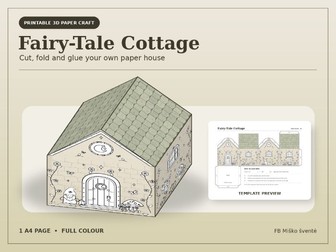
Build a miniature paper village with A4 house templates. The house fits on one sheet and includes cutting and folding guides, labelled glue tabs and step-by-step instructions in English. Fairy-Tale Cottage — a woodland home with leaf-shaped roof tiles, a fairy, a lantern-carrying gnome and hidden forest animals. Use the template for primary art and design lessons, seasonal craft sessions or an after-school club. Children can build a house individually or work in groups to create a village display. Cutting, folding and joining the pieces gives them practice in fine motor skills, following instructions and turning a flat template into a 3D model. The set includes one-page PDFs. Print in landscape at 100% (Actual Size). For sturdier models, use 160–220 g/m² cardstock. Each house carries a small FB Miško šventė mark on the base.
Winter house template to colorQuick View
NatureschoolDarzeliai

Winter house template to color

(0)
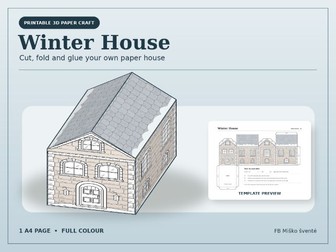
Build a miniature paper village with full-colour A4 house templates. The house fits on one sheet and includes cutting and folding guides, labelled glue tabs and step-by-step instructions in English. Winter House — a stone house with arched windows and a snow-covered roof. Use the template for primary art and design lessons, seasonal craft sessions or an after-school club. Children can build a house individually or work in groups to create a village display. Cutting, folding and joining the pieces gives them practice in fine motor skills, following instructions and turning a flat template into a 3D model. The set includes four separate, one-page PDFs. Print in landscape at 100% (Actual Size). For sturdier models, use 160–220 g/m² cardstock.
Printable 3D Paper House | Cut, Fold & Glue Craft | Christmas CottagesQuick View
NatureschoolDarzeliai

Printable 3D Paper House | Cut, Fold & Glue Craft | Christmas Cottages

(0)
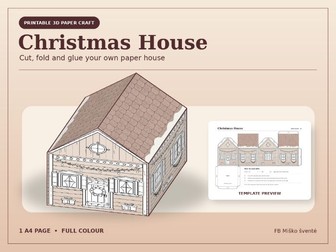
Build a miniature paper village with full-colour A4 house templates. The house fits on one sheet and includes cutting and folding guides, labelled glue tabs and step-by-step instructions in English. Christmas House — a wooden cottage with shutters, evergreen garlands and a wreath on the door. Use the template for primary art and design lessons, seasonal craft sessions or an after-school club. Children can build a house individually or work in groups to create a village display. Cutting, folding and joining the pieces gives them practice in fine motor skills, following instructions and turning a flat template into a 3D model. The set includes ** one-page PDF**. Print in landscape at 100% (Actual Size). For sturdier models, use 160–220 g/m² cardstock. Each house carries a small FB Miško šventė mark on the base.
Forest Celebration | Enchanted Woodland Fairy Coloring PageQuick View
NatureschoolDarzeliai

Forest Celebration | Enchanted Woodland Fairy Coloring Page

(0)
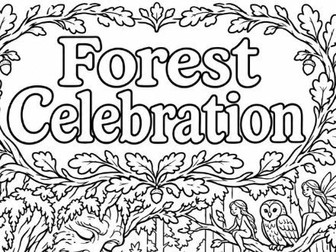
Step into an enchanted woodland where a forest fairy with fern-frond hair and a leafy cloak meets an ancient tree spirit. Look closely to find an owl, deer, tiny fairies and mushrooms tucked among the roots. This single-page printable features detailed black-and-white line art and large outlined “Forest Celebration” lettering that children can color as part of the scene. Use it as a quiet art activity, a companion to a fairy-tale lesson, or a creative writing prompt: What are the woodland creatures celebrating?