Hiroshima KS3 History Free Source Lesson: Reading a 1945 SourceQuick View
SimulationLessons

Hiroshima KS3 History Free Source Lesson: Reading a 1945 Source

(0)
Free Hiroshima KS3 History source lesson: a 30-minute lesson on one secret 1945 record, the Interim Committee notes of 31 May 1945, with editable slides and a Word worksheet on provenance, inference and judgement. What is the lesson about? Weeks before the atomic bomb was dropped on Hiroshima, a secret US committee advising the Secretary of War, Henry L. Stimson, agreed not to give Japan any warning and chose the kind of target it wanted. Students read the declassified notes and ask the historian’s questions: who made this source, what is it, why was it made, and what can we infer from it? They finish by deciding whether this one source suggests the decision was justified, not justified, or both. Why use it? It is a ready-to-teach introduction to the enquiry ‘How far was the decision to drop the atomic bomb justified?’ and a strong source-skills lesson in its own right. It works as a starter for a Second World War unit, a cover lesson with full speaker notes, or a short source-analysis practice for Year 8 or Year 9. What’s included Slides (PowerPoint + PDF): content note, Do Now with answers, context, the source with Who? What? Why?, a glossary, inference questions and a judgement prompt, plus speaker notes and a 30-minute plan Worksheet (Word + PDF): the source in full, a glossary, seven questions in three parts (provenance, inference, judgement), an extension, and a teacher answer page with the historian’s note (the last page, kept separate for printing) START HERE page Accurate and sensitive: the extract is cut exactly from the declassified record in the US National Archives (public domain), with a full reference. There are no photographs or descriptions of the bombing’s human effects, and the content note is built into the slides and worksheet. Students act only as historians weighing evidence about a decision. Skills practised: provenance (who, what, why and when), inference from a primary source, the difference between a private record and a public statement, and a supported judgement using a quotation. These are the same skills students need for GCSE History source and interpretation questions. The full enquiry (paid) adds eleven more sources, including Britain’s consent of 4 July 1945, the Potsdam Declaration, a secret Japanese message, casualty estimates that name their sources and a survivor’s words; two complete 60-minute lessons; worksheets at three levels; a card sort and continuum; an assessment with mark scheme and model answers; and the Evidence Scales interactive, where students weigh twelve sources and compare what was known in July 1945 with hindsight. Related: Hiroshima KS3 History Enquiry: Was the Atomic Bomb Justified? (full version). Free for classroom use. Last updated: 04/11/2026 (first release). The full version is available from the same author on Tes.
BTEC Health and Social Care Unit 2 – Human Biology and HealthQuick View
SimulationLessons

BTEC Health and Social Care Unit 2 – Human Biology and Health

(0)
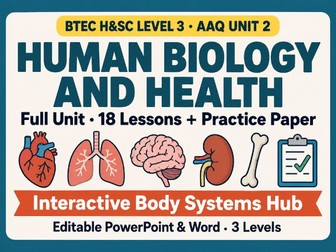
BTEC Health and Social Care Unit 2 Human Biology and Health (AAQ Level 3): 18 lessons, three-level worksheets, a practice paper and an interactive. Body Systems Hub: an offline interactive to explore and quiz nine body systems, from cardiovascular to immune/lymphatic. In the Case Clinic a service user’s story and observations appear (temperature, pulse, BP, breathing rate, oxygen saturation, glucose), and students choose the body system, the mechanism and the right care actions, from calling 999 to the GP, district nurse and care plan. Unit 2 is the externally assessed human biology unit (80 marks, 1 h 30 min) of the new Pearson AAQ BTEC National in Health and Social Care. This pack addresses content areas (A1–A4, B1–B6, C1.1–C1.8) in specification order, each lesson linked to service users and NHS care. What’s included 18 lessons (60 min): cells; tissues; energy and metabolism; homeostasis; the heart; blood vessels and blood; respiratory; nervous; endocrine; blood glucose and osmoregulation; musculoskeletal; immune and lymphatic; digestive and reproductive; CHD and stroke; COPD and asthma; diabetes; dementia and brain injury; cancer 36 editable PowerPoint decks: Teacher (plan, answers, notes; 358 slides) and Student (no answers; 247 slides) 54 editable Word worksheets: 3 levels per lesson (939 marks), with full answer key Original 80-mark Unit 2-style practice paper (AO1–AO4), mark scheme, RAG revision checklist Teacher guide: suggested 90-GLH pathway, misconceptions, AO3/AO4 model-answer comparison, coverage table, Unit 3 mapping Every lesson: Do Now, active task, care-link scenario, exam-style question, exit ticket START HERE page and 95 print-ready PDFs Accuracy: unit names, codes and exam format follow the specification below. Clinical values are checked against NHS pages and are for teaching only. All exam-style questions are our own; no Pearson papers or mark schemes are reproduced. Sensitive topics (cancer, stroke, dementia) have teacher notes. Please note: three secondary-effect points (C1.4.3, C1.6.3, C1.7.3: the psychological effects listed for asthma, dementia and brain injury) are not taught here; the Teacher Guide and teacher-only slides flag them. Alignment: Pearson Level 3 AAQ BTEC National in Health and Social Care, Unit 2 Human Biology and Health (mandatory unit of the Extended Certificate 610/3964/0, Issue 4, October 2025). Also maps to legacy BTEC Nationals (2016) Unit 3 Anatomy and Physiology. Not endorsed by or affiliated with Pearson. Check the current specification at qualifications.pearson.com. Licence: supplied under the Tes licence you choose at checkout (standard, or Multi-User/School Licence where purchased); sharing with colleagues is governed by that licence. Try it free first: Free BTEC Health and Social Care Unit 2 – Heart Labelling + Quiz Last updated: 14/11/2026.
Free Sleep Science for Teens Poster KS3 PSHE + Planner DemoQuick View
SimulationLessons

Free Sleep Science for Teens Poster KS3 PSHE + Planner Demo

(0)
A free sleep science poster for KS3 PSHE: NHS sleep ranges, the teen body clock, screens and caffeine on one page, plus a Body Clock Planner demo. A one-page poster for teens: NHS sleep ranges, the body clock and the teen shift, light and screens, caffeine amounts, energy drinks, lie-ins and habits that help. Plus a Body Clock Planner demo: explore a routine and fix one invented teen’s week (works offline; nothing is stored or sent). The body clock (circadian rhythm) is the roughly 24-hour internal cycle that tells the body when to feel sleepy and alert. What’s included The poster (editable Word + one-page PDF) Body Clock Planner demo (1 offline HTML file, 1 Fix-the-routine teen) START_HERE_Open_Me.html Who it’s for: KS3 PSHE teachers and tutors in Years 7 to 9. Many pupils are tired in the morning and don’t know why; the teen body clock shift, late screens and energy drinks are a large part of the answer, and the poster explains them in plain words. How to use it Starter (10 minutes): ask pupils how many hours of sleep someone their age needs, then check the NHS range on the poster. Planner (15 minutes): run the demo on the board and fix the invented teen’s week together, one change at a time. Plenary (5 minutes): pupils choose one habit from the poster to try for a week. It also works in tutor time, before exams or after a holiday, when routines slip. The poster suits form rooms and the library, and can go home with a parents’ evening pack. Facts checked against NHS sources on 04/11/2026. General health education, not medical advice. This resource does not diagnose or treat any sleep problem. Anyone with ongoing trouble sleeping, or who is very sleepy in the day even after enough time in bed, should talk to a parent or carer, the school nurse or a GP. Not endorsed by the DfE or the NHS. Want the full lessons? The full resource adds four more Fix-the-routine teens, a 60-minute lesson with the Truth Line myth-or-fact walk and an If–Then habit plan, an optional data-investigation lesson, worksheets at three levels, a no-tech paper version and full answers. The full version: Sleep Lesson KS3 PSHE – Teen Body Clock, Screens + Caffeine Free to use with your own classes under the Tes licence. Please don’t post the files publicly or share them beyond that licence. Last updated: 13/11/2026. The full version is available from the same author on Tes.
Free BTEC Health and Social Care Unit 2 – Heart Labelling + QuizQuick View
SimulationLessons

Free BTEC Health and Social Care Unit 2 – Heart Labelling + Quiz

(0)
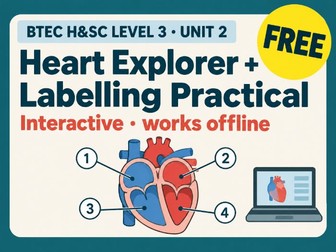
A free BTEC Health and Social Care Unit 2 heart resource: an editable heart labelling sheet with answers, plus the interactive Heart Explorer (Level 3). Try the interactive Heart Explorer: click any part of the heart, conduction system, blood or vessels to see its name and job, then quiz yourself. It works offline on a whiteboard, laptop or phone, with no log-in. The heart is the muscular pump of the cardiovascular system, sending blood around the lungs and the rest of the body. What’s included Heart Explorer (the cardiovascular system from the Body Systems Hub): Explore and Quiz modes, an offline HTML page Heart labelling practical: a one-page editable Word sheet (12 labels, the blood route and a care-link question) with a PDF copy A separate answer sheet (Word and PDF) Who it’s for: Level 3 learners on the Pearson BTEC National in Health and Social Care, and their teachers. It also helps learners on other health and care courses who need the structure of the heart and the route of blood. How to use it Starter (10 minutes): open Explore mode on the board and ask learners to name each part before you click it. Main task (20 minutes): learners complete the labelling sheet, then trace the blood route from the body back to the body. Plenary (10 minutes): learners use Quiz mode on phones or laptops; finish with the care-link question, which ties the science to a service user. It also makes a tidy revision task before the exam, or a cover lesson, as the answers are on a separate sheet. Want the whole unit? The full unit adds 18 lessons for Unit 2 Human Biology and Health, with Teacher and Student slides, worksheets at three levels, an 80-mark practice paper with mark scheme, and the complete Body Systems Hub with nine systems and the Case Clinic, where learners link body systems to care cases. The full version: BTEC Health and Social Care Unit 2 – Human Biology and Health Alignment: Pearson AAQ BTEC National in Health and Social Care, Unit 2 Human Biology and Health, B1.1.1 (heart). Not endorsed by or affiliated with Pearson. Check the current specification and sample assessment materials at qualifications.pearson.com. Free to use with your own classes under the Tes licence. Please don’t post the files publicly or share them beyond that licence. Last updated: 14/11/2026. The full version is available from the same author on Tes.
Sleep Lesson KS3 PSHE – Teen Body Clock, Screens + CaffeineQuick View
SimulationLessons

Sleep Lesson KS3 PSHE – Teen Body Clock, Screens + Caffeine

(0)
Sleep lesson for KS3 PSHE (RSHE 2026): the teen body clock, screens, caffeine and lie-ins in 60 minutes, an optional data lesson and a Body Clock Planner. Body Clock Planner (interactive): students set lights out, wake-up, phone-off, weekend times and caffeine drinks, and see hours slept against the NHS range for their age, caffeine left at lights out (a labelled simple half-life model), the weekend shift (social jet lag) and weekly sleep debt. Then they fix the routine for five invented teens, each with a “can’t change” rule (scores count once). Offline; nothing stored or sent. The body clock (circadian rhythm) is the roughly 24-hour internal cycle that tells the body when to feel sleepy and alert. Your body clock (60 min): NHS sleep ranges, the Truth Line myth-or-fact walk, melatonin, the teen shift, screens, caffeine and energy drinks, lie-ins and an If–Then habit plan. Optional: sleep data investigation (60 min): a fictional 7-day diary and class dataset: mean, median and range, a bar chart (Stretch: scatter graph), and why a pattern is not proof. What’s included 4 editable PowerPoint decks: Teacher (plan, answers, notes) and Student 6 editable Word worksheets at 3 levels Truth Line signs and 12 statement cards; 8 If–Then habit cards Sleep science poster, class dataset (24 fictional pupils), optional private diary, parent/carer tips letter No-tech Fix the routine, answer key, teacher guide with a 20-minute tutor-time route START HERE page; 18 PDFs Nobody is asked to share their own sleep, the diary is never collected, and pupils are never compared. Accuracy: checked on 04/11/2026 against NHS sources, EFSA (caffeine), legislation.gov.uk and GOV.UK. Energy drinks: on 16/07/2026 the UK Government announced a ban on selling high-caffeine energy drinks (over 150 mg/l; not tea or coffee) to under-16s in England, intended from April 2027 and subject to Parliamentary approval; not yet law when checked. General health education, not medical advice; it does not diagnose or treat any sleep problem. Anyone with ongoing trouble sleeping, or very sleepy in the day after enough time in bed, should talk to a parent or carer, the school nurse or a GP. Curriculum (England): DfE statutory RSHE guidance (from 1 September 2026), secondary Health protection and prevention, point 6 (good-quality sleep, screen-free time before bed, phones out of the bedroom). Other UK nations have their own curricula and rules; the sleep science and NHS advice apply UK-wide. Not endorsed by the DfE or the NHS. Licence: supplied under the Tes licence you choose at checkout (standard, or Multi-User/School Licence where purchased). Print and edit for your pupils; do not share outside your school or post publicly. Try it free first: Free Sleep Science for Teens Poster KS3 PSHE + Planner Demo Last updated: 13/11/2026.
Free Word Roots Do Now KS3 – 4 Weeks of Starters + Root ForgeQuick View
SimulationLessons

Free Word Roots Do Now KS3 – 4 Weeks of Starters + Root Forge

(0)
Free word roots Do Now starters for KS3: the first four weeks of a 36-week etymology programme (prefixes and suffixes), plus a Root Forge interactive demo. Includes a free Root Forge demo: pupils build real words from prefix, root and suffix tiles and see the meaning assemble, then crack four unseen subject words in Word Detective. Etymology is the study of word origins; roots are meaningful word parts, including those from Greek, Latin and Old English. Weeks 1 to 4 cover the prefixes un-, in-, non-, pre-, post-, re-, sub-, super-, inter-, trans- and the suffixes -tion, -ment, -ity, ready to use tomorrow. What’s included Editable PowerPoint Do Now deck for Weeks 1 to 4 (15 slides, with a PDF copy): meet the parts (colour-tagged Latin or Old English; Greek roots begin in Week 10 of the full programme), the Do Now and an answer slide for each week, with teacher notes. Student pages for Weeks 1 to 4 at Support, Core and Stretch (Word, with 6-page PDF copies of each level). Root Forge demo (offline HTML): Set 1 tiles (36 target words) and Word Detective Case file 1 (4 unseen words). Root Forge saves nothing: words found and scores stay only while the page is open, and reloading or closing the page clears them. Nothing is sent anywhere, and it works offline. START_HERE_Open_Me.html. Who it’s for: KS3 English teachers, literacy leads and tutors who want a short, regular vocabulary routine. Because the parts turn up in science, maths and humanities words, the starters also suit form time or a whole-department literacy focus. How to use it Do Now (5–10 minutes, once a week): show the parts slide, let pupils work on their level of student page, then reveal the answer slide. Root Forge (10 minutes): build words on the board together, then let pairs race to find more on laptops or phones. Word Detective (5 minutes): crack the four unseen words as a plenary. Pupils at Support, Core and Stretch do the same Do Now at their own level, so the whole class can mark it together. Roots and example words were checked against saved dictionary entries. UK spelling throughout. Want the whole year? The full unit adds four 60-minute lessons on Greek and Latin roots, all 36 weekly Do Now starters in six editable half-term decks, student booklets at three levels, half-term assessments, a word wall, and the full Root Forge: 6 tile sets (230 target words), 24 Word Detective cases and a Class Challenge mode. The full version: Etymology KS3 – Greek and Latin Word Roots + 36 Do Now Starters Free to use with your own classes under the Tes licence. Please don’t post the files publicly or share them beyond that licence. Last updated: 13/11/2026. The full version is available from the same author on Tes.
Etymology KS3 – Greek and Latin Word Roots + 36 Do Now StartersQuick View
SimulationLessons

Etymology KS3 – Greek and Latin Word Roots + 36 Do Now Starters

(0)
Etymology for KS3: Greek and Latin word roots in four 60-minute lessons, then 36 weekly 10-minute Do Now starters for Years 7–9, plus assessments. Root Forge: an offline interactive where pupils build real words from Greek and Latin tiles (tele + scope = far + look) and see the meaning assemble, then turn Word Detective and crack unseen science, maths, history and geography words from their parts. Class Challenge mode runs Real or Fake? and Root Flash on the board. Etymology is the study of word origins; roots are meaningful word parts, including those from Greek, Latin and Old English. Roots and examples were checked against saved dictionary entries (Online Etymology Dictionary and Wiktionary), with false friends and folk etymologies flagged. What’s included Root Forge (one offline HTML file): 6 tile sets (one per half term, 230 target words), each word scoring once; 24 Word Detective cases (first answer counts); Class Challenge for 2–4 teams. Saves and sends nothing; progress clears on reload or close. 4 lessons (60 min) with Teacher slides (13/12/12/12: plan, answers, notes), Student slides (10/9/9/9) and worksheets at 3 levels: 1 How words are built (Morpheme Mingle); 2 Latin roots rupt, ject, dict, port (Root Relay); 3 Greek roots in science and maths (Root Forge challenge); 4 Word Detective and false friends (Real or Fake? four corners). 36 weekly Do Now starters in 6 editable half-term decks (126 slides): 3–4 word parts a week, colour-tagged Greek, Latin or Old English, a Do Now and an answer slide, teacher notes give each part’s source. Student booklets at 3 levels: one page per week, 36 weeks each. Assessment: baseline and end-of-year test (the same 36-mark check of taught parts, not a standardised reading or vocabulary measure) and 6 half-term assessments (20 marks each) with mark schemes; class and pupil progress trackers. Word wall (41 A4 cards), game kit and paper Root Forge (no-tech version), teacher guide (year plan, routines, accuracy notes, misconceptions), root reference and a full answer key. START HERE page: 33 Word and 15 PowerPoint files, each with a print-ready PDF (48 PDFs). Alignment: KS3 English programme of study (England): “learning new vocabulary, relating it explicitly to known vocabulary and understanding it with the help of context and dictionaries” (Reading); builds on KS2 morphology and etymology; supports GCSE English Language AO6. Not endorsed by the DfE or any exam board. UK spelling throughout (haemoglobin, anaemia, synchronise), with notes where US spelling differs. Licence: supplied under the Tes licence you choose at checkout (standard, or Multi-User/School Licence where purchased); sharing with colleagues is governed by that licence. Try it free first: Free Word Roots Do Now KS3 – 4 Weeks of Starters + Root Forge Last updated: 13/11/2026.
Free Oracy Sentence Stem Posters KS3/KS4 – 6 Talk Moves + DemoQuick View
SimulationLessons

Free Oracy Sentence Stem Posters KS3/KS4 – 6 Talk Moves + Demo

(0)
Free oracy sentence stem posters for KS3/KS4: six talk-move posters with Starter, Developing and Expert stems, plus a Talk Moves Trainer demo. Six sentence-stem posters, one per talk move: agree and build, challenge, clarify, question, give evidence and summarise, each with Starter, Developing and Expert stems. Editable PowerPoint with A4 and A3 print PDFs. Plus a Talk Moves Trainer demo: one invented class discussion with four pauses where pupils choose the next talk move and the words, with explained feedback and a discussion map, and a Starter-level stem roulette. Works offline; no accounts, tracking or network calls: answers and scores stay in the open page only and are cleared on refresh or close. Oracy is using speaking and listening to communicate and learn; sentence stems are ready-made openings that help pupils join in. What’s included 6 talk move posters (editable PowerPoint, 6 slides + A4 PDF + A3 PDF) Talk Moves Trainer demo (1 offline HTML file, 1 discussion) START_HERE_Open_Me.html Who it’s for: KS3 and KS4 teachers in any subject, and oracy or literacy leads planning a whole-department routine. The three levels let quieter pupils start with a simple stem and stretch confident speakers. How to use it Display: print the A3 posters for the classroom wall and point to them during any discussion. Starter (10 minutes): run the Trainer on the board and let the class choose the talk move at each pause. Stem roulette (5 minutes): spin for a Starter stem and ask pupils to finish it about the lesson topic. The PowerPoint is editable, so you can add subject words or change the colours to match your room. Using the same stems in every subject helps pupils see that good talk is a skill, not a one-off lesson. Want the full set? The full resource adds five more Trainer discussions, six more posters with an ink-saver version, three 60-minute lessons with worksheets at three levels, stem cards, role cards, Talk Tokens, a debate kit, an oracy rubric and a teacher guide. The full version: Oracy Sentence Stems KS3/KS4 – Display, 3 Lessons + Trainer Independent resource: not produced, checked or endorsed by the Oracy Education Commission, Voice 21, the University of Cambridge, the DfE or any exam board. Free to use with your own classes under the Tes licence. Please don’t post the files publicly or share them beyond that licence. Last updated: 13/11/2026. The full version is available from the same author on Tes.
Oracy Sentence Stems KS3/KS4 – Display, 3 Lessons + TrainerQuick View
SimulationLessons

Oracy Sentence Stems KS3/KS4 – Display, 3 Lessons + Trainer

(0)
Oracy sentence stems for KS3/KS4: a 12-poster secondary display, three 60-minute discussion and debate lessons, and the Talk Moves Trainer interactive. Talk Moves Trainer: six invented discussions across subjects unfold line by line. At 24 pauses pupils choose the best next talk move, then the words to say it, with explained feedback. Each discussion ends with a discussion map showing who built on whom. Plus a projector stem roulette for any lesson. One offline HTML file; scores count once; no accounts, tracking or network calls, and answers clear on refresh or close. Oracy is using speaking and listening to communicate and learn; sentence stems are ready-made openings that help pupils join in. The display covers six talk moves (agree and build, challenge, clarify, question, give evidence, summarise), each with Starter, Developing and Expert stems, plus overview, norms, roles, continuum, debate and “speak like an expert” posters. Three 60-minute lessons: 1 Talk moves (Trainer, 36-card stem sort, roles, Talk Tokens) · 2 Structured debate (claim, evidence, rebuttal, a 12-minute class debate) · 3 Speak like an expert (subject stems, inner and outer circle, self/peer rubric). What’s included 12 display posters: editable PowerPoint in colour and ink-saver, plus A4 and A3 print PDFs 6 editable PowerPoint lesson decks: Teacher (plan, answers, notes) and Student 9 editable Word worksheets at 3 levels Stem bank, desk strips, 36 stem cards, bookmarks, role cards, Talk Tokens, rubric, debate kit No-tech version of two Trainer discussions, answer key, teacher guide, START HERE page, 26 PDFs Curriculum (England): KS3/KS4 Spoken English, any subject. KS3: formal debates and structured discussions, building on what has been said; KS4: building on others’ contributions, asking questions to clarify, challenging courteously. Built with the Oracy Education Commission (2024) and Curriculum and Assessment Review (2025) recommendations in mind; the rubric uses the four oracy strand names (physical, linguistic, cognitive, social and emotional), credited in the teacher guide. On 04/11/2026 a Government oracy framework and a revised national curriculum (to be published in 2027 for first teaching in 2028) were announcements, not published requirements: check GOV.UK. Independent resource: not produced, checked or endorsed by the Oracy Education Commission, Voice 21, the University of Cambridge, the DfE or any exam board. Every pupil, discussion, source, survey and data table is invented for practice. Licence: supplied under the Tes licence you choose at checkout (standard, or Multi-User/School Licence where purchased). Print, enlarge, edit and display in your school; do not share outside your school or post publicly. Try it free first: Free Oracy Sentence Stem Posters KS3/KS4 – 6 Talk Moves + Demo Last updated: 13/11/2026.
Free GCSE Maths Resit Percentages – Self-Marking Gap FinderQuick View
SimulationLessons

Free GCSE Maths Resit Percentages – Self-Marking Gap Finder

(0)
Free GCSE Maths resit percentages diagnostic: a self-marking Gap Finder with 10 questions, worked hints and a printable Red / Amber / Green plan. Interactive Percentages Gap Finder: 10 self-marking questions, two for each of five skills (FDP conversions, percentages without a calculator, multipliers, percentage change and reverse percentages). A wrong answer shows a worked hint, and the results screen is a printable Red / Amber / Green plan. Works offline on a whiteboard, PC or phone; nothing is saved or sent. A gap finder is a short diagnostic that shows which skills a learner already has and which to revisit next. What’s included Percentages_Gap_Finder.html (offline, 10 questions, worked hints, RAG plan) One-page RAG plan to fill in (editable Word + PDF) START_HERE_Open_Me.html Who it’s for: post-16 learners resitting GCSE Maths at Foundation tier, and the FE and sixth-form teachers who teach them. Questions use adult contexts: VAT, sale prices, pay rises and bills. It also suits Year 11 students aiming for a grade 4. How to use it First lesson (20 minutes): learners take the Gap Finder on phones or college PCs. No log-in is needed, and nothing is saved, so learners can retake it without worry. Plan (10 minutes): learners copy their Red, Amber and Green skills onto the paper plan and pick one Red skill to fix first. Revisit (10 minutes, a few weeks later): learners take it again and compare. The worked hints mean learners get help the moment they go wrong, which suits mixed groups where you can’t sit with everyone. The paper plan gives you a quick record of each learner’s gaps for target setting. Suits AQA (8300), Pearson Edexcel (1MA1) and OCR (J560) GCSE Mathematics, Foundation tier. This resource is not endorsed by, or affiliated with, AQA, Pearson Edexcel or OCR. All questions are our own; none is taken from a past paper. Want the full course? The full unit has ten 60-minute Foundation lessons on Number and Ratio & proportion, editable Teacher and Student slides, a workbook at three levels with worked answers, a mini-assessment, and the 20-question Grade 4 Gap Finder (Form A before the unit, Form B after it) with Price Tag, a shopping-and-pay percentages game. The full version: GCSE Maths Resit Post-16 – Grade 4 Number Lessons + Gap Finder Free to use with your own classes under the Tes licence. Please don’t post the files publicly or share them beyond that licence. Last updated: 13/11/2026. The full version is available from the same author on Tes.
GCSE Maths Resit Post-16 – Grade 4 Number Lessons + Gap FinderQuick View
SimulationLessons

GCSE Maths Resit Post-16 – Grade 4 Number Lessons + Gap Finder

(0)
GCSE Maths resit unit for post-16: ten 60-minute Foundation lessons on Number and Ratio & proportion, a three-level workbook and a self-marking Gap Finder. Grade 4 Gap Finder included: a 20-question self-marking diagnostic (10 non-calculator, then 10 calculator) with worked hints on wrong answers and a printable Red / Amber / Green plan telling each learner which lesson to revisit. Use Form A before the unit and Form B after it (same topics, new numbers) to show progress, plus Price Tag, a shopping-and-pay percentages game. Works offline on a whiteboard, PC or phone; nothing is saved or sent. Number and Ratio & proportion are the GCSE Maths topic areas (calculation, fractions, percentages, ratio and rates) that carry Foundation marks on every paper. Adult contexts throughout: payslips and NI (2026/27), wages, best buys, VAT, travel, recipes. Ten lessons: rounding and estimation · FDP · percentages and VAT · percentage change and reverse percentages · ratio · direct proportion and best buys · speed, density and rates · interest and depreciation · standard form and calculator skills · wages, payslips and mixed practice. Each runs Do Now → I do → We do → You do → activity → exam-style practice → exit ticket. What’s included Gap Finder with Price Tag (1 offline HTML file: 40 diagnostic questions across Forms A and B, 26 Price Tag items) 20 PowerPoint files: 200 teacher slides (plan, answers, mark schemes, notes) and 130 student slides (no answers) Student workbook at 3 levels (Support, Core, Stretch), 161 questions per level, editable Word Answer key with full worked solutions and mark-scheme codes (M1, A1, B1, C1) Mini-assessment (40 marks, non-calculator and calculator) with mark scheme and topic map Card pack for 7 activities (Estimate Line, Exam Question Relay and more) Teacher guide (10-week sequence, misconceptions, sources) START HERE page and 28 print-ready PDFs Accurate: every answer and working line is generated and checked by code. VAT 20%, 2026/27 NI thresholds and the £12.71 National Living Wage checked on GOV.UK on 04/11/2026; interest and exchange rates are illustrative. Exam fit (Foundation, grades 1–5): three 1 h 30 min papers; AQA and Edexcel Paper 1 is non-calculator (80 marks each), OCR Paper 2 (100 marks each). Alignment: DfE GCSE Mathematics subject content (2013), N1–N3, N6, N9–N15 and R1, R3–R11, R16. Suits AQA (8300), Pearson Edexcel (1MA1) and OCR (J560) Foundation. Not endorsed by, or affiliated with, AQA, Pearson Edexcel or OCR. All questions are our own; none is taken from a past paper. Licence: supplied under the Tes licence you choose at checkout (standard, or Multi-User/School Licence where purchased); sharing with colleagues is governed by that licence. Try it free first: Free GCSE Maths Resit Percentages – Self-Marking Gap Finder Last updated: 13/11/2026.
Free GCSE English Resit – AQA Paper 1 Question Decoder + MapQuick View
SimulationLessons

Free GCSE English Resit – AQA Paper 1 Question Decoder + Map

(0)
Free GCSE English resit starter for AQA Paper 1: a Question Decoder interactive and a two-page question map with each question’s skill, marks and time. Interactive Question Decoder for AQA GCSE English Language Paper 1: learners match each question to its skill, marks and time, then play a ten-question “Which question is this?” quiz. Works offline on a whiteboard or phone, with no log-in. AQA GCSE English Language Paper 1 (Explorations in Creative Reading and Writing) tests reading of an unseen fiction extract in Section A and writing in Section B. What’s included Question Decoder (offline HTML): 5 question cards to decode, a 10-question quiz and the full question map Paper 1 question map (Word and two-page PDF): what each question asks, AO, marks, suggested minutes, a top tip and the 2026 question changes START HERE page Who it’s for: post-16 learners resitting the exam in college or sixth form, and Year 11 students who need a clear picture of the paper. Many resit learners lose marks by spending too long on one question or answering the wrong one. Knowing what each question wants is the quickest win. How to use it First lesson (15 minutes): run the Decoder on the board and match each question to its skill and marks together. Quiz (10 minutes): learners play “Which question is this?” on phones and compare scores. Keep it: learners stick the map in their book or folder and use it in every timed practice. It also suits a tutorial, a drop-in revision session or a cover lesson, because the Decoder explains itself and the map stands alone. The map is editable, so you can add your own tips or examples. Want the full course? The full unit has ten 60-minute lessons on Paper 1 Section A (Questions 1–4) for post-16 resit groups, with editable Teacher and Student slides, a workbook at three levels, Do Now sentence tasks, model answers, a mock with a mark guide, and the Zoom-In Lab, a second interactive for close reading of public-domain extracts. Every lesson stands alone, so learners who miss a week can catch up. The full version: GCSE English Resit Post-16 – AQA Paper 1 Reading, 10 Lessons This resource is not endorsed by, or affiliated with, AQA. Question wording is our own example wording in the AQA style. Free to use with your own classes under the Tes licence. Please don’t post the files publicly or share them beyond that licence. Last updated: 13/11/2026. The full version is available from the same author on Tes.
GCSE English Resit Post-16 – AQA Paper 1 Reading, 10 LessonsQuick View
SimulationLessons

GCSE English Resit Post-16 – AQA Paper 1 Reading, 10 Lessons

(0)
GCSE English Language resit unit for post-16: ten 60-minute AQA Paper 1 Reading lessons, a three-level workbook, a mock and the Zoom-In Lab interactive. Zoom-In Lab included: learners click a word in an extract, pick the method, zoom in on the key word, choose the most precise effect and get an auto-built What–How–Why paragraph with a six-point self-check. Works offline on a whiteboard, college PC or phone. AQA GCSE English Language Paper 1 tests reading of an unseen fiction extract (Section A, Questions 1–4) and creative writing (Section B). This unit teaches Section A to post-16 resit groups. What’s included 10 × 60-minute lessons, each with an editable Teacher deck (plan, answers, notes) and Student deck: 20 PowerPoint files, 204 teacher and 137 student slides Student workbook at three levels (Support, Core, Stretch), each covering all 10 lessons, in Word and PDF 30 AO5/AO6 Do Now sentence tasks (three per lesson) for Section B accuracy 16 Question 1 multiple-choice practice questions in the current format, with evidence Answer guide with every answer and 23 model answers at three indicative levels (developing, secure, strong) Mock Paper 1 Section A on an unseen public-domain extract, with a mark guide and model answers Teacher guide, card pack for six activities, extract booklet Zoom-In Lab: 4 extracts, 24 annotated phrases, 14 methods; bonus Question Decoder 29 print-ready PDFs; START HERE page linking everything in teaching order Made for FE resit groups: every lesson stands alone, so learners who miss a week can catch up; three levels suit mixed groups; the Lab works on phones with no log-ins. The teacher guide adds a post-mock feedback and redraft lesson. Built for the current paper: since summer 2026, Question 1 is four multiple-choice questions, Question 3 names one effect and Question 4 gives a statement to agree or disagree with. Practice uses tick boxes and left-hand line numbers, in line with AQA’s announced summer 2027 layout. Contexts suit 16–19 learners. All extracts are public-domain 20th-century fiction (Mansfield, Conan Doyle, Joyce, Buchan), printed exactly and cited. Alignment: AQA GCSE English Language (8700), Paper 1 Section A Reading (Questions 1–4; AO1, AO2, AO4), checked against the AQA specification version 1.5 (14/10/2021) and the 2026 sample assessment materials (mark scheme version 1.1). Not endorsed by, or affiliated with, AQA. Model-answer levels are indicative only (our wording), and the Lab’s checklist level shows completed steps, not an examiner’s judgement; neither is an AQA mark. Licence: supplied under the Tes licence you choose at checkout (standard, or Multi-User/School Licence where purchased); sharing with colleagues is governed by that licence. Try it free first: Free GCSE English Resit – AQA Paper 1 Question Decoder + Map Last updated: 13/11/2026.
Free Prevent Duty Staff Check – Myth or Fact? Quiz + PosterQuick View
SimulationLessons

Free Prevent Duty Staff Check – Myth or Fact? Quiz + Poster

(0)
Free Prevent duty check for school staff: 10 myth-or-fact statements with sourced feedback and a printable mini certificate, plus a one-page staff poster. An interactive “Prevent: Myth or Fact?” check: 10 statements, instant feedback with the source for each answer, and a printable mini certificate with the staff member’s name, date and score. It works offline on a projector, laptop or phone; nothing typed is saved or sent. The Prevent duty is the legal duty, under the Counter-Terrorism and Security Act 2015, for schools to have due regard to the need to prevent people from being drawn into terrorism. What’s included Myth or Fact? check (offline HTML): 5 myths and 5 facts, each explained and sourced (checked against GOV.UK on 04/11/2026, including the DfE guidance for DSLs updated 02/10/2026) “Prevent: 8 facts for every member of staff”: a one-page poster with sources and a blank for your DSL (editable Word + PDF) Who it’s for: DSLs, deputies and leaders who brief staff on Prevent, and anyone running induction for new or supply staff. The check clears up common myths about Prevent and gives staff the source behind each answer. How to use it Staff briefing (10 minutes): run the check on the projector. Staff vote myth or fact on each statement, then you reveal the sourced answer. Self-study (10 minutes): send the file to staff to complete on a laptop or phone and print their mini certificate. Noticeboard: add your DSL’s name to the poster and put it up in the staffroom. The certificate shows the name, date and score, so it can sit with your own training records. It records taking part in a short check; it is not an accredited qualification. Want the full INSET? The full pack adds the Prevent Pathway Simulator (10 branching cases with a certificate), 37 editable INSET slides with notes, a facilitator guide (60, 45 and 20-minute routes), scenario cards, a card sort and four corners, a 15-question knowledge check, a staff handout and poster, a leaders’ compliance checklist and a training record. The full version: Prevent Duty Staff Training 2026 – INSET + Branching Simulator This check supports, but does not replace, your safeguarding policy, your DSL and the statutory guidance. Not produced or endorsed by the Home Office or the Department for Education. Contains public sector information licensed under the Open Government Licence v3.0. Free to use under the Tes licence. Please don’t post the files publicly or share them beyond that licence. Last updated: 13/11/2026. The full version is available from the same author on Tes.
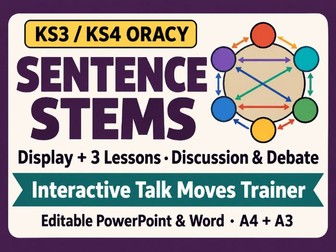
Prevent Duty Staff Training 2026 – INSET + Branching SimulatorQuick View
SimulationLessons

Prevent Duty Staff Training 2026 – INSET + Branching Simulator

(0)
Prevent duty staff training for 2026: an editable INSET for all school staff with 37 trainer slides, a facilitator guide and a branching simulator. Prevent Pathway Simulator: staff work through 10 branching school cases (28 decisions) along the pathway (notice, record, tell the DSL, the DSL’s decision, the outcome), with feedback that names its source, ‘put it right’ steps after some wrong turns, a score summary and a printable, named, dated certificate. Room vote mode; nothing typed is saved or sent. The certificate records participation in a practice activity, not an accredited qualification. The Prevent duty is the duty in the Counter-Terrorism and Security Act 2015 for schools to have due regard to the need to prevent people from being drawn into terrorism. Checked on GOV.UK on 04/11/2026: the statutory Home Office guidance is still the 2023 version (in force since 31/12/2023). New this autumn, and covered here with KCSIE 2026 Annex A: DfE practical guidance for DSLs (24/09/2026, updated 02/10/2026: weapons/explosives fixation, antisemitism) and “Notice, check, share” (28/08/2026). What’s included 37 editable trainer slides with notes and sources: the law, ideologies, online radicalisation, what is NOT an indicator, notice-record-tell, referral, Channel, local arrangements, leaders’ slide Facilitator guide: 60/45/20-minute plans, self-study route, leaders’ layer, source map, answers Simulator cases written around behaviour, not identity, e.g. violent misogyny, a primary pupil, SEND, a parent’s worry, and when Prevent is not the route 10 scenario cards, Myth or fact? sort (16 cards), What next? four corners 15-question knowledge check with sourced answers Staff handout and “Who do I tell?” poster with editable local blanks Leaders’ compliance checklist (16 sourced items), training record, START HERE, 11 PDFs Accuracy and tone: every key point names its source. Safeguarding, not suspicion: no single profile; faith, ethnicity, background and SEND are not indicators; staff don’t investigate, they record and tell the DSL. No real attack images or extremist material. Important: this supports, but does not replace, your safeguarding policy, your DSL, your local Prevent referral arrangements and the statutory guidance. Not produced or endorsed by the Home Office or the DfE. Written for England (KCSIE); schools in Wales should use “Keeping learners safe”. Contains public sector information licensed under the Open Government Licence v3.0. All names and situations are fictional. Licence: supplied under the Tes licence you choose at checkout (standard, or Multi-User/School Licence where purchased); sharing copies, including the Simulator, is governed by that licence. No sharing with other schools (including in a trust). Try it free first: Free Prevent Duty Staff Check – Myth or Fact? Quiz + Poster Last updated: 13/11/2026.
Food Safety and Hygiene AQA GCSE + KS3 – 3 Lessons + InteractiveQuick View
SimulationLessons

Food Safety and Hygiene AQA GCSE + KS3 – 3 Lessons + Interactive

(0)
Food safety and hygiene lessons for AQA GCSE Food Preparation and Nutrition and KS3: 3 one-hour lessons, worksheets, exam questions and an interactive. Includes Danger Zone Kitchen: an offline interactive where pupils follow a batch of chicken curry from delivery to leftovers while a bacteria growth meter responds to every choice and an inspector reviews the shift. Food safety means storing, preparing and cooking food in ways that prevent food poisoning, summed up as the 4 Cs: cleaning, cooking, chilling and avoiding cross-contamination. Ideal for non-practical lessons, cover or revision: no cooking, tasting or handling of food is needed. What’s included Danger Zone Kitchen (offline HTML): 5 stations incl. an 11-item fridge puzzle, probe challenge, date labels, hot holding, an allergen question, cooling and reheating; an inspector report naming the 4 Cs, with a separate safety check (any critical error means the food could not be served). 28 points, each decision scored once. Cooking follows the FSA rule (75 °C for 30 seconds); the growth meter is a labelled simplified model. 3 lessons (60 min each; Teacher/Student slides 20/16, 17/14, 18/15): 1 Bacteria, food poisoning and the danger zone (the five AQA bacteria, high risk foods, Danger Zone Line); 2 The 4 Cs in practice (storage, defrosting, probing, hot holding, reheating, a 16-card 4 Cs Sort); 3 Allergens and practical-room safety (the 14 allergens, Label Check, knife grips, a 12-picture Practical Room Inspection). 9 worksheets (Word) at three levels, including 6-mark exam-style questions. Exam-style questions (47 marks, 45 minutes) with an AQA-style mark scheme, including a levels-of-response 6-mark question. 16 practical room safety cards, a card pack, and a teacher guide (where AQA and FSA figures differ; full answer key). START HERE page; 22 print-ready PDFs. Alignment: AQA GCSE Food Preparation and Nutrition (8585) 3.4.1.1, 3.4.1.4, 3.4.2.1 and 3.4.2.2, the allergies in 3.5.1.1, and Skills 1 (temperature probe) and 2 (bridge hold, claw grip). KS3: supports the DfE design and technology programme of study, cooking and nutrition. Not endorsed by or affiliated with AQA, the Food Standards Agency, the NHS or the DfE. Check the current specification at aqa.org.uk. UK figures (AQA 8585 and FSA GOV.UK pages, saved November 2026): fridge 0 to 5 °C; freezer about -18 °C; danger zone 5 to 63 °C (AQA; the FSA’s consumer pages say 8 to 63 °C); core 75 °C for cooking and reheating (AQA; FSA: 75 °C for 30 seconds or 70 °C for 2 minutes); hot holding at 63 °C or above. Licence: supplied under the Tes licence you choose at checkout (standard, or Multi-User/School Licence where purchased); sharing with colleagues is governed by that licence. Try it free first: Free Food Hygiene AQA GCSE + KS3 – 4 Cs Poster + Fridge Demo Last updated: 13/11/2026.
Free Gambling PSHE KS3/KS4 – Loot Box Interactive + Odds SheetQuick View
SimulationLessons

Free Gambling PSHE KS3/KS4 – Loot Box Interactive + Odds Sheet

(0)
A free gambling PSHE resource for KS3/KS4: an offline Loot Box Opener interactive plus a one-page odds explainer (Word and PDF) for one lesson. What is a loot box? A mystery item in a video game, paid for with real money or in-game currency, where you don’t know what you’ll get until you open it. Loot Box Opener: pupils open invented Mystery Crates (1, 10, 50, or until a Legendary appears) and compare what they got with the drop rates. A live counter turns gems into packs and pounds: 50 crates cost £49.90 in the invented shop, and a 1% item takes 100 crates on average (buying 100 crates costs £99.80). Pupils quickly see why “1%” means most players won’t get the rare item in 50 tries, and how gem packs hide the real price. What’s included Loot Box Opener (offline HTML; whiteboard, laptop or phone; practice gems only, nothing saved or sent; keyboard accessible, light and dark mode) One-page odds explainer (Word + PDF): chance as fractions and percentages, the real cost of loot boxes, the house edge, and the law in Great Britain, with where to get help Who it’s for: PSHE leads, tutors and maths teachers in Years 7 to 11. Many pupils meet loot boxes in games long before they meet betting, so this is a good way in. How to use it: a 10–15 minute starter or tutor-time activity on gambling and gaming, a maths link to probability, or a cover task. Ask pupils to predict how many crates a Legendary takes before they open any, then open 10, then 50, and compare. Finish with the explainer: what does the house edge mean for the player over time? All games, items and odds are invented; no real games or brands, and no real money. Neutral, non-judgemental tone. Legal points describe the law in Great Britain (England, Scotland and Wales), where gambling is regulated by the Gambling Commission. Northern Ireland has its own law. Not produced or endorsed by the Department for Education, the Gambling Commission, the Department for Culture, Media and Sport, GamCare, Childline/NSPCC or any games or gambling company. The full version: Gambling PSHE Lessons KS3/KS4 – Loot Boxes, Odds & Online Betting Free to use with your own classes under the Tes licence. Please don’t post the files publicly or share them beyond that licence. Last updated: 13/11/2026. The full version is available from the same author on Tes.
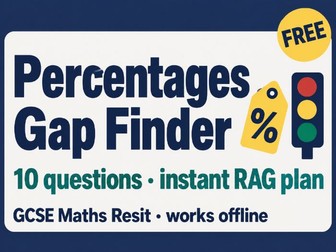
Free Payslip Detective KS4 – Spot the Payroll Error + PosterQuick View
SimulationLessons

Free Payslip Detective KS4 – Spot the Payroll Error + Poster

(0)
Free Payslip Detective for KS4: two fictional UK payslips, each with one planted payroll error, plus a one-page labelled payslip poster with 2026/27 rates. Interactive demo (works offline): two fictional UK payslips, each with one planted payroll error. Students click the wrong line, then choose what the worker should do. Points are scored once per payslip, so the first answer counts. A payslip is the record an employer gives with each payment, showing gross pay, each deduction and net (take-home) pay. What’s included The detective demo (1 offline HTML file, 2 payslips) “Anatomy of a UK payslip”: a one-page labelled poster with 15 parts (editable Word + PDF), 2026/27 rates START_HERE_Open_Me.html Who it’s for: KS4 PSHE, careers and maths teachers, and tutors preparing Year 10 and 11 students for part-time work, work experience or an apprenticeship. Many young people get their first payslip without knowing what a tax code or NI deduction means, and payroll mistakes do happen. How to use it Starter (10 minutes): show the poster and ask students to find gross pay, net pay and the tax code. Detective (15 minutes): run the demo on the board. The class agrees which line is wrong, then votes on what the worker should do next. Plenary (5 minutes): students write down the one line on a payslip they would always check. It also suits a tutor-time money session, a maths lesson on percentages or a cover lesson. The poster is a useful display for a careers board or a sixth-form common room. Rates are for the 2026/27 tax year (England), checked on GOV.UK. This is finance education, not financial advice. Every name, employer and figure on the payslips is fictional. Recheck GOV.UK before using it in later tax years. Want the full lessons? The full resource has two 60-minute lessons on reading a payslip and working out deductions, worksheets at three levels, and the Payslip Builder & Detective: students choose a job, hours and age band and watch a payslip fill in, with PAYE, NI, pension and student loan explained step by step, then hunt for the error on all 8 payslips. The full version: Payslip Lesson KS4 – Tax Code, PAYE, NI, Pension + Student Loan Free to use with your own classes under the Tes licence. Please don’t post the files publicly or share them beyond that licence. Last updated: 13/11/2026. The full version is available from the same author on Tes.
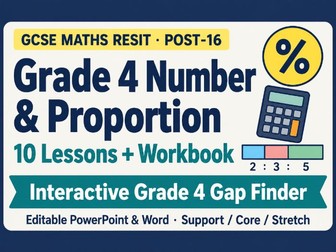
Payslip Lesson KS4 – Tax Code, PAYE, NI, Pension + Student LoanQuick View
SimulationLessons

Payslip Lesson KS4 – Tax Code, PAYE, NI, Pension + Student Loan

(0)
Payslip lesson pack for KS4: two 60-minute lessons on reading a UK payslip and calculating deductions for 2026/27, with the Payslip Builder & Detective. Payslip Builder & Detective (interactive): students choose a job, hours and age band and watch a UK payslip fill in, with its tax code and deductions (PAYE income tax, National Insurance, workplace pension and student loan) explained step by step. Then they hunt for the planted error on 8 payslips. All figures are for the 2026/27 tax year (England), checked on GOV.UK. A payslip is the record an employer gives with each payment, showing gross pay, each deduction and net (take-home) pay. Reading a payslip: gross vs net pay, tax codes (1257L, BR, 0T, emergency), PAYE, NI, pension, student loan, payroll and NI numbers, year to date, and a Gross to Net human line. Calculating deductions and Payslip Detective: a worked example, a Deduction Relay, an 8-station error hunt (tax code, pension, hours, overtime rate, below minimum wage, NI, student loan plan, net pay sum) and what to do next (payroll, HMRC’s Check your Income Tax service, Acas, the Student Loans Company). What’s included Payslip Builder & Detective (1 offline HTML file: Builder, 8 Detective payslips scored once each, editable rates and sources panel; recheck GOV.UK before later years) 4 editable PowerPoint decks: Teacher (plan, answers, notes) and Student 6 editable Word worksheets at 3 levels Answer key with full workings, including the Relay and all 11 payslips 11-payslip set (Word), 8 Payslip Detective stations with a Detective Log, activity cards, an editable 2026/27 rates card and an “Anatomy of a UK payslip” poster Teacher guide: every rate with its GOV.UK source and date, misconceptions, sensitivity notes START HERE page; 17 PDFs Deductions often missed: workplace pension auto-enrolment (age 22+, £10,000 trigger, 5% employee / 3% employer on qualifying earnings, opting out) and student loans (Plan 2, Plan 5 and the Postgraduate Loan), plus National Living Wage and minimum wage rates from 1 April 2026. Accuracy: every rate checked on GOV.UK (HMRC, DWP and Student Loans Company pages) on 04/11/2026; sources are listed in the teacher guide and the interactive. People, employers and NI numbers are fictional. This is finance education, not financial advice. Curriculum: KS4 Citizenship (DfE national curriculum: income and expenditure, savings and pensions, how public money is raised and spent); KS4 PSHE economic wellbeing and careers. Also suits GCSE Maths percentages in context. Licence: supplied under the Tes licence you choose at checkout (standard, or Multi-User/School Licence where purchased). Print and edit for your pupils; do not share outside your school or post publicly. Try it free first: Free Payslip Detective KS4 – Spot the Payroll Error + Poster Last updated: 13/11/2026.
Free Food Hygiene AQA GCSE + KS3 – 4 Cs Poster + Fridge DemoQuick View
SimulationLessons

Free Food Hygiene AQA GCSE + KS3 – 4 Cs Poster + Fridge Demo

(0)
Free food hygiene poster for AQA GCSE Food Preparation and Nutrition and KS3: the 4 Cs on one A4 page (Word + PDF), plus a fridge-loading interactive demo. Includes a free fridge-loading demo from Danger Zone Kitchen: pupils put a café delivery into the fridge, freezer and dry store, then check the fridge thermometer. Each choice scores once and explains the rule. Works offline. Food hygiene means storing, preparing and cooking food in ways that prevent food poisoning, summed up as the 4 Cs: cleaning, cooking, chilling and avoiding cross-contamination. What’s included The 4 Cs poster (Word + PDF, one A4 page): cleaning, cooking, chilling and cross-contamination, with the key AQA temperatures and a note on the FSA’s current wording. Fridge-loading demo (one offline HTML file): 11 delivery items and the fridge thermometer question (12 points). Works on an interactive whiteboard, laptop or phone. Answers stay while the page is open; closing or refreshing clears them. Who it’s for: food teachers at KS3 and GCSE, and anyone teaching a first practical. It helps pupils learn the rules before they handle raw meat, chilled food or leftovers in the food room. How to use it Starter (10 minutes): run the fridge demo on the board. Pupils call out where each item goes before you place it. Poster task (15 minutes): pupils use the poster to write one rule for each of the 4 Cs in their own words. Before a practical (5 minutes): recap the temperatures on the poster as a quick quiz. Put the poster up next to the fridge or by the sinks so pupils see it in every practical. The Word file is editable, so you can add your own room rules. Alignment: AQA GCSE Food Preparation and Nutrition (8585) 3.4.2; supports KS3 D&T cooking and nutrition. Not endorsed by or affiliated with AQA, the Food Standards Agency, the NHS or the Department for Education. Check the current specification at aqa.org.uk. Want the full unit? The full three-lesson unit adds four more Danger Zone Kitchen stations (probe challenge, hot holding, allergens, cooling and reheating) with a bacteria growth meter and inspector report, slides, three-level worksheets, a 12-picture Practical Room Inspection, safety cards and an exam-style assessment. The full version: Food Safety and Hygiene AQA GCSE + KS3 – 3 Lessons + Interactive Free to use with your own classes under the Tes licence. Please don’t post the files publicly or share them beyond that licence. Last updated: 13/11/2026. The full version is available from the same author on Tes.
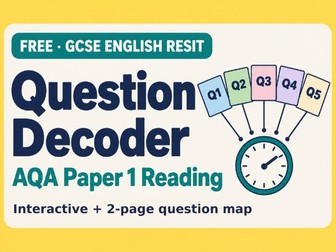
Gambling PSHE Lessons KS3/KS4 – Loot Boxes, Odds & Online BettingQuick View
SimulationLessons

Gambling PSHE Lessons KS3/KS4 – Loot Boxes, Odds & Online Betting

(0)
A gambling PSHE pack for KS3 and KS4: two editable 60-minute lessons on loot boxes, odds, online betting, adverts and the law, plus an Odds Lab simulator. Gambling means risking money or something of value on an uncertain outcome, hoping to win more than you stake. The Odds Lab, an offline simulator: pupils bet virtual tokens on an invented slot machine, scratchcard, loot box and football bet, then run 1,000 plays and a class of 30 players to watch the house edge win. Every game shows its odds and the maths. It ends with Spot the Hook (7 invented adverts). Nothing is saved or sent. No real brands, adverts or money, and a neutral, non-judgemental tone (some pupils’ families gamble). What’s included Lesson 1 Chance, Odds and Loot Boxes (KS3, Y7–9); Lesson 2 Online Betting, Adverts and the House Edge (KS4, Y10–11); 60 min each 4 editable PowerPoint decks: Teacher (plan, safeguarding checklist, answers, notes) and Student 6 Word worksheets at 3 levels (Support, Core, Stretch with expected-value maths) and answer key Activity cards: Chance or Skill? four corners, Beat the House dice game, Spot the Hook sort, continuum debate Teacher guide: safeguarding, timings, misconceptions, worked calculations, law sources, RSHE map, cover routes START HERE page; PDF copies of every document Every figure checked: each probability, expected value and house edge (slot 9.6%, scratchcard 15%, bookmaker’s margin 8.9%; a 1% item takes 100 crates on average, costing £99.80) is calculated by code from the invented odds. UK law (checked November 2026 against the Gambling Act 2005, Gambling Commission and DCMS): 18+ for most gambling and the National Lottery; online slots rules (stake limits, no auto-play); bonus wagering capped at 10× (January 2026); advertising rules; why most loot boxes are not legally gambling (2023 industry guidance). Legal points describe the law in Great Britain, where gambling is regulated by the Gambling Commission; Northern Ireland has its own gambling law. Scope and safeguarding: money, odds, design, adverts, law and help (trusted adult, Childline, National Gambling Helpline); not health effects. This supports, but does not replace, your safeguarding policy, your DSL and local procedures. Alignment: DfE statutory RSHE guidance (July 2025, from 1 September 2026): Wellbeing online points 4 and 5; Teaching about the law (para 63, which lists gambling). Not produced or endorsed by the DfE, the Gambling Commission, DCMS, GamCare, Childline/NSPCC or any games or gambling company. Licence: supplied under the Tes licence you choose at checkout (standard, or Multi-User/School Licence where purchased); sharing the Odds Lab with pupils is governed by that licence. Do not post the files on a public website. Try it free first: Free Gambling PSHE KS3/KS4 – Loot Box Interactive + Odds Sheet Last updated: 13/11/2026.