Year 1 History of Toys Writing Unit (TWS)Quick View
JamesWyh

Year 1 History of Toys Writing Unit (TWS)

(0)
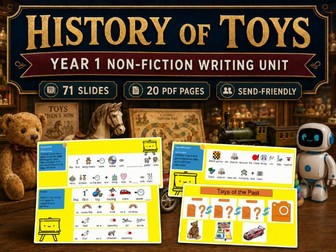
A complete Year 1 non-fiction writing unit on the history of toys, with a 71-slide PowerPoint, SEND scaffolds and differentiated writing frames. This engaging, ready-to-teach English unit supports children in researching, planning and writing a structured non-fiction report about toys from the past. It offers meaningful cross-curricular links with the Year 1 History curriculum and the study of toys within living memory. The lessons are linked with The Write Stuff (TWS) approach, including experience lessons, vocabulary collection, sentence stacking, writing lenses and a carefully structured independent writing sequence. What is included? A comprehensive 71-slide teaching PowerPoint A 14-page PDF of additional scaffolds A 6-page PDF of differentiated writing frames Lessons introducing the shape and structure of a non-fiction report Activities for organising headings, subheadings, facts and sections Vocabulary-building and experience lessons Modelled sentences and shared writing opportunities Dual-coded sentence scaffolds to support lower-attaining pupils and children with SEND Interactive sorting and report-building activities Links to carefully selected online puzzles, songs and videos Planning, independent writing and review lessons Open writing frames and more heavily scaffolded alternatives Report sections Children explore and write about: Brilliant Bears – the history of teddy bears and fascinating bear facts Brilliant Board Games – how games have changed and why children enjoy them Wonderful Wheels – historical and modern toy cars, including exciting facts and comparisons Writing skills covered The unit develops children’s understanding and application of: Non-fiction report structure Headings and subheadings Statements and factual sentences Questions Alliteration Adjectives and verbs Similes and comparisons Vocabulary selection Sentence construction Oral rehearsal Planning, drafting and independent writing The final outcome is an organised non-fiction report titled Toys of the Past, allowing pupils to demonstrate their historical knowledge alongside their developing writing skills. This resource can be taught as a complete English unit or used alongside a Year 1 History topic about toys from the past, changes within living memory, old and new toys, teddy bears, board games and toy cars. Download the free - TopMarks Font - and install to avoid formatting issues.
The Bear and the Piano Writing Unit (TWS)Quick View
JamesWyh

The Bear and the Piano Writing Unit (TWS)

(0)
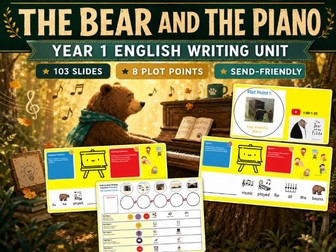
A complete Year 1 English writing unit for The Bear and the Piano, with 103 PowerPoint slides, eight plot points, modelled writing and SEND support. This detailed, ready-to-teach unit is linked with The Write Stuff (TWS) approach and supports children in building towards an independent adventure story inspired by David Litchfield’s The Bear and the Piano. The resource includes: Plot Points 1–8, with carefully sequenced teaching slides Experience lessons to develop vocabulary and background knowledge Sentence-stacking opportunities and modelled examples Clear learning intentions and steps to success Vocabulary gathering and sentence-building activities An additional independent letter-writing opportunity Guided planning for an adventure story Independent writing, editing and publishing lessons Scaffolded sentence stems and writing frames Oracy, drama, music and sensory-learning opportunities Dual-coded visuals throughout the PowerPoint, supporting lower-attaining pupils and children with SEND Plot point display circles for use on working walls or classroom displays Links to a YouTube video of the story and other carefully selected video and audio clips The unit explores setting descriptions, emotions, expanded vocabulary, exclamations, sequencing, recount writing and adventure-story structure. It can be taught as a complete English unit or adapted to suit the needs of your class. Important font information: This resource uses the Topmarks font. Please download and install this free font before opening the PowerPoint to ensure that all slides display correctly and avoid formatting issues. Please note that a copy of the book is not included. Teachers may wish to use their own copy alongside the linked video.
The Storm Whale Year 1 Writing Unit (TWS)Quick View
JamesWyh

The Storm Whale Year 1 Writing Unit (TWS)

(0)
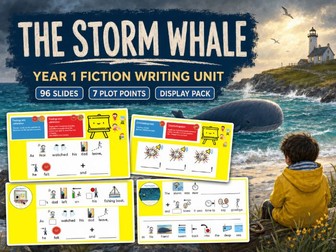
A complete Year 1 fiction writing unit for The Storm Whale, with 96 PowerPoint slides, seven plot points, display resources and SEND-friendly support. This detailed, ready-to-teach English unit supports children in exploring, orally rehearsing and writing a story inspired by The Storm Whale. The narrative is broken into manageable plot points, enabling pupils to build effective sentences before independently writing their own innovated version. The lessons are linked with The Write Stuff (TWS) approach, including experience lessons, vocabulary development, writing lenses, sentence stacking, modelled writing and an independent writing sequence. What is included? A 75-slide main teaching PowerPoint A separate 21-slide independent writing PowerPoint 96 PowerPoint slides in total A one-page plot-point overview graph A 17-page plot-point display pack Seven clearly sequenced plot points Video links and precise timings for revealing the story Modelled writing and scaffolded sentence activities Detailed teaching notes for the independent writing sequence Dual-coded vocabulary and sentence scaffolds Drama, discussion and oral-rehearsal opportunities A storm-themed experience lesson Retrieval, inference, prediction and vocabulary activities Handwriting-practice opportunities Optional incidental writing linked to a sea-life recount or whale fact file Support for lower-attaining pupils and children with SEND Plot-point sequence The story is organised into seven manageable stages: The lonely little boy Discovering the whale Hiding the whale in the bath Dad discovers Noi’s feelings Taking the whale back to sea Saying goodbye to his whale friend Noi sees his friend again The included display materials can be used to build a classroom working wall as each plot point is taught. Writing skills covered The unit supports children in developing: Descriptive vocabulary Adjectives and expanded noun phrases Powerful verbs Character feelings Sentence openers Oral sentence rehearsal Onomatopoeia Sensory description Story sequencing Capital letters, full stops and finger spaces Planning and innovating a familiar narrative Independent story writing Retrieval, inference and prediction Independent writing outcome Children create their own character and innovate key story details while retaining the familiar emotional journey and narrative structure. The independent-writing PowerPoint provides clear teaching notes, shared planning prompts and progressive scaffolds for each stage. The final story is written for a purposeful audience, with the suggested outcome of sharing the finished stories with a Reception class. Please note that a copy of The Storm Whale is not included. Teachers may wish to use their own copy alongside the linked video materials. Download the Topmarks free font to avoid formatting issues.
Song of the Sea Year 1 Writing Unit (TWS)Quick View
JamesWyh

Song of the Sea Year 1 Writing Unit (TWS)

(0)
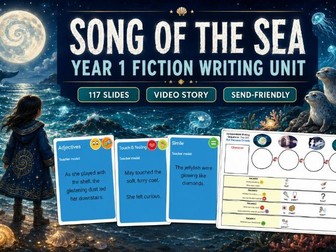
A complete Year 1 fiction writing unit based on the animated short Song of the Sea, with 117 PowerPoint slides, video links and SEND-friendly support. This imaginative, ready-to-teach English unit uses a beautiful animated video story to inspire children to plan and write their own magical ocean adventure. The film is revealed gradually, allowing pupils to predict, explore characters’ feelings and develop effective sentences at each stage of the narrative. The lessons are linked with The Write Stuff (TWS) approach, including experience lessons, writing lenses, vocabulary collection, sentence stacking, oral rehearsal and a carefully sequenced independent writing outcome. What is included? Video file of the animated story Plot Point Display Circles A comprehensive 117-slide teaching PowerPoint A complete sequence of sentence-stacking lessons Timed video prompts showing when to pause and reveal each section Six carefully sequenced story stages Modelled sentences and complete teacher-model texts Experience lessons incorporating drama and sensory exploration Vocabulary gathering and oral rehearsal activities Plot-point recapping and sequencing Talk for Writing-style actions and oral retelling Independent planning and success-criteria activities Several lessons for independently writing the story Editing, improving and publishing opportunities A final reading-inference activity Dual-coded slides and visual sentence scaffolds to support lower-attaining pupils and children with SEND Story sequence Children follow May on a magical adventure as she: Discovers a bright, glistening shell Follows a trail of magical dust Finds a mysterious golden key Opens a hidden chest Discovers a soft, magical coat Walks towards the beach Dives beneath the waves Encounters seals, jellyfish, coral and a magnificent whale Emerges beneath a bright, magical moon Writing skills covered The unit supports children in developing: Descriptive sentences Adjectives and expanded vocabulary Powerful verbs Adverbs and sentence openers Character feelings Inner thoughts and questions Sensory description Alliteration Similes Onomatopoeia Story sequencing Oral storytelling Planning, drafting, editing and publishing Reading inference The final outcome is an independently written magical adventure story, allowing children to adapt characters, settings and details while following the familiar narrative structure. This resource is ideal for Year 1, but the visual scaffolding and adaptable tasks may also support pupils working below age-related expectations in Year 2 or children with additional learning needs.
The Last Bear Year 3 Fiction Writing Unit (TWS)Quick View
JamesWyh

The Last Bear Year 3 Fiction Writing Unit (TWS)

(0)
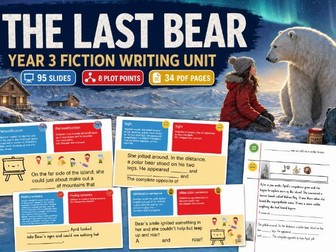
A complete Year 3 fiction writing unit for The Last Bear, with 95 PowerPoint slides, eight plot points, display materials and printable scaffolds. This detailed, ready-to-teach English unit supports pupils in exploring and writing an Arctic adventure inspired by Hannah Gold’s The Last Bear. Children follow April Wood’s journey to Bear Island, from her initial isolation to her extraordinary friendship with a polar bear. The unit follows The Write Stuff (TWS) approach, using carefully sequenced plot points, experience days, vocabulary collection, writing lenses, sentence stacking, modelled examples and an extended rewriting outcome. What is included? A comprehensive 95-slide teaching PowerPoint A 14-page plot-point display pack A 20-page printable resource and scaffold pack 34 printable PDF pages in total Eight carefully sequenced plot points Modelled and scaffolded sentences Vocabulary-generation activities Printable extracts and writing frames Cloze passages for additional support Research activities about polar bears WWF, YouTube and documentary links Experience-day activities Recapping and oral-rehearsal lessons Extended rewriting lessons Support for lower-attaining pupils and children with SEND Plot-point sequence The narrative is organised into eight manageable stages: April arrives on Bear Island April becomes bored and begins exploring April discovers the polar bear April meets Bear April devises a plan to befriend him April approaches Bear with food April and Bear explore the island together April finds her roar The accompanying display materials allow teachers to reveal each plot point gradually and build a clear working wall throughout the unit. Writing skills covered The unit supports pupils in developing: Arctic setting descriptions Expanded noun phrases Precise adjectives and verbs Similes Fronted adverbials Vocabulary for emotions Inner thoughts Questions and dialogue Speech punctuation Adverbs Powerful sentence openers Contrasting ideas Characterisation Suspense and atmosphere Alliteration Story sequencing Paragraph development Editing and rewriting Experience and vocabulary development Children explore the Arctic environment through images, sound, video and factual research. They learn about polar bears, generate language to describe the island and consider how April might safely gain Bear’s trust. Final writing outcome Following the sentence-stacking sequence, pupils recap the eight plot points and complete an extended rewrite of April’s adventure. The printable resources provide different levels of support, including modelled openings, structured writing frames, sentence prompts and cloze passages. Important font information: The PowerPoint uses the Kinetic Letters Unjoined font. Please download and install this font before opening the resource to prevent formatting issues. Please note that a copy of The Last Bear is not included. Teachers will need their own copy of the novel to teach the complete unit.
When I Am by Myself Year 1 Poetry Unit (TWS)Quick View
JamesWyh

When I Am by Myself Year 1 Poetry Unit (TWS)

(0)
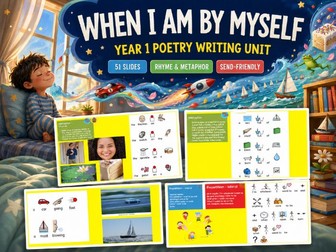
A complete Year 1 poetry writing unit with 51 PowerPoint slides, teaching rhyme, metaphors, precise verbs and imaginative rhyming couplets. This creative, ready-to-teach English unit supports children in exploring the structure of a poem before composing their own version of When I Am by Myself. Pupils imagine the exciting, unusual and humorous things they could become when they close their eyes. The lessons are linked with The Write Stuff (TWS) approach, including experience activities, writing lenses, vocabulary generation, modelled composition, sentence scaffolds and opportunities for pupils to deepen each poetic idea. What is included? A comprehensive 51-slide teaching PowerPoint Activities introducing the shape and structure of the model poem Visual representations of the poem’s repeated structure Rhyming-word games and matching activities Modelled poetic lines Dual-coded sentence scaffolds Vocabulary-generation activities Picture-observation and “tiny details” tasks Interactive Wordwall and YouTube links Oral rehearsal and performance opportunities Movement-generation activities Support for lower-attaining pupils and children with SEND Poetry skills covered The unit develops children’s understanding and use of: Rhyme Rhyming couplets Metaphors Noun phrases Precise verbs Movement vocabulary Repetition Poem structure Rhythm and oral rehearsal Imaginative language Vocabulary selection Performance and expression Learning sequence Children begin by exploring the shape of the model poem, identifying its repeated patterns and discussing the ideas behind it. They then explore rhyme and create imaginative metaphors by noticing the smallest details in photographs and everyday objects. Example ideas include becoming: The sprinkles on a cake The petal on a flower The stalk on a pepper A shelf full of books A sea full of boats A bag full of sweets The later lessons develop movement ideas and precise verbs. Pupils use images, sound clips and physical actions to create lines about racing cars, sailing boats, rockets, animals and the sea. Final writing outcome Children compose their own imaginative poem using the repeated structure: When I’m by myself, and I close my eyes… They create rhyming metaphors, develop actions using precise verbs and finish with a repeated reflective ending. The unit can conclude with children reading or performing their finished poems aloud. This resource is ideal for Year 1 poetry, but its strong visual scaffolding also makes it suitable for children working below age-related expectations, pupils with SEND or adapted Year 2 teaching. Download and install the free TopMarks font to avoid formatting issue.
The Street Beneath Year 3 Writing Unit (TWS)Quick View
JamesWyh

The Street Beneath Year 3 Writing Unit (TWS)

(0)
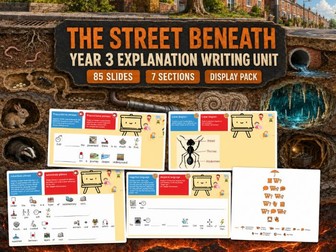
A complete Year 3 non-fiction explanation-writing unit about the world beneath our feet, with 85 PowerPoint slides, display resources and SEND support. This engaging, ready-to-teach English unit takes children on an extraordinary journey from the pavement beneath their feet through soil, animal habitats, caves, rock and underground mines. Inspired by The Street Beneath My Feet, the unit combines English, science, geography and history knowledge before guiding pupils towards an independent explanation text. The lessons follow The Write Stuff (TWS) approach, including experience days, vocabulary collection, writing lenses, sentence stacking, modelled examples, text-shape exploration and an independent writing outcome. What is included? A comprehensive 74-slide teaching PowerPoint A separate 11-slide display PowerPoint 85 PowerPoint slides in total Seven carefully sequenced sections of an explanation text Modelled and scaffolded sentence activities Vocabulary-generation tasks Experience-day activities Video, virtual-tour and research links Planning and independent writing lessons Recapping and oral-rehearsal activities Dual-coded resources supporting lower-attaining pupils and children with SEND Display materials for building a working wall throughout the unit Journey beneath the street Children explore and write about: The pavement and soil beneath their feet The rock cycle Insects, spiders and centipedes Underground animal habitats and burrows Beetles and fascinating insect facts Plant roots growing through soil Caves, caverns, stalactites and stalagmites Decay and decomposing materials Coal and underground mining Victorian children who worked in mines The deepest layers beneath Earth’s surface Experience and knowledge-building activities The unit includes memorable activities to help children gather knowledge and vocabulary, including: Learning and performing a rock-cycle song Creating an additional rock-cycle rap verse Watching extracts about burrowing animals Researching underground habitats Drawing and labelling underground creatures Exploring facts about beetles Taking a virtual tour of Stump Cross Caverns Investigating decay Exploring underground chambers Learning about coal mining and Victorian child labour Writing skills covered After recapping the complete journey and reviewing their modelled sentences, pupils plan and write an extended explanation text about what can be found beneath the street. The separate display PowerPoint supports teachers in creating a clear working wall that grows as each section is taught. This resource is ideal for Year 3 non-fiction writing and works particularly well alongside science learning about rocks, soils, fossils and plants, as well as history learning about Victorian mining. Install the Kinetic letters Unjoined font to avoid formatting issues. Please note that a copy of The Street Beneath My Feet is not included. Teachers may wish to use their own copy alongside the unit.
Theseus and the Minotaur Year 3 Unit (TWS)Quick View
JamesWyh

Theseus and the Minotaur Year 3 Unit (TWS)

(0)
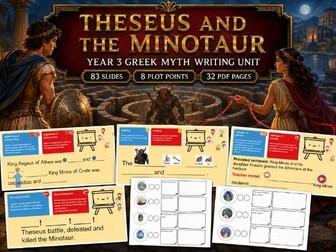
A complete Year 3 Greek mythology writing unit for Theseus and the Minotaur, with 83 PowerPoint slides, adapted resources and a plot-point display pack. This exciting, ready-to-teach English unit introduces pupils to the features of Greek mythology before guiding them through the dramatic story of Theseus, Ariadne and the Minotaur. The lessons follow The Write Stuff (TWS) approach, using experience activities, vocabulary collection, writing lenses, sentence stacking, modelled examples and adapted writing frames. What is included? A comprehensive 83-slide teaching PowerPoint A 15-page adapted resource pack A 17-page plot-point display pack 32 printable PDF pages in total A clearly sequenced myth-writing journey Modelled and scaffolded sentence activities Cloze passages and adapted writing frames Vocabulary banks and oral-rehearsal prompts An independent Minotaur-description task Experience-day activities Myth-innovation planning resources Support for lower-attaining pupils and children with SEND Plot-point sequence The display pack organises the myth into eight clear stages: Story opening and introductions Introducing the Minotaur Theseus joins the sacrificial group Meeting their fate Ariadne’s proposal Theseus kills the Minotaur The catch Theseus plans his escape The display materials can be revealed gradually to build a working wall and help pupils retain the complete narrative structure. Story and learning journey Children explore: The conventions of Greek myths Theseus as the hero King Aegeus and King Minos The conflict between Athens and Crete The creation and imprisonment of the Minotaur The annual sacrifice Theseus volunteering to face the monster The journey to Crete Ariadne’s plan and marriage proposal The ball of string and the labyrinth Theseus’ battle with the Minotaur The escape from Crete The consequences of Theseus’ promises Writing skills covered The unit includes an extended description of the Minotaur, encouraging pupils to create a vivid and detailed portrayal of the mythical creature. The adapted resource pack also includes planning prompts for pupils to innovate the myth by changing: The main character The monster The number of people in the group The method of travel The love interest How the monster is defeated The ending This allows teachers to use the resource for a supported retelling or progress towards a more independent, innovated myth. This unit is ideal for Year 3 fiction writing and offers valuable cross-curricular links with history learning about Ancient Greece, Greek gods, heroes, myths and legends. Install the Kinetic Letters Unjoined font to avoid formatting issues.
Decimal Place Value Poster HTU. Tenths, Hundredths, ThousandthsQuick View
JamesWyh

Decimal Place Value Poster HTU. Tenths, Hundredths, Thousandths

(0)
Decimal Place Value Poster HTU. Tenths, Hundredths, Thousandths. Bright and children friendly. Objective: Recognise and write decimal equivalents of any number of tenths or hundredths. Count up and down in hundredths; recognise that hundredths arise when dividing an object by one hundred and dividing tenths by ten.
Converting Measurements : Capacity, Mass and LengthQuick View
JamesWyh

Converting Measurements : Capacity, Mass and Length

(0)
A very helpful aid for converting back and forth the 3 main measures of Capacity, Mass and Length. Includes: ml to L, g to Kg, m to Km. Objective: I can convert between different units of metric measure (for example, kilometre and metre; centimetre and metre; centimetre and millimetre; gram and kilogram; litre and millilitre).
Alan Peat Sentence PostersQuick View
JamesWyh

Alan Peat Sentence Posters

(2)
Can be used in whole of KS2 to help children vary and make more interesting sentences. Child friendly, examples given, key word lists. Posters Included: - BOYS Sentences - 2A Sentences - Simile / Metaphor - 3ED Sentences - 2 Pairs Sentences - De: De Sentences - Outside (Inside) Sentences - Double -ly ending
Viking Resources 5 Lesson PPTs + SheetsQuick View
JamesWyh

Viking Resources 5 Lesson PPTs + Sheets

(2)
Linked to my lesson plans on the Vikings for KS2. Using interactive activities and Power Points these lessons give children a good understanding at the Vikings and their impact on the UK. (Presentations, Objectives, Powerpoints, Activities, Display Work, Extensions, Challenges) L1 - Vikings Intro L2 - Questioning the Vikings L3 - Longships L4 - Artefacts L5 - Burials
Aid/Poster Reading the Analogue Clock - Hands, Hours, MinutesQuick View
JamesWyh

Aid/Poster Reading the Analogue Clock - Hands, Hours, Minutes

(0)
A resource that helps children read the analogue clock, spell the key vocab, understanding o'clock, half past, quarter past and quarter to. Also with time conversions for hours and minutes. Objective: Convert between different units of measure [for example, kilometre to metre; hour to minute. I can read, write and convert time between clocks with hands (analogue clocks) and digital 12- and 24-hour clocks.
Multiply and Divide by 10 and 100 Frame Tenths Hundredths Place ValueQuick View
JamesWyh

Multiply and Divide by 10 and 100 Frame Tenths Hundredths Place Value

(0)
A template to help children keep their place value when multiplying and dividing by 10 and 100. Clear instructions and very children friendly. I have used this resources many years to teach this maths objective with great success. (Maths, Frame, Resource, Aid, Help, SEN) Objective: Find the effect of dividing a one- or two-digit number by 10 and 100, identifying the value of the digits in the answer as ones, tenths and hundredths.
Descriptive Devices - expanded noun phrases, similes, metaphors, personification, atmosphereQuick View
JamesWyh

Descriptive Devices - expanded noun phrases, similes, metaphors, personification, atmosphere

(0)
A useful learning aid/mat to remind writers what they can include to increase their description within narratives and other text types. Laminate and have next to all writers! A handy learning tool! Use expanded noun phrases (2A Sentences) to add detail, qualification and precision: The mansion -> The grand, old mansion with towering chimneys. Create atmosphere/images by using a range of language: Similes - The road meandered like a serpent. - use like or as Metaphors - The moon was a ghostly galleon. - compare without like or as Personification - The wind whispered their fate. - give human features Alliteration - Slithering serpents. Indigo igloos. - first letter repetition Onomatopoeia - Crash! Bang! Whoosh! - word sounds like the sound!
Protractor Guide - How to Measure KS2Quick View
JamesWyh

Protractor Guide - How to Measure KS2

(0)
A clear 3 step method to measure angles with a protractor. Child friendly and easy to use. Objectives: I can find acute and obtuse angles and order a set of given angles by size. Know angles are measured in degrees: estimate and compare acute, obtuse and reflex angles.
Catholic Primary School Prayer PostersQuick View
JamesWyh

Catholic Primary School Prayer Posters

(0)
Lovely posters for your classroom. The standard catholic primary school prayers. Useful for the children to learn and to be up on display promoting the ethos of your school. (also handy to remind yourself) Includes: - Morning - Our Father - Hail Mary - Grace Before Meals - Grace After Meals - End of day prayer - The Memorare
Lower KS2 Maths Vocabulary PosterQuick View
JamesWyh

Lower KS2 Maths Vocabulary Poster

(0)
A clear and useful poster that children can use to solve word problems. Including all the vocab found in LKS2 for Addition, Subtraction , Division and Multiplication. + - x /