CAIE AS Chemistry Topics 10 11&12 Group2 Group17 Nitrogen Student Workbook 2025-2027 SyllabusQuick View
alexamaku

CAIE AS Chemistry Topics 10 11&12 Group2 Group17 Nitrogen Student Workbook 2025-2027 Syllabus

(0)
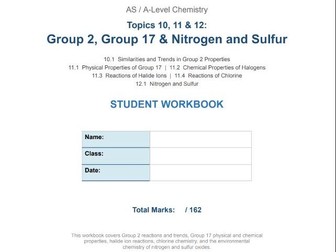
Perfect booklet for Mock Prep or Independent Revision and Mastery This workbook is designed to support structured, independent revision aligned precisely to the CAIE AS Chemsitry Topics 10 11 12 Group2 Group17 Nitrogen Sulfur Student Booklet/Workbook specification. **Questions are organised into progressive sections from foundational recall through to full examination-style problems **mirroring the cognitive demand students will encounter in their final papers. Every question maps directly to one or more syllabus learning outcomes, with mark allocations that reflect real examination weighting. A complete mark scheme is provided, enabling self-assessment, peer marking, or teacher-led review. Learning out comes covered Topic 10 Group 2 Reactions (with equations) of metals with O2, H2O, dilute HCl/H2SO4 Reactions of oxides/hydroxides/carbonates with water and dilute acids Thermal decomposition of nitrates/carbonates including trend in thermal stability Trends in physical/chemical properties across Group 2 (linked to above) Variation in solubilities of hydroxides and sulfates Topic 11 Group 17 (Halogens) 11.1 Physical Colours + trend in volatility (Cl2, Br2, I2) Trend in bond strength of halogen molecules Explain volatility via London forces 11.2 Chemical (halogens + hydrogen halides) Relative reactivity as oxidising agents Reactions with hydrogen + relative reactivity Relative thermal stabilities of hydrogen halides + explanation via bond strength 11.3 Halide ions Relative reactivity as reducing agents Reactions with: aqueous Ag+ then aqueous NH3 concentrated H2SO4 (include balanced equations) 11.4 Chlorine reactions Chlorine with cold/hot NaOH(aq): interpret via oxidation numbers; recognise disproportionation Explain chlorine in water purification incl. HOCl and ClO– production Topic 12 Nitrogen and sulfur Explain low reactivity of N2 (triple bond strength + lack of polarity) Ammonia: basicity (Brønsted–Lowry) structure/formation of NH4+ displacement of NH3 from ammonium salts by acid–base reaction Sources of nitrogen oxides + catalytic removal from exhausts NO/NO2 forming PAN (photochemical smog) with unburned hydrocarbons Role of NO/NO2 in acid rain (direct + catalytic oxidation of SO2)
CAIE AS Chemistry Topic 7 Equilibria Student Workbook 2025-2027 SyllabusQuick View
alexamaku

CAIE AS Chemistry Topic 7 Equilibria Student Workbook 2025-2027 Syllabus

(0)
Perfect booklet for Mock Prep or Independent Revision and Mastery This workbook is designed to support structured, independent revision aligned precisely to the CAIE AS Chemsitry Topic 7 Equilibria Student specification. **Questions are organised into progressive sections from foundational recall through to full examination-style problems **mirroring the cognitive demand students will encounter in their final papers. Every question maps directly to one or more syllabus learning outcomes, with mark allocations that reflect real examination weighting. A complete mark scheme is provided, enabling self-assessment, peer marking, or teacher-led review. Learning out comes covered Equilibria & Acids/Bases Topic 7.1 Chemical equilibria Reversible reactions; dynamic equilibrium (equal rates; constant concentrations); closed system requirement Define Le Chatelier’s principle Predict effects of T, concentration, pressure, catalyst (qualitative) Deduce and use Kc and Kp expressions; use mole fraction & partial pressure Do equilibrium calculations (no quadratic solving required) Calculate equilibrium quantities from data State what affects equilibrium constant value (and what doesn’t) Haber and Contact processes: conditions + explanation using Le Chatelier Topic 7.2 Brønsted–Lowry acids and bases Names/formulas of common acids: HCl, H2SO4, HNO3, CH3COOH Names/formulas of common alkalis: NaOH, KOH, NH3 Describe Brønsted–Lowry theory Strong vs weak acids/bases (full vs partial dissociation) pH scale basics (acid < 7, alkali > 7, water 7) Qualitative strong vs weak behaviour (reactive metals, pH, conductivity) Neutralisation: H+(aq) + OH–(aq) → H2O(l) Salts formed in neutralisation Sketch pH titration curves (strong/weak combos) Choose suitable indicators (no pKa use)
CAIE AS Chemistry Topic 9 The Periodic Table: chem periodicity Student Workbook 2025-2027 SyllabusQuick View
alexamaku

CAIE AS Chemistry Topic 9 The Periodic Table: chem periodicity Student Workbook 2025-2027 Syllabus

(0)
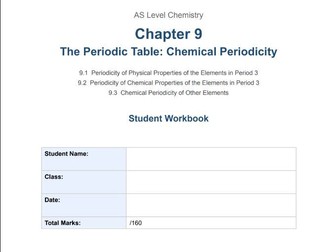
Perfect booklet for Mock Prep or Independent Revision and Mastery This workbook is designed to support structured, independent revision aligned precisely to the CAIE AS Chemsitry Topic 9 The Periodic Table: chemical periodicity Student specification. **Questions are organised into progressive sections from foundational recall through to full examination-style problems ** mirroring the cognitive demand students will encounter in their final papers. Every question maps directly to one or more syllabus learning outcomes, with mark allocations that reflect real examination weighting. A complete mark scheme is provided, enabling self-assessment, peer marking, or teacher-led review. Learning out comes covered Topic 9 Periodic Table: chemical periodicity 9.1 Physical properties (Period 3) Describe qualitative periodic trends: atomic radius, ionic radius, melting point, conductivity Explain mp and conductivity via structure/bonding 9.2 Chemical properties (Period 3) Reactions (with equations) of Period 3 elements with O2, Cl2, H2O (Na & Mg only) Variation in oxidation number of specified oxides/chlorides via valence electrons Reactions of oxides with water + likely pH Acid/base behaviour of oxides/hydroxides including amphoteric behaviour (as specified) Reactions of chlorides with water + likely pH Explain trends using bonding and electronegativity Suggest bonding types from observed properties 9.3 Other elements Predict properties of an element in a given group using periodicity Deduce nature/position/identity of unknown elements from physical/chemical data
CAIE AS Chemistry Topic 5 and 6 Energetics Electrochemistry Student Workbook 2025-2027 SyllabusQuick View
alexamaku

CAIE AS Chemistry Topic 5 and 6 Energetics Electrochemistry Student Workbook 2025-2027 Syllabus

(0)
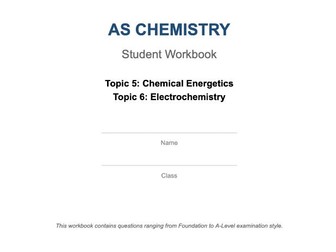
Perfect booklet for Mock Prep or Independent Revision and Mastery This workbook is designed to support structured, independent revision aligned precisely to the CAIE AS Chemsitry Topic 5 and 6 Energetics_Electrochemistry specification. **Questions are organised into progressive sections from foundational recall through to full examination-style problems ** mirroring the cognitive demand students will encounter in their final papers. Every question maps directly to one or more syllabus learning outcomes, with mark allocations that reflect real examination weighting. A complete mark scheme is provided, enabling self-assessment, peer marking, or teacher-led review. Learning out comes covered Topic 5.1 Enthalpy change, ΔH Understand reactions have enthalpy changes; exo (ΔH negative) / endo (ΔH positive) Construct/interpret reaction pathway diagrams (ΔH and activation energy) Define standard conditions (298 K, 101 kPa) and enthalpy terms: ΔHr, ΔHf, ΔHc, ΔHneut Explain energy transfers via bond breaking/making Use bond energies to calculate ΔHr Understand some bond energies are exact vs averages Calculate enthalpy changes using experimental results, including q = mcΔT and ΔH = –mcΔT/n Topic 5.2 Hess’s law Apply Hess’s law to construct simple cycles Use cycles to calculate: enthalpy changes not directly measurable calculations using bond energy data Topic 6 Electrochemistry (Redox) Topic 6.1 Redox processes Calculate oxidation numbers in compounds/ions Balance equations using oxidation number changes Define/use redox, oxidation, reduction, disproportionation (electron transfer + oxidation number change) Identify oxidising/reducing agents Use Roman numerals for oxidation numbers
CAIE AS Chemistry Topic 4. States of Matter Student Workbook 2025-2027 SyllabusQuick View
alexamaku

CAIE AS Chemistry Topic 4. States of Matter Student Workbook 2025-2027 Syllabus

(0)
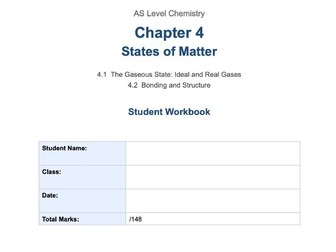
Perfect booklet for Mock Prep or Independent Revision and Mastery This workbook is designed to support structured, independent revision aligned precisely to the CAIE AS Chemsitry Topic 4. States of Matter specification. **Questions are organised into progressive sections from foundational recall through to full examination-style problems **mirroring the cognitive demand students will encounter in their final papers. Every question maps directly to one or more syllabus learning outcomes, with mark allocations that reflect real examination weighting. A complete mark scheme is provided, enabling self-assessment, peer marking, or teacher-led review. Learning out comes covered Topic 4.1 The gaseous state: ideal and real gases; pV = nRT Explain gas pressure via collisions Understand ideal gas assumptions (zero volume, no IMF) Use pV = nRT including determination of Mr Cambridge A level Chemistry 2 c… Topic 4.2 Bonding and structure Describe lattice structures: giant ionic (NaCl, MgO), simple molecular (I2, C60, ice), giant molecular (SiO2, graphite, diamond), giant metallic (Cu) Relate structure/bonding to mp/bp, conductivity, solubility Deduce structure/bonding type from information
CAIE AS Chemistry Topic 3 Chemical_Bonding Student Workbook 2025-2027 SyllabusQuick View
alexamaku

CAIE AS Chemistry Topic 3 Chemical_Bonding Student Workbook 2025-2027 Syllabus

(0)
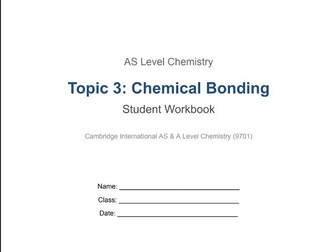
Perfect booklet for Mock Prep or Independent Revision and Mastery This workbook is designed to support structured, independent revision aligned precisely to the CAIE AS Chemsitry Topic 3 Chemical_Bonding specification. **Questions are organised into progressive sections from foundational recall through to full examination-style problems **mirroring the cognitive demand students will encounter in their final papers. Every question maps directly to one or more syllabus learning outcomes, with mark allocations that reflect real examination weighting. A complete mark scheme is provided, enabling self-assessment, peer marking, or teacher-led review. Learning out comes covered Topic 3.1 Electronegativity and bonding Define electronegativity Explain factors affecting electronegativity: nuclear charge, radius, shielding Explain trends across periods/down groups Use Pauling EN differences to predict ionic vs covalent bonding (covalent character in ionic compounds not assessed) Topic 3.2 Ionic bonding Define ionic bonding as electrostatic attraction between oppositely charged ions Describe ionic bonding using NaCl, MgO, CaF2 Topic 3.3 Metallic bonding Define metallic bonding as attraction between positive metal ions and delocalised electrons Topic 3.4 Covalent bonding and coordinate bonding Define covalent bonding; describe covalent bonding in: H2, O2, N2, Cl2, HCl, CO2, NH3, CH4, C2H6, C2H4 Understand Period 3 expanded octet in: SO2, PCl5, SF6 Describe coordinate bonding in: NH4+ formation and Al2Cl6 Describe σ and π bonds via orbital overlap; explain σ/π formation in H2, C2H6, C2H4, HCN, N2 Use hybridisation to describe sp, sp², sp³ Define bond energy and bond length; use them to compare reactivity Topic 3.5 Shapes of molecules (VSEPR) State/explain shapes and bond angles for: BF3, CO2, CH4, NH3, H2O, SF6, PF5 Predict shapes and bond angles for analogous species Topic 3.6 Intermolecular forces, electronegativity and bond properties Describe hydrogen bonding (N–H, O–H) and explain anomalous properties of water (mp/bp, surface tension, ice density) Explain bond polarity and dipole moments using electronegativity Describe van der Waals’ forces and types: London dispersion (id–id) and permanent dipole–permanent dipole (pd–pd) (including hydrogen bonding) State bonding types are generally stronger than intermolecular forces Topic 3.7 Dot-and-cross diagrams Use dot-and-cross diagrams for ionic, covalent, coordinate bonding (including expanded octet and odd-electron species)
CAIE AS Chemistry TOPIC 2 Amount of Substance Student Workbook 2025-2027 SyllabusQuick View
alexamaku

CAIE AS Chemistry TOPIC 2 Amount of Substance Student Workbook 2025-2027 Syllabus

(0)
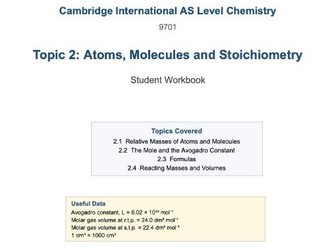
Perfect booklet for Mock Prep or Independent Revision and Mastery This workbook is designed to support structured, independent revision aligned precisely to the CAIE AS Chemsitry Topic 2 Amount of Substance specification. **Questions are organised into progressive sections from foundational recall through to full examination-style problems **mirroring the cognitive demand students will encounter in their final papers. Every question maps directly to one or more syllabus learning outcomes, with mark allocations that reflect real examination weighting. A complete mark scheme is provided, enabling self-assessment, peer marking, or teacher-led review. Learning out comes covered Topic 2.1 Relative masses of atoms and molecules Define unified atomic mass unit (1/12 of a carbon-12 atom) Define Ar, relative isotopic mass, Mr, relative formula mass in terms of the unified atomic mass unit Topic 2.2 The mole and the Avogadro constant Define and use mole in terms of the Avogadro constant Topic 2.3 Formulas Write formulas of ionic compounds from charges/oxidation numbers, including: Predict ionic charge from Periodic Table position Recall names/formulas of ions: NO3–, CO3²–, SO4²–, OH–, NH4+, Zn²+, Ag+, HCO3–, PO4³– Write/construct balanced equations, including ionic equations (no spectator ions) Use correct state symbols Define and use empirical and molecular formula Use anhydrous, hydrated, water of crystallisation Calculate empirical and molecular formulas from data Topic 2.4 Reacting masses and volumes (solutions and gases) Perform mole calculations involving: reacting masses + % yield gas volumes solution volumes and concentrations limiting/excess reagent deducing stoichiometric relationships from calculations
CAIE AS Chemistry TOPIC 1 Atomic Structure Student Workbook 2025-2027 SyllabusQuick View
alexamaku

CAIE AS Chemistry TOPIC 1 Atomic Structure Student Workbook 2025-2027 Syllabus

(0)
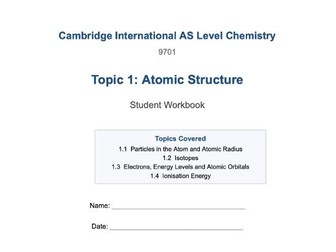
Perfect booklet for Mock Prep or Independent Revision and Mastery This workbook is designed to support structured, independent revision aligned precisely to the CAIE AS Chemsitry Topic 1 specification. **Questions are organised into progressive sections from foundational recall through to full examination-style problems **mirroring the cognitive demand students will encounter in their final papers. Every question maps directly to one or more syllabus learning outcomes, with mark allocations that reflect real examination weighting. A complete mark scheme is provided, enabling self-assessment, peer marking, or teacher-led review. Learning out comes covered Topic 1.1 Particles in the atom and atomic radius Candidates should be able to: understand that atoms are mostly empty space surrounding a very small, dense nucleus that contains protons and neutrons; electrons are found in shells in the empty space around the nucleus identify and describe protons, neutrons and electrons in terms of their relative charges and relative masses understand the terms atomic and proton number; mass and nucleon number describe the distribution of mass and charge within an atom describe the behaviour of beams of protons, neutrons and electrons moving at the same velocity in an electric field determine the numbers of protons, neutrons and electrons present in both atoms and ions given atomic or proton number, mass or nucleon number and charge state and explain qualitatively the variations in atomic radius and ionic radius across a period and down a group Topic 1.2 Isotopes Learning outcomes Candidates should be able to: define the term isotope in terms of numbers of protons and neutrons understand the notation ᴬ_Z X for isotopes, where A is the mass or nucleon number and Z is the atomic or proton number state that and explain why isotopes of the same element have the same chemical properties state that and explain why isotopes of the same element have different physical properties, limited to mass and density.
CAIE AS Chemistry Topic 8 Reaction-kinetics Student Workbook 2025-2027 SyllabusQuick View
alexamaku

CAIE AS Chemistry Topic 8 Reaction-kinetics Student Workbook 2025-2027 Syllabus

(0)
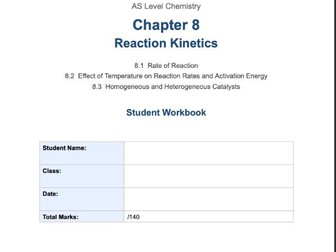
Perfect booklet for Mock Prep or Independent Revision and Mastery This workbook is designed to support structured, independent revision aligned precisely to the CAIE AS Chemsitry Topic_7_Equilibria_Student specification. **Questions are organised into progressive sections from foundational recall through to full examination-style problems ** mirroring the cognitive demand students will encounter in their final papers. Every question maps directly to one or more syllabus learning outcomes, with mark allocations that reflect real examination weighting. A complete mark scheme is provided, enabling self-assessment, peer marking, or teacher-led review. Learning out comes covered Topic 8.1 Rate of reaction Define/use rate, collision frequency, effective vs non-effective collisions Explain effects of concentration/pressure on rate (collision theory) Calculate rate from experimental data Topic 8.2 Temperature & activation energy Define activation energy (EA) Sketch/use Boltzmann distribution to explain EA Explain temperature effects using Boltzmann + collision theory Topic 8.3 Catalysts Define catalyst/catalysis; catalyst gives different mechanism with lower EA Explain catalyst effect via Boltzmann distribution Construct/interpret pathway diagrams with/without catalyst