John Clare 'I Am!' WJEC GCSE Paired Poetry Revision Guide & Discussion Revision MatQuick View
bg4eg3ng

John Clare 'I Am!' WJEC GCSE Paired Poetry Revision Guide & Discussion Revision Mat

(0)
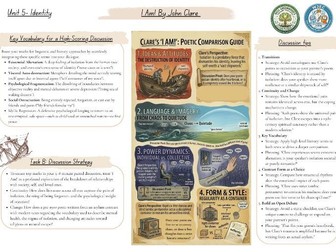
Resource Overview Unlock top marks in the WJEC GCSE English Literature paired poetry discussion with this comprehensive, visually stunning revision and preparation pack for John Clare’s ‘I Am!’. Designed specifically to meet the high-level linguistic and structural demands of the Unit 5: Identity component, these resources break down complex contextual, structural, and thematic concepts into highly digestible, student-friendly revision mats. Perfect for independent revision, group work, or scaffolding a high-scoring 5–8 minute paired discussion. What’s Included? Knowledge & Context Revision Mat (Image 1) Thematic Summary: A clear breakdown of the poem’s core themes: absolute isolation, psychological ruin, and the longing for peaceful escape. Contextual Anchors: Explores how context shapes meaning, covering Clare’s asylum institutionalization, his rise and fall as the “Peasant Poet”, and the impact of the Industrial Revolution/Enclosure Acts. Language & Symbolic Imagery: Close-analysis points for key quotes focusing on madness, disappearing identity, and nature as a sanctuary. Poetic Structure & Breakdown: An in-depth visual analysis of the poem’s tripartite structure (three sestets), regular iambic pentameter acting as a “disciplined container” for madness, the disrupted opening (caesura), and the shifting/resolving rhyme scheme. Comparison & Discussion Strategy Guide (Image 2) Key Vocabulary for High-Scoring Discussions: A bank of sophisticated tier-3 literary terms complete with definitions and quote matches (e.g., Existential Alienation, Visceral Auto-destruction, Psychological Fragmentation, Social Ostracisation, Idyllic Regression). Poetic Comparison Guide: Visual pillars comparing Ideas & Attitudes, Language & Imagery (Chaos vs. Quietude), Power Dynamics (Individual vs. Collective), and Form & Style (Regularity vs. Free Verse). Includes targeted “Discussion Pivots” to help students seamlessly bridge ‘I Am!’ with their partner’s poem. Discussion Tips & Phrasing Templates: Actionable strategies and sentence frames for transitions, tracking continuity/change, embedding key vocabulary, contrasting form, and building an open debate.
WJEC GCSE English Unit 5 Relationships: La Belle Dame sans Merci Complete 2-Page Knowledge OrganiserQuick View
bg4eg3ng

WJEC GCSE English Unit 5 Relationships: La Belle Dame sans Merci Complete 2-Page Knowledge Organiser

(0)
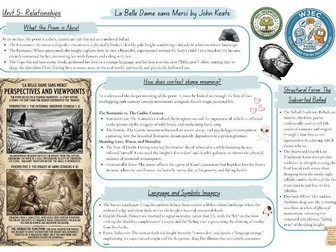
Are your students preparing for the WJEC Task B Spoken Language Paired Poetry Discussion? Help them secure the top mark bands with this premium, high-quality, 2-page visual Knowledge Organiser bundle. Specifically engineered to address the core assessment criteria, these resources move away from standard essay-writing prep to focus entirely on continuity, change, and comparative dialogue over time. Using John Keats’s classic 1820 poem, “La Belle Dame sans Merci,” as an anchor text, this set equips learners with the high-level vocabulary, structural insights, and conversation prompts needed to sustain an insightful 5–8 minute academic discussion.
English Skills Pack: Descriptive, Persuasive, and Narrative Writing Worksheet BundleQuick View
bg4eg3ng

English Skills Pack: Descriptive, Persuasive, and Narrative Writing Worksheet Bundle

(0)
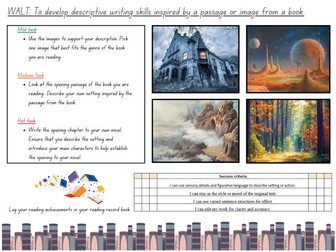
Elevate your English lessons with this comprehensive, multi-page Skills Pack designed to develop students’ reading, analysis, and extended writing abilities. Built around clear learning objectives (WALT) and structured with differentiated Mild, Medium, and Hot “Nando’s Chilli Tasks”, this resource provides everything you need to guide students from initial reading discussion to independent, high-quality writing. This pack covers a diverse range of essential English objectives, complete with Success Criteria checklists, student self-evaluation sections, and integrated oracy expectations. What’s Included in This Pack: **Setting Description & Figurative Language Mastery: ** Activities focused on identifying and describing how writers create setting in fiction using a mentor text example (“The old forest was alive with whispers…”). Targeted tasks for identifying, analysing, and using figurative language: similes, metaphors, personification, alliteration, hyperbole, and lists of three. Visual stimuli pages (including cave, winter moon, and haunted house scenes) to inspire descriptive writing. Narrative Perspective & Character Development: Lessons exploring how first-person narration reveals character thoughts and emotions. Tasks ranging from tracking character feelings with evidence to writing a short, first-person inner monologue. Character-focused descriptive writing tasks utilizing the “zoom effect” to transition from a broad character description to smaller, precise details using ambitious vocabulary. Includes 5 unique character illustration prompts. Expressing & Justifying Personal Opinions: A complete WAGOLL (What A Good One Looks Like) book review template based on The Hobbit by J.R.R. Tolkien. Differentiated outcomes including creating opinion bubble maps, providing written oral presentations with star ratings, and writing formal book reviews using evidence. Making Supported Inferences: Activities designed to help students deduce meaning and make inferences using clues from both text extracts and visual prompts (including a 4-quadrant canine image matrix). Differentiated pathways leading up to a formal PEE (Point, Evidence, Explanation) essay response. Extended Persuasive Writing Unit: A structured guide to developing persuasive writing skills to convince a reader to visit a travel destination. Includes a persuasive word bank (featuring words like phenomenal, outstanding, radiant, sensational) and sentence starters (e.g., “I urge you to…”, “You would be foolish to miss out on…”). Complete step-by-step planning frames: from brainstorming positive destination features (with a Lapland WAGOLL) to drafting a full persuasive article and completing a “2 stars and a wish” self-evaluation. An extension essay prompt exploring why persuasive techniques are essential to engage a reader.
Lord of the Flies: Character & Theme Annotation Worksheets (Ch. 4)Quick View
bg4eg3ng

Lord of the Flies: Character & Theme Annotation Worksheets (Ch. 4)

(0)
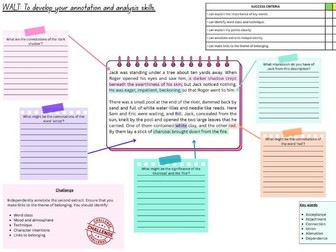
Looking for a ready-to-print, high-impact lesson to sharpen your students’ textual analysis skills? This comprehensive annotation and analysis resource focuses on the pivotal Chapter 4 face-paint scene from William Golding’s Lord of the Flies. Designed to develop critical reading independence, it guides students through close-language analysis while tracking the central theme of belonging. What’s Included? Clear Learning Objectives & Success Criteria: Features a structured “WALT” (We Are Learning To) focus and a student-friendly success criteria checklist for self or peer assessment. Guided Extract Analysis (Extract 1): Scaffolds students’ thinking with targeted prompt questions exploring the connotations of color imagery (“white”, “red”), symbolism (“darker shadow”, “charcoal”, “fire”), and initial character impressions of Jack. Independent Challenge (Extract 2): A differentiated, higher-tier challenge that asks students to independently annotate Jack’s transformation scene. Theme & Vocabulary Support: Includes a dedicated “Key Words” bank featuring sophisticated thematic vocabulary (such as alienation, union, connection, and dependence) to elevate students’ analytical writing. Skills Focused On: Identifying word classes and literary techniques. Analysing mood, atmosphere, and character intentions. Explaining points clearly with links to broader text themes. Perfect for: KS3 Extension, GCSE English Literature preparation, whole-class reading, or independent homework tasks.Fully editable and ready to download!
Myths and Legends Complete Pack: Character Analysis, Vocabulary & Poetry SkillsQuick View
bg4eg3ng

Myths and Legends Complete Pack: Character Analysis, Vocabulary & Poetry Skills

(0)
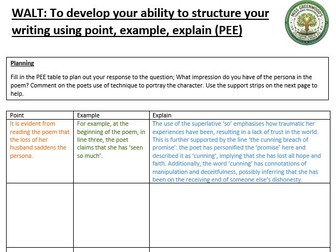
Bring the world of ancient tales to life while sharpening critical reading, analytical writing, and poetry skills! This comprehensive 15-page student workbook/teacher pack is explicitly designed to support your “Myths and Legends” scheme of work. It is highly versatile, fully adaptable, and perfect for differentiation across varying class abilities. What is Included in This Resource? This pack is structured around progressive WALT (We Are Learning To) objectives that guide students through history, reading comprehension, critical writing, and self-evaluation: Introduction to Mythology: Exploration of the cultural importance and origins of Greek mythology, featuring historical context, discussions on gods/goddesses, and its enduring influence on modern literature and media. *Character Exploration (Heroes vs. Villains): Guided visual and textual analysis comparing character archetypes—featuring structured analysis prompts for Perseus and the Minotaur (focusing on symbolism, color choice, and body language). Reading Comprehension & Key Elements: An engaging retold extract of Pandora’s Box paired with textual analysis tasks to help students explicitly identify and evaluate the core components of traditional myths. Vocabulary & Etymology Building: Dedicated dictionary and synonym-mapping activities alongside a Frayer Model exercise focusing on the etymology and root breakdown of the word “Mythology”. Poetry Analysis Integration: Step-by-step introduction to identifying and understanding complex poetic techniques and features using a specific target text (“Kicva’s Story”). Analytical Writing Mastery (PEE Framework): Structured planning sheets and support sentence starters for writing using Point, Example, Explain (PEE), paired with contextual WAGOLL (What A Good One Looks Like) and WABOLL (What A Bad One Looks Like) exemplars for modeling. Assessment & Peer/Self-Evaluation: A formal assessment question focusing on reader impressions and poetic techniques, rounded out with an evaluated “Yellow Box” reflection task to let students immediately implement teacher feedback and upgrade their work. Key Features: Ready to Print & Teach: Seamlessly acts as a student booklet for a multi-week unit. Built-in Scaffolding: Packed with word banks (including compare-and-contrast terminology), structured tables, and paragraph starters to support lower-ability learners or EAL students. Fully Adaptable: Provided in a format that allows you to differentiate or tweak the tasks to perfectly suit your specific classroom dynamic. Perfect for: Key Stage 3 (KS3) English classes, upper Key Stage 2 (KS2) classes exploring myths, or functional skills reading/writing practice.
Lord of the Flies Context Analysis & PEE Paragraph Pack (WWII & Totalitarianism)Quick View
bg4eg3ng

Lord of the Flies Context Analysis & PEE Paragraph Pack (WWII & Totalitarianism)

(0)
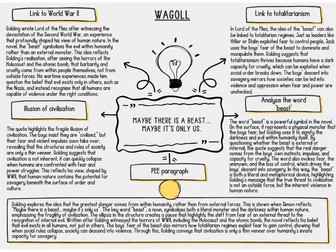
An engaging, comprehensive lesson resource designed to help students bridge the gap between contextual knowledge and high-level analytical writing for William Golding’s Lord of the Flies. This resource focuses on exploring how the historical and social context of 1950s Britain, Golding’s WWII experiences, and the rise of totalitarian regimes heavily influence the novel’s core themes. What’s Included: Retrieval & Vocabulary Tasks: Activities designed to recap previous learning and define key historical terms like totalitarianism, dehumanisation, and authoritarian. WAGOLL (What A Good One Looks Like): A high-quality exemplar PEE paragraph analyzing the iconic quote, “Maybe there is a beast… maybe it’s only us,” mapping out exact links to the Holocaust, the atomic bomb, and political manipulation. Independent Analysis Workshop: A structured analysis grid for the quote “After all, we’re not savages,” guiding students to dissect the noun “savages” and explore post-war disillusionment. Differentiated Support Sheet: Complete with tailored sentence starters, deep-thinking prompt questions (exploring Jack’s dictatorship vs. Ralph’s democracy), and structural guidance to help all abilities write an analytical PEE paragraph. Progress Evaluation & Extension: Self-assessment success criteria and an “Extra Hot” PERI-ometer extension task for high-achieving students. Perfect for GCSE or Key Stage 4 students preparing for context-heavy essay responses.
KS3 English Year 7: Heroes and Villains | Reading, Comprehension & Analytical WritingQuick View
bg4eg3ng

KS3 English Year 7: Heroes and Villains | Reading, Comprehension & Analytical Writing

(0)
Save hours of planning time with this comprehensive, highly engaging ‘Heroes and Villains’ teacher resource pack. Perfectly designed for KS3 Year 7 students, this 13-page adaptable booklet builds foundational English language and literature skills through exciting modern and classical contexts. This resource focuses heavily on breaking down analytical writing and reading comprehension. It guides students seamlessly from acquiring key vocabulary up to structuring, planning, and independently writing high-quality responses to “How” style assessment questions using the PEE (Point, Evidence, Explanation) framework. Fully editable and easily differentiated, you can adapt these resources to perfectly suit the needs of your individual classes. What’s Included in This Pack? This student booklet follows a clear, structured learning journey (WALT objectives included): Lessons 1–2: Master Key Vocabulary – Interactive word clouds and tables exploring sophisticated synonyms, antonyms, and traits of heroes and villains (e.g., resilient, valiant, empathetic, dystopian). Lessons 3–4: Reading & Comprehension Skills – Real-world media analysis task (featuring an inspiring article about a heroic Akita dog) to introduce evidence tracking. Lesson 5: Exploring Modern Day Heroes – Critical thinking activities prompt students to evaluate modern vs. traditional hero archetypes, traits, and role models. Lesson 6: Component Breakdown of a Superhero – Fun, creative task where students design their own multi-dimensional superhero complete with an origin story, motivations, and crucial character flaws. Lesson 7: Ancient Greek Olympic Heroes – A dive into context and literature, identifying values prized in ancient culture and evaluating societal impact. Lesson 8: Annotation Skills Mastery – Active reading and close-analysis text assessment using a local rescue news article. Lessons 9–11: The “How” Style Assessment Strategy – Full, step-by-step scaffolding for analytical writing, featuring a WAGOLL (What A Good One Looks Like) model paragraph, peer-analysis success criteria, structural planning tables, and extended writing templates. Lesson 12: Review, Self-Evaluation & Dedicated Feedback Response – An integrated “Yellow Box” reflection tool designed to build student independence in proofreading, making changes, and executing targeted teacher feedback.