Data Analysis questions for GCSE PE. Range of practice questions included such as analysing graphs to spot trends, predicting trends, interpreting and displaying data. Answers provided
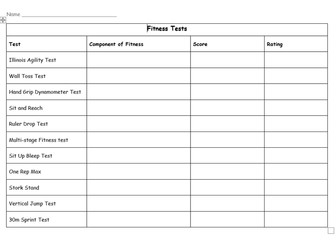
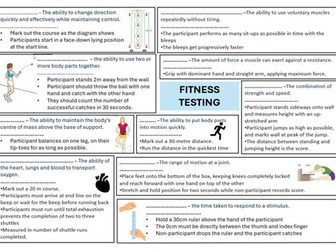
Fitness Test Cards
30m Sprint
Hand Grip Dynamometer
Illinois Agility Test
Multi-stage Fitness Test & partner record sheet
One Rep Max
Ruler Drop Test
Sit and Reach Test
Sit Up Bleep Test
Stork Stand Test
Vertical Jump Test
Wall Throw Test
Each card includes test protocol
Normative Data
Definition for component of fitness
Example sports
There is also a sheet for pupils to record their scores and ratings
PE Worksheets for non doers
These are generic and can relate to all sports
Once they have been used in one sport they can be reused with the same pupils again in a different sport or with a different year group.
Non Participant Checklist - a list of tasks for them to carryout during the lesson
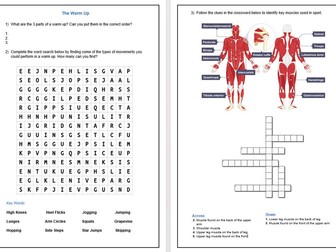
Non Participant Worksheet - Word search and crossword for them to complete about the 3 parts of a warm up
Non Participant Sheet: Skills and Techniques - Observation, Analysis, Feedback and Reflection Tasks
Non Participant Sheet: Rules and Officiating - Rules, Scoring Systems, Analysis and Reflection
Non Participant Sheet: Leadership and Coaching - Leadership, Coaching and Reflection Tasks
Non Participant Sheet: Fitness and Health - Identifying components of fitness being used in lesson, Health Benefits being gained.
Non Participant Sheet: Game Play and tactics - Understanding what a tactic is and providing examples of tactics being used in the lesson, observing game play and analysing what makes a good team.
Year Group: 7
Duration: 6 lessons
Lesson Length: 60 minutes
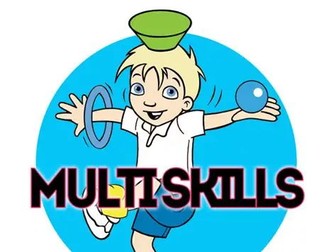
Overall Aim: To develop learners’ fundamental movement skills, physical literacy, across a range of activities, enabling them to:
• Improve coordination, balance, agility, and spatial awareness.
• Apply core skills (e.g., running, jumping, throwing, catching) in different contexts and games.
• Enhance decision-making, teamwork, and communication through practical tasks.
• Build confidence, motivation, and enjoyment in physical activity.
A range of exam questions (multiple choice, 1/2/3 mark questions, 6 mark questions and 9 mark questions alongside a mark scheme with answers for Sports Psychology
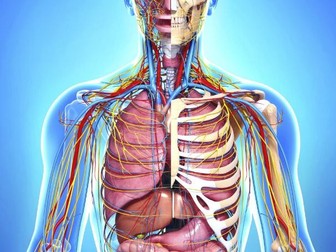
For GCSE PE AQA Anatomy & Physiology
This workbook is for students aiming for Grade 7–9. It focuses on:
Applying knowledge to real sporting examples
Analysing and evaluating, not just recalling
Linking across topics (synoptic learning)
Research Tasks
All answers provided.
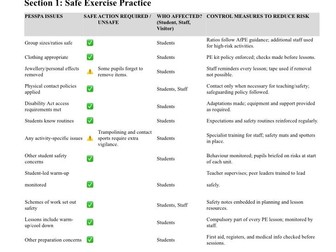
This document is in line with afPE and covers risk assessments for:
Section 1: Safe Exercise Practice
Section 2: Group Management
Section 3: Procedures and Routines
Section 4: Equipment
Section 5: Transport
Section 6: Teaching Facility
Section 7: Away Fixtures
Section 8: Individual Sports (separate risk assessment for each sport)
There is a declaration on the final page so it can be shown to your PE department and signed so you are compliant.
Everything you need to teach Physical Training.
This Includes:
Student Workbook (84 pages)
Each lesson has a learning objective, starter retrieval activity, key information, tasks, questions. There is a glossary of key terms and an end of unit test.
Workbook Answer Booklet (35 pages)
Answers included for everything covered in the student workbook.
Powerpoints for each lesson that link with the student workbook and include answers to starter activity, student tasks and questions.
Lesson 1 - Health and Fitness
Lesson 2 - The Components of Fitness
Lesson 3 - Fitness Testing
Lesson 4 - Reasons for and limitations of fitness testing
Lesson 5 - The Principles of Training
Lesson 6 - The Methods of Training
Lesson 7 - Heart Rates and Training Zones
Lesson 8 - Training Seasons
Lesson 9 - Preventing Injury
Lesson 10 - Warm Up and Cool Down
Also included are fitness test cards and knowledge organisers - these have been scaffolded to provided different levels of challenge
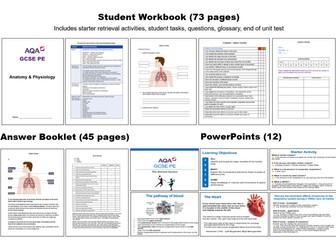
Everything you need to teach Anatomy & Physiology.
This Includes:
Student Workbook (73 pages)
Each lesson has a learning objective, starter retrieval activity, key information, tasks, questions. There is a glossary of key terms and an end of unit test.
Workbook Answer Booklet (45 pages)
Answers included for everything covered in the student workbook.
Powerpoints for each lesson that link with the student workbook and include answers to starter activity, student tasks and questions.
Lesson 1 - The Skeletal System
Lesson 2 - The Functions of the Skeletal System
Lesson 3 - Joint Classification & Movement
Lesson 4 - Synovial Joints
Lesson 5 - The Muscular System
Lesson 6 - Antagonistic Pairs
Lesson 7 - The Cardiovascular System
Lesson 8 - Blood Vessels
Lesson 9 - The Respiratory System
Lesson 10 - Lung Volumes
Lesson 11 - Aerobic & Anaerobic Exercise
Lesson 12 - The Short & Long Term Effects of Exercise
4 Dingbat Games to play covering key terms from the following topics:
The Skeletal System
The Muscular System
The Respiratory System
The Cardiovascular System
Great for a fun starter activity/plenary!
Scheme of Learning for Year 7 Hockey
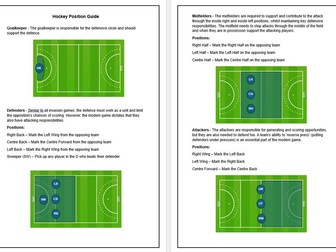
Visual Handout with key informtion about positions (roles, starting positions, playing area) and attacking, defending and balanced formations for 6 and 7 a side matches.
Very easy to give to pupils so they can take responsibility for their learning and also useful for giving to non doers.
Lots of fun challenges!
Lesson 1 - Team building: Engage in team-building activities and show active listening, personal sharing, and collaborative bonding.
Lesson 2 - Problem Solving: To work collaboratively with others to solve problems, implement solutions and overcome challenges
Can be used at the start of an OAA scheme of work on for new year 7’s in their first PE lesson/day at school or as tutor activities.
Fill in the gaps sheet for GCSE PE. All topics covered:
Anatomy & Physiology
Movement Analysis
Physical Training
Sports Psychology
Health, Fitness & Wellbeing
Socio-cultural Influences
Can be used once pupils have completed a topic to revise for end of unit test/mock/exam or as a retrieval starter activity. It is also a great scaffolding resource.
Answers are included
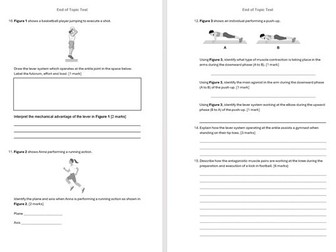
End of topic tests and mark schemes for:
Anatomy and Physiology
Movement Analysis
Physical Training
Sports Psychology
Includes: multiple choice, 1/2/3 mark questions, 6 mark questions and 9 mark questions.
For GCSE PE AQA Sports Psychology
This workbook is for students aiming for Grade 7–9. It focuses on:
Applying knowledge to real sporting examples
Analysing and evaluating, not just recalling
Linking across topics (synoptic learning)
Research Tasks
All answers provided.