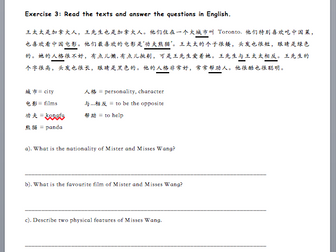
Worksheet with 3 reading exercises and 2 writing exercises about people’s appearances and characteristics.
Could be used for homework/revision or a few exercises can be selected as a starter to a lesson. Answers are on the last page and a vocabulary bank is added at the beginning of the worksheet (but could be removed for students with higher prior attainment).
This worksheet is useful as an addition to Jin Bu 2 Chapter 2.1 aimed at Year 8 and/or Year 9 students.
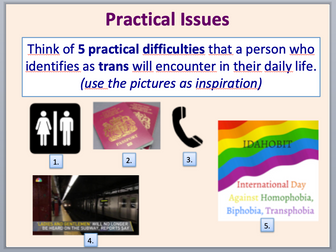
Presentation which can be used for assembly/tutor-time/afterschoolclubs/sex education on Gender Identity and Gender Expression (but a few introductory slides are included on Biological Sex and Sexual Orientation). The presentation includes activities which can be done in small groups. The answers are in the box for notes underneath the powerpoint or on the slides themselves.
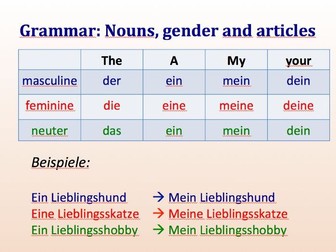
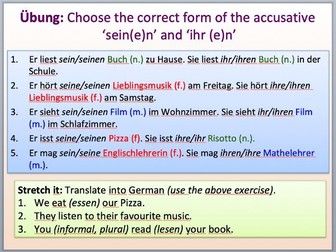
German lesson for year 7 or beginners. Can be used with Stimmt textbook 1 Chapter 1, includes reading and writing exercises. Students will learn the usage of mein/meine/dein/deine in the nominative case along side favourite things (Lieblingssachen) as vocabulary.
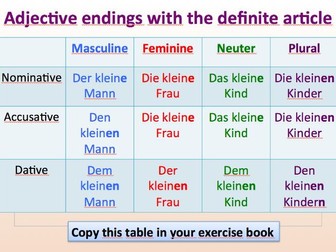
A PPT presentation about adjective endings for the Nominativ, Dativ and Akkusativ in German.
The adjectives presented follow:
- the definite article ‘der’+‘dieser/jener/jeder/welcher’.
- the indefinite article ‘ein’+‘mein/dein/sein/ihr/unser/euer/Ihr/ihr’.
- adjectives with no determiner in front of it.
Suitable for A1/A2 learners.
Includes extension activities (stretch it) and answers on the slides.
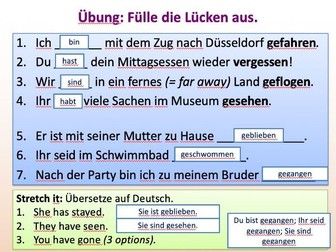
This powerpoint introduces students to the Perfect Tense in German with both ‘haben’ (for regular and irregular verbs) and ‘sein’. It includes some explanation-slides and grammar-exercises and can be combined with the method of Stimmt! Textbook 2 Kapitel 1, but can also be used separately.
The following verbs are included in the presentation:
wohnen (to live) – ich habe gewohnt
machen (to do) – ich habe gemacht
schneien (to snow) – es hat geschneit
regnen (to rain) – es hat geregnet
arbeiten (to work) – du hast gearbeitet
essen (to eat) – ich habe gegessen
sehen (to see) – ich habe gesehen
finden (to find) – ich habe gefunden
nehmen (to take) – ich habe genommen
vergessen (to forget) – wir haben vergessen
fahren (to drive) – ich bin gefahren
fliegen (to fly) – ich bin geflogen
gehen (to go) – ich bin gegangen
schwimmen (to swim) – ich bin geschwommen
bleiben (to stay) – ihr seid geblieben
German lesson for year 10/11 GCSE students or adult learners on possessive pronouns/possessive adjectives in German. Can be used in combination with Stimmt! Grammar & Translation Workbook, Pearson. Includes speaking, listening, reading and writing exercises.
Possessive pronouns/possessive adjectives in the presentation:
mein(e)/n
dein(e)/n
sein(e)/n
ihr(e)/n
sein(e)/n
unser(e)/n
euer(e)/n
Ihr(e)/n
ihr(e)/n
Students will learn the usage of these pronouns in the nominative case and accusative case along side favourite things (Lieblingssachen) as vocabulary.
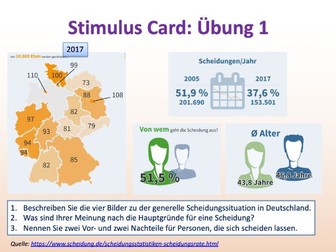
Lesson with reading/writing/speaking-exercises for A-level students about modern marriages, divorces and civil partnerships in the German-speaking world. Can be used for 1.3 Familie im Wandel, AQA A-level German Hodder.
LO: Sie können über moderne Ehen, Scheidungen und Lebenspartnerschaften im deutschsprachigen Raum sprechen.
Alle: Sie kennen 17 Wörter zu Ehe und Lebenspartnerschaft. (DE-EN, EN-DE)
Einige: Sie können Ihre Meinung zu Ehen, Scheidungen und Lebenspartnerschaften äußern.
Wenige: Sie können 2-3 Hauptgründe beschreiben warum Menschen Ehen, Scheidungen und Lebenspartnerschaften eingehen.
The following vocabulary is included:
Heiraten – to marry + Akk (schwach)
Befürworten – to support + Akk (schwach)
Geschieden - divorced
Geschieden werden – to get divorced + (die Ehe) (stark)
Sich schieden lassen – to get divorced (stark)
Gleichgeschlechtlich – same-sex
Die Ehe(n) – the marriage
Das Ehejahr(e) – the year of marriage
Das Ehepaar(e) – the married couple
Das Paar(e) – the couple
Der Ehepartner(-) – the spouse
Der Lebenspartner(-) - the civil partner
Die Lebenspartnerschaft(en) – the civil partnership
Die eingetragene(n) Lebenspartnerschaft(en) – the civil partnership
Die Scheidung(en) – the divorce
Das Scheidungsjahr(e) – the year of divorce
Die Scheidungsrate(n) – divorce rate
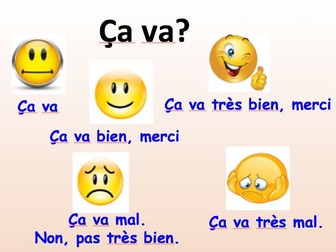
A powerpoint with vocabulary in French to say who one is doing and one’s age. Suitable for Year 7 or Beginner.
The following vocabulary is included:
Comment ça va?
Ça va très bien.
Ça va bien, merci.
Comme ci comme ça.
Ça va mal.
Non, pas très bien.
Quel âge as-tu?
J’ai onze/douze ans.
C’est combien?
Quel âge a-t’il/elle?
Powerpoint with reading, speaking and listening exercises about countries and travelling vocabulary in Italian (originally intended for 2 hours). Suitable for total beginners of Italian or Key Stage 3.
The following vocabulary is included:
COUNTRIES:
Inghilterra
Gran Bretagna
Regno Unito
Paesi Bassi
Belgio
Francia
Germania
Spagna
America
VERB ‘VIVERE’:
Io vivo
Tu vivi
Lei/Lui vive
Noi viviamo
Voi vivete
Loro vivono
VERB ‘VENIRE DA’:
Io vengo da
Tu vieni da
Lei/Lui viene da
Noi veniamo da
Voi venite da
Loro vengono da
KEY PHRASES COUNTRIES:
Dove vivi?
Da dove vieni?
TRAVEL VOCABULARY:
L’acqua
Il caffè
Il tè
La gazzosa
Il sandwich
Il biglietto del treno / Il biglietto aereo
Il giornale
La rivista
Il passaporto
La carta d’identità
Il bagno
La caffetteria
L’aeroporto
La stazione ferroviaria
KEY PHRASES TRAVELLING
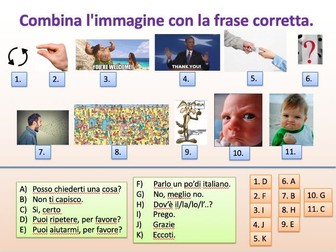
Posso chiederti una cosa?
No, meglio no
Sì, certo
Prego
Eccoti
Grazie!
Non ti capisco.
Dov’è il/la/lo/l’…?
Puoi ripetere, per favore?
Parlo un po 'di italiano
Puoi aiutarmi, per favore?
A powerpoint with vocabulary in French with the numbers 0 to 13 and some key sentences asking and saying someone’s age. Suitable for Year 7 or Beginner. The PPT has a learning objective, differentiated learning outcomes and answers are included on the slides.
The following vocabulary is included:
Numbers 0-13
Oui
Non
J’ai
Tu as
Il a
Elle a
Quel âge as-tu?
J’ai douze ans.
In Speaking/Reading-exercises:
Bonsoir
Bonjour
Comment t’appeles-tu?
Comment vous appellez-vous?
Je m’appelle…
Au revoir
Comment ça va?
Quel âge a-t-elle?
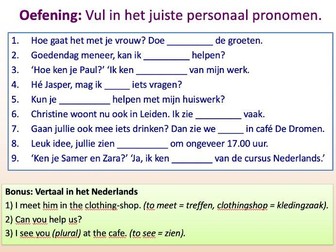
Powerpoint with grammar exercises and a listening exercise (audio included in powerpoint) about possessive pronomen and direct/indirect object pronomen in Dutch. Suitable for beginners/intermediate of Dutch or Key Stage 3/4.
The following vocabulary is included:
luisteren - to listen
hebben - to have
zijn - to be
Possessive pronomen:
mijn
jouw/je
uw
zijn
haar
onze/ons
jullie
hun
Direct object pronomen:
mij/me
jou/je
u
hem
haar
het
ons
jullie
hen/ze
Direct object pronomen for objects:
hem
het
ze
Indirect object pronomen:
mij/me
jou/je
u
hem
haar
het
ons
jullie
aan hen/hun/ze
Listening-exercise:
Gezin – nuclear family
Vieren – to celebrate
Bezoek – visit
Doorgaan – to continue
Blijven – to stay
Vanwege – due to
Toespraak – speech
aanwezig - present
gesprek - conversation
bekend – wellknown, famous
oorspronkelijk - originally
treffen – to meet
ten slotte – finally
afsluiten – to close
Worksheet with 3 reading exercises and 3 writing exercises about daily routine and hobbies in Mandarin Chinese.
Could be used for homework/revision or a few exercises can be selected as a starter to a lesson. Answers are on the last page and a vocabulary bank is added at the beginning of the worksheet (but could be removed for students with higher prior attainment).
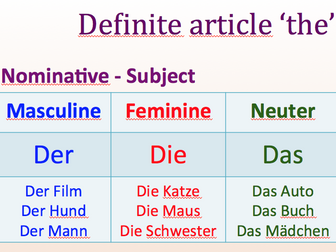
A PPT presentation about the definite article ‘the’ and indefinite article ‘a/an’ for the Nominativ and Akkusativ in German. Suitable for A1 learners.
Includes extension activities (stretch it) and answers on the slides.
A Quiz with queer or LGBTQI* questions. Answers are included.
The following main themes are included (each consists of 10 questions)
Use Your Tongue (Language, Literature and Queer slang)
Practically Magic (Witchcraft and astrology)
Riot Grrrl (Queer femme round)
Bisexual plants (horticulture and the natural/ unnatural world) + Queer as punk (music)
Camp sites (famous places and the corresponding queer importance)
QOOTD (style and fashion)
What you looking at? (Picture round)
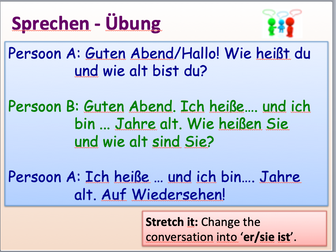
German for Absolute Beginners or Year 7.
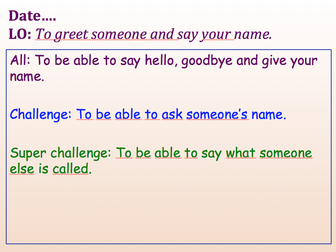
This Powerpoint show includes speaking activities and a few reading activities on the vocabulary listed below. It also includes the grammar point of the 1st, 2nd and 3rd person singular of the regular verbs ‘heißen’ and ‘wohnen’.
The following vocabulary is included:
- Guten Tag - Hello/good day.
- Hallo - Hello.
- Ich heiße - My name is
- Wie heißt du? - What is your name (informal)?
- Wie heißen Sie? - What is your name (formal)?
- Wie geht’s? - How are you?
- Nicht schlecht - not bad.
- Und dir? - And you? (informal)
- Und Ihnen? - And you? (formal)
- Gut, danke. - Fine, thank you.
- Tschüss - Bye.
- Auf Wiedersehen - Goodbye.
Pictures have been taken from Clipart where possible.
Worksheet with 4 reading exercises and 1 translation exercise about drinks in Mandarin.
Could be used as homework/a starter/revision. Answers are on the last page and a vocabulary bank is provided at the beginning.
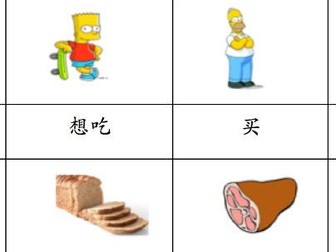
Worksheet with 3 reading exercises and 3 writing exercises about foods in Mandarin Chinese.
Could be used for homework/revision or a few exercises can be selected as a starter to a lesson. Answers are on the last page and a vocabulary bank is added at the beginning of the worksheet (but could be removed for students with higher prior attainment).
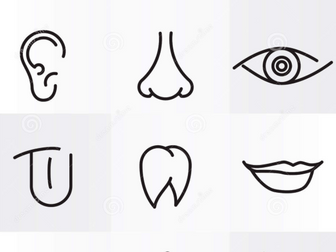
Worksheet with reading and writing exercises for body parts - Mandarin.
Answers are provided on the last page.
Could be used as a homework or revision sheet after students have learnt vocabulary related to body parts/health.
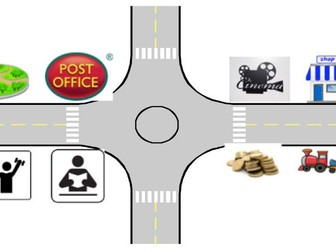
Worksheet with 3 reading exercises and 2 writing exercises for places in a town and relative place words/directions.
This worksheet is useful as an addition to Jin Bu 2 Chapter 3.1 and 3.2 and aimed at Year 8 students. There is a vocabulary bank which can be removed and answers are on the last page.
Can be used as a starter to a lesson/homework/revision.
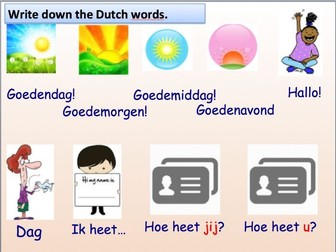
Powerpoint with reading, speaking and listening exercises about greetings and numbers in Dutch. Suitable for total beginners of Dutch or Key Stage 3.
The following vocabulary is included:
GREETINGS:
Goedendag
Goedemorgen
Goedemiddag
Goedenavond
Hallo
Dag
Ik heet…
Hoe heet jij?
Hoe heet u?
Hoe gaat het?
Goed, dank je/u.
En met jou/u?
Niet slecht
Tot ziens
NUMBERS:
1-100
KEY PHRASES WITH NUMBERS:
Hoe oud ben jij?
Hoe oud bent u?
Ik ben … jaar oud.
VERB ‘TO BE’:
Ik ben
Jij bent
Hij/zij/het is
U bent
Wij zijn
Jullie zijn
Zij zijn
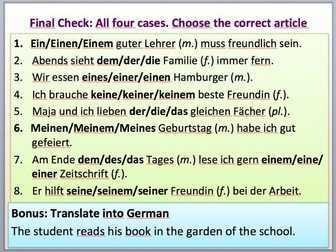
A PPT presentation about the definite article ‘the’ and indefinite article ‘a/an’ for the Nominativ, Genitiv, Dativ and Akkusativ in German. Suitable for K3 and K4.
Includes bonus activities and answers on the slides.