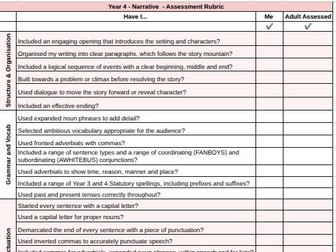
Year 4 Writing Assessment RubricsQuick View
laura_cooper_95

Year 4 Writing Assessment Rubrics

(0)
Save time with these comprehensive Year 4 Writing Assessment Rubrics, fully aligned with the National Curriculum for England. This resource includes genre-specific success criteria for Narrative, Newspaper Report, Diary, Non-Chronological Report, Biography, Persuasive Writing, Discussion, Setting Description and Letter Writing. Each rubric is divided into Structure & Organisation, Grammar & Vocabulary, Punctuation and Handwriting, with self-assessment and teacher assessment checklists to support formative assessment, peer assessment and independent editing. Ideal for classroom use, writing moderation, assessment evidence, success criteria and end-of-unit writing tasks, these rubrics help pupils understand expectations while providing teachers with a consistent assessment tool across a range of writing genres.
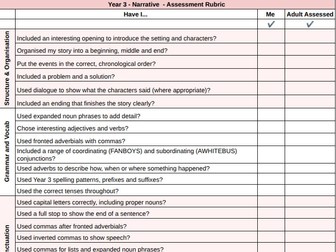
Year 3 Writing Assessment RubricsQuick View
laura_cooper_95

Year 3 Writing Assessment Rubrics

(0)
Save time with these comprehensive Year 3 Writing Assessment Rubrics, fully aligned with the National Curriculum for England. This resource includes genre-specific success criteria for Narrative, Newspaper Report, Diary, Non-Chronological Report, Biography, Persuasive Writing, Discussion, Setting Description, Letter Writing and Explanation Texts. Each rubric is divided into Structure & Organisation, Grammar & Vocabulary, Punctuation and Handwriting, with self-assessment and teacher assessment checklists to support formative assessment, peer assessment and independent editing. Ideal for classroom use, writing moderation, assessment evidence, success criteria and end-of-unit writing tasks, these rubrics help pupils understand expectations while providing teachers with a consistent assessment tool across a range of writing genres.
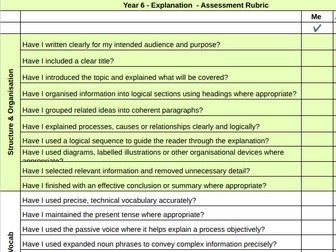
Year 6 Writing Assessment RubricsQuick View
laura_cooper_95

Year 6 Writing Assessment Rubrics

(0)
Save time with these comprehensive Year 6 Writing Assessment Rubrics, designed to support the National Curriculum for England and the end-of-KS2 Teacher Assessment Framework (TAF). This resource includes genre-specific success criteria for Narrative, Newspaper Report, Diary, Non-Chronological Report, Biography, Persuasive Writing, Discussion, Setting Description, Letter Writing and Explanation Texts. Each rubric is organised into Composition (Structure & Organisation), Grammar & Vocabulary, Punctuation and Handwriting, reflecting the key skills and expectations pupils should develop by the end of Year 6. The criteria are designed to support pupils in working towards the Year 6 end-of-primary writing expectations, including writing effectively for purpose and audience, developing ideas coherently, using grammar and vocabulary deliberately, applying punctuation accurately and maintaining fluent, legible handwriting. With self-assessment and teacher assessment checklists, these rubrics are ideal for formative assessment, peer assessment, independent editing, writing moderation, assessment evidence and end-of-unit writing tasks. They provide teachers with a consistent, accessible assessment tool while helping pupils understand and take ownership of the expectations for writing at the end of Key Stage 2.
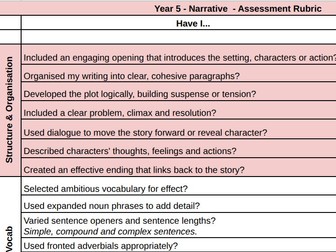
Year 5 Writing Assessment RubricsQuick View
laura_cooper_95

Year 5 Writing Assessment Rubrics

(0)
Save time with these comprehensive Year 5 Writing Assessment Rubrics, fully aligned with the National Curriculum for England. This resource includes genre-specific success criteria for Narrative, Newspaper Report, Diary, Non-Chronological Report, Biography, Persuasive Writing, Discussion, Setting Description, Letter Writing and Explanation Texts. Each rubric is divided into Structure & Organisation, Grammar & Vocabulary, Punctuation and Handwriting, with self-assessment and teacher assessment checklists to support formative assessment, peer assessment and independent editing. Ideal for classroom use, writing moderation, assessment evidence, success criteria and end-of-unit writing tasks, these rubrics help pupils understand expectations while providing teachers with a consistent assessment tool across a range of writing genres.