Understanding Adichie - Text A - Unit 3 WJEC English Lit Lang GCSEQuick View
sofiasanchezg4

Understanding Adichie - Text A - Unit 3 WJEC English Lit Lang GCSE

(0)
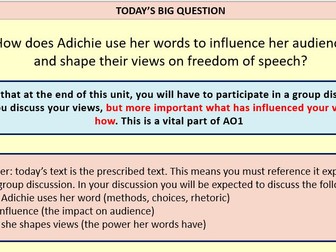
The lesson BIG QUESTION is: How does Adichie use her words to influence her audience and shape their views on freedom of speech? This lesson is designed to enable students to strengthen their AO1 skills ahead of the Unit 3 - Influence and Power - NEA (group discussion). Do it now: Retrieval of Adichie’s key ideas BIG QUESTION: How does Adichie use her words to influence her audience and shape their views on freedom of speech? KEY FOCUS: Thinking critically about Adichie’s choices: Students are introduced to eight possible impacts of Adichie’s words and work in groups to identify evidence from the transcript that creates these impacts. They annotate the text, explain how Adichie’s choices affect the audience, and prepare to teach their findings to the class. SCAFFOLDED GROUP FEEDBACK CONSOLIDATION: Scaffolded three sentence reflection on the influence and power of Adichie’s speech. Lesson includes teacher notes with detailed analysis of the speech. (Previous lesson in which students focus on comprehending Adichie’s speech and ideas is also available.)
Chimamanda Ngozi Adichie - Text A - Unit 3 WJEC English Lit Lang GCSEQuick View
sofiasanchezg4

Chimamanda Ngozi Adichie - Text A - Unit 3 WJEC English Lit Lang GCSE

(0)
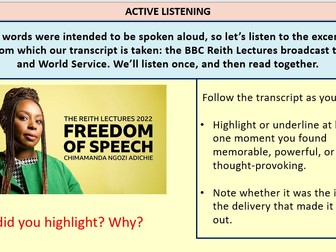
This lesson introduces students to Adichie’s Reith Lecture on freedom of speech, focusing on the ideas she communicates rather than her methods. It is part of a scheme of work preparing students for Task A of Unit 3, the NEA group discussion. Students begin by recalling prior learning about human rights and exploring key vocabulary needed to access the text. After a short pre‑reading task on Article 19: Freedom of Expression, they are introduced to transcript conventions to reduce cognitive load. Students then listen to the excerpt of Adichie’s speech while following the transcript, highlighting memorable or thought‑provoking moments (this links directly to the NEA mark scheme). Comprehension questions ensure they understand her views on the power of words, misunderstandings about free speech, the dangers of censorship, and the value of open debate. In the development phase, students engage in a structured small‑group discussion using five provocative statements, first forming their own views, then considering Adichie’s perspective, and finally comparing with Malala, Susan B. Anthony, and the Human Rights poster (other texts in the Unit 3 Anthology.) Students are given structured opportunity to practice their group discussion skills. A short reflection consolidates learning and prepares them for the next lesson on influence and power.
Unit 3 - Susan B Antony and Malala Yousafzai - Human Rights - WJEC English Lit Lang GCSEQuick View
sofiasanchezg4

Unit 3 - Susan B Antony and Malala Yousafzai - Human Rights - WJEC English Lit Lang GCSE

(0)
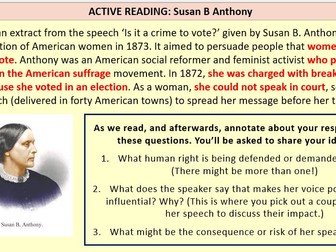
The lesson is intended to a) read, understand, and think critically about two of the Unit 3 anthology texts (Susan B Anthony and Yousafzai Malala), and offer an opportunity to practice group discussion skills. The lesson begins with the introduction of the central discussion question: “People should use their voices to challenge injustice, even when it is risky.” Do you agree? Explain what has influenced your views. Each subsequent part of the lesson is designed to enable a group discussion practice at the end, followed by a reflection. In the lesson, students actively read and annotate both texts, identifying the human rights defended, the techniques that make each speaker influential, and the risks they faced. Teacher indicative content is included to enable the practitioner to target questioning. Using sentence stems, students prepare and take part in a guided discussion on whether people should speak out against injustice, explaining what has influenced their views. The lesson ends with a structured reflection on human rights, personal influences, discussion contributions, and targets for future oracy work.
Text E Human Rights - Unit 3 Influence and Power - WJEC GCSE English Lit LangQuick View
sofiasanchezg4

Text E Human Rights - Unit 3 Influence and Power - WJEC GCSE English Lit Lang

(0)
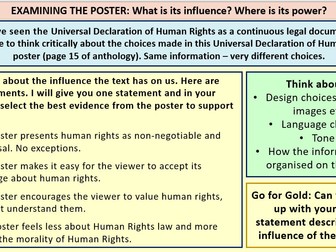
This lesson introduces students to the concept of influence and power in non‑fiction texts, using the Universal Declaration of Human Rights (legal document) and the illustrated anthology poster (Text E). Students learn to think critically about how texts shape our views, not just what they say. The lesson begins by activating prior knowledge about human rights and framing the unit’s big question: How do writers use influence and power to shape our thinking? Students then read the legal UDHR to establish a baseline of formality, authority, and legal power. They next encounter Text E and compare their first impressions with the legal document. Through guided statements, paired discussion, and teacher‑supported annotation, students explore how the poster communicates influence and power through design, tone, language, and organisation. Teacher notes provide clear indicative content for each statement to support consistent delivery across classrooms. The lesson ends with a structured consolidation task where students complete reflective sentence starters to show their understanding of the poster’s impact and how it has shaped their own thinking - a key AO1 skill for the Unit 3 group discussion. Overall, I hope the resource builds students’ confidence in analysing non‑fiction texts, comparing different forms, and articulating how texts influence beliefs and attitudes. I’m hoping it prepares them directly for the demands of the Unit 3 NEA.
Relationship Poems Scheme - WJEC English Lit and LangQuick View
sofiasanchezg4

Relationship Poems Scheme - WJEC English Lit and Lang

(0)
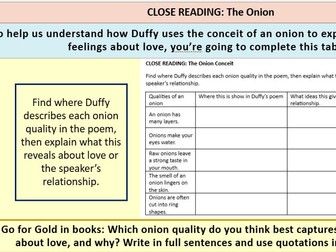
This is a series of 5 lessons in which students introduce the two ‘Relationship’ poems from the WJEC English Literature and Language GCSE - Unit 1 poetry anthology: Duffy’s ‘Valentine’ and Dunn’s 'Modern Love’ Lesson sequence: Introduce ‘Valentine’ with focus on the conceit Guided Analysis of ‘Valentine’ - with targeted questions and indicative content Unseen practice with introduction to sonnet: ‘Sonnet 29’ - Elizabeth Barret Browning with focus on how and why poets subvert conventions. Introduction and analysis of 'Modern Love’ - focus on finding meaning in small details Comparison practice with ‘Valentine’ and ‘Modern Love’ All lessons include notes and handouts. All lessons follow learning cycle: recap prior knowledge, introduce new learning, guided practice, independent apply. Useful supporting resource is the teacher knowledge organiser for ‘Modern Love’.
'Modern Love' - Teacher Knowledge OrganiserQuick View
sofiasanchezg4

'Modern Love' - Teacher Knowledge Organiser

(0)
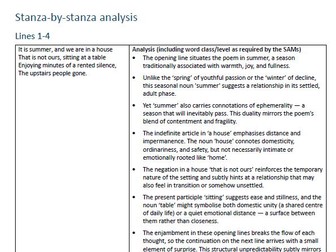
This is a comprehensive knowledge organiser aimed at teachers of the WJEC English Literature and Language GCSE - Unit 1 Context and Meaning. The knowledge organiser is organised into sections: summary, biographical information, title analysis and then a stanza-by-stanza detailed analysis (including name word classes as per the exam). There is also a section on style, structure and form. I styled the organiser on those we might find on LitCharts.
Conflict Poems Scheme - WJEC English Lit and LangQuick View
sofiasanchezg4

Conflict Poems Scheme - WJEC English Lit and Lang

(0)
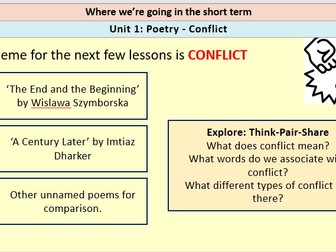
This is a series of 8 lessons in which students introduce the two ‘Conflict’ poems from the WJEC English Literature and Language GCSE - Unit 1 poetry anthology: Imtiaz Dharker’s ‘A Century Later’ and Wisława Szymborska​’s ‘The End and the Beginning’ Lesson sequence: Introduce ‘The End and the Beginning’ Guided Analysis of ‘The End and the Beginning’ Introduction to ‘A Century Later’ Guided Analysis of ‘A Century Later’ Unseen Practice with 5 marker focus: ‘Remains’ by Simon Armitage Unseen Practice with focus on structure for effect: ‘Anthem for a Doomed Youth’ by Wilfred Owen Introduction to comparison using ‘The Emigree’ by Carol Rumens Key Task - Comparison Paragraph practice Bonus - Revision lesson for ahead of a conflict themed mock. All lessons include notes and handouts. All lessons follow learning cycle: recap prior knowledge, introduce new learning, guided practice, independent apply. Useful supporting resource is the teacher knowledge organiser for ‘The End and the Beginning’.
The End and the Beginning Teacher Knowledge OrganiserQuick View
sofiasanchezg4

The End and the Beginning Teacher Knowledge Organiser

(0)
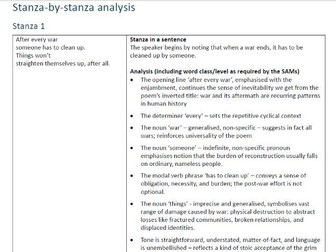
This is a comprehensive knowledge organiser aimed at teachers of the WJEC English Literature and Language GCSE - Unit 1 Context and Meaning. The knowledge organiser is organised into sections: summary, biographical information, title analysis and then a stanza-by-stanza detailed analysis (including name word classes as per the exam). There is also a section on style, structure and form, as well as commentary on the poem’s themes. The organiser contains bibliography and possible comparison poems. I styled the organiser on those we might find on LitCharts.