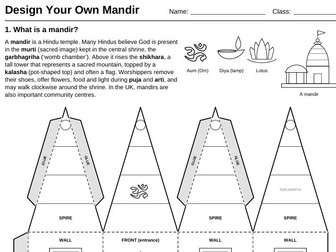
A creative “Design Your Own Hindu Mandir” worksheet that guides students in exploring the key features, symbolism, and purpose of a mandir before designing their own temple. Ideal for RS lessons, homework, or cover work, and great for encouraging thoughtful discussion about Hindu worship and sacred spaces.
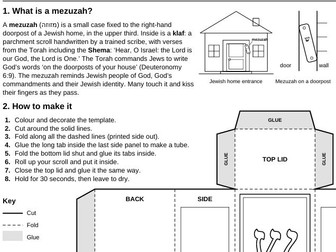
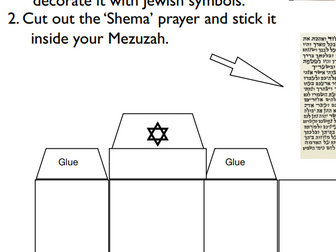
Design Your Own Mezuzah worksheet - a creative resource for students to craft and personalize their own mezuzah designs while exploring its cultural and religious significance.
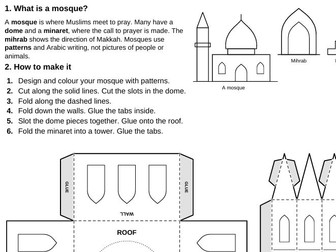
A “Design Your Own Mosque” worksheet that introduces students to the key features, symbolism, and purpose of a mosque before guiding them to create their own design. Ideal for RS lessons, homework, or cover work, and perfect for supporting understanding of Islamic worship, community life, and sacred architecture.
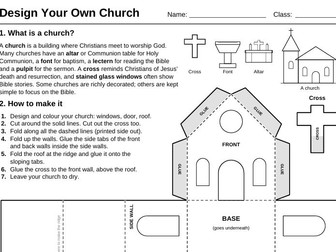
A “Design Your Own Church” worksheet that helps students explore the key features, symbolism, and purpose of Christian churches before creating their own design. Perfect for RS lessons, homework, or cover work, and ideal for supporting understanding of worship, sacred spaces, and Christian community life.
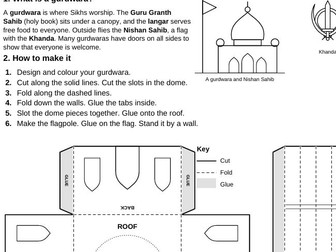
A “Design Your Own Gurdwara” worksheet that introduces students to the key features, symbolism, and purpose of a Sikh gurdwara before guiding them to create their own design. Ideal for RS lessons, homework, or cover work, and perfect for supporting understanding of Sikh worship, community service, and sacred architecture.
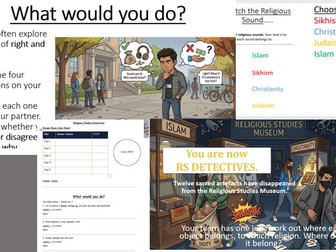
A single-lesson taster covering five world faiths through investigation-style activities: object sorting, an escape room, a sounds quiz, quickfire judgements, and ethical discussion.
Running order
Welcome & Briefing (5 mins) – Introduce pupils as “RS Detectives” investigating missing sacred objects.
Mystery Sorting Task (10 mins) – Pupils sort images of religious artefacts into four piles: Christianity, Sikhism, Hinduism, Islam.
Escape Room (10 mins) – Pupils find clue cards around the room, answer each correctly to collect a digit, and crack the final code (23131).
Religious or Not? Quickfire (5 mins) – Read out each practice (yoga, fasting, Christmas tree, etc.); pupils respond thumbs up/down, followed by quick discussion.
Religious Sounds Quiz (10 mins) – Play each sound clip; pupils match it to the correct faith from the options given.
Moral Dilemmas (10 mins) – In pairs, pupils discuss the four ethics questions on the worksheet and record whether they agree or disagree, and why.
Design Your Own Religion (5 mins) – Pupils complete the creative task, then are awarded their RS Detective certificate.
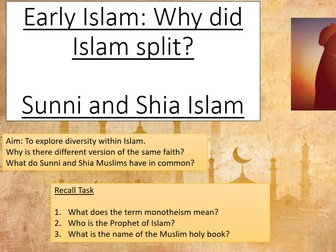
Early Islam: Why Did Islam Split? — Sunni and Shia Islam
Instructions for delivery — KS3
Overview
A full lesson exploring the origins of the Sunni–Shia split following the death of Muhammad in 632 CE, examining shared beliefs, key differences, and the diversity within Islam.
Running order
• Recall Task (5 mins) – pupils answer starter questions on monotheism, the Prophet, and the Qur’an
• True or False (5 mins) – pupils test prior knowledge on the origins of Islam and the leadership dispute
• Explaining the Split (10 mins) – teacher input on the deaths of Muhammad and the rival claims of Abu Bakr and Ali
• Sunni and Shia Islam (10 mins) – pupils compare the two viewpoints on leadership using the slide explanation
• Comprehension Task (15 mins) – pupils read the model paragraph and answer the three questions on the split, similarities, and the Ummah
• Video Clip (5 mins) – watch the linked YouTube video for consolidation
• Card Sort (10 mins) – pupils cut out and sort statement cards into three columns: beliefs/practices, Sunni, and Shia
• Knowledge Grid Task (15 mins) – using the Knowledge Sheet and class notes, pupils create a detailed grid covering similarities, differences, and key questions, with at least three symbols or images
• Plenary (5 mins) – pupils respond to the statement “Sunni and Shia Muslims are the same” (agree/disagree)
What to print
• Model Paragraph and Questions — Model_Paragraph.docx — 1 per pupil
• Card Sort statements — Task.docx — 1 set per pupil/pair, cut into individual cards
• Sunni and Shia Islam Knowledge Grid — Sunni_and_Shia_-_Info_Grid.pdf — 1 per pupil
What to prepare
• Slides loaded and ready — Varieties_of_Islam.pptx
• YouTube clip cued up (slide 7 link)
• Scissors for the card sort task
• Spare copies of the Knowledge Grid for the extension/mind map task
A lesson used to introduce Religious Studies to year 6 at secondary school,
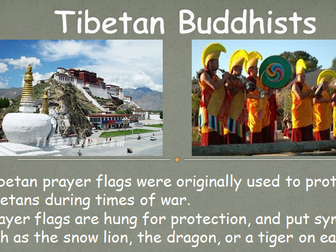
I used the lesson with template worksheet to introduce prayer flags, starting with images of Mount Everest and Bear Grylls (who is the youngest Briton to climb it). Then show a clip from Bruce Almighty on Prayers - YouTube linked on the Bruce Almighty Slide.
Students then complete and design their own prayer flags.
A worksheet describing the life of Muhammad. Students have to complete the activity by drawing pictures without depicting the Prophet (PBUH).
Text is borrowed from another contributer.
A Complete lesson on the formation of the Church.
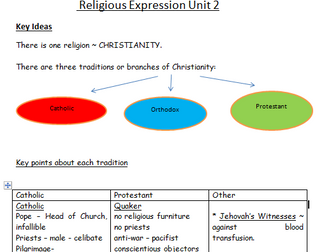
Lesson includes activities on the layout of the Catholic, Anglican, Orthodox, Quaker Churches. Includes brief list of activities to support teaching. Listed below.
1. Biography of Jesus Mind map
Born in Israel about 2000 years ago
Israel was part of the Roman Empire
Born Jewish
Mary was his mother
Incarnation
Miracle Birth
Baptised by his cousin John
12 disciples
Miracles/Parables
Crucifixion
Resurrection
2. The Incarnation - God made flesh.
‘The Word became flesh and made his dwelling among us. We have seen his glory, the glory of the one and only Son, who came from the Father, full of grace and truth.’ – John 1:14
3. What qualities would the disciples have needed? Bravery, loyalty, trust etc...
4. Diamond ranking activity.
5. The Story of the Pentecost. Read acts 2 and take a quotation. Worksheet to support.
6. Video - how were the disciples persecuted?
7. Mindmap ways the Romans used to kill people. E.g. Crucifixion, boiling, stabbing, flayed, whipped, thrown off a tower, beheaded.
8. Homework - research modern examples of Christians being persecuted eg. Syria and Iraq.
9. The Schism
East and West.
Latin vs Greek
Celibacy vs marriage.
Creeds.
Beards.
Catholic and orthodox split
10. Schism worksheet. Colour east and west.
Missing words activity.
Schism worksheet.
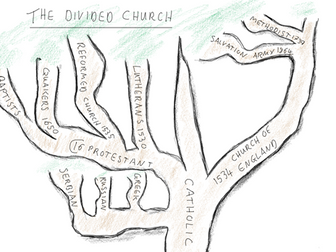
11. 'The Divided Church' worksheet. Copy the tree diagram.
12. Notes on the reformation.
The Reformation.
Reasons for split.
Indulgences for good works.
Role of priests - pope rejected as infallible.
Use of statues in worship.
Catholic and Protestant split.
13. The Church
Define Church - community of believers.
Visit St Swithen's and St Peters Church.
Draw and label diagrams of both Churches.
Diagrams of Quaker and Orthodox Churches.
Do we need Church buildings at all?
14. Church features matching up sheet.
15. The ecumenical movement.
WJEC/EDUQAS Revision pack for the Religious Studies B.
Revision notes focus on Catholic vs Protestant and Islam for comparative responses.
We have trialled this pack over a number of years with great results from students.
Pack includes notes and model answers on the following modules.
Religion and Conflict
Religious Expression
Religion and Medicine
Authority Religion & State.
Is it fair?
Looking for meaning
Our World
Relationships
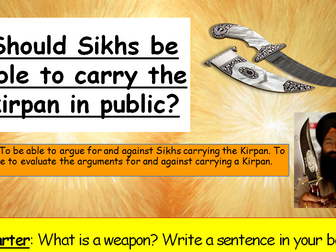
A lesson investigating whether the Kirpan is a weapon used with KS3 Religious Studies.
Slides can be printed as supporting worksheets.
Slide 9 can be printed and given to small groups for a group discussion on the Kirpan.
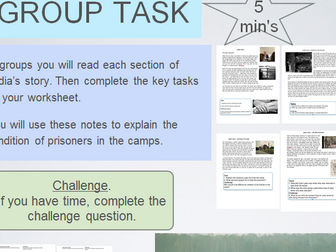
A lesson on the Holocaust.
The lesson takes students through a personal account of one survivor 'Lydia'.
Recap events of the Holocaust.
Watch a summary clip of Lydia's story.
Then students read each section of the story in small groups and complete the attached worksheets.
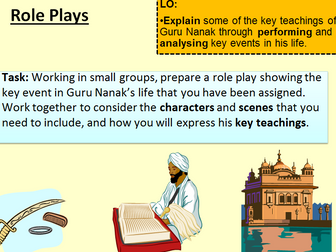
A lesson on the teachings on Guru Nanak.
The lesson includes a power point presentation and the five plays.
The lesson introduces Guru Nanak and then students are put into small groups to prepare the performances for the rest of the rest of the class.


 Quick View