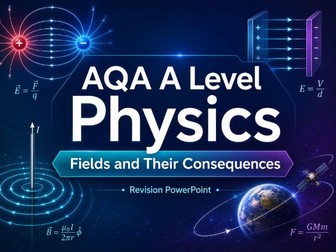
AQA A Level Physics Fields and Their ConsequencesQuick View
ironicfe

AQA A Level Physics Fields and Their Consequences

(0)
A comprehensive AQA A Level Physics Fields and Their Consequences revision PowerPoint designed for classroom teaching, intervention, retrieval practice and exam preparation. Each major topic begins with Do Now (DNA) retrieval questions followed by a separate answer slide for immediate feedback and correction. Key knowledge is presented using a Cornell note-taking structure with Cues/Questions, Main Notes and Summary sections to help students organise, retrieve and review essential ideas. After each key point, students complete three short-answer whiteboard questions testing knowledge, understanding and common misconceptions. Answers are provided for rapid assessment and correction. Longer book-work questions are followed by worked solutions and detailed revision notes. Topics include: • Force fields and field lines • Gravitational fields and Newton’s law of gravitation • Gravitational potential and equipotentials • Orbits, satellites and escape velocity • Electric fields and Coulomb’s law • Electric field strength and electric potential • Parallel plate fields • Capacitance and dielectrics • Energy stored in capacitors • Capacitor charge and discharge • Time constant and exponential decay • Magnetic fields and magnetic flux density • Forces on currents and charged particles • Cyclotrons • Magnetic flux, Faraday’s law and Lenz’s law • Generators, AC, transformers and power transmission Designed for whole-class display with clear layouts, large readable text, worked examples and exam-focused practice.
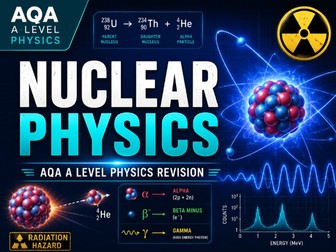
AQA A Level Physics Nuclear PhysicsQuick View
ironicfe

AQA A Level Physics Nuclear Physics

(0)
A comprehensive AQA A Level Physics Nuclear Physics revision PowerPoint designed for classroom teaching, intervention, retrieval practice and exam preparation. Each major topic begins with Do Now (DNA) retrieval questions followed by a separate answer slide for immediate feedback and correction. Key knowledge is presented using a Cornell note-taking structure with Cues/Questions, Main Notes and Summary sections to help students organise, retrieve and review essential ideas. After each key point, students complete three short-answer whiteboard questions testing knowledge, understanding and common misconceptions. Answers are provided for rapid assessment and correction. Longer book-work questions are followed by worked solutions and detailed revision notes. Topics include: • Rutherford scattering and the nuclear model • Alpha, beta and gamma radiation • Radiation properties, uses and safety • Background radiation and inverse square law • Radioactive decay, activity and decay constant • Half-life calculations and decay graphs • Carbon dating and nuclear waste storage • Nuclear stability and decay chains • Alpha, beta plus, beta minus and gamma emission • Nuclear radius and nuclear density • Mass-energy equivalence • Binding energy and binding energy per nucleon • Nuclear fission and fusion • Induced fission, chain reactions and critical mass • Nuclear reactor control rods, moderator and coolant Designed for whole-class display with clear layouts, large readable text, worked examples and exam-focused practice.
AQA A Level Physics AstrophysicsQuick View
ironicfe

AQA A Level Physics Astrophysics

(0)
A comprehensive AQA A Level Physics Astrophysics revision PowerPoint designed for classroom teaching, intervention, retrieval practice and exam preparation. Each major topic begins with Do Now (DNA) retrieval questions followed by a separate answer slide for immediate feedback and correction. Key knowledge is presented using a Cornell note-taking structure with Cues/Questions, Main Notes and Summary sections to help students organise, retrieve and review essential ideas. After each key point, students complete three short-answer whiteboard questions testing knowledge, understanding and common misconceptions. Answers are provided for rapid assessment and correction. Longer book-work questions are followed by worked solutions and detailed revision notes. Topics include: • Refracting and reflecting telescopes • Cassegrain telescopes • Chromatic and spherical aberration • CCDs, human eye comparison and quantum efficiency • Optical and radio telescopes • Angular resolution and Rayleigh criterion • Apparent and absolute magnitude • Luminosity, intensity and inverse square law • Parallax, parsecs and light years • Wien’s law and Stefan’s law • Stellar spectral classes • Hertzsprung–Russell diagrams • Supernovae, neutron stars and black holes • Red shift, Doppler effect and Hubble’s law • Big Bang evidence, quasars, dark matter and dark energy • Exoplanet detection methods Designed for whole-class display with clear layouts, large readable text, worked examples and exam-focused practice.
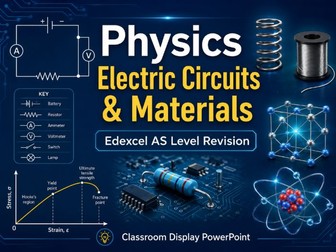
Physics Electric Circuits and MaterialsQuick View
ironicfe

Physics Electric Circuits and Materials

(0)
A comprehensive Edexcel AS/A Level Physics Electric Circuits and Materials revision PowerPoint designed for classroom teaching, intervention, retrieval practice and exam preparation. Each topic begins with Do Now (DNA) retrieval questions followed by a separate answer slide for immediate feedback and correction. Key knowledge is presented using a Cornell note-taking structure with Cues/Questions, Main Notes and Summary sections to support organised revision and long-term retention. After each key point, students complete three short-answer whiteboard questions testing knowledge, understanding and common misconceptions. Answers are provided for rapid assessment and correction. Longer book-work questions are followed by clear answer notes. Topics include: • Current, charge, potential difference and resistance • Electrical energy, power and EMF • Current–voltage characteristics • Ohmic conductors, filament lamps and diodes • Thermistors and temperature effects • Resistivity, drift velocity and charge carriers • Superconductivity and applications • Series and parallel circuits • Cells in series and parallel • Kirchhoff-style current and p.d. reasoning • Electrical heating and power loss • Potential dividers, LDRs and thermistors • Internal resistance and lost volts • Density and upthrust • Stokes’ law • Hooke’s law, elastic strain energy and springs • Stress, strain, Young modulus, ductile and brittle materials Designed for board display with organised layouts, large readable text, visuals, misconception checks and exam-focused practice.
AQA A Level Physics Medical PhysicsQuick View
ironicfe

AQA A Level Physics Medical Physics

(0)
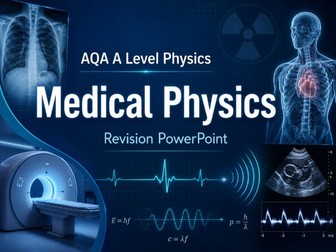
A comprehensive AQA A Level Physics Medical Physics revision PowerPoint designed for classroom teaching, intervention, retrieval practice and exam preparation. Each topic begins with Do Now (DNA) retrieval questions followed by a separate answer slide for immediate feedback and correction. Key knowledge is presented using a Cornell note-taking structure with Cues/Questions, Main Notes and Summary sections to support organised revision and long-term retention. After each key point, students complete three short-answer whiteboard questions testing knowledge, understanding and common misconceptions. Answers are provided for rapid assessment and correction. Longer book-work questions are followed by clear answer notes. Topics include: • The eye, focusing and vision defects • Ray diagrams, lenses and magnification • The ear, cochlea and hearing response • Decibels, loudness and hearing loss • ECG waveforms and biological measurements • Ultrasound, acoustic impedance and attenuation • A-scans, B-scans and endoscopy • MRI principles, proton spin and RF pulses • X-ray tubes, spectra and image sharpness • CT scanning and flat-panel detectors • Gamma cameras and medical tracers • PET scanning, effective half-life and radionuclide therapy • Brachytherapy and radiotherapy Designed for whole-class display with organised layouts, large readable text, diagrams, misconception checks and exam-focused practice.
Gravitational Fields and OscillationsQuick View
ironicfe

Gravitational Fields and Oscillations

(0)
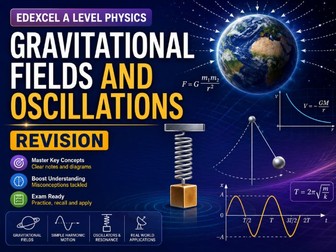
A comprehensive Edexcel A Level Physics Gravitational Fields and Oscillations revision PowerPoint designed for classroom teaching, intervention, retrieval practice and exam preparation. Each topic begins with Do Now (DNA) retrieval questions followed by a separate answer slide for immediate feedback and correction. Key knowledge is presented using a Cornell note-taking structure with Cues/Questions, Main Notes and Summary sections to support organised revision and long-term retention. After each key point, students complete three short-answer whiteboard questions testing knowledge, understanding and common misconceptions. Answers are provided for rapid assessment and correction. Longer book-work questions are followed by clear answer notes and worked explanations. Topics include: • Force fields and gravitational field strength • Newton’s law of universal gravitation • Radial gravitational fields and inverse square law • Gravitational potential and equipotential lines • Field strength–distance and potential–distance graphs • Comparing gravitational and electrostatic forces • Conditions for simple harmonic motion • Angular frequency and radians • SHM displacement, velocity and acceleration equations • Displacement–time, velocity–time and acceleration–time graphs • Mass–spring systems and simple pendulums • Period of oscillation • Energy changes in SHM • Light, critical and heavy damping • Forced oscillations and resonance Designed for board display with organised layouts, large readable text, diagrams, misconception checks and exam-focused practice.
Nuclear, Particle and Thermal PhysicsQuick View
ironicfe

Nuclear, Particle and Thermal Physics

(0)
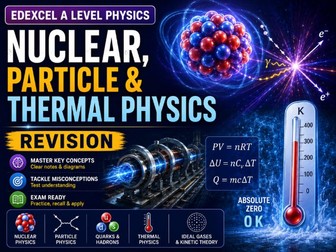
A comprehensive Edexcel A Level Physics Nuclear, Particle and Thermal Physics revision PowerPoint designed for classroom teaching, intervention, retrieval practice and exam preparation. Each topic begins with Do Now (DNA) retrieval questions followed by a separate answer slide for immediate feedback and correction. Key knowledge is presented using a Cornell note-taking structure with Cues/Questions, Main Notes and Summary sections to support organised revision and long-term retention. After each key point, students complete three short-answer whiteboard questions testing knowledge, understanding and common misconceptions. Answers are provided for rapid assessment and correction. Longer book-work questions are followed by clear answer notes and worked explanations. Topics include: • Rutherford scattering and the nuclear model • Atomic structure, isotopes and specific charge • Particles, antiparticles and photons • Annihilation and pair production • Fundamental forces and exchange particles • Feynman diagrams • Hadrons, leptons and bosons • Baryons, mesons and conservation laws • Quarks, antiquarks and strangeness • Internal energy and thermal energy transfer • Specific heat capacity and latent heat • Absolute zero and Kelvin scale • Ideal gas laws and gas equations • Work done by gases • Brownian motion • Molecular kinetic theory and RMS speed Designed for board display with organised layouts, large readable text, diagrams, misconception checks and exam-focused practice.
AQA A Level Physics Measurements and Their ErrorsQuick View
ironicfe

AQA A Level Physics Measurements and Their Errors

(0)
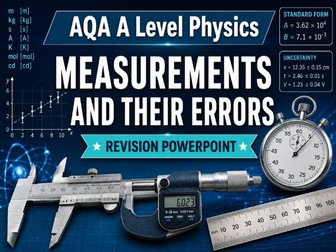
A comprehensive AQA A Level Physics Measurements and Their Errors revision PowerPoint designed for classroom teaching, intervention, retrieval practice and exam preparation. Each major topic begins with Do Now (DNA) retrieval questions followed by a separate answer slide for immediate feedback and correction. Key knowledge is presented using a Cornell note-taking structure with Cues/Questions, Main Notes and Summary sections to help students organise, retrieve and review essential ideas. After each key point, students complete three short-answer whiteboard questions testing knowledge, understanding and common misconceptions. Answers are provided for rapid assessment and correction. Longer book-work questions are followed by worked solutions and detailed revision notes. Topics include: • SI base units and derived units • Unit prefixes and standard form • Unit conversions, including area and volume conversions • Significant figures and sensible rounding • Random and systematic errors • Accuracy, precision, repeatability, reproducibility and resolution • Absolute, fractional and percentage uncertainty • Combining uncertainties • Uncertainties from graphs and gradients • Orders of magnitude • Estimation and Fermi-style reasoning Designed for whole-class display with large readable text, clear layouts, worked examples, misconception checks and exam-focused practice.
AQA A Level Physics Particles and RadiationQuick View
ironicfe

AQA A Level Physics Particles and Radiation

(0)
A comprehensive AQA A Level Physics Particles and Radiation revision PowerPoint designed for classroom teaching, intervention, retrieval practice and exam preparation. Each major topic begins with Do Now (DNA) retrieval questions followed by a separate answer slide for immediate feedback and correction. Key knowledge is presented using a Cornell note-taking structure with Cues/Questions, Main Notes and Summary sections to help students organise, retrieve and review essential ideas. After each key point, students complete three short-answer whiteboard questions testing knowledge, understanding and common misconceptions. Answers are provided for rapid assessment and correction. Longer book-work questions are followed by worked solutions and detailed revision notes. Topics include: • Constituents of the atom • Isotopes, nucleons and specific charge • Stable and unstable nuclei • Alpha and beta decay • Particles, antiparticles and photons • Annihilation and pair production • Fundamental interactions and exchange particles • Feynman diagrams • Hadrons, leptons, baryons and mesons • Quarks, antiquarks and conservation laws • Photoelectric effect • Work function and threshold frequency • Energy levels and photon emission • Fluorescent tubes • Wave-particle duality and de Broglie wavelength Designed for whole-class display with clear layouts, worked examples, misconception checks and exam-focused practice.
AQA A Level Physics Mechanics and MaterialsQuick View
ironicfe

AQA A Level Physics Mechanics and Materials

(0)
A comprehensive AQA A Level Physics Mechanics and Materials revision PowerPoint designed for classroom teaching, intervention, retrieval practice and exam preparation. Each major topic begins with Do Now (DNA) retrieval questions followed by a separate answer slide for immediate feedback and correction. Key knowledge is presented using a Cornell note-taking structure with Cues/Questions, Main Notes and Summary sections to help students organise, retrieve and review essential ideas. After each key point, students complete three short-answer whiteboard questions testing knowledge, understanding and common misconceptions. Answers are provided for rapid assessment and correction. Longer book-work questions are followed by worked solutions and detailed revision notes. Topics include: • Scalars and vectors • Resolving and combining vectors • Moments, couples and stability • Motion along a straight line • Displacement, velocity and acceleration graphs • SUVAT equations • Projectile motion • Newton’s laws of motion • Momentum and impulse • Work, energy and power • Conservation of energy • Density and bulk properties of solids • Hooke’s law and elastic strain energy • Springs in series and parallel • Stress, strain and Young modulus • Ductile and brittle materials Designed for whole-class display with clear layouts, large readable text, worked examples, misconception checks and exam-focused practice.
AQA AS/A Level Physics ElectricityQuick View
ironicfe

AQA AS/A Level Physics Electricity

(0)
A comprehensive AQA AS/A Level Physics Electricity revision PowerPoint designed for classroom teaching, intervention, retrieval practice and exam preparation. Each major topic begins with Do Now (DNA) retrieval questions followed by a separate answer slide for immediate feedback and correction. Key knowledge is presented using a Cornell note-taking structure with Cues/Questions, Main Notes and Summary sections to help students organise, retrieve and review essential ideas. After each key point, students complete three short-answer whiteboard questions testing knowledge, understanding and common misconceptions. Answers are provided for rapid assessment and correction. Longer book-work questions are followed by worked solutions and detailed revision notes. Topics include: • Current, charge and potential difference • Resistance, electrical power and energy • Current–voltage characteristics • Ohmic conductors, filament lamps and diodes • Thermistors and temperature effects • Resistivity and superconductivity • Series and parallel circuits • Resistors and cells in circuits • Kirchhoff-style current and p.d. reasoning • Potential dividers • LDR and thermistor sensing circuits • Electromotive force • Internal resistance and lost volts • Determining EMF and internal resistance from graphs Designed for whole-class display with clear layouts, large readable text, worked examples, misconception checks and exam-focused practice.
AQA A Level Physics Further Mechanics and Thermal PhysicsQuick View
ironicfe

AQA A Level Physics Further Mechanics and Thermal Physics

(0)
A comprehensive AQA A Level Physics Further Mechanics and Thermal Physics revision PowerPoint designed for classroom teaching, intervention, retrieval practice and exam preparation. Each major topic begins with Do Now (DNA) retrieval questions followed by a separate answer slide for immediate feedback and correction. Key knowledge is presented using a Cornell note-taking structure with Cues/Questions, Main Notes and Summary sections to help students organise, retrieve and review essential ideas. After each key point, students complete three short-answer whiteboard questions testing knowledge, understanding and common misconceptions. Answers are provided for rapid assessment and correction. Longer book-work questions are followed by worked solutions and detailed revision notes. Topics include: • Circular motion • Angular displacement, angular speed and radians • Centripetal acceleration and centripetal force • Simple harmonic motion • SHM displacement, velocity and acceleration graphs • SHM equations and maximum values • Mass–spring systems and pendulums • Energy changes in SHM • Damping, forced oscillations and resonance • Internal energy and thermal energy transfer • Specific heat capacity and specific latent heat • Absolute zero and Kelvin scale • Ideal gas laws • Molecular kinetic theory and Brownian motion • RMS speed and kinetic theory assumptions Designed for whole-class display with clear layouts, large readable text, worked examples, misconception checks and exam-focused practice.
AQA A Level Physics Waves revision PowerPointQuick View
ironicfe

AQA A Level Physics Waves revision PowerPoint

(0)
A comprehensive AQA A Level Physics Waves revision PowerPoint designed for classroom teaching, intervention, retrieval practice and exam preparation. Each major topic begins with Do Now (DNA) retrieval questions followed by a separate answer slide for immediate feedback and correction. Key knowledge is presented using a Cornell note-taking structure with Cues/Questions, Main Notes and Summary sections to help students organise, retrieve and review essential concepts. After each key point, students complete three short-answer whiteboard questions testing knowledge, understanding and common misconceptions. Answers are provided for rapid assessment and correction. Longer book-work questions are followed by worked solutions and detailed revision notes. Topics include: • Progressive waves • Longitudinal and transverse waves • Wave speed, frequency, wavelength and period • Phase difference and radians • Polarisation • Principle of superposition • Stationary waves, nodes, antinodes and harmonics • Interference and coherence • Path difference and fringe formation • Young’s double-slit experiment • Single-slit diffraction • Diffraction gratings • Refraction and Snell’s law • Critical angle and total internal reflection • Optical fibres, modal dispersion and material dispersion Designed for whole-class display with clear layouts, large readable text, misconception checks and exam-focused practice.
OCR A Level Physics Electrons, Waves and PhotonsQuick View
ironicfe

OCR A Level Physics Electrons, Waves and Photons

(0)
A comprehensive OCR A Level Physics Electrons, Waves and Photons revision PowerPoint designed for classroom teaching, intervention, retrieval practice and exam preparation. Each major topic begins with Do Now (DNA) retrieval questions followed by a separate answer slide for immediate feedback and correction. Key knowledge is presented using a Cornell note-taking structure with Cues/Questions, Main Notes and Summary sections to help students organise, retrieve and review essential concepts. After every key point, students complete three short-answer whiteboard questions testing knowledge, understanding and common misconceptions. Answers are provided for rapid assessment and correction. Longer book-work questions are followed by worked solutions and detailed revision notes. Topics include: • Charge, current and drift velocity • Potential difference, EMF and resistance • I–V characteristics and resistivity • Electrical power and energy • Kirchhoff’s laws and circuit calculations • Potential dividers and internal resistance • Progressive and stationary waves • Harmonics and resonance • Refraction, TIR and optical fibres • Superposition, interference and diffraction • Photoelectric effect and photons • Energy levels and wave-particle duality • de Broglie wavelength Designed for whole-class display with large readable text, clear layouts and exam-focused practice.
OCR A Level Physics Foundations of PhysicsQuick View
ironicfe

OCR A Level Physics Foundations of Physics

(0)
A comprehensive OCR A Level Physics Foundations of Physics revision PowerPoint designed for classroom teaching, intervention, retrieval practice and exam preparation. The resource follows a structured revision sequence. Each major topic begins with Do Now (DNA) retrieval questions followed by a separate answer slide for immediate feedback and correction. Key knowledge is presented using a Cornell note-taking structure with Cues/Questions, Main Notes and Summary sections, helping students organise, retrieve and review essential ideas. After every key point, students complete three short-answer whiteboard questions testing knowledge, understanding and common misconceptions. Answers are provided for rapid assessment and correction. Students then complete longer book-work questions followed by detailed model answers and revision notes. Topics include: • SI base and derived units • Unit prefixes and conversions • Significant figures and data presentation • Orders of magnitude and estimation • Random and systematic errors • Accuracy, precision, repeatability and reproducibility • Absolute, fractional and percentage uncertainty • Combining uncertainties • Uncertainty from graphs • Scalars and vectors • Vector addition and resolution Designed for whole-class display with large readable text, clear layouts and exam-focused practice.
OCR A Level Physics Particles and Medical PhysicsQuick View
ironicfe

OCR A Level Physics Particles and Medical Physics

(0)
A comprehensive OCR A Level Physics Particles and Medical Physics revision PowerPoint designed for classroom teaching, intervention, retrieval practice and exam preparation. Each major topic begins with Do Now (DNA) retrieval questions followed by a separate answer slide for immediate feedback and correction. Key knowledge is presented using a Cornell note-taking structure with Cues/Questions, Main Notes and Summary sections to support understanding, organisation and long-term retention. After each key point, students complete three short-answer whiteboard questions testing knowledge, understanding and common misconceptions. Answers are provided for rapid assessment and correction. Longer book-work questions are followed by worked solutions and detailed revision notes. Topics include: • Capacitance, energy storage and exponential discharge • Electric fields and electric potential • Magnetic fields and forces on charges • Cyclotrons • Magnetic flux and electromagnetic induction • Faraday’s and Lenz’s laws • Generators and transformers • Atomic and nuclear structure • Particle classification, quarks and leptons • Radioactive decay and half-life • Nuclear stability, binding energy, fission and fusion • Nuclear reactors • X-ray imaging and CT scanning • Ultrasound imaging • PET scanning and medical tracers Designed for whole-class display with clear layouts, worked calculations, misconception checks and exam-focused practice.
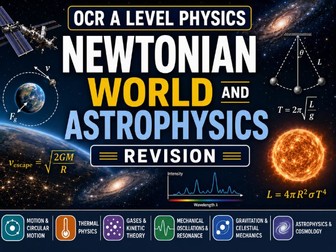
OCR A Level Physics Newtonian World and AstrophysicsQuick View
ironicfe

OCR A Level Physics Newtonian World and Astrophysics

(0)
A comprehensive OCR A Level Physics Newtonian World and Astrophysics revision PowerPoint designed for classroom teaching, intervention, retrieval practice and exam preparation. Each major topic begins with Do Now (DNA) retrieval questions followed by a separate answer slide for immediate feedback and correction. Key knowledge is presented using a Cornell note-taking structure with Cues/Questions, Main Notes and Summary sections to support organisation, retrieval and long-term retention. After each key point, students complete three short-answer whiteboard questions testing knowledge, understanding and common misconceptions. Answers are provided for rapid assessment and correction. Longer book-work questions are followed by worked solutions and detailed revision notes. Topics include: • Thermal physics and internal energy • Specific heat capacity and latent heat • Ideal gases and kinetic theory • Circular motion and angular quantities • Simple harmonic motion • Damping, forced oscillations and resonance • Gravitational fields and potential • Orbits, satellites and escape velocity • Stellar evolution and HR diagrams • Spectra, Wien’s and Stefan’s laws • Parallax and astronomical distances • Redshift, Hubble’s law and the Big Bang • Dark matter and dark energy Designed for whole-class display with clear layouts and exam-focused practice.
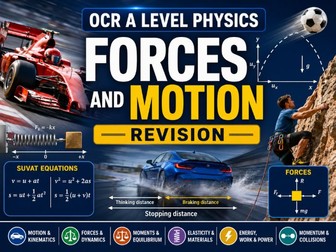
OCR A Level Physics Forces and MotionQuick View
ironicfe

OCR A Level Physics Forces and Motion

(0)
A comprehensive OCR A Level Physics Forces and Motion revision PowerPoint designed for classroom teaching, intervention, retrieval practice and exam preparation. Each major topic begins with Do Now (DNA) retrieval questions followed by a separate answer slide for immediate feedback and correction. Key knowledge is presented using a Cornell note-taking structure with Cues/Questions, Main Notes and Summary sections to help students organise and retrieve essential ideas. After every key point, students complete three short-answer whiteboard questions testing knowledge, understanding and common misconceptions. Answers are provided for rapid assessment and correction. Longer book-work questions are followed by worked solutions and detailed answer notes. Topics include: • Kinematics and SUVAT equations • Motion graphs and free fall • Stopping distances and projectile motion • Forces and free-body diagrams • Terminal velocity • Moments, equilibrium and centre of mass • Density, pressure and upthrust • Work, energy and power • Springs and Hooke’s law • Stress, strain and Young modulus • Newton’s laws • Momentum, impulse and collisions Designed for whole-class display with large readable text, clear layouts, calculation modelling and exam-focused practice.
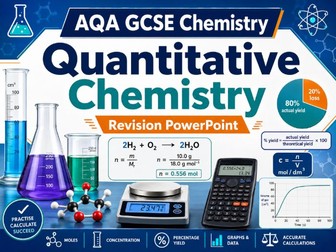
AQA GCSE Chemistry Quantitative ChemistryQuick View
ironicfe

AQA GCSE Chemistry Quantitative Chemistry

(0)
A comprehensive AQA GCSE Chemistry Quantitative Chemistry revision PowerPoint designed for classroom teaching, intervention, retrieval practice and exam preparation. The resource follows a structured revision sequence. Each topic begins with Do Now (DNA) retrieval questions followed by a separate answer slide for immediate feedback and correction. After each key teaching point, students complete three short-answer whiteboard questions testing knowledge, understanding and common misconceptions. Answers are included for rapid assessment and correction. Students then complete book-work questions followed by model answers and key-point notes to support accurate revision and independent learning. Topics include: • Conservation of mass and balanced equations • Relative formula mass • The mole and Avogadro constant • Mass–mole calculations • Reacting masses and mole ratios • Limiting reactants • Concentration calculations in g/dm³ and mol/dm³ • Percentage yield • Atom economy • Moles of solutions and gases • Gas volumes at RTP • Higher Tier multi-step quantitative calculations Designed for whole-class display with large readable text, clear layouts and frequent opportunities for retrieval, calculation practice, misconception checking and exam-focused application.
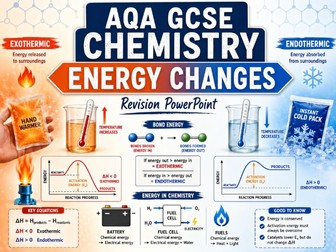
AQA GCSE Chemistry Energy ChangesQuick View
ironicfe

AQA GCSE Chemistry Energy Changes

(0)
A comprehensive AQA GCSE Chemistry Energy Changes revision PowerPoint designed for classroom teaching, intervention, retrieval practice and exam preparation. The resource follows a clear, structured revision sequence. Each topic begins with Do Now (DNA) retrieval questions followed by a separate answer slide for immediate feedback and correction. After every key teaching point, students complete three short-answer whiteboard questions testing knowledge, understanding and common misconceptions. Answers are provided to support rapid assessment and correction. Students then complete book-work questions followed by model answers and key-point notes, helping them improve responses and build accurate revision notes. Topics include: • Exothermic and endothermic reactions • Energy transfer to and from the surroundings • Everyday uses of energy changes • Activation energy • Reaction profile diagrams • Comparing reactant and product energy levels • Bond breaking and bond making • Bond energy calculations (HT) • Calculating overall energy change (HT) • Chemical cells and batteries • Fuel cells and hydrogen-oxygen fuel cells Designed for whole-class display with large, readable text, clear layouts and frequent opportunities for retrieval, questioning, misconception checking and exam-focused practice.
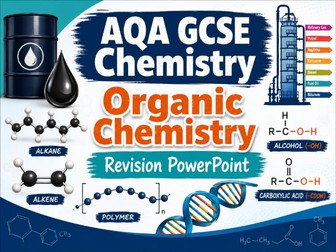
AQA GCSE Chemistry Organic ChemistryQuick View
ironicfe

AQA GCSE Chemistry Organic Chemistry

(0)
A comprehensive AQA GCSE Chemistry Organic Chemistry revision PowerPoint designed for classroom teaching, intervention, retrieval practice and exam preparation. The resource follows a structured revision sequence. Each topic begins with Do Now (DNA) retrieval questions followed by a separate answer slide for immediate feedback and correction. After every key teaching point, students complete three short-answer whiteboard questions testing knowledge, understanding and common misconceptions. Answers are included for rapid assessment and correction. Students then complete book-work questions followed by model answers and key-point notes to support accurate revision and independent learning. Topics include: • Crude oil, hydrocarbons and alkanes • Fractional distillation and petrochemicals • Properties and combustion of hydrocarbons • Cracking and alkenes • Tests and reactions of alkenes • Alcohols and fermentation • Carboxylic acids and esters • Addition polymerisation • Condensation polymerisation (HT) • Amino acids and polypeptides (HT) • DNA, proteins, starch and cellulose Designed for whole-class display with large readable text, clear layouts and frequent opportunities for retrieval, questioning, misconception checking and exam-focused practice.