KS3 Gothic Comprehension Pack (Year 8) – 8 Texts, Jekyll & Hyde, Dracula & Frankenstein LinksQuick View
elasticbandy

KS3 Gothic Comprehension Pack (Year 8) – 8 Texts, Jekyll & Hyde, Dracula & Frankenstein Links

(0)
A carefully designed KS3 Gothic comprehension pack featuring 8 original reading texts written specifically for mixed ability Year 8 pupils. Each text maintains a consistent level of challenge and focuses on vocabulary development, inference, and language analysis within the Gothic genre. Designed to support KS3 units on Gothic fiction including Jekyll & Hyde, Dracula, and Frankenstein, with a focus on atmosphere, symbolism, tension, and the conventions of Gothic literature. All texts are approximately 180–200 words and follow a clear, consistent structure to support confidence, progression, and classroom usability. The pack has been created to provide accessible challenge while developing key KS3 reading and analytical skills. WHAT’S INCLUDED 8 original Gothic comprehension texts Consistent word count (approximately 180–200 words) Key vocabulary boxes (Tier 2 and stretch vocabulary) Multiple choice, retrieval, vocabulary, inference, and analysis questions Fiction and non-fiction Gothic texts Printable, classroom-ready worksheets Teacher information page included EDUCATIONAL FOCUS Vocabulary in context Retrieval and inference Language analysis Understanding atmosphere and symbolism Gothic genre conventions SUITABLE FOR KS3 (Year 8) Mixed ability classes Gothic literature units Jekyll & Hyde, Dracula and Frankenstein schemes of work Literacy lessons Guided reading Homework or cover work TEACHING BENEFITS Carefully controlled difficulty across all 8 texts Consistent structure for weekly use Accessible challenge for mixed ability learners Can be used in any order across a Gothic unit Strong curriculum links to KS3 Gothic literature Related Resource: A matching KS3 Myths & Legends Comprehension Pack is also available, designed for Year 7 pupils and following the same consistent structure, vocabulary focus, and question progression to support progression across KS3.
Year 7 Percy Jackson Grammar Homework (Editing & Proofreading)Quick View
elasticbandy

Year 7 Percy Jackson Grammar Homework (Editing & Proofreading)

(0)
This Percy Jackson-themed grammar accuracy and proofreading homework was created in response to recurring literacy errors seen in KS3 classwork, including apostrophes, capital letters, spelling, punctuation, and presentation. Designed to fit alongside a Year 7 Myths and Legends or Percy Jackson unit, this resource encourages pupils to edit and proofread writing to an academic standard rather than simply copy or rewrite sentences. References to Percy and his journey make the task purposeful and relevant while reinforcing core literacy expectations. The worksheet includes: A clear rationale for pupils (“Why am I receiving this homework?”) An apostrophe reminder (possession and contractions) Explicit academic presentation expectations (handwriting and letter formation) Sentence-level editing based on realistic classroom errors (e.g. percys, doesnt, try’s) A proofreading paragraph linked to themes of heroism, change, and loss A full answer sheet for quick and efficient marking This resource is ideal for: Year 7 English Percy Jackson units Myths and Legends schemes of work KS3 literacy intervention Homework focused on grammar accuracy and proofreading Book scrutiny preparation The tone is intentionally academic and age-appropriate for KS3, avoiding overly simplistic or primary-style grammar worksheets. It is particularly effective for addressing core KS2 literacy skills (apostrophes, capital letters, punctuation, and presentation) that should be carried over and consistently applied in KS3 written work.
KS3 Myths & Legends Comprehension Pack (Year 7) – 8 Texts, Vocabulary FocusQuick View
elasticbandy

KS3 Myths & Legends Comprehension Pack (Year 7) – 8 Texts, Vocabulary Focus

(0)
KS3 Myths & Legends Reading Comprehension Pack 8 Original Texts | 170–190 Words | Vocabulary, Retrieval, Inference & Analysis This KS3 Myths & Legends Comprehension Pack contains eight carefully written reading texts designed to support vocabulary development, reading comprehension, and analytical skills for mixed ability Year 7 pupils. Each text has been written at a consistent difficulty level and word count (170–190 words), ensuring accessibility, fairness, and ease of use across lessons, guided reading, homework, and cover work. The myths and legends are original retellings and explanations based on classical mythology, allowing pupils to engage with myths while developing key literacy skills in a structured and supportive format. What’s Included Eight original myths and legends comprehension texts Consistent word count (170–190 words per text) Key vocabulary boxes with Tier 2 vocabulary taken directly from the text Six comprehension questions per worksheet Balanced progression of skills: retrieval, vocabulary, inference, and analysis A mixture of narrative and non-fiction mythology texts Printable, classroom-ready worksheets Teacher information page and cover page included Texts Included Medusa the Gorgon The Minotaur and the Labyrinth Poseidon: God of the Sea Hades and the Underworld Pandora’s Box The Oracle of Delphi (non-fiction) Icarus and Daedalus Theseus and the Minotaur Skills Developed Reading comprehension and fluency Vocabulary in context (Tier 2 focus) Inference and interpretation Language analysis Understanding themes and messages in myths Suitable For KS3 (Year 7) Mixed ability classes Myths and Legends units Percy Jackson linked schemes of work Literacy lessons Guided reading Homework or cover lessons What Makes This Resource Different Unlike many comprehension resources, every text in this pack has been carefully levelled to ensure consistent difficulty and structure. All passages follow the same word count range and question style, meaning teachers can use the worksheets in any order without variation in challenge. Vocabulary has been deliberately embedded and matched to each text to support vocabulary growth for KS3 pupils while maintaining a sophisticated but accessible reading level. Created by Mrs Jaques-Williams’ Literacy & English Resources © 2026 All Rights Reserved. This resource is for single classroom use only and may not be shared, redistributed, or resold.
Visual Inference Photos & Picture Prompts – Objects With a Story (KS2–KS4)Quick View
elasticbandy

Visual Inference Photos & Picture Prompts – Objects With a Story (KS2–KS4)

(0)
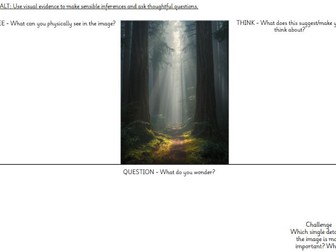
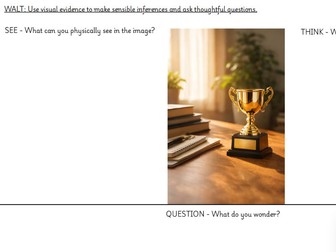
This resource contains a collection of carefully selected photographs designed to help pupils explore inference, curiosity and storytelling through visual prompts. Images encourage pupils to consider what an object might suggest about events, people and situations, using the See, Think, Question framework. Pupils are prompted to observe details, make thoughtful inferences and ask meaningful questions based on visual evidence. Images include a range of positive, neutral and curious everyday objects across indoor, school and outdoor settings, allowing pupils to practise inference across different contexts without relying on prior knowledge. What’s Included: 12 visual inference worksheets One photograph per page Consistent See • Think • Question structure Optional challenge question on every page Clear WALT and skills focus Suitable For: KS2 (Upper) KS3 KS4 SEND & EAL Oracy, reading and writing lessons Skills Developed: Making inferences from visual evidence Exploring narrative possibilities and perspective Asking thoughtful, open-ended questions Developing curiosity and creative thinking How This Resource Can Be Used: Reading inference lessons Writing starters and narrative prompts Oracy and discussion activities Cover or supply lessons Mixed-ability and low-prep lessons Visual literacy and comprehension tasks This resource is part of the See, Think, Question Visual Inference Series, designed to develop inference skills through carefully structured visual prompts. Also available: People & Emotion – See Think Question Places & Atmosphere – See Think Question No prior knowledge required. Photographs only. Fully printable. Low-prep and classroom-ready. Created by Mrs Jaques-Williams’ Literacy & English Resources.
Visual Inference Photos & Picture Prompts – Places & Atmosphere (KS2–KS4)Quick View
elasticbandy

Visual Inference Photos & Picture Prompts – Places & Atmosphere (KS2–KS4)

(0)
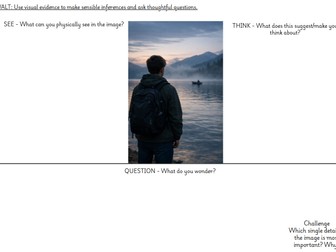
Visual Inference Photographs for Reading, Oracy and Writing A low-prep, flexible visual inference resource designed to help pupils explore setting, mood and atmosphere using carefully selected photographs. This resource uses the See, Think, Question framework to support pupils in making sensible inferences from visual evidence, encouraging discussion, speculation and thoughtful questioning. The images range from calm and peaceful to busy, eerie and ambiguous settings, allowing pupils to practise inference across a variety of contexts. Ideal for developing inference skills before reading or writing tasks, and particularly effective for supporting oracy, SEND and EAL learners. Skills Covered Making inferences from visual evidence Exploring setting, mood and atmosphere Developing speaking and listening Asking thoughtful, open-ended questions Supporting descriptive and creative writing What’s Included 12 full-page photographic stimuli Structured See / Think / Question prompts on every page Clear WALT statement for skills-based learning Consistent challenge question on each image Fully printable and display-ready pages Suitable For KS2 (Upper) KS3 KS4 SEND EAL Why Teachers Use This Resource No prior knowledge required Photographs only – highly accessible Encourages discussion and pupil talk Easy to differentiate Minimal preparation Versatile across reading, writing and oracy lessons Suggested Uses Reading inference starters Oracy and discussion tasks Descriptive writing inspiration Setting and atmosphere lessons Intervention or small-group work Cover lessons
Shakespeare – Power and Control in The Tempest (Act 1 Scene 2)Quick View
elasticbandy

Shakespeare – Power and Control in The Tempest (Act 1 Scene 2)

(0)
A high-quality KS3 Shakespeare analysis resource focused on how different types of power are presented through character and language in Act 1 Scene 2 of The Tempest. This lesson is carefully scaffolded to support pupils in moving from guided language analysis to independent interpretation, making it ideal for Year 8 classes and particularly suitable for higher-attaining pupils. How the task is structured: Prospero and Ariel: Guided analysis exploring how Prospero’s authority is established through language, command, and control. Miranda and Prospero: Guided focus on Miranda’s emotional and moral power, with underlined quotations highlighting her empathy and compassion and how these influence Prospero. Prospero and Caliban: Independent analysis section where pupils decide for themselves how power is shown, challenged, or enforced. Skills focus: Analysing Shakespeare’s language choices Identifying different forms of power (authority, control, empathy, force) Selecting precise quotations Evaluating whether power is fair or unjust Making justified interpretations using evidence What’s included: Carefully selected public-domain extracts from Act 1 Scene 2 Clear WALT and success criteria A focused language analysis skill (zooming in on key words and explaining how they show power or control) Guided and independent questions to support differentiation Key prompts to encourage deeper thinking and discussion Why teachers value this resource: Directly supports core KS3 Shakespeare themes Encourages higher-order thinking and evaluation Reduces teacher talk with clear scaffolding Ideal for lessons on power, authority, and relationships Easily adaptable for different ability levels Suitable for: KS3 English KS3 Shakespeare The Tempest Themes of power and control Language analysis practice This resource works well as a standalone lesson or as part of a wider Shakespeare unit exploring power, obedience, and moral authority.
KS3 Reading & Inference – Short Extracts & Skills MEGA PACKQuick View
elasticbandy

KS3 Reading & Inference – Short Extracts & Skills MEGA PACK

9 Resources
9 Complete Resources | Text-Agnostic | No Prior Knowledge Required Resource Description A comprehensive bundle of nine low-prep, skills-focused reading and inference resources designed to support KS3 pupils in developing core reading and analysis skills using short, text-agnostic fiction extracts. This bundle covers a wide range of essential reading skills, including inference, vocabulary in context, writer’s intent, character analysis and atmosphere. Each resource is structured consistently, making it easy to use across lessons, interventions, cover work or assessment practice. Ideal for building confident, independent readers while reducing teacher workload. Skills Covered Across the Bundle Retrieval Word-level inference Inference with evidence Character reactions and motivation Setting and atmosphere Tension and suspense Power and control Internal and external conflict Relationships and trust Vocabulary in context Writer’s intent and reader response What’s Included (9 Resources) Character Reactions Character Motivation & Decisions Setting & Atmosphere Tension & Suspense Power & Control Conflict (Internal vs External) Relationships & Trust Vocabulary in Context Writer’s Intent Each resource includes: One short fiction extract Ten scaffolded comprehension and inference questions (15 marks total) Vocabulary development task Challenge or extended response task Answer sheet with flexible marking guidance Teacher reference table showing skill focus Why Teachers Use This Bundle No prior knowledge of a set text required Suitable for Years 7–9 Consistent structure across all resources Easy to differentiate for mixed-ability classes Minimal preparation and marking Ideal for lessons, cover work, intervention or assessment Strong progression towards GCSE-style reading analysis Suggested Uses KS3 English schemes of work Reading interventions Cover lessons Homework or revision Assessment practice Skills-based starters and plenaries
KS3 Reading & Inference – Short Extracts & Skills: Writer’s IntentQuick View
elasticbandy

KS3 Reading & Inference – Short Extracts & Skills: Writer’s Intent

(0)
A low-prep, skills-focused reading and inference resource designed to support KS3 pupils in analysing writer’s intent and purpose using a short, text-agnostic fiction extract. This resource encourages pupils to explore why a writer has chosen certain words, structures and silences, and how these choices shape meaning and reader response. Pupils practise retrieval, inference, language analysis and vocabulary in context while developing confidence in explaining how writers influence the reader without stating ideas directly. Suitable for use as a standalone lesson, starter activity, cover work or intervention task. Skills Covered Retrieval Word-level inference Inference with evidence Language analysis Writer’s intent and purpose Reader response Vocabulary in context What’s Included One short fiction extract Ten scaffolded comprehension and inference questions (15 marks total) Vocabulary development task (synonyms in context) Short written challenge task linked to writer’s intent Answer sheet with flexible marking guidance Teacher reference table showing the skill focus for each question Why Teachers Use This Resource No prior knowledge of a set text required Suitable for Years 7–9 Easy to differentiate for mixed-ability classes Minimal preparation and marking Supports progression towards GCSE-style reading analysis Series Information This resource forms part of the series: KS3 Reading & Inference – Short Extracts & Skills Each resource in the series focuses on a different core reading skill and can be used independently or bundled for wider curriculum coverage. Suggested Uses KS3 English lessons Cover work Reading interventions Homework or revision Assessment practice Skills-based starters or plenaries
KS3 Reading & Inference – Short Extracts & Skills: Vocabulary in ContextQuick View
elasticbandy

KS3 Reading & Inference – Short Extracts & Skills: Vocabulary in Context

(0)
A low-prep, skills-focused reading and inference resource designed to help KS3 pupils develop confidence with vocabulary in context using a short, text-agnostic fiction extract. This resource supports pupils in exploring how writers choose specific words to create meaning, tension and implied ideas. Pupils practise retrieval, inference, language analysis and precise vocabulary work, learning to interpret words based on context rather than dictionary definitions. Suitable for use as a standalone lesson, starter activity, cover work or intervention task. Skills Covered Retrieval Word-level inference Inference with evidence Vocabulary analysis Language choices Writer’s intent Vocabulary in context What’s Included One short fiction extract Ten scaffolded comprehension and inference questions (15 marks total) Vocabulary development task (synonyms in context) Short written challenge task Answer sheet with flexible marking guidance Teacher reference table showing the skill focus for each question Why Teachers Use This Resource No prior knowledge of a set text required Suitable for Years 7–9 Builds confidence with unfamiliar vocabulary Easy to differentiate Minimal preparation and marking Supports progression towards GCSE-style analysis Series Information This resource forms part of the series: KS3 Reading & Inference – Short Extracts & Skills Each resource focuses on a different core reading skill and can be used independently or bundled for wider curriculum coverage. Suggested Uses KS3 English lessons Cover work Reading interventions Homework or revision Vocabulary development sessions Assessment practice
Literacy Loop Cards – Powerful Verb Upgrades | Vocabulary Game for Writing | KS2–KS4 | 32 CardsQuick View
elasticbandy

Literacy Loop Cards – Powerful Verb Upgrades | Vocabulary Game for Writing | KS2–KS4 | 32 Cards

(0)
Literacy Loop Cards – Set 1: Powerful Verb Upgrades A fast-paced, whole-class vocabulary game designed to help pupils improve their writing by replacing weak, overused verbs with stronger, more precise alternatives. This printable “I have, Who has” loop card activity gets the whole class reading, listening and thinking about word choice – while building ambitious vocabulary that transfers directly into their writing. Ideal as a starter, plenary, revision task or low-prep cover lesson. What’s included • 32 printable loop cards • Teacher instruction page • Answer key • Ready to print and use • Colour design (clear and easy to read) Example vocabulary upgrades look → gaze run → sprint break → shatter think → ponder make → create build → construct help → assist finish → conclude These are the kinds of words pupils need for stronger creative and analytical writing. How it works Each pupil receives a card One pupil starts by reading their prompt The class listens and matches the correct synonym The game continues around the room until the loop returns to the start If the vocabulary is correct, the loop completes perfectly. Perfect for • KS2–KS4 English • KS3 literacy lessons • Vocabulary development • Creative writing • Descriptive writing • Intervention groups • Mixed ability classes • EAL/SEND support • Cover lessons • Starters or plenaries Skills developed • Vocabulary precision • Speaking & listening • Reading fluency • Word choice in writing • Confidence with ambitious language
Literacy Loop Cards – Descriptive Adjective Upgrades | Vocabulary Game for Creative WritingQuick View
elasticbandy

Literacy Loop Cards – Descriptive Adjective Upgrades | Vocabulary Game for Creative Writing

(0)
Literacy Loop Cards – Set 2: Descriptive Adjective Upgrades A fast-paced, whole-class vocabulary game designed to help pupils improve their descriptive writing by replacing simple adjectives with stronger, more precise alternatives. This printable “I have, Who has” loop card activity gets every pupil reading aloud, listening carefully and matching meanings – while building ambitious vocabulary that transfers directly into their creative and analytical writing. Perfect for starters, plenaries, revision or low-prep cover lessons. What’s included • 32 printable loop cards • Teacher instructions page • Answer key • Ready-to-print format • Reusable and easy to laminate Example vocabulary upgrades big → vast small → minuscule dark → gloomy bright → radiant dirty → filthy clean → immaculate old → ancient rich → affluent strange → peculiar scary → ominous These are the kinds of precise, ambitious words pupils need for stronger descriptions of settings, characters and atmosphere. How it works Each pupil receives one card A pupil reads their prompt aloud The class listens and finds the matching stronger word The loop continues until it returns to the starting card If the vocabulary is correct, the loop completes perfectly. Perfect for • KS2–KS4 English • KS3 literacy lessons • Creative writing • Descriptive writing • Vocabulary development • Intervention groups • Mixed ability classes • EAL/SEND support • Starters or plenaries • Cover lessons Skills developed • Ambitious vocabulary choices • Speaking & listening • Reading fluency • Descriptive language • Writing confidence Why teachers like loop cards • No preparation beyond printing • Whole class actively involved • Quick to run (5–10 minutes) • Reusable year after year • Easy for non-specialists to deliver • Works with any class size Designed by an experienced secondary English teacher. Practical, low-prep and classroom-tested. Mrs Jaques-Williams’ Literacy & English Resources
KS3 Reading & Inference – Short Extracts & Skills: Relationships & TrustQuick View
elasticbandy

KS3 Reading & Inference – Short Extracts & Skills: Relationships & Trust

(0)
A low-prep, skills-focused reading and inference resource designed to support KS3 pupils in exploring relationships and trust through a short, text-agnostic fiction extract. This resource helps pupils analyse how writers present trust, uncertainty and fragile relationships through actions, silence and decisions, rather than direct explanation. Pupils practise retrieval, inference, language analysis and vocabulary in context while developing confidence in explaining how relationships are shaped by choice and consequence. Suitable for use as a standalone lesson, starter activity, cover work or intervention task. Skills Covered Retrieval Word-level inference Inference with evidence Relationship analysis Character decisions and trust Writer’s intent Vocabulary in context What’s Included One short fiction extract Ten scaffolded comprehension and inference questions (15 marks total) Vocabulary development task (synonyms in context) Answer sheet with flexible marking guidance Teacher reference table showing the skill focus for each question Why Teachers Use This Resource No prior knowledge of a set text required Suitable for Years 7–9 Easy to differentiate for mixed-ability classes Minimal preparation and marking Supports progression towards GCSE-style reading analysis Series Information This resource forms part of the series: KS3 Reading & Inference – Short Extracts & Skills Each resource focuses on a different core reading skill and can be used independently or bundled for wider curriculum coverage. Suggested Uses KS3 English lessons Cover work Reading interventions Homework or revision Assessment practice Skills-based starters or plenaries
KS3 Reading & Inference – Short Extracts & Skills: Conflict (Internal vs External)Quick View
elasticbandy

KS3 Reading & Inference – Short Extracts & Skills: Conflict (Internal vs External)

(0)
A low-prep, skills-focused reading and inference resource designed to support KS3 pupils in exploring internal and external conflict through a short, text-agnostic fiction extract. This resource helps pupils distinguish between inner struggle and external pressure, analysing how writers show conflict through character thoughts, actions and reactions. Pupils practise retrieval, inference, language analysis and vocabulary in context while developing confidence in explaining how conflict influences decisions. Suitable for use as a standalone lesson, starter activity, cover work or intervention task. Skills Covered Retrieval Word-level inference Inference with evidence Internal conflict External conflict Decision-making under pressure Writer’s intent Vocabulary in context What’s Included One short fiction extract Ten scaffolded comprehension and inference questions (15 marks total) Vocabulary development task (synonyms in context) Challenge question linked to conflict Answer sheet with flexible marking guidance Teacher reference table showing the skill focus for each question Why Teachers Use This Resource No prior knowledge of a set text required Suitable for Years 7–9 Easy to differentiate for mixed-ability classes Minimal preparation and marking Supports progression towards GCSE-style reading analysis Series Information This resource forms part of the series: KS3 Reading & Inference – Short Extracts & Skills Each resource focuses on a different core reading skill and can be used independently or bundled for wider curriculum coverage. Suggested Uses KS3 English lessons Cover work Reading interventions Homework or revision Assessment practice Skills-based starters or plenaries
KS3 Reading & Inference – Short Extracts & Skills: Power & ControlQuick View
elasticbandy

KS3 Reading & Inference – Short Extracts & Skills: Power & Control

(0)
A low-prep, skills-focused reading and inference resource designed to support KS3 pupils in exploring power and control through a short, text-agnostic fiction extract. This resource encourages pupils to analyse how writers present authority, dominance and influence through character behaviour, silence and reactions, rather than direct explanation. Pupils practise retrieval, inference, language analysis and vocabulary in context while developing confidence in explaining how power is established and maintained. Suitable for use as a standalone lesson, starter activity, cover work or intervention task. Skills Covered Retrieval Word-level inference Inference with evidence Character judgement Power and control Writer’s intent Vocabulary in context What’s Included One short fiction extract Ten scaffolded comprehension and inference questions (15 marks total) Vocabulary development task (synonyms in context) Challenge question linked to power and control Answer sheet with flexible marking guidance Teacher reference table showing the skill focus for each question Why Teachers Use This Resource No prior knowledge of a set text required Suitable for Years 7–9 Easy to differentiate for mixed-ability classes Minimal preparation and marking Supports progression towards GCSE-style reading analysis Series Information This resource forms part of the series: KS3 Reading & Inference – Short Extracts & Skills Each resource focuses on a different core reading skill and can be used independently or bundled for wider curriculum coverage.
KS3 Reading & Inference – Short Extracts & Skills: Tension & SuspenseQuick View
elasticbandy

KS3 Reading & Inference – Short Extracts & Skills: Tension & Suspense

(0)
A low-prep, skills-focused reading and inference resource designed to support KS3 pupils in exploring tension and suspense through a short, text-agnostic fiction extract. This resource helps pupils understand how writers create suspense through pace, sound, setting and character reaction, encouraging pupils to infer tension rather than being told directly. Pupils practise retrieval, inference, language analysis and vocabulary in context while developing confidence in explaining how tension is built. Suitable for use as a standalone lesson, starter activity, cover work or intervention task. Skills Covered Retrieval Word-level inference Inference with evidence Language analysis Tension and suspense Vocabulary in context Writer’s intent What’s Included One short fiction extract Ten scaffolded comprehension and inference questions (15 marks total) Vocabulary development task (synonyms in context) Answer sheet with flexible marking guidance Teacher reference table showing the skill focus for each question Why Teachers Use This Resource No prior knowledge of a set text required Suitable for Years 7–9 Easy to differentiate for mixed-ability classes Minimal preparation and marking Supports progression towards GCSE-style reading analysis Series Information This resource is part of the series: KS3 Reading & Inference – Short Extracts & Skills Each resource in the series focuses on a different core reading skill and can be used independently or bundled for wider curriculum coverage. Suggested Uses KS3 English lessons Cover work Reading interventions Homework or revision Assessment practice Skills-based starters or plenaries
KS3 Reading & Inference – Short Extracts & Skills: Setting & AtmosphereQuick View
elasticbandy

KS3 Reading & Inference – Short Extracts & Skills: Setting & Atmosphere

(0)
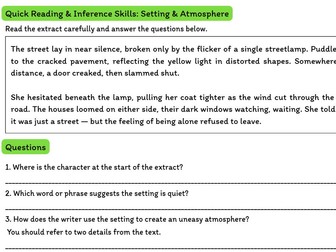
A low-prep, skills-focused reading and inference resource designed to support KS3 pupils in analysing setting and atmosphere using a short, text-agnostic fiction extract. This resource helps pupils explore how writers create mood through setting, description and word choice, encouraging pupils to infer atmosphere rather than relying on explicit explanation. Pupils practise retrieval, inference, language analysis and vocabulary in context while developing confidence in explaining how setting influences meaning. Suitable for use as a standalone lesson, starter activity, cover work or intervention task. Skills Covered Retrieval Word-level inference Inference with evidence Language analysis Setting and atmosphere Vocabulary in context Writer’s intent What’s Included One short fiction extract Ten scaffolded comprehension and inference questions (15 marks total) Vocabulary development task (synonyms in context) Answer sheet with flexible marking guidance Teacher reference table showing the skill focus for each question Why Teachers Use This Resource No prior knowledge of a set text required Suitable for Years 7–9 Easy to differentiate for mixed-ability classes Minimal preparation and marking Supports progression towards GCSE-style reading analysis Series Information This resource is Resource 3 in the series: KS3 Reading & Inference – Short Extracts & Skills Each resource in the series focuses on a different core reading skill and can be used independently or bundled for wider curriculum coverage. Suggested Uses KS3 English lessons Cover work Reading interventions Homework or revision Assessment practice Skills-based starters or plenaries
Percy Jackson & the Lightning Thief – Book Cover Inference WorksheetQuick View
elasticbandy

Percy Jackson & the Lightning Thief – Book Cover Inference Worksheet

(0)
See, Think, Question | Years 5–8 | English This engaging See, Think, Question worksheet uses the book cover of Percy Jackson & the Lightning Thief to develop pupils’ inference, reasoning, and questioning skills. Designed for classes between Years 5, 6, 7 and 8, this resource is ideal for UKS2–KS3 transition work as well as mixed-ability classes. Pupils do not need prior knowledge of the story to access the task. Pupils are guided to: Identify clear visual details and important words from the book cover Explain what these details make them think about the story or character Link ideas back to the image using visual evidence Ask thoughtful questions inspired by what they can see The structured layout supports younger learners while still allowing challenge and depth for older pupils. What’s included: 1 printable A4 worksheet Clear See / Think / Question structure Child-friendly WALT and success criteria Optional challenge question to stretch confident writers Skills focus: Visual inference Evidence-based reasoning Speaking and listening Questioning and curiosity Suitable for: Year 5 Year 6 Year 7 Year 8 UKS2 and KS3 English This resource works well as: A lesson starter or hook A pre-reading or prediction task A transition activity between KS2 and KS3 A low-stakes assessment or cover lesson No preparation required – simply print and use.
KS3 Reading & Inference – Short Extracts & Skills: Character Motivation & DecisionsQuick View
elasticbandy

KS3 Reading & Inference – Short Extracts & Skills: Character Motivation & Decisions

(0)
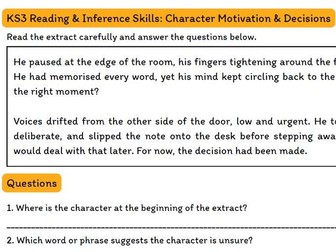
Choices, Pressure and Consequence | No Prior Text Knowledge Required A low-prep, skills-focused reading and inference resource designed to support KS3 pupils in analysing character motivation and decision-making using a short, text-agnostic fiction extract. This resource encourages pupils to explore why characters act the way they do, focusing on internal conflict, pressure, and consequence. Pupils practise retrieval, inference, language analysis and vocabulary in context, while developing confidence in explaining decisions using evidence from the text. Suitable for use as a standalone lesson, starter activity, cover work or intervention task. Skills Covered Retrieval Word-level inference Inference with evidence Language analysis Character motivation and decision-making Vocabulary in context Writer’s intent What’s Included One short fiction extract Ten scaffolded comprehension and inference questions (15 marks total) Optional challenge question Vocabulary development task (synonyms in context) Answer sheet with flexible marking guidance Teacher reference table showing the skill focus for each question Why Teachers Use This Resource No prior knowledge of a set text required Suitable for Years 7–9 Easy to differentiate for mixed-ability classes Minimal preparation and marking Supports progression towards GCSE-style reading analysis Series Information This resource is Resource 2 in the series: KS3 Reading & Inference – Short Extracts & Skills Each resource in the series focuses on a different core reading skill and can be used independently or bundled for wider curriculum coverage. Suggested Uses KS3 English lessons Cover work Reading interventions Homework or revision Assessment practice Skills-based starters or plenaries Tags KS3 English Reading Inference Comprehension Character Decision Making Vocabulary Cover Work English Skills
KS3 Reading & Inference – Short Extracts & Skills: Character ReactionsQuick View
elasticbandy

KS3 Reading & Inference – Short Extracts & Skills: Character Reactions

(0)
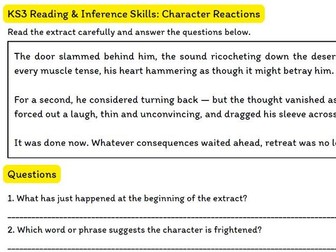
A low-prep, skills-focused reading and inference resource designed to support KS3 pupils in analysing character reactions and emotions using a short, text-agnostic extract. Pupils practise retrieval, inference, language analysis and vocabulary in context, while developing confidence in explaining how writers show emotion through actions and word choices rather than direct explanation. Skills Covered Retrieval Word-level inference Inference with evidence Language analysis Character reactions and emotions Vocabulary in context Writer’s intent What’s Included One short fiction extract Ten scaffolded comprehension and inference questions (15 marks total) Vocabulary development task Answer sheet with flexible marking guidance Teacher reference table showing the skill focus for each question Why Teachers Use This Resource No prior knowledge of a set text required Suitable for Years 7–9 Easy to differentiate Minimal preparation and marking Supports progression towards GCSE-style analysis Series Information This resource is Resource 1 in the series: KS3 Reading & Inference – Short Extracts & Skills Each resource focuses on a different core reading skill and can be used independently or bundled for wider curriculum coverage. Suggested Uses KS3 English lessons Cover work Reading interventions Homework or revision Assessment practice Tags KS3 English Reading Inference Comprehension Character Vocabulary Cover Work English Skills
People & Emotion – See Think Question Visual Inference Photographs (KS2–KS4)Quick View
elasticbandy

People & Emotion – See Think Question Visual Inference Photographs (KS2–KS4)

(0)
People & Emotion – See Think Question Visual Inference Photographs (KS2–KS4) This resource contains a set of carefully selected photographs designed to develop pupils’ inference, discussion and questioning skills using the See, Think, Question framework. Each worksheet features a single photograph with structured prompts to support pupils in: observing visual detail making sensible inferences asking thoughtful, open-ended questions The images include a range of positive, neutral and ambiguous emotions, making this resource suitable for repeated use across different lessons, topics and age groups. What’s included: 12 visual inference worksheets One photograph per page Consistent See / Think / Question structure Optional challenge question on every page Suitable for: Upper KS2 KS3 KS4 SEND EAL Works well for: Reading and inference lessons Oracy and discussion tasks Writing starters Cover or supply lessons PSHE and character exploration Skills developed: Making inferences from visual evidence Exploring feelings, motivation and perspective Justifying ideas using detail Asking meaningful questions No prior knowledge required. Photographs only. Fully printable.
Different types of triangles (Curriculum Cymraeg)Quick View
elasticbandy

Different types of triangles (Curriculum Cymraeg)

(19)
Triangle lesson explaining the different types of triangles. Powerpoint included making use of Curriculum Cymraeg (for those of you in Wales!) to find different types of triangles within the pictures. Also included triangle hunt worksheet for around the classroom/school. Could hunt for triangular windows or the shape of house roofs etc.