This lesson is designed to be easy and straightforward enough so that a sub can deliver with great results, or to make an art teacher shine! Students are encouraged to use the digital platform they are comfortable with to create an expressive digital self-portrait.
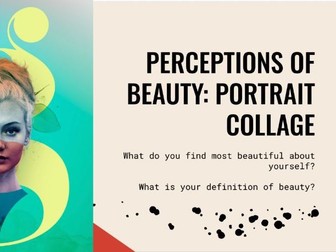
Inspired by contemporary artist Marcelo Monreal, students will create a layered digital self-portrait using organic and geometric elements to highlight what makes them unique.
Students reflect on guiding questions such as “What do you find most interesting about yourself?” and “What is your definition of beauty?” while looking basic digital collage techniques like overlay, splicing, and layering. The resource includes clear requirements, examples, differentiation ideas (including a Cubism-inspired extension), and student-friendly directions. It can be completed as quickly as one lesson, or stretched to be as long as 3 or 4.
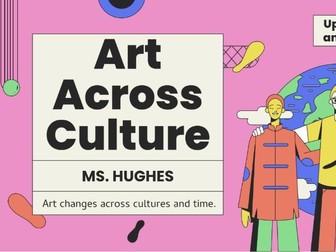
Take your students on a journey through Japan, Mexico, India and Australia through these flexible, easy-to-use visual art projects in this 76 slide presentation. Suitable for upper elementary or middle school, this presentation has so much flexibility that it could easily be used for up to 12 week unit, or broken down into mini units, or even use one of the draw-alongs to use as a sub plan or individual class! The presentation has multiple hyperlinks that forward you to stencils and templates, so that everything is organized in one easy-to-find place.
What’s Included in This Resource:
Cultural Unit 1: Mexico – Day of the Dead (Dia De Los Muertos)
Projects: Create a collaborative “Skull Garland” for classroom decor and intricate “Sugar Skull Paper Art” using layering techniques.
Extras: Detailed skull stencils, display options, and extension tasks for freehand drawing.
Cultural Unit 2: Japan – Cherry Blossoms & Koi Fsh
Concepts: Dive into Japanese watercolor techniques and the legendary symbolism of the Koi fish.
Projects: Paint delicate cherry blossoms using “straw blowing” and “blooming” techniques, create oil pastel Koi fish with watercolor-resist backgrounds.
Extras: Specific “how-to” guides for 3D Koi fish templates and varied watercolor techniques like salt and tissue effects.
Cultural Unit 3: India – The Art of the Elephants
Projects: A guided “Draw-Along” to create detailed elephants focused on symmetry and texture.
Extras: Border design guides, and unique elephant examples.
Cultural Unit 4: Australia – Aboriginal Dot Painting
Projects: Create meaningful Aboriginal Dot Painting using the rhythmic technique of dotting with common tools like Q-tips.
Extras: A guide to Aboriginal symbols (campsites, tracks, and paths) and group activity frameworks to build classroom community.
Essential Teaching Tools:
Multimedia Integration: Embedded links to supplementary videos for every culture to provide authentic context and expert tutorials.
Assessment & Literacy: Built-in exit tickets and a “Constructive Feedback Sandwich” challenge to help students use professional “art smart” vocabulary.
Differentiation: Clearly labeled extension tasks for early finishers and “Refining” steps to challenge older students with advanced layering and shading.
Start your art classes with meaningful thinking, discussion, and visual analysis—no prep required!
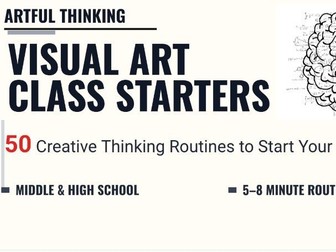
This resource includes 50 short (5–8 minute) artful thinking routines designed for middle and high school visual art classrooms. These routines help students build strong observation, interpretation, and reasoning skills while using appropriate art vocabulary.
Perfect for bell ringers, warm-ups, critiques, art history lessons, and sketchbooks, each routine makes student thinking visible through writing, discussion, and drawing.
What’s Included:
50 ready-to-use visual thinking routines
Clear student-friendly prompts
Real student work examples (Grades 6–11)
Art vocabulary support
Flexible use across art history and studio practice
Featured Routines:
I See, I Think, I Wonder
Claim, Support, Question
Connect, Extend, Challenge
Step-by-Step Analysis
Compare & Contrast
Visual Inventory
Perfect For: Middle & High School Visual Art • IB MYP/DP • Art History • Critiques • Substitute Plans
Low prep. High engagement. Big thinking.
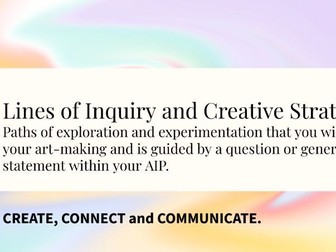
This 30 page PDF was designed specifically for the IB Visual Arts Art-making Inquiries Portfolio (AIP). This resource breaks down complex concepts into student-friendly language, provides visual examples, and supports students as they create their Lines of Inquiry, develop Generative Statements, and understand how creative strategies drive inquiry-based artmaking.
Full Introduction to Creative Strategies
Clear explanations and organized visuals explaining all five IB Transformative Creative Strategy categories:
Each strategy includes definitions, sub-categories, and visual examples for immediate classroom use.
Lines of Inquiry & Generative Statement Development
Students learn:
What Lines of Inquiry are
How inquiry connects to Create / Connect / Communicate (DP Visual Arts core)
How to generate open-ended, curiosity-driven questions
What makes a strong Line of Inquiry
Step-by-step LOI development from mind maps → strategies → statements
High-Quality Artist Case Studies
Engaging examples that illustrate each creative strategy in action:
Maya Lin – Decontextualization (Juxtaposition Strategy)
Sophie Calle – Extension Strategy
Peter Fischli & David Weiss – Juxtaposition Strategy
Alberto Giacometti – Distillation Strategy
Sun Xun – Combinatory Strategy
Bill Viola – Associative Strategy
Homma – Material Transformation (Extension Strategy)
Mind Map & Brainstorming Activities
Students create generative thinking maps exploring themes, concepts, personal interests, identities, and contexts.
Two Complete AIP Art-Making Tasks
Fully developed, scaffolded activities aligned to the AIP assessment objectives:
Task 1 — “Amplification” (Extension Strategy)
Task 2 — “Contradictions” (Juxtaposition Strategy)
AIP Layout Exemplars
A full collection of 10 layout examples demonstrating ways to present.
✔ Aligns 100% with the IB DP Visual Arts (first assessment 2027)
✔ Helps students understand creative strategies through real artworks
✔ Scaffolds critical thinking, research, and visual analysis
✔ Encourages personal, meaningful inquiry
✔ Saves hours of planning, explanation, and resource creation
✔ Provides concrete examples that make abstract concepts accessible
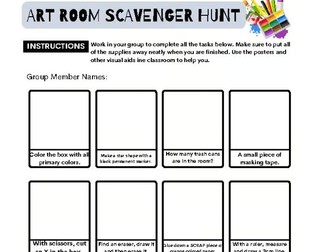
Looking for a fun and interactive way to introduce students to the art room? A scavenger hunt is the perfect solution! Students have fun working in teams, and discovering where to find items, as well as where they should put their trash, finished work and drying work.
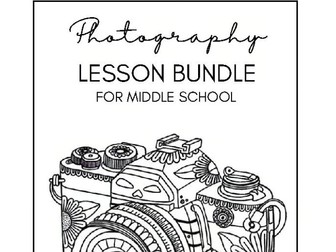
These fun photography projects suitable for grade 6-8 are designed to be easily taught and can be done with low tech (phone) or high tech options. This all-in-one package features five projects which include:
Photo Alphabet
Sun Printing
Toy Photography
David Hockney Inspired Photo Collages
Photo Scavenger Hunt
In addition to each project being engaging, the booklet also features additionally colouring sections (front cover), extensions of learning, and experiments for students to fully grasp tasks. Filled will full color examples, and easy to follow instructions, this resource is a great addition to the middle school art programme or even an after school class.
Through these projects, students learn fundamental photographic skills such as:
-working within a theme
-negative space
-composition techniques
-forced perspective
-shallow depth of field
AND so much more!
Personally, each project takes me between 2-3 lessons to complete, but they can all be easily customizable to suit your learning environment. I hope this product gets your students excited about photography and its endless possibilities!
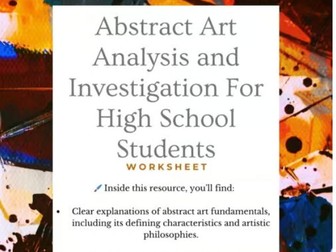
Welcome to my comprehensive Abstract Art Worksheet, specially designed for high school visual art classes! Engage your students in the captivating world of abstract art as they explore its definition, major groups, and influential artists.
It asks prompting questions to help guide students to realize their own abstract artworks. Great for the beginning of a unit for students to independently explore, the IB curriculum, IGCSE or even A level.
Inside this resource, you’ll find:
Clear explanations of abstract art fundamentals, including its defining characteristics and artistic philosophies.
In-depth insights into key abstract art movements.
Stimulating exercises and prompts tailored for student sketchbooks, encouraging experimentation with shapes, colors, and techniques to ignite their creativity.
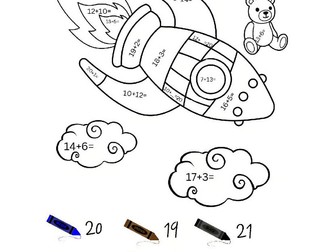
Inspired by the book Whatever Next!, this addition math worksheet is great for addition practice for numbers 10-20. Each sum corresponds to a color to get students involved and engaged in the work.
I suggested printing the worksheet as large as possible, so students can work in groups of pairs.
Answer key included.
Whatever Next! by Jill Murphy is a wonderful book for integrating throughout multiple subjects in lower primary.
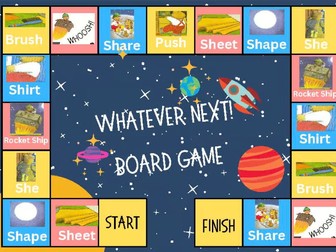
This board game uses images taken directly from the book with an emphasis on “sh” words.
Suitable for English, Literacy, Phonics and Writer’s Workshop.
This worksheet follows the KQED Youtube series on the seven elements of art. All seven worksheets include both an answer key and an in class extension task suitable for rooms with limited supplies.
All video run under 5 minutes, but students will generally need you to pause the video for clarification and watch it twice. Once that is done, and you take up the answers as a class, it should take up an entire 50 minute period to an hour. If your class is longer, there is an extension activity that could be used in class or assigned as homework.
Please watch the video before showing the students, so you are familiar with the artwork shown.
This worksheet follows the KQED Youtube series on the seven elements of art. All seven worksheets include both an answer key and an in class extension task suitable for rooms with limited supplies.
All videos run under 5 minutes, but students will generally need you to pause the video for clarification and watch it twice. Once that is done, and you take up the answers as a class, it should take up an entire 50 minute period to an hour. If your class is longer, there is an extension activity that could be used in class or assigned as homework.
Please watch the video before showing the students, so you familiar with the artwork shown.
This worksheet follows the KQED Youtube series on the seven elements of art. All seven worksheets include both an answer key and an in class extension task suitable for rooms with limited supplies.
All videos run under 5 minutes, but students will generally need you pause the video for clarification and watch it twice. Once that is done, and you take up the answers as a class, it should take up an entire 50 minute period to an hour. If your class is longer, there is an extension activity that could be used in class or assigned as homework.
Please watch the video before showing the students, so you familiar with the artwork shown.
This worksheet follows the KQED Youtube series on the seven elements of art. All seven worksheets include both an answer key and an in class extension task suitable for rooms with limited supplies.
All videos run under 5 minutes, but students will generally need you pause the video for clarification and watch it twice. Once that is done, and you take up the answers as a class, it should take up an entire 50 minute period to an hour. If your class is longer, there is an extension activity that could be used in class or assigned as homework.
Please watch the video before showing the students, so you familiar with the artwork shown.
This worksheet follows the KQED Youtube series on the seven elements of art. All seven worksheets include both an answer key and an in class extension task suitable for rooms with limited supplies.
All videos run under 5 minutes, but students will generally need you to pause the video for clarification and watch it twice. Once that is done, and you take up the answers as a class, it should take up an entire 50 minute period to an hour. If your class is longer, there is an extension activity that could be used in class or assigned as homework.
Please watch the video before showing the students, so you familiar with the artwork shown.
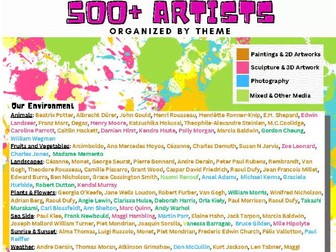
How often have you spent time and energy thinking of artists to help support student research and development? Over two years in the making, this quick reference 3 page, A3 poster has saved me so much time in the classroom! It features over 500 artists organized by categories most relevant to middle school and high school level students. In addition, all artists are color coded into which medium is predominately used (painting/2D, sculpture/3D, photography, mixed media).
*Please be mindful that some artists may features nudes, or topics not suitable for certain cultures (ex: LGTBQ/Mental illness), so individual discretion is needed.
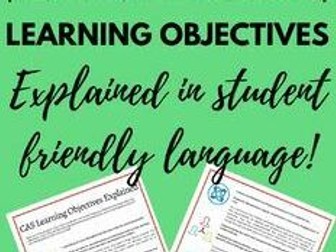
This teaching tool describes in detail the IB DP CAS learning objectives directly from the curriculum, but it also break down the content in understandable student friendly language. It asks students thought provoking questions to check for understanding as well as providing real world examples.
For me, it has promoted great classes discussions, as well as healthy debates in class. Students can even break intro groups and create mini presentations about each LO.
Design to be used as a poster or a resources that they can keep alongside other CAS resources. It can also be handy to place in your CAS Handbook
Due to the inclusive and broad aspects of CAS, students can often get confused as to what qualifies as a CAS experience. This poster is designed for students to ask themselves reflective questions and determine if an experience they are planning meets the CAS criteria. Created in an A3 size, it can easily be printed and used in a classroom as a resource which CAS Coordinators and CAS Supervisors can direct students to. Personally, it has saved me a great deal of time in the classroom.
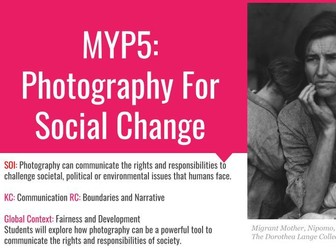
MYP 5 visual arts unit planner complete with some supporting materials including: website links, videos, and a summative RUBRIC which lists all formative assessment tasks. The Unit teaches about the importance of social documentary photography, the “rules” of a goof photography, photography analysis, brainstorming while connecting to a concept, and preparing for final display. The planner uses IB MYP vocabulary and content.
As educators, we are aware of the transformative power and multitude of benefits service learning can provide for our students. This poster is designed to help guide students to create service experiences which are meaningful and have lasting effects. It can act as a classroom tool to assist in their planning, and ensure they are thinking about both global and local issues.
In my CAS classes, I take the time to break down all five points individually as a lesson, adding additional examples and taking questions if they arise. During the remainder of the year it acts as an anchor chart if students have questions as well as a great starting-off point if students are looking for ideas.
This bundle includes all of the A3 PDF posters relating to CAS. Keep in mind that these can easily be sized down to A4 and used as class resources.
5 Tips for Success Service Learning
50 CAS Experiences
CAS Learning Objectives Explained
What is NOT CAS
This worksheet follows the KQED Youtube series on the seven elements of art. All seven worksheets include both an answer key and an in class extension task suitable for rooms with limited supplies.
All videos run under 5 minutes, but students will generally need you pause the video for clarification and watch it twice. Once that is done, and you take up the answers as a class, it should take up an entire 50 minute period to an hour. If your class is longer, there is an extension activity that could be used in class or assigned as homework.
Please watch the video before showing the students, so you familiar with the artwork shown.


 Quick View