Here are just three of the PowerPoint presentations I have created and used with my current year 9 English group in preparation for their WJEC Eduqas Poetry exam - I will upload more soon. Hope they help!
A series of factsheets for use alongside the teaching of AC2.1 Biological theories. Resource contains factsheets for:
Albert Bandura’s social learning theory
Asch and conformity study
Bowlby’s maternal depravation theory
Freud’s psychodynamic theory
Eysenck’s personality theory
Skinner’s oeprant conditioning theory
Sutherland’s differential association theory
Yochelson and Samenow’s criminal personality theory
Also included is a blank template sheet for students to compile key information from the fact sheets (tailored to exam requirements: Theory category, theory sub-category, theorist, summary of theory, study undertaken, key statistics and findings, strengths and limitations, and application to case study.)
This resource allows students to create a centralised revision page for each theory.
AC2.1 Biological theories (Available)
and
AC2.3 Sociological theories (Available soon)
A series of factsheets for use alongside the teaching of AC2.1 Biological theories. Resource contains factsheets for:
Emile Durkheim’s functionalist approach
Left Realism
Right Realism
Merton’s strain theory
Also included is a blank template sheet for students to compile key information from the fact sheets (tailored to exam requirements: Theory category, theory sub-category, theorist, summary of theory, study undertaken, key statistics and findings, strengths and limitations, and application to case study.)
This resource allows students to create a centralised revision page for each theory.
AC2.1 Biological theories
and
AC2.2 Individualistic theories
Also available soon.
Here is a multi lesson resource I have created (following the guidelines and prompts of the teacher CSP booklet) for A-Level Media studies. Attached are also some tasks and resources for use within the lesson(s).
Includes:
Social, Cultural and Historical context of the music video
Opportunities for comparison with the Michael Jackson - Billie Jean CSP
Genre theory and Representation theory
Mise en Scene analysis
Much more…
This powerpoint and the aforementioned resources cover both Media Language and Media Representation, of the key areas of the theoretical framework. (Slides are clearly marked at the top)
For use with AQA new Media Studies A-Level Specification.
Unit 3 - Crime Scene to Courtroom
This resource contains all needed Knowledge Organisers for the UNIT (1 per AC) = 11 in total.
Each Knowledge organiser contains key vocabulary and concepts appropriate to each specific AC.
For the WJEC Applied Diploma in Criminology post-16 course
(Unit 4 - Crime and Punishment knowledge organisers also available soon)
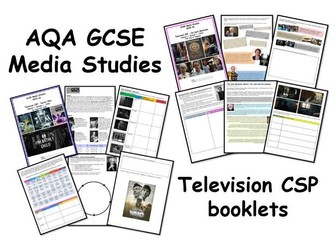
This is a bundle containing two complete, comprehensive student work books which cover the entirety of the specification for Media Studies GCSE (television products) for AQA.
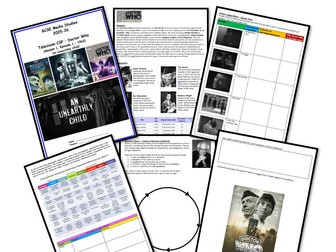
Doctor Who CSP booklet
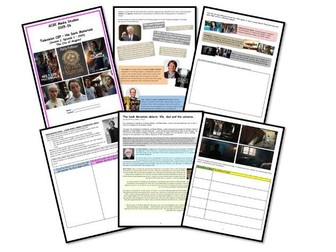
His Dark Materials CSP booklet
Both booklets contain information, tasks and activities for a full-course of study for each TV CSP. Each booklet contains:
Links to AQA specification
Character profiles
In-depth study, activities and information concerning media language in each TV CSP
In-depth study, activities and information concerning media representations in each TV CSP
In-depth study, activities and information concerning media audiences in each TV CSP
In-depth study, activities and information concerning media industries in each TV CSP
Activities and information for social, cultural and historical context(s)
Activities for relevant and appropriate theory
Homework tasks and more…
Book booklets are available singularly.
A comprehensive student work booklet for the teaching of the His Dark Materials - The City of Magpies (2020) Close Study Product for AQA GCSE Media Studies.
The booklet itself covers the full course of study for the His Dark Materials - The City of Magpies (2020) CSP. The booklet is split into sections focusing clearly on Media Language, Media Representations, Media Audience and Media Industry; as well as relevant and appropriate media theory and contextual information throughout.
Each section contains a variety of tasks for students to complete alongside the teaching of the His Dark Materials - The City of Magpies CSP. Booklet covers everything required by the AQA CSP Student Booklet and the AQA specification.
Doctor Who - An Unearthly Child (1963) booklet also available.
A comprehensive student work booklet for the teaching of the Doctor Who - An Unearthly Child (1963) Close Study Product for AQA GCSE Media Studies.
The booklet itself covers the full course of study for the Doctor Who (1963) CSP. The booklet is split into sections focusing clearly on Media Language, Media Representations, Media Audience and Media Industry; as well as relevant and approprriate media theory and contextual information throughout.
Each section contains a variety of tasks for students to complete alongside the teaching of the Doctor Who CSP. Booklet covers everything required by the AQA CSP Student Booklet and the AQA specification.
His Dark Materials - The City of Magpies (2021) booklet will also be available soon.
Unit 4 - Crime and Punishment
This resource contains all needed Knowledge Organisers for the UNIT (1 per AC)
Each Knowledge organiser contains key vocabulary and concepts appropriate to each specific AC.
For the WJEC Applied Diploma in Criminology post-16 course
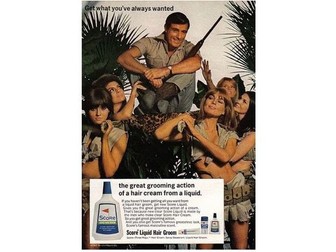
These presentations concern themselves with taking a look at the Media Language and Media Representations used within the Score Liquid Hair Cream Advert - culminating in a practice exam question from the AQA specimen exam paper 1.
This resource can be used successfully alongside the student CSP booklet created by AQA.
Unit 1 - Changing Awareness of Crime Knowledge Organisers
This resource contains all needed Knowledge Organisers for the UNIT (1 per AC) = 11 in total.
Each Knowledge organiser contains key vocabulary and concepts appropriate to each specific AC.
For the WJEC Applied Diploma in Criminology post-16 course
(Unit 2 - Criminological Theories knowledge organisers also available)
A series of factsheets for use alongside the teaching of AC2.1 Biological theories. Resource contains factsheets for:
Jacobs et al. - XYY theory
Hutchings and Mednick - Adoption Studies
Lange and Christiansen - Twin Studies
Biochemical explanations
Brain injuries and disorders
Lombroso - Atavistic features theory
Sheldon - Somatotypes theory
Also included is a blank template sheet for students to compile key information from the fact sheets (tailored to exam requirements: Theory category, theory sub-category, theorist, summary of theory, study undertaken, key statistics and findings, strengths and limitations, and application to case study.)
This resource allows students to create a centralised revision page for each theory.
AC2.2 Individualistic theories
and
AC2.3 Sociological theories
Also available soon.
Unit 2 - Criminalogical Theories
This resource contains all needed Knowledge Organisers for the UNIT (1 per AC) = 10 in total.
Each Knowledge organiser contains key vocabulary and concepts appropriate to each specific AC.
For the WJEC Applied Diploma in Criminology post-16 course
(Unit 3 - Criminological Theories knowledge organisers also available)
Four A3 sized Knowledge Organisers for AQA GCSE Media Studies - One for each area of the theoretical framework (audience, language, representation and industry)
Each knowledge organiser contains:
Key subject specific vocabulary surrounding the key area of the framework
Relevant and applicable theory surrounding said area of the framework
A list of CSPs which can be assessed on said area of the framework in one or either of the exams
Overview of both Media One and Two for students to become familiar with.
Great for teaching alongside the student CSP booklet!
Here are some resources to help students get their heads around what is required of them in terms of the planning of their campaigns in Unit 1, AC3.1 of the WJEC specification for Criminology.
Attached is a teacher-led Powerpoint and an accompanying booklet for use as a practice campaign prior to their Unit 1 controlled assessment.
Unit 1 - Changing Awareness of Crime [11]
Unit 2 - Criminological Theories [10]
Unit 3 - Crime Scene to Courtroom [11]
Unit 4 - Crime and Punishment [10]
This resource contains all needed Knowledge Organisers for the entire WJEC Applied Diploma in Criminology = 42 Knowledge Organisers in total.
Each Knowledge organiser contains key vocabulary and concepts appropriate to each specific AC within each Unit.
For the WJEC Applied Diploma in Criminology post-16 course.
Each unit also available seperately.
A powerpoint of around five or six lessons regarding the Lil Nas X A Level CSP for the 2024 AQA examinations specification.
Included in this resource is:
A complete set of lessons
Worksheets appplicable to specific lessons (all labelled)
Wider learning work headed ‘Extra’ on slides
A comprehensive work book designed to help students understand key media studies theory at GCSE level.
Theories are split into the respective areas of the key theoretical framework for AQA Media Studies and application of theories to current (exam in 2024) close study products.
There is also space for further theories to be taught and applied to Close Study Products.
Feedback much appreciated.
A booklet containing tasks associated with Unit 4 of the WJEC Applied Diploma in Criminology qualification for post-16 students.
The booklet contains independent study tasks designed to help students revise for their Unit 4 exam.
There are five types of task:
Watch a video and make notes/summarise topic
Cornell notes on specific topics
Research topic and complete a task
Read an article or journal and complete a task
Answer an exam question
A booklet containing relevant theory appropriate to A Level Media Studies, covering the four key areas of the Media Studies framework.
This booklet contains almost every theory covered in the A Level qualification with a section to apply said theories to Close Study Products and an opportunity for wider reading in terms of theory also.
A booklet that allows students to apply theories studied to a range of infamous cases.
Each case study contains:
Name
Sentence given
Crimes committed
Date of arrest
Information surrounding the case
Image of the offender
As well as space for student work in boxes labelled:
Contextual information (can be used as a research task)
Theories the student will apply
Details of chosen theories
How specific theories might apply to this specific case study