AQA GCSE Physics: Topic 3 Particle Model of Matter - Complete Revision Summary & ExercisesQuick View
adlensadler

AQA GCSE Physics: Topic 3 Particle Model of Matter - Complete Revision Summary & Exercises

(0)
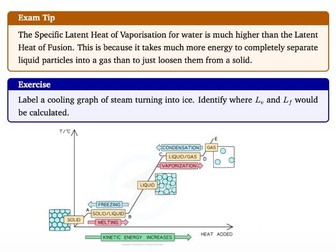
Overview A comprehensive and structured summary of the entire Topic 3: Particle Model of Matter for AQA GCSE Physics (Paper 1). This 19-page PDF booklet contains everything students need to master this unit, from basic definitions to complex calculations and required practicals. What’s included in this booklet: Complete Theory Coverage: All sub-topics explained clearly, including Density, States of Matter, Internal Energy, Specific Heat Capacity, Latent Heat, and Gas Pressure. Required Practical Focus: Detailed methodology and tips for the Density experiment (Regular, Irregular solids, and Liquids). Mathematical Support: Clear formulas, unit conversion guides (e.g., cm³ to m³), and step-by-step calculation examples. Exam-Style Exercises: Every section is followed by targeted practice questions to consolidate learning. Full Solutions: Worked answers are provided at the end of the document, making it perfect for independent study or quick marking. Exam Tips & Core Concepts: Highlighted boxes to help students avoid common pitfalls and focus on high-yield exam points. Perfect for: Revision lessons or independent revision guides. In-class teaching notes. Homework assignments or intervention groups.
GCSE Maths | Indices: Mastery & Fluency Practice | With Full SolutionsQuick View
adlensadler

GCSE Maths | Indices: Mastery & Fluency Practice | With Full Solutions

(0)
GCSE Maths | Indices: Mastery & Fluency Practice A focused fluency practice worksheet on Indices for GCSE Maths. Designed to build speed and accuracy across all index laws, progressing from straightforward to exam-style challenge. Structure Section 1 – Multiplication & Division Laws Simplify expressions using aᵐ × aⁿ = aᵐ⁺ⁿ and aᵐ ÷ aⁿ = aᵐ⁻ⁿ Section 2 – Power of a Power & Brackets Problems involving (aᵐ)ⁿ = aᵐⁿ with combined operations Section 3 – Zero & Negative Indices Including tricky cases like 20k⁰ − (20k)⁰, fractional conversions, and 0.04 as a power of 5 Section 4 – Speed & Challenge Problems Mixed problem solving: solve for unknown powers, order values, and multi-step simplification Includes ✓ Laws summary at the top for quick reference ✓ 16 carefully graded questions ✓ Full worked solutions with every step shown ✓ Print-ready PDF (5 pages) Suitable for GCSE Higher and Foundation (Grades 5–9). Great for revision, homework, or timed fluency drills. Written by an experienced GCSE tutor.
Laws of Indices MasterclassQuick View
adlensadler

Laws of Indices Masterclass

(0)
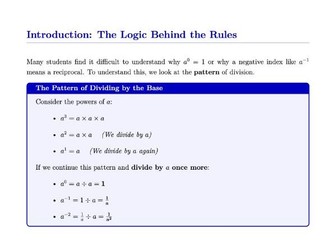
A complete masterclass on Laws of Indices that goes beyond memorising rules — it teaches students WHY the rules work. Starting from the logical pattern behind a⁰=1 and negative indices, this resource builds understanding from the ground up before introducing each law. Includes: Introduction: The Logic Behind the Rules (why a⁰=1, why negative indices mean reciprocals) Part 1: The Fundamental Laws (multiplication, division, power of a power, zero & negative indices) Part 2: Fractional Indices (roots and powers, with worked examples) Part 3: Solving Index Equations (matching bases strategy) Full Solutions — Teacher’s Reference Suitable for GCSE Higher and A-level students. Perfect for revision, homework, or independent study. Clear explanations with step-by-step worked examples and practice problems. Topics covered: index laws, fractional indices, negative indices, zero index, surds, solving index equations, algebra revision.