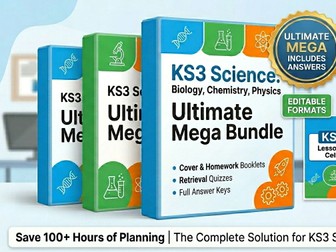
Include: Cover Booklets, Homework Booklets, Retrieval Booklets, and Mastery Booklets.
Save 100+ Hours of Planning | The All-in-One Solution for Biology, Chemistry, and Physics
Planning for KS3 Science across two or three years can be overwhelming. This comprehensive, departmental-level bundle contains every resource you need to teach the complete National Curriculum with confidence. Every worksheet is ready to print, and every PowerPoint is ready to teach.
Perfect for: Heads of Department, Early Career Teachers (ECTs), NQTs, and busy Science teachers looking to regain their work-life balance.
NCFE Child Development Full Specification Revision Booklets with Answers – Ideal for Low-Stakes Testing & Exam Prep
This printable and editable revision booklet covers the entire specification for NCFE Child Development . It’s packed with varied, student-friendly tasks designed to boost knowledge, improve exam technique, and support retrieval practice in a low-pressure format.
This resource is for one subject but each specification point has a revision booklet and answers that fully align with the relevant GCSE.
Included in this resource:
5 multiple choice questions
Two batches of true or false statements
Gap-fill paragraph with word bank
Keyword match-up activity
Spot the mistake exam-style task
5 short answer questions
2 explain-with-example questions
1 ranking activity
Concept sorting table
Mini retrieval quiz (3×3 format)
Command word practice template
Whiteboard Q&A (10 questions)
2 mini case study application tasks
Full answer sheet included
Perfect for independent revision, in-class consolidation, or homework. Ideal for preparing students for topic tests, mock exams or final assessments.
revision booklet, GCSE, full specification, low stakes testing, retrieval practice, exam questions, answer sheet, command words, KS4 revision, printable booklet, editable Word resource Ai was used to help make these resources.
One booklet for each of the following specification points:
Child Development and Early Years Summary
Holistic Development and Influences
Aspects of Growth: Covers physical, cognitive, communication, and social/emotional development.
Key Factors: Analysis of nature versus nurture, biological and environmental influences, and how transitions impact a child’s progress.
Practical Care and Play
Routines and Needs: Focuses on meeting basic care needs and implementing daily routines.
Role of Play: The practitioner’s responsibility in facilitating play activities to support learning and development.
Professional Frameworks and Provision
Settings: The purpose and variety of early years provisions.
Legislation: Understanding safeguarding, health and safety, equality, and confidentiality procedures.
Professionalism: Expectations regarding behavior, appearance, and timekeeping.
Roles: The importance of partnership working and the involvement of specialists.
Observation and Planning
Observation Methods: Techniques for recording progress, distinguishing between objective and subjective data.
Planning Cycle: Using a child-centered approach to observe, assess, and plan for future development needs.
This KS3 Science Independent Study Booklet Series provides a full three-year KS3 science curriculum of ready-to-use homework and cover work booklets, with one booklet for every part of the KS3 specification. Designed by an outstanding UK science teacher and created with support from AI, these booklets allow students to work independently while maintaining high academic standards.
Each booklet is carefully structured to guide students through a complete topic without teacher input, making them ideal for cover lessons, homework, remote learning, intervention, and independent study. Written in clear, student-friendly language for ages 11–14, the booklets support all abilities while reinforcing key scientific knowledge and vocabulary.
Every booklet includes 10 structured learning sections:
• Topic Summary & Key Concepts
• Student Reflection Tasks
• Keyword Definitions
• Gap-Fill Knowledge Check
• “Why? Why? Why?” Deep Thinking Questions
• Tiered Learning (Define, Explain, Apply, Evaluate)
• Mini Retrieval Quiz
• Spot the Mistake
• Ranking Challenge
• Exam-style PEE Paragraph Builder
• True or False Knowledge Check
The series covers all Biology, Chemistry and Physics topics across Years 7–9, including cells, human body systems, ecosystems, energy, electricity, forces, magnetism, chemical reactions, particles, acids & alkalis, climate, Earth structure, space, and more.
These booklets require no preparation, are fully printable, and provide meaningful learning when students are working independently. Perfect for non-specialist cover staff, absent teachers, homework setting, and maintaining curriculum continuity.
This resource series provides full coverage of the KS3 Science curriculum across Biology, Chemistry and Physics.
Biology Topics:
Cells and Microscopy
Specialised Cells
Organisation of the Body
Skeletal and Muscular Systems
Gas Exchange and Breathing
Respiration
Digestion
Nutrition and Diet
Human and Plant Reproduction
Variation and Inheritance
Genetics and DNA
Evolution and Natural Selection
Adaptations
Interdependence
Food Chains and Food Webs
Ecosystems
Photosynthesis
Plant Mineral Nutrition
Disease and the Immune System
Health and Lifestyle
Chemistry Topics:
States of Matter
Changes of State
Particle Model
Elements, Compounds and Mixtures
Separating Techniques
Atoms and the Periodic Table
Metals and Non-Metals
Acids, Alkalis and Indicators
Neutralisation
Chemical Reactions
Combustion
Earth’s Structure and Atmosphere
Climate and Climate Change
Greenhouse Gases
Fuels and Energy Resources
Environmental Chemistry
Physics Topics:
Forces
Contact and Non-Contact Forces
Speed and Distance-Time Graphs
Motion
Energy Stores and Transfers
Work and Power
Heating and Cooling
Thermal Energy
Electricity
Circuits
Current, Voltage and Resistance (KS3)
Magnetism
Electromagnets
Uses of Magnetism
Waves
Sound
Light
Reflection and Refraction
Space
The Solar System
Gravity and Orbits
NCFE Child Development Full Specification retrieval practice Booklets with Answers. This GCSE Retrieval Practice and Revision Workbook series has been created by an outstanding UK classroom teacher, with support from AI technology, to give you ready-to-use retrieval worksheets, revision tasks, and independent study resources for every GCSE specification point.
Each booklet targets one topic from the GCSE specification, providing structured low-stakes recall, exam-style practice, and knowledge organiser summaries that strengthen memory and boost exam confidence.
Perfect for classwork, homework, intervention, or revision lessons, these booklets help students close gaps, recall key content, and prepare effectively for assessments.
Each booklet includes:
Knowledge Snapshots – short topic summaries for quick revision.
Retrieval Grid (4×4) – sixteen recall questions for active practice.
Gap-Fill Paragraphs – vocabulary and context application.
Mixed Retrieval Quiz – multiple-choice, short-answer, and matching questions.
True or False + Correct It – correct misconceptions and test understanding.
Retrieval Pyramid & Mini Test – increasing challenge and scaffolding.
Retrieval Sorting Cards – interactive cut-and-sort revision activity.
Reflection Section – self-assessment and metacognitive review.
Complete Answer Booklet Included – ideal for self-marking or teacher feedback.
A complete, printable GCSE retrieval practice resource designed to save planning time, improve recall, and support confident exam performance across the full specification.
Child Development and Early Years Summary
Development and Influences Covers holistic growth, including physical, cognitive, communication, and social/emotional aspects. It examines nature versus nurture, biological and environmental factors, and the impact of life transitions on a child’s progress.
Care, Play, and Provision Focuses on meeting basic care needs through routines and play. It details the practitioner’s role in facilitating activities and explores the different types, purposes, and settings of early years provision.
Legislation and Professionalism Outlines legal frameworks for safeguarding, health and safety, and equality. It also covers professional expectations—such as behavior and attendance—and the importance of partnership working with specialists.
Observation and Planning Explores objective and subjective observation methods used to track development. It emphasizes the child-centered planning cycle to observe, assess, and plan for a child’s individual needs.
This NCFE Child Development Complete Resource Bundle includes all resources required to teach and support the full NCFE Child Development specification, with one resource for each part of the course. Designed by an experienced UK classroom teacher, with support from AI-assisted resource development, this bundle provides a consistent, high-quality set of materials for teaching, homework, cover lessons, revision, and independent study.
All resources are fully editable, clearly structured, and written in accessible language suitable for a wide range of learners. The bundle is ideal for non-specialist cover staff, intervention sessions, independent learning, and exam preparation, while also supporting strong curriculum alignment and progression throughout the course.
What’s included in the bundle:
• Independent Study Booklets for every specification point
• Mastery & Intervention Booklets targeting misconceptions and key skills
• Retrieval Practice and Low-Stakes Assessment resources
• Critical Thinking Booklets focused on evaluation, justification, and applied understanding
• Fully completed answer sheets for all resources
• Printable and digital formats suitable for classroom and home use
How the resources support learning:
Each resource is designed to help students consolidate knowledge, deepen understanding, and apply learning to realistic child development contexts. Activities include structured questions, retrieval tasks, extended responses, evaluative thinking, and reflection, supporting both coursework-style tasks and exam preparation.
This is a no-prep bundle that saves significant planning time while ensuring meaningful, specification-linked learning continues in lessons, at home, or during cover.
Perfect for departments looking for a complete, consistent NCFE Child Development resource pack that supports progress, independence, and confidence across the full course.
For each style of worksheet or booklet each part of the specification is covered.
Child Development and Early Years Summary
Holistic Development and Influences
Aspects of Growth: Covers physical, cognitive, communication, and social/emotional development.
Key Factors: Analysis of nature versus nurture, biological and environmental influences, and how transitions impact a child’s progress.
Practical Care and Play
Routines and Needs: Focuses on meeting basic care needs and implementing daily routines.
Role of Play: The practitioner’s responsibility in facilitating play activities to support learning and development.
Professional Frameworks and Provision
Settings: The purpose and variety of early years provisions.
Legislation: Understanding safeguarding, health and safety, equality, and confidentiality procedures.
Professionalism: Expectations regarding behavior, appearance, and timekeeping.
Roles: The importance of partnership working and the involvement of specialists.
Observation and Planning
Observation Methods: Techniques for recording progress, distinguishing between objective and subjective data.
Planning Cycle: Using a child-centered approach to observe, assess, and plan for future development needs.
This fully editable NCFE Child Development worksheet is designed to closely match the specification and is ideal for homework, cover lessons, independent study, and revision. Each task is carefully structured to help students consolidate key content, deepen understanding, and apply knowledge effectively.
The worksheet supports a range of teaching and learning approaches, including retrieval practice, flipped learning, home learning, and in-class support. Clear instructions and scaffolded activities allow students to work independently, making it suitable for use by non-specialist cover staff as well as subject teachers.
This is a no-prep resource, saving valuable teacher time while still providing meaningful, curriculum-linked learning. Activities are accessible and engaging, supporting progress across a range of abilities.
AI was used to help create and structure this resource, ensuring clarity, consistency, and alignment with the NCFE Child Development specification, while professional teacher oversight ensures it remains classroom-ready and student-friendly.
Perfect for maintaining progress when teaching time is limited, and for reinforcing learning throughout the course.
Child Development and Early Years Summary
Holistic Development and Influences
Aspects of Growth: Covers physical, cognitive, communication, and social/emotional development.
Key Factors: Analysis of nature versus nurture, biological and environmental influences, and how transitions impact a child’s progress.
Practical Care and Play
Routines and Needs: Focuses on meeting basic care needs and implementing daily routines.
Role of Play: The practitioner’s responsibility in facilitating play activities to support learning and development.
Professional Frameworks and Provision
Settings: The purpose and variety of early years provisions.
Legislation: Understanding safeguarding, health and safety, equality, and confidentiality procedures.
Professionalism: Expectations regarding behavior, appearance, and timekeeping.
Roles: The importance of partnership working and the involvement of specialists.
Observation and Planning
Observation Methods: Techniques for recording progress, distinguishing between objective and subjective data.
Planning Cycle: Using a child-centered approach to observe, assess, and plan for future development needs.
NCFE Independent Study Booklets | Created Using AI and UK Teacher Expertise | 10 Structured Activities for Revision, Retrieval and Homework, Whole specification covered & answers
This NCFE Independent Study Booklet was created using advanced AI technology in collaboration with an outstanding UK teacher. It combines the accuracy of AI-generated structure with classroom expertise to provide high-quality, ready-to-use learning materials. Each booklet includes ten carefully designed sections that build knowledge, retrieval practice and exam-ready thinking. Written at a reading age of 14–16, the booklet is ideal for homework, revision, intervention or cover lessons.
The resource develops confidence through scaffolded activities and PIXL-style reasoning tasks that encourage students to explain, apply and evaluate their understanding. Teachers can use it in any GCSE subject or exam board, including AQA, Edexcel, OCR and WJEC.
Contents include: Summary paragraph, Gap-fill, Why? Why? Why? reasoning, Tiered learning (define, explain, apply, evaluate), Mini retrieval quiz, Spot the mistake, Ranking challenge, Keyword match-up, PEE paragraph builder and Quick-fire true or false relay. Answers to all questions included.
This booklet saves preparation time, supports independent learning and provides clear evidence of retrieval and metacognition. It is fully editable, printable and adaptable for classroom, homework or remote learning use.
GCSE independent study booklet, AI teaching resource, teacher-created, revision workbook, retrieval practice, PIXL thinking hard, GCSE homework, intervention, mastery learning, printable GCSE resource, KS4 study guide.
Child Development and Early Years Summary
Holistic Development and Influences
Aspects of Growth: Covers physical, cognitive, communication, and social/emotional development.
Key Factors: Analysis of nature versus nurture, biological and environmental influences, and how transitions impact a child’s progress.
Practical Care and Play
Routines and Needs: Focuses on meeting basic care needs and implementing daily routines.
Role of Play: The practitioner’s responsibility in facilitating play activities to support learning and development.
Professional Frameworks and Provision
Settings: The purpose and variety of early years provisions.
Legislation: Understanding safeguarding, health and safety, equality, and confidentiality procedures.
Professionalism: Expectations regarding behavior, appearance, and timekeeping.
Roles: The importance of partnership working and the involvement of specialists.
Observation and Planning
Observation Methods: Techniques for recording progress, distinguishing between objective and subjective data.
Planning Cycle: Using a child-centered approach to observe, assess, and plan for future development needs.
This complete KS3 Science Retrieval & Revision Workbook Bundle covers every Biology, Chemistry and Physics topic in the KS3 curriculum, with one retrieval booklet per specification point. Developed by an outstanding UK science teacher, supported by AI-assisted resource creation, this bundle delivers high-quality, ready-to-use retrieval practice for every lesson across Years 7, 8 and 9.
Each booklet is written in student-friendly language (ages 11–14) and designed to strengthen long-term memory through structured recall tasks, varied question types and clear scientific vocabulary. All booklets include a fully completed teacher answers version, making them ideal for classwork, homework, independent study, intervention, revision, or cover lessons.
Topics included across the full KS3 Science course
(Complete Biology, Chemistry and Physics coverage)
Biology:
• Cells & Microscopy
• Body Systems & Organs
• Gas Exchange & Breathing
• Respiration
• Digestion
• Reproduction (Human & Plant)
• Health, Lifestyle & Diet
• Microbes & Disease
• Ecology & Food Webs
• Adaptations
• Interdependence
• Photosynthesis
• Inheritance & Variation
• Genetics
• Evolution
Chemistry:
• States of Matter
• Particle Model
• Elements, Compounds & Mixtures
• Separating Techniques
• Atoms, Elements & Periodic Table
• Acids, Alkalis & Indicators
• Chemical Reactions
• Metals & Non-Metals
• Combustion
• Earth & Atmosphere
• Climate Science
• Fuels & Energy Resources
• Environmental Chemistry
Physics:
• Forces
• Motion
• Speed & Distance-Time Graphs
• Energy Stores & Transfers
• Work & Power
• Heating & Cooling
• Electricity
• Circuits
• Magnetism & Electromagnets
• Waves
• Sound
• Light
• Space & Solar System
Every major KS3 science theme is fully covered.
Each booklet includes 10–12 retrieval activities, such as:
• Knowledge Snapshots (key facts for each topic)
• 4×4 Retrieval Grid (16 recall questions)
• Last Lesson & Last Week Recall
• Gap-Fill Summary with Word Bank
• Mixed Retrieval Quiz (MCQs, short answers, matching)
• True/False + Correct It (fix misconceptions)
• Retrieval Pyramid (Recall → Explain → Apply)
• Mini Test (12 marks)
• Retrieval Sorting Cards (cut-and-sort activity)
• Reflection & Review (metacognition)
These activities build retrieval strength, reinforce vocabulary, and help students secure the fundamental concepts needed for GCSE success.
What’s included in the full download
• One fully editable booklet per KS3 science topic
• Student version (no answers)
• Full teacher answers version
• Printable PDFs included
• Complete three-year KS3 retrieval curriculum in one bundle
Perfect for departments seeking a consistent, high-impact retrieval routine across the whole of KS3 Science. Saves hours of planning and provides a ready-made system for recall, assessment and intervention.
This KS3 Science Mastery & Intervention Booklet Series provides a complete set of targeted support and challenge resources for every topic across the full KS3 Biology, Chemistry and Physics curriculum. Each booklet focuses on one specific science topic, making them ideal for intervention, catch-up, revision, homework, cover work, and targeted support sessions.
Designed by an outstanding UK science teacher, with support from AI-assisted resource development, these booklets are structured to identify misconceptions, strengthen core understanding, and build confidence in exam-style responses. All booklets include a fully completed teacher answers version, making them suitable for self-marking, peer assessment, or guided teacher feedback.
Each Mastery & Intervention booklet includes:
Knowledge Boost Notes with clear, student-friendly explanations
Diagnostic Starter Questions to assess prior knowledge
Keyword Definition Tasks linked directly to the specification
Step-by-Step Scaffolded Explanations for key processes
Fill-In Model Answers and Exam Technique Practice
Spot the Mistake Activities to address misconceptions
Scaffolded Practice Questions with guided hints
Independent “Now Try It Yourself” Questions
Misconception Match-Up Tasks
Exam-Style Questions with Command Word Focus
Reflection and Confidence Review Tasks
The series covers all KS3 Science topics, including:
Cells and body systems, ecosystems, photosynthesis, inheritance and evolution, states of matter, particle model, chemical reactions, acids and alkalis, forces, energy, electricity, magnetism, electromagnets, waves, light, sound, space, and all other core KS3 Biology, Chemistry and Physics content.
These booklets require no preparation, are fully printable, and are ideal for use by non-specialist cover staff, intervention tutors, and classroom teachers who need meaningful, structured work that leads to real progress.
Perfect for closing gaps, building mastery, and preparing students for GCSE science from the very start of KS3.
This resource provides full coverage of the KS3 Science curriculum across Biology, Chemistry and Physics.
Biology includes: cells and microscopy, body systems, breathing and respiration, digestion, nutrition, human and plant reproduction, variation and inheritance, genetics, evolution, adaptations, food chains, ecosystems, photosynthesis, plant nutrition, disease, immunity, health and lifestyle.
Chemistry includes: states of matter, particle model, elements, compounds and mixtures, separating techniques, periodic table, metals and non-metals, acids and alkalis, neutralisation, chemical reactions, combustion, Earth’s atmosphere, climate change, greenhouse gases, fuels and environmental chemistry.
Physics includes: forces, motion, speed, energy stores and transfers, work and power, heating, electricity, circuits, magnetism, electromagnets, waves, sound, light, space and gravity.
This KS3 Geography Mastery Booklet Series provides a complete set of targeted mastery and intervention resources, with one booklet for every topic across the KS3 Geography curriculum. Designed by an outstanding UK classroom teacher, with support from AI-assisted resource creation, these booklets are built to secure core knowledge, correct misconceptions, and deepen understanding across Years 7, 8 and 9.
Each booklet focuses on one specific geography topic and is structured to move students from basic recall to confident explanation and application. This makes them ideal for intervention groups, catch-up sessions, homework, revision, cover work, and targeted support lessons. All booklets are written in clear, student-friendly language for ages 11–14 and include a full teacher answers version for guided feedback or self-marking.
Each Mastery Booklet includes:
• Knowledge boost notes with clear explanations
• Diagnostic starter questions to assess prior understanding
• Keyword definition tasks linked to the specification
• Step-by-step scaffolded explanations
• Fill-in model answers with exam technique practice
• Spot the mistake activities to address misconceptions
• Scaffolded practice questions with guided hints
• Independent “Now Try It Yourself” questions
• Misconception match-up tasks
• Exam-style questions focused on command words
• Reflection and confidence review tasks
The series covers all major KS3 Geography content, including geographical skills, rivers, coasts, weather and climate, ecosystems, population, settlements, urbanisation, development, resources, sustainability, the UK and the wider world.
These booklets require no preparation, are fully printable, and provide a consistent approach to closing gaps and building mastery across the whole KS3 course.
KS3 Geography Topics Covered (Years 7–9)
This resource provides full coverage of the KS3 Geography curriculum across physical, human and environmental geography, plus core geographical skills.
Geographical skills include: map skills, grid references, OS maps, atlases, GIS, digital mapping, fieldwork, data collection and presentation.
Physical geography includes: Earth’s structure, rocks and soils, weathering, plate tectonics, earthquakes and volcanoes, weather and climate, climate change, the water cycle, rivers, flooding, coasts, glaciers, ecosystems, rainforests, deserts and cold environments.
Human geography includes: population, migration, settlements, urbanisation, megacities, development, global inequality, industry and employment, tourism, trade, globalisation, resources, energy and sustainability.
UK and global geography includes: UK physical and human landscapes, Africa, Asia, Europe, the Middle East and Russia.
This KS3 Geography Independent Study Booklet Series provides a complete set of ready-to-use homework and cover work booklets, with one booklet for every key topic across the KS3 Geography curriculum. Designed by an outstanding UK classroom teacher, with support from AI-assisted resource creation, these booklets allow students to work independently while maintaining high academic expectations.
Each booklet is fully structured to guide students step by step through a single geography topic without the need for direct teacher instruction. This makes them ideal for cover lessons, homework setting, remote learning, intervention, revision, and independent study. The language is clear, student-friendly, and accessible for pupils aged 11–14, while still building accurate geographical vocabulary and understanding.
Each independent study booklet includes:
A clear topic summary and key knowledge overview
Student reflection and follow-up questions
Keyword definitions linked directly to the specification
Gap-fill knowledge checks
“Why? Why? Why?” deeper thinking questions
Tiered learning tasks (define, explain, apply, evaluate)
Mini retrieval quizzes
Spot the mistake activities
Ranking and sorting challenges
Exam-style paragraph writing tasks
True or false knowledge checks
The series covers all major KS3 Geography content, including geographical skills, physical landscapes, rivers and coasts, weather and climate, ecosystems, population, settlements, urbanisation, development, resources, sustainability, the UK, and the wider world.
These booklets require no preparation, are fully printable, and ensure students continue to make progress even in the absence of a specialist teacher. A highly practical solution for departments seeking consistent, meaningful independent learning across Years 7, 8 and 9.
KS3 Geography Topics Covered (Years 7–9)
This resource series provides full coverage of the KS3 Geography curriculum across Physical, Human and Environmental Geography, including geographical skills.
Geographical Skills Topics:
Map Skills and Grid References
Using Atlases and OS Maps
Geographical Information Systems (GIS)
Digital Mapping
Fieldwork Skills
Data Collection and Presentation
Interpreting Graphs and Charts
Physical Geography Topics:
The Structure of the Earth
Rocks, Weathering and Soils
Plate Tectonics
Earthquakes and Volcanoes
Weather and Climate
Climate Change
The Water Cycle
Rivers
Flooding
Coasts
Glaciation
Ecosystems
Rainforests
Hot Deserts
Cold Environments
Human Geography Topics:
Population
Population Change
Migration
Settlements
Urbanisation
Megacities
Economic Activity
Industry and Employment
Development and Global Inequality
Trade and Globalisation
Tourism
Resource Management
Energy Resources
Sustainability
UK and Global Geography Topics:
The Physical Landscape of the UK
The Human Landscape of the UK
Africa
Asia
Europe
The Middle East
Russia
The Wider World
This complete KS3 Science Hoemwork Workbook Bundle covers every Biology, Chemistry and Physics topic in the KS3 curriculum, with one homework booklet per specification point. Developed by an outstanding UK science teacher, supported by AI-assisted resource creation, this bundle delivers high-quality, ready-to-use retrieval practice for every lesson across Years 7, 8 and 9.
Each booklet is written in student-friendly language (ages 11–14) and designed to strengthen long-term memory through structured recall tasks, varied question types and clear scientific vocabulary. All booklets include a fully completed teacher answers version, making them ideal for classwork, homework, independent study, intervention, revision, or cover lessons.
Topics included across the full KS3 Science course
(Complete Biology, Chemistry and Physics coverage)
Biology:
• Cells & Microscopy
• Body Systems & Organs
• Gas Exchange & Breathing
• Respiration
• Digestion
• Reproduction (Human & Plant)
• Health, Lifestyle & Diet
• Microbes & Disease
• Ecology & Food Webs
• Adaptations
• Interdependence
• Photosynthesis
• Inheritance & Variation
• Genetics
• Evolution
Chemistry:
• States of Matter
• Particle Model
• Elements, Compounds & Mixtures
• Separating Techniques
• Atoms, Elements & Periodic Table
• Acids, Alkalis & Indicators
• Chemical Reactions
• Metals & Non-Metals
• Combustion
• Earth & Atmosphere
• Climate Science
• Fuels & Energy Resources
• Environmental Chemistry
Physics:
• Forces
• Motion
• Speed & Distance-Time Graphs
• Energy Stores & Transfers
• Work & Power
• Heating & Cooling
• Electricity
• Circuits
• Magnetism & Electromagnets
• Waves
• Sound
• Light
• Space & Solar System
Every major KS3 science theme is fully covered.
Each booklet includes 10–12 retrieval activities, such as:
• Knowledge Snapshots (key facts for each topic)
• 4×4 Retrieval Grid (16 recall questions)
• Last Lesson & Last Week Recall
• Gap-Fill Summary with Word Bank
• Mixed Retrieval Quiz (MCQs, short answers, matching)
• True/False + Correct It (fix misconceptions)
• Retrieval Pyramid (Recall → Explain → Apply)
• Mini Test (12 marks)
• Retrieval Sorting Cards (cut-and-sort activity)
• Reflection & Review (metacognition)
These activities build retrieval strength, reinforce vocabulary, and help students secure the fundamental concepts needed for GCSE success.
What’s included in the full download
• One fully editable booklet per KS3 science topic
• Student version (no answers)
• Full teacher answers version
• Printable PDFs included
• Complete three-year KS3 retrieval curriculum in one bundle
Perfect for departments seeking a consistent, high-impact retrieval routine across the whole of KS3 Science. Saves hours of planning and provides a ready-made system for recall, assessment and intervention.
This GCSE Retrieval Practice and Revision Workbook series has been created by an outstanding UK classroom teacher, with support from AI technology, to give you ready-to-use retrieval worksheets, revision tasks, and independent study resources for every GCSE specification point.
Each booklet targets one topic from the GCSE specification, providing structured low-stakes recall, exam-style practice, and knowledge organiser summaries that strengthen memory and boost exam confidence.
Perfect for classwork, homework, intervention, or revision lessons, these booklets help students close gaps, recall key content, and prepare effectively for assessments.
Each booklet includes:
Knowledge Snapshots – short topic summaries for quick revision.
Retrieval Grid (4×4) – sixteen recall questions for active practice.
Gap-Fill Paragraphs – vocabulary and context application.
Mixed Retrieval Quiz – multiple-choice, short-answer, and matching questions.
True or False + Correct It – correct misconceptions and test understanding.
Retrieval Pyramid & Mini Test – increasing challenge and scaffolding.
Retrieval Sorting Cards – interactive cut-and-sort revision activity.
Reflection Section – self-assessment and metacognitive review.
Complete Answer Booklet Included – ideal for self-marking or teacher feedback.
A complete, printable GCSE retrieval practice resource designed to save planning time, improve recall, and support confident exam performance across the full specification.
1.1.1 Hospitality and catering providers
1.1.2 Working in the hospitality industry
1.1.3 Working conditions in the
1.1.4 Contributing factors to the success
1.2.1 The ops of the front/back house
1.2.2 Customer requirements in
1.2.3 Hospitality and catering provision
1.3.1 Health and safety in hospitality
1.3.2 Food safety
1.4.1 Food related causes of ill health
1.4.2 Symptoms and signs of food-related
1.4.3 Preventative control measures of
1.4.4 The Environmental Health Officer
2.1.1 Understanding the importance of
2.1.2 How cooking methods can impact on
2.2.1 Factors affecting menu planning
2.2.2 How to plan production
2.3.1 How to prepare and make dishes
2.3.2 Presentation techniques
2.3.3 Food safety practices
2.4.1 Reviewing of dishes
2.4.2 Reviewing own performance
This GCSE Retrieval Practice and Revision Workbook series has been created by an outstanding UK classroom teacher, with support from AI technology, to give you ready-to-use retrieval worksheets, revision tasks, and independent study resources for every GCSE specification point.
Each booklet targets one topic from the GCSE specification, providing structured low-stakes recall, exam-style practice, and knowledge organiser summaries that strengthen memory and boost exam confidence.
Perfect for classwork, homework, intervention, or revision lessons, these booklets help students close gaps, recall key content, and prepare effectively for assessments.
Each booklet includes:
Knowledge Snapshots – short topic summaries for quick revision.
Retrieval Grid (4×4) – sixteen recall questions for active practice.
Gap-Fill Paragraphs – vocabulary and context application.
Mixed Retrieval Quiz – multiple-choice, short-answer, and matching questions.
True or False + Correct It – correct misconceptions and test understanding.
Retrieval Pyramid & Mini Test – increasing challenge and scaffolding.
Retrieval Sorting Cards – interactive cut-and-sort revision activity.
Reflection Section – self-assessment and metacognitive review.
Complete Answer Booklet Included – ideal for self-marking or teacher feedback.
A complete, printable GCSE retrieval practice resource designed to save planning time, improve recall, and support confident exam performance across the full specification.
LO1: Responsibilities (employees vs employers)
LO1: Key legislation to know
LO1: Safety signage
LO1: Fire extinguishers & fire blanket
LO1: Role of the HSE
LO2: Situations & hazards
LO2: Effects & who is affected
LO2: Risk of harm
LO3: Existing control measures
LO3: Recommend controls as context changes
LO4: Security risks
LO4: Security measures
LO1: Interpret technical information
LO1: Plan sequence of work
LO2: Identify resources
LO2: Calculate materials & costs
LO2: Set success criteria
LO2: Prepare for tasks
LO3: Apply techniques (choose ≥3 areas)
LO3: Health & safety in practice
LO3: Evaluate quality
Example 1 – Community ramp project
Example 2 – School storage inspection
Example 3 – Hospice brick BBQ (sustainable)
LO1: Who is involved – client team
LO1: Who is involved – contractor team
LO1: Who is involved – statutory & general
LO1: Types of projects
LO2: Processes (planning → handover → maintenance)
LO2: Calculate resources
LO2: Factors affecting success
LO2: Interpret sources
LO3: Sequence processes
LO3: Time apportioning
LO3: Planning tools
LO3: Set tolerances
Revision Card Maker Bundle – student-friendly worksheets to help learners create their own personalised revision cards for every specification point.
This bundle provides everything students need to design and build their own revision cards, with clear, printable worksheets that guide them step by step. Each sheet prompts learners to record key terms, definitions, symbols, and exam-style questions, encouraging them to actively engage with the content and take ownership of their learning.
Perfect for exam preparation, retrieval practice, and active recall, the worksheets support knowledge retention and full specification coverage. Students can use them as flashcards, knowledge organisers, or quick-fire study cards for independent learning and class revision.
Teachers benefit from ready-to-use resources that save planning time, while students create revision cards tailored to their individual strengths and needs.
Hidden within the creation process, AI helped to create these time saving resources – ensuring they are consistent, engaging, and easy to use across the full specification.
Suitable for all students, these revision worksheets make study sessions more interactive, effective, and personalised – the perfect tool for exam success.
One worksheet for each part of the specification:
1.1.1 Hospitality and catering providers
1.1.2 Working in the hospitality industry
1.1.3 Working conditions in the
1.1.4 Contributing factors to the success
1.2.1 The ops of the front/back house
1.2.2 Customer requirements in
1.2.3 Hospitality and catering provision
1.3.1 Health and safety in hospitality
1.3.2 Food safety
1.4.1 Food related causes of ill health
1.4.2 Symptoms and signs of food-related
1.4.3 Preventative control measures of
1.4.4 The Environmental Health Officer
2.1.1 Understanding the importance of
2.1.2 How cooking methods can impact on
2.2.1 Factors affecting menu planning
2.2.2 How to plan production
2.3.1 How to prepare and make dishes
2.3.2 Presentation techniques
2.3.3 Food safety practices
2.4.1 Reviewing of dishes
2.4.2 Reviewing own performance
GCSE Independent Study Booklets | Created Using AI and UK Teacher Expertise | 10 Structured Activities for Revision, Retrieval and Homework, Whole specification covered & answers
This GCSE Independent Study Booklet was created using advanced AI technology in collaboration with an outstanding UK teacher. It combines the accuracy of AI-generated structure with classroom expertise to provide high-quality, ready-to-use learning materials. Each booklet includes ten carefully designed sections that build knowledge, retrieval practice and exam-ready thinking. Written at a reading age of 14–16, the booklet is ideal for homework, revision, intervention or cover lessons.
The resource develops confidence through scaffolded activities and PIXL-style reasoning tasks that encourage students to explain, apply and evaluate their understanding. Teachers can use it in any GCSE subject or exam board, including AQA, Edexcel, OCR and WJEC.
Contents include: Summary paragraph, Gap-fill, Why? Why? Why? reasoning, Tiered learning (define, explain, apply, evaluate), Mini retrieval quiz, Spot the mistake, Ranking challenge, Keyword match-up, PEE paragraph builder and Quick-fire true or false relay. Answers to all questions included.
This booklet saves preparation time, supports independent learning and provides clear evidence of retrieval and metacognition. It is fully editable, printable and adaptable for classroom, homework or remote learning use.
GCSE independent study booklet, AI teaching resource, teacher-created, revision workbook, retrieval practice, PIXL thinking hard, GCSE homework, intervention, mastery learning, printable GCSE resource, KS4 study guide.
3.2.1.1 - Protein
3.2.1.2 - Fats
3.2.1.3 - Carbohydrates
3.2.2.1 - Vitamins
3.2.2.2 - Minerals
3.2.2.3 - Water
3.2.3.1 - Nutritional needs for life
3.2.3.2 - Special dietary groups
3.2.3.3 - Reducing risk of diet-related
3.2.3.4 - The Eatwell Guide and DRVs
3.2.3.5 - Meal planning
3.3.1 - Cooking of food and heat transfer
3.3.2 - Functional and chemical
3.4.1 - Food spoilage and contamination
3.4.2 - Principles of food safety
3.5.1 - Factors affecting food choice
3.5.2 - Food labelling and marketing
3.5.3 - British and international
3.5.4 - Sensory evaluation
3.6.1 - Environmental impact and
3.6.2 - Food sources and primary
3.6.3 - Secondary processing and food
NCFE Child Development Full Specification Activity Booklets with Answers Ideal for Low-Stakes Testing & Exam Prep
This printable and editable activities booklet covers the entire specification for NCFE Child Development. It’s packed with varied, student-friendly tasks designed to build confidence, support retrieval practice, and deepen understanding through structured and engaging activities.
This resource is for one subject but each specification point has an activities booklet and answers that fully align with the relevant GCSE.
Included in this resource:
Summary comprehension task
3 things you learnt reflection
Real-world examples task
Keyword identification and definition
Gap-fill paragraph with word bank
“Why? Why? Why?” thinking questions
Tiered learning: define, explain, apply, evaluate
Find the fib (true/false analysis)
Mini retrieval quiz
Mastering the exam question (sample answers with improvement tasks)
What if? creative thinking scenarios
Full answer sheet included
Perfect for independent study, in-class consolidation, or homework. Ideal for preparing students for topic tests, mock exams or final assessments.
activities booklet, GCSE, full specification, low-stakes testing, retrieval practice, exam questions, answer sheet, KS4 revision, printable booklet, editable Word resource Ai was used to help make these resources.
One booklet for each of the following specification points:
Child Development and Early Years Summary
Holistic Development and Influences
Aspects of Growth: Covers physical, cognitive, communication, and social/emotional development.
Key Factors: Analysis of nature versus nurture, biological and environmental influences, and how transitions impact a child’s progress.
Practical Care and Play
Routines and Needs: Focuses on meeting basic care needs and implementing daily routines.
Role of Play: The practitioner’s responsibility in facilitating play activities to support learning and development.
Professional Frameworks and Provision
Settings: The purpose and variety of early years provisions.
Legislation: Understanding safeguarding, health and safety, equality, and confidentiality procedures.
Professionalism: Expectations regarding behavior, appearance, and timekeeping.
Roles: The importance of partnership working and the involvement of specialists.
Observation and Planning
Observation Methods: Techniques for recording progress, distinguishing between objective and subjective data.
Planning Cycle: Using a child-centered approach to observe, assess, and plan for future development needs.
NCFE Child Development Diamond 9 Activity Bundle Whole Specification Covered and answers. Diamond 9 Activity Bundle – evaluative ranking worksheets to build analysis, justification, and exam-ready skills.
This resource uses a Diamond 9 ranking activity to help students prioritise key ideas, evaluate importance, and justify decisions. Learners rank nine statements into a diamond shape (most important at the top, least at the bottom) before explaining their top choices. Extension tasks push learners to compare and justify decisions in more depth.
Perfect for exam writing practice, tackling extended response questions, and strengthening essay structure and writing skills, this activity supports evaluative thinking and prepares students for higher-level exam responses.
These revision worksheets are flexible printable resources, ideal for classroom tasks, group discussions, homework, or independent learning. By ranking and justifying, students practise active recall and retrieval practice while covering the full specification coverage.
Teachers save planning time with these ready-to-use, time-saving resources, while students gain confidence in evaluation and justification – essential skills for top-grade performance.
Hidden within the creation process, AI helped to create these time saving resources – ensuring they are consistent, professional, and student-friendly.
Suitable for all students, this Diamond 9 bundle makes revision interactive, evaluative, and exam-focused.
One worksheet per specification point:
Child Development and Early Years Summary
Holistic Development and Influences
Aspects of Growth: Covers physical, cognitive, communication, and social/emotional development.
Key Factors: Analysis of nature versus nurture, biological and environmental influences, and how transitions impact a child’s progress.
Practical Care and Play
Routines and Needs: Focuses on meeting basic care needs and implementing daily routines.
Role of Play: The practitioner’s responsibility in facilitating play activities to support learning and development.
Professional Frameworks and Provision
Settings: The purpose and variety of early years provisions.
Legislation: Understanding safeguarding, health and safety, equality, and confidentiality procedures.
Professionalism: Expectations regarding behavior, appearance, and timekeeping.
Roles: The importance of partnership working and the involvement of specialists.
Observation and Planning
Observation Methods: Techniques for recording progress, distinguishing between objective and subjective data.
Planning Cycle: Using a child-centered approach to observe, assess, and plan for future development needs.
Agree/Disagree Continuum Activity Bundle – interactive worksheets to develop reasoning, evaluation, and exam technique.
This resource uses an Agree/Disagree Continuum to help students explore key statements, form opinions, and justify their reasoning with evidence. Learners place ideas on a scale (from strongly disagree to strongly agree) and then provide reasons to support their choice. Extension tasks encourage students to consider both sides of an argument, building higher-level evaluative skills.
Perfect for exam writing practice, tackling extended response questions, and improving essay structure and writing skills, this activity supports learners in developing balanced, analytical answers that match top band exam criteria.
These revision worksheets are flexible printable resources, suitable for group discussion, classroom debates, homework, or independent learning. By requiring learners to justify positions with subject knowledge, the activity promotes active recall and retrieval practice, while reinforcing full specification coverage.
Teachers save valuable planning time with these ready-to-use, time-saving resources, while students benefit from a framework that improves critical thinking and exam performance.
Hidden within the creation process, AI helped to create these time saving resources – ensuring they are consistent, professional, and student-friendly.
Suitable for all students, this Agree/Disagree bundle makes revision interactive, evaluative, and exam-focused.
One worksheet per specification point:
Child Development and Early Years Summary
Holistic Development and Influences
Aspects of Growth: Covers physical, cognitive, communication, and social/emotional development.
Key Factors: Analysis of nature versus nurture, biological and environmental influences, and how transitions impact a child’s progress.
Practical Care and Play
Routines and Needs: Focuses on meeting basic care needs and implementing daily routines.
Role of Play: The practitioner’s responsibility in facilitating play activities to support learning and development.
Professional Frameworks and Provision
Settings: The purpose and variety of early years provisions.
Legislation: Understanding safeguarding, health and safety, equality, and confidentiality procedures.
Professionalism: Expectations regarding behavior, appearance, and timekeeping.
Roles: The importance of partnership working and the involvement of specialists.
Observation and Planning
Observation Methods: Techniques for recording progress, distinguishing between objective and subjective data.
Planning Cycle: Using a child-centered approach to observe, assess, and plan for future development needs.
GCSE Independent Study Booklets | Created Using AI and UK Teacher Expertise | 10 Structured Activities for Revision, Retrieval and Homework, Whole specification covered & answers
This GCSE Independent Study Booklet was created using advanced AI technology in collaboration with an outstanding UK teacher. It combines the accuracy of AI-generated structure with classroom expertise to provide high-quality, ready-to-use learning materials. Each booklet includes ten carefully designed sections that build knowledge, retrieval practice and exam-ready thinking. Written at a reading age of 14–16, the booklet is ideal for homework, revision, intervention or cover lessons.
The resource develops confidence through scaffolded activities and PIXL-style reasoning tasks that encourage students to explain, apply and evaluate their understanding. Teachers can use it in any GCSE subject or exam board, including AQA, Edexcel, OCR and WJEC.
Contents include: Summary paragraph, Gap-fill, Why? Why? Why? reasoning, Tiered learning (define, explain, apply, evaluate), Mini retrieval quiz, Spot the mistake, Ranking challenge, Keyword match-up, PEE paragraph builder and Quick-fire true or false relay. Answers to all questions included.
This booklet saves preparation time, supports independent learning and provides clear evidence of retrieval and metacognition. It is fully editable, printable and adaptable for classroom, homework or remote learning use.
GCSE independent study booklet, AI teaching resource, teacher-created, revision workbook, retrieval practice, PIXL thinking hard, GCSE homework, intervention, mastery learning, printable GCSE resource, KS4 study guide.
LO1: Responsibilities (employees vs employers)
LO1: Key legislation to know
LO1: Safety signage
LO1: Fire extinguishers & fire blanket
LO1: Role of the HSE
LO2: Situations & hazards
LO2: Effects & who is affected
LO2: Risk of harm
LO3: Existing control measures
LO3: Recommend controls as context changes
LO4: Security risks
LO4: Security measures
LO1: Interpret technical information
LO1: Plan sequence of work
LO2: Identify resources
LO2: Calculate materials & costs
LO2: Set success criteria
LO2: Prepare for tasks
LO3: Apply techniques (choose ≥3 areas)
LO3: Health & safety in practice
LO3: Evaluate quality
Example 1 – Community ramp project
Example 2 – School storage inspection
Example 3 – Hospice brick BBQ (sustainable)
LO1: Who is involved – client team
LO1: Who is involved – contractor team
LO1: Who is involved – statutory & general
LO1: Types of projects
LO2: Processes (planning → handover → maintenance)
LO2: Calculate resources
LO2: Factors affecting success
LO2: Interpret sources
LO3: Sequence processes
LO3: Time apportioning
LO3: Planning tools
LO3: Set tolerances
"Diamond 9 Activity Bundle – evaluative ranking worksheets to build analysis, justification, and exam-ready skills.
This resource uses a Diamond 9 ranking activity to help students prioritise key ideas, evaluate importance, and justify decisions. Learners rank nine statements into a diamond shape (most important at the top, least at the bottom) before explaining their top choices. Extension tasks push learners to compare and justify decisions in more depth.
Perfect for exam writing practice, tackling extended response questions, and strengthening essay structure and writing skills, this activity supports evaluative thinking and prepares students for higher-level exam responses.
These revision worksheets are flexible printable resources, ideal for classroom tasks, group discussions, homework, or independent learning. By ranking and justifying, students practise active recall and retrieval practice while covering the full specification coverage.
Teachers save planning time with these ready-to-use, time-saving resources, while students gain confidence in evaluation and justification – essential skills for top-grade performance.
Hidden within the creation process, AI helped to create these time saving resources – ensuring they are consistent, professional, and student-friendly.
Suitable for all students, this Diamond 9 bundle makes revision interactive, evaluative, and exam-focused.""""
One worksheet per specification point:
3.1.1 - General Practical Skills (Skill
3.1.2 - Knife Skills (Skill 2)
3.1.3 - Preparing Fruit and Vegetables
3.1.4 - Use of the Cooker (Skill 4)
3.1.5 - Use of Equipment (Skill 5)
3.1.6 - Cooking Methods (Skill 6)
3.1.7 - Prepare, Combine and Shape (Skill
3.1.8 - Sauce Making (Skill 8)
3.1.9 - Tenderise and Marinate (Skill 9)
3.1.10 - Dough (Skill 10)
3.1.11 - Raising Agents (Skill 11)
3.1.12 - Setting Mixtures (Skill 12)
3.2.1.1 - Protein
3.2.1.2 - Fats
3.2.1.3 - Carbohydrates
3.2.2.1 - Vitamins
3.2.2.2 - Minerals
3.2.2.3 - Water
3.2.3.1 - Nutritional needs for life
3.2.3.2 - Special dietary groups
3.2.3.3 - Reducing risk of diet-related
3.2.3.4 - The Eatwell Guide and DRVs
3.2.3.5 - Meal planning
3.3.1 - Cooking of food and heat transfer
3.3.2 - Functional and chemical
3.4.1 - Food spoilage and contamination
3.4.2 - Principles of food safety
3.5.1 - Factors affecting food choice
3.5.2 - Food labelling and marketing
3.5.3 - British and international
3.5.4 - Sensory evaluation
3.6.1 - Environmental impact and
3.6.2 - Food sources and primary
3.6.3 - Secondary processing and food


 Quick View