Sonnet 18 Context and AnalysisQuick View
HaydnWood15

Sonnet 18 Context and Analysis

(0)
A clear PDF on Shakespeare’s Sonnet 18, covering context, form, imagery, the volta, poetic immortality and the poem’s central argument about beauty and art. This resource is useful because it works carefully through the poem’s structure and shows how the argument develops from the opening comparison with summer, the instability of natural beauty, the shift at the volta, the challenge to death, and the final claim that poetry can preserve beauty beyond physical decay. What makes it especially helpful is the balance between context and close reading. The booklet explains where the sonnet sits in the 1609 sequence, why it marks a shift away from beauty surviving through children and towards beauty surviving through verse, and how Shakespeare uses the English sonnet form to turn praise into a controlled argument. It also gives clear attention to key details such as ‘rough winds’, ‘summer’s lease’, ‘the eye of heaven’, ‘every fair from fair’, ‘eternal lines’ and the final couplet.
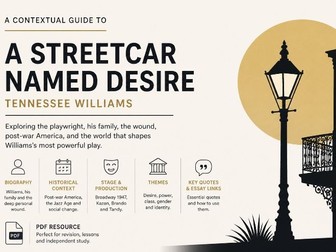
Streetcar Context and Essay LinksQuick View
HaydnWood15

Streetcar Context and Essay Links

(0)
A clear PDF on A Streetcar Named Desire context, linking Tennessee Williams’s life, post-war America, New Orleans, class, gender, sexuality, mental illness and stagecraft to the play’s biggest ideas. This resource is useful because it keeps context tied to the play instead of turning it into a pile of background notes. It begins with Williams himself - his family history, Rose Williams, and the biographical weight behind Blanche’s removal - then moves through the original Broadway production, post-war masculinity, New Orleans, Belle Reve, Stanley as the new American man, Blanche’s performance of femininity, Stella’s dependence, sexual shame, and the institutional power behind the ending.
Macbeth Plot and Key QuotesQuick View
HaydnWood15

Macbeth Plot and Key Quotes

(0)
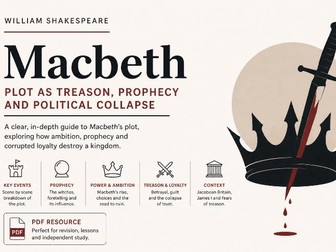
A detailed PDF on Macbeth, covering the whole plot scene by scene, with key quotations, contextual links and whole-play revision points. This resource is useful because it takes students through the play step by step - from the witches and Macbeth’s rise, through Duncan’s murder, Banquo’s death, the apparitions, Macduff’s grief, Lady Macbeth’s breakdown and Macbeth’s defeat - while constantly showing what each part of the plot means. The focus stays on treason, prophecy, guilt, kingship, tyranny and political collapse, so students can see the shape of the tragedy rather than just memorise events. What makes it especially helpful is the way it keeps plot and analysis together. Each section gives students the key moment, the quotation, and the bigger point Shakespeare is making. That means it works well for students who know the play loosely but need help seeing how the scenes connect, how Macbeth changes, and how images like blood, sleep, darkness and equivocation build across the whole play.
Gatsby Context and Essay LinksQuick View
HaydnWood15

Gatsby Context and Essay Links

(0)
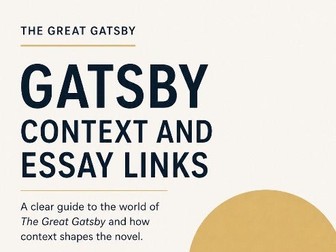
A sharp PDF on The Great Gatsby context, linking the novel to the First World War, the Jazz Age, Prohibition, class, consumer culture, gender, race and the American Dream. This resource is useful because it does not dump context in a separate pile and leave students to force it into essays later. It organises the material around Gatsby’s wartime self-invention, the performance culture of the Jazz Age, bootlegging and illegal glamour, old money and new money, consumer desire, gender expectations, Tom Buchanan’s racial panic, the valley of ashes, and Fitzgerald’s own relationship with wealth and class. What makes it especially helpful is the way it keeps turning context into argument. Each section includes quotations, a strong essay point, and clear links to characters or themes, so students can see how to use period detail properly instead of bolting it on. The sections on class and self-invention are particularly strong, showing how Gatsby’s mansion, parties, shirts and car are not random luxuries but part of a carefully staged identity aimed at crossing a class boundary that the novel never really allows him to cross.
Of Mice and Men Chapter 3 AnalysisQuick View
HaydnWood15

Of Mice and Men Chapter 3 Analysis

(0)
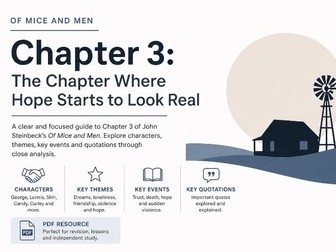
A clear, detailed PDF on Chapter 3 of Of Mice and Men, focused on hope, loneliness, violence and foreshadowing. This resource is built around one of the novella’s most important chapters and shows why Chapter 3 matters so much. It tracks the chapter through the bunkhouse setting, George’s conversation with Slim, Lennie’s danger, Candy’s dog, the dream farm, Curley’s attack, and the way Steinbeck starts preparing the ending long before it arrives. What makes it useful is that it keeps the analysis organised around the chapter’s real turning points. It shows how Steinbeck lets the dream briefly feel possible, then places that hope beside death, fear and violence. It also brings out the chapter’s bigger ideas clearly: the coldness of ranch life, the rarity of friendship, the disposability of the weak, Lennie as both innocent and dangerous, and Slim as the closest thing the ranch has to moral authority. The resource also works well for essay writing because it keeps returning to patterns and methods rather than just retelling events. It links Candy’s dog to the ending, the dream farm to the American Dream, the Weed story to later tragedy, and Curley’s fight to Lennie’s lack of control. The included file type is PDF.
Hamlet Character, Corruption and the Broken StateQuick View
HaydnWood15

Hamlet Character, Corruption and the Broken State

(0)
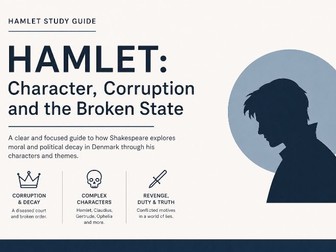
A thoughtful PDF on Hamlet, focused on character and the breakdown of the Danish court. It explores how Shakespeare uses Hamlet, Claudius, Gertrude, Ophelia, Polonius, Laertes, Fortinbras, the Ghost and Horatio to show a world damaged by secrecy, revenge, surveillance and moral decay. The resource is built around the idea that Denmark is a broken state, and that the people in it are shaped - and damaged - by that corruption. It starts with the court itself, then moves through Hamlet’s grief and paralysis, Claudius as the polished political villain, Gertrude and Ophelia in a diseased court, Polonius and surveillance, Laertes and Fortinbras as foils, and finally the Ghost and Horatio as figures tied to memory, truth and survival. What makes it useful is that it helps students see connections across the play instead of treating every character separately. Hamlet’s thought, Claudius’ performance, Ophelia’s obedience, Polonius’ spying and Horatio’s survival all feed into the same bigger picture of corruption, disorder and damaged human relationships. It also includes a strong final section on critical interpretations, with frameworks linked to A.C. Bradley, T.S. Eliot, feminist readings and revenge tragedy, plus a closing summary of the main themes for essay planning.
2026 AQA A-Level Media Studies Prediction PapersQuick View
HaydnWood15

2026 AQA A-Level Media Studies Prediction Papers

(0)
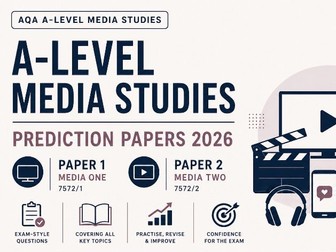
Exam-focused PDF of component 1 and component 2. \2026 AQA A-Level Media Studies prediction papers for Paper 1: Media One and Paper 2: Media Two. Includes full, unofficial revision papers in the style of the real exams, with a wide spread of likely question types across advertising, television, online media, video games, newspapers and radio. This resource is designed for serious revision in the run-up to the exam. It gives students two full practice papers based on the 7572/1 and 7572/2 structure, with realistic timings, mark allocations and question styles. Paper 1 includes media language and representation work, industries and audiences, and longer responses on close study products including Sephora: Black Beauty is Beauty, Old Town Road, The Daily Mail, The War of the Worlds and Newsbeat. Paper 2 includes prediction questions on television, online and participatory media, and video games, with references to products such as Capital and Deutschland 83, The Responder and Lupin, Taylor Swift, The Voice, Horizon Forbidden West and The Sims FreePlay.
Eduqas Macbeth 15 and 25 Marker GuideQuick View
HaydnWood15

Eduqas Macbeth 15 and 25 Marker Guide

(0)
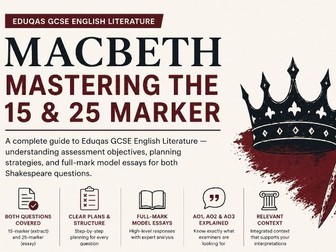
A straightforward PDF guide to the Eduqas GCSE English Literature Macbeth questions, covering both the 15-marker extract question and the 25-marker whole-play essay with planning, structure and full model responses. This resource is useful because it deals with the two Macbeth questions separately and properly. It explains what the 15-marker is asking for, how it is assessed, what a good extract answer needs to do, and how to keep the writing focused on Shakespeare’s language and dramatic choices. It then gives an exam-style extract on Lady Macbeth, a clear planning structure, and a full model essay built around the key phrases in the passage. It also covers the 25-marker in a much more practical way than most revision sheets do. The booklet explains the assessment, the importance of a whole-play argument, and the need to track an idea across the play rather than just retell events. It uses an example question on ambition, gives students a usable essay structure, and includes a full model essay that follows Macbeth from secret desire to violence, fear and emptiness.
Edexcel Macbeth Planning, Structure and Model AnswersQuick View
HaydnWood15

Edexcel Macbeth Planning, Structure and Model Answers

(0)
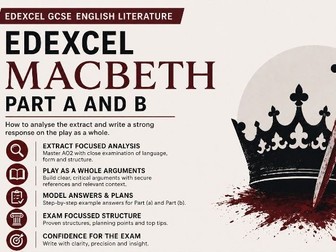
Exam-focused PDF for Edexcel GCSE English Literature Macbeth Section A, covering both part (a) and part (b) with model answers, plans and essay structure. This resource is useful because it does more than give students a few sample paragraphs. It starts by explaining how Section A actually works: part (a) stays tightly on the extract and rewards close AO2 analysis of language, form and structure, while part (b) moves out to the play as a whole and needs a stronger argument, accurate references and relevant context. That distinction is where a lot of students go wrong, so the booklet tackles it directly from the start. The booklet then works through an extract from Act 2, Scene 2 and gives a full part (a) example on Lady Macbeth being in control, including a structure, plan, model introduction, model paragraphs and conclusion. It then moves into part (b) with a question on the importance of conflict elsewhere in the play, again giving students a usable structure, planning points, model introduction, model paragraphs and conclusion. The second half is not an add-on - it is a proper guide to handling the wider-play response well.
Eduqas Poetry Structure and Model AnswersQuick View
HaydnWood15

Eduqas Poetry Structure and Model Answers

(0)
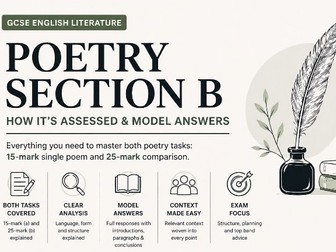
Exam-focused PDF for Eduqas GCSE English Literature Section B poetry, covering both the 15-mark single-poem response and the 25-mark comparison with structure, plans and model answers. This resource is useful because it deals with the whole section properly, not just one poem or one question. It starts by explaining how Section B is assessed, including the difference between 7(a) and 7(b), what stronger answers do, and why comparison in the 25-marker has to stay continuous throughout. It then works through a 15-mark question on Sonnet 43, with a structure, plan, model introduction, model paragraph and conclusion, before moving into a 25-mark comparison with Valentine, again giving a structure, plan, model introduction, comparison paragraphs and conclusion.
AQA Macbeth Supernatural Question and Model AnswerQuick View
HaydnWood15

AQA Macbeth Supernatural Question and Model Answer

(0)
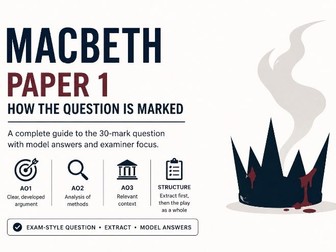
A focused PDF on the supernatural in Macbeth, with an AQA-style question, extract, model answer and clear essay structure for GCSE English Literature. This resource is built around a common Macbeth question and shows students exactly how to shape a strong response. It starts by breaking down how the question is marked, including AO1, AO2 and AO3, then moves into an exam-style extract on the witches, a clear 30-mark essay structure, a model introduction, two extract paragraphs, and a wider-play paragraph on how the supernatural continues to manipulate Macbeth. It also includes a second practice extract on Lady Macbeth and a final in-lesson task with paragraph ideas and useful quotations. The focus throughout is practical. Students are shown how to start with the extract, move out to the play as a whole, keep linking back to the question, and use brief, relevant context rather than bolted-on comments. The material covers the witches’ unsettling appearance, the seductive force of prophecy, the wider pattern of supernatural influence in the play, and the connection between witchcraft, ambition, disorder and Jacobean beliefs.
AQA GCSE English Language Paper 1 Reading WalkthroughQuick View
HaydnWood15

AQA GCSE English Language Paper 1 Reading Walkthrough

(0)
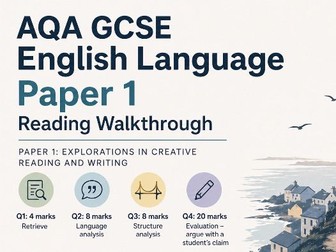
A clear, exam-focused PDF walkthrough for AQA GCSE English Language Paper 1 Reading, covering Q2 language, Q3 structure and Q4 evaluation with planning and model answers. This resource is designed to guide students through the key reading questions on Paper 1, Section A in a way that is practical and easy to apply in the exam. It includes an exam-style source, question breakdowns, planning guidance, paragraph structures, model answers and a final revision summary. The main focus is on Q2 language analysis, Q3 structure analysis and Q4 evaluation, with repeated emphasis on avoiding feature-spotting and always explaining how the writer’s choices affect the reader. The resource uses a single source throughout so students can see exactly how to move from reading to planning to writing. It breaks down language choices such as personification and simile, shows how structure moves from arrival to recognition to threat, and models how to build a clear judgment for evaluation. It also includes a strong set of revision takeaways on what each question rewards and how to organise a response under pressure.
AQA English Language Paper 2 Section B WalkthroughQuick View
HaydnWood15

AQA English Language Paper 2 Section B Walkthrough

(0)
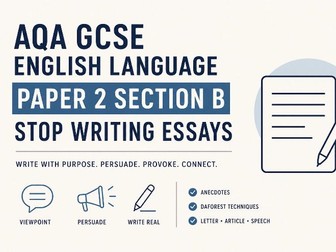
A clear, practical PDF for AQA GCSE English Language Paper 2 Section B, focused on viewpoint writing, planning and writing with a real voice. This resource is built around one central idea: Paper 2 Section B is not a literature essay. It shows students what the task is actually rewarding, then breaks down how to write more effectively for letter, article and speech forms. It covers how to plan 3 or 4 focus points instead of stiff essay paragraphs, how to open with an anecdote, how to use DAFOREST with control, how to build the middle of a response without drifting into essay mode, and how to end with force rather than a flat conclusion. Included are model openings, quick tasks, form-specific guidance, planning grids, sentence stems and a final checklist. The resource is especially useful for helping students sound more natural, persuasive and deliberate under exam pressure. It is a strong fit for GCSE English Language revision, intervention, tutoring, classroom teaching, homework, cover work and independent study.
AQA Unseen Poetry Marking and ResponseQuick View
HaydnWood15

AQA Unseen Poetry Marking and Response

(0)
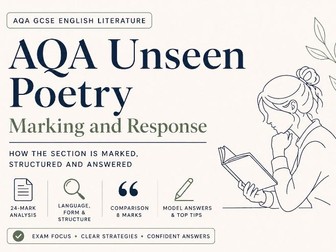
AQA English Literature GCSE, Paper 2. A clear, exam-focused PDF on AQA GCSE English Literature Unseen Poetry, covering how the section is marked, how to structure both answers, and what strong responses actually do. This resource is built to make the unseen poetry section feel much less vague. It explains the difference between the 24-mark response and the 8-mark comparison, sets out the assessment focus for each, and shows students how to move from first reading to a controlled written answer. It includes an example 24-marker, a model introduction, three model body paragraphs, advice on what top-band writing is doing, an example 8-marker, a short comparison structure, and a final exam approach page that makes the whole section feel manageable. The emphasis throughout is practical. Students are shown how to give a whole-poem overview first, stay tightly on the wording of the question, analyse writer’s choices rather than feature-spot, and keep the comparison concise and method-led. The resource also models the kind of writing that usually lifts answers - short quotations, clear paragraph focus, attention to endings, contrasts, patterns and shifts, and a proper sense of argument rather than retelling.
Classic Novels Comprehension Reading TasksQuick View
HaydnWood15

Classic Novels Comprehension Reading Tasks

(0)
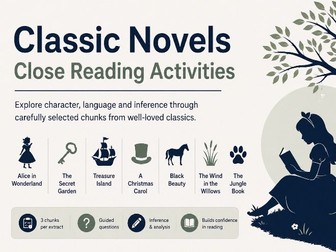
A practical PDF of short close reading and comprehension tasks built around extracts from classic children’s and nineteenth-century fiction. This resource gives students short, manageable extract work that still pushes them beyond simple retrieval. It includes carefully chosen chunks, guided questions and small analytical prompts on Alice in Wonderland, The Secret Garden, Treasure Island, A Christmas Carol, Black Beauty, The Wind in the Willows, The Jungle Book, Tom Sawyer, and Heidi, followed by a mixed comparison task at the end. The focus throughout is on character, language, inference, viewpoint, figurative language, atmosphere and comparison. Each extract is broken into three short chunks so that students can build confidence step by step, with questions that move from straightforward understanding into word-level analysis and short written interpretation. The final comparison slide then asks students to compare characters and effects across texts rather than treating each extract in isolation.
AQA The Prelude Analysis & ComparisonQuick View
HaydnWood15

AQA The Prelude Analysis & Comparison

(0)
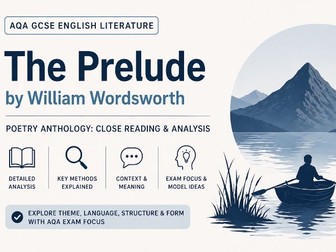
A clear, exam-focused PDF on ‘The Prelude’ by William Wordsworth for AQA GCSE English Literature, covering close analysis, methods, context and strong comparison ideas. This resource breaks the poem down in a way that is genuinely useful for essay writing. It focuses on the central shift from confidence to fear, the presentation of nature as active and overpowering, and the way the memory continues to disturb the speaker long after the boat trip ends. It covers key quotations, movement in the poem, the arrival of the mountain as the main turning point, and the ending’s psychological aftermath. It also explains the methods that matter most in this poem, including the shift in tone, personification, blunt repetition in ‘black and huge’, blank verse, the first-person retrospective voice, and the poem’s structure from outward movement to interruption, retreat and aftermath. Context is kept brief and relevant, with useful guidance on Romanticism, the sublime and the autobiographical nature of The Prelude. The resource also includes strong comparison pathways to Storm on the Island, Exposure, Ozymandias and Kamikaze, making it especially helpful for AQA anthology revision.
Of Mice and Men Chapters 1-2 Analysis PDFQuick View
HaydnWood15

Of Mice and Men Chapters 1-2 Analysis PDF

(0)
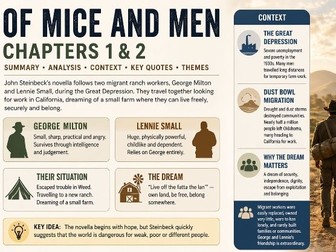
A clear, high-value PDF on Of Mice and Men Chapters 1 and 2, covering summary, analysis, context, themes and key methods for essay writing and revision. This resource focuses on the opening of Steinbeck’s novella, tracking George and Lennie’s arrival in California, the dream of the farm, the contrast between the riverbank and the ranch, and the introduction of key tensions in the bunkhouse. It covers the Great Depression setting, migrant ranch work, foreshadowing, animal imagery, dialogue, the ranch hierarchy, and the early presentation of George, Lennie, Curley, Curley’s wife and Slim. It also includes theme-based exam paragraph material on friendship, the American Dream, and power and threat.
Much Ado Extract AnalysisQuick View
HaydnWood15

Much Ado Extract Analysis

(0)
A focused PDF of Much Ado About Nothing extract analysis, with key words, ideas, context and sharp exam-focused commentary. This resource offers a clear, useful set of extract-based analyses on some of the most teachable and examinable moments in Much Ado About Nothing. It includes Beatrice and Benedick’s ‘war of wit’, Benedick’s gulling scene, Beatrice’s response to being tricked into love, Hero’s public shaming, and the ‘Kill Claudio’ turning point, each paired with an exam-style question and concise support on language, ideas, context and interpretation. The play is built around the comic antagonism of Beatrice and Benedick, the deception of Hero and Claudio, and the sudden darkening of the action at the wedding scene, where Claudio denounces Hero publicly. Official Shakespeare summaries from the Shakespeare Birthplace Trust, the Royal Shakespeare Company, and Folger all outline these same central movements in the plot and show how the play moves between wit, deception, public shame and reconciliation.
Streetcar Named Desire Critics and Critical DebateQuick View
HaydnWood15

Streetcar Named Desire Critics and Critical Debate

(0)
A sharp, essay-focused PDF on A Streetcar Named Desire critics and critical debate, designed to help students use criticism with more precision in essays and revision. This resource gives students a clear, usable guide to some of the most important critical readings of A Streetcar Named Desire. It covers major debates around Blanche’s downfall, Stanley’s violence, Stella’s loyalties, gender, class, illusion and reality, dramatic method, rape, and the play’s blend of realism with theatricalism. It is built to help students move beyond plot summary into stronger interpretation, sharper argument, and more confident use of critical views. Included are concise explanations of key critics and approaches, including Joseph Wood Krutch, Mary Ann Corrigan, John T. von Szeliski, Kathleen Margaret Lant, Anca Vlasopolos, John S. Bak, Nicholas Grene, and Philip C. Kolin, alongside guidance on how to use criticism effectively in essays by making a point, using evidence, introducing a critic, and then agreeing, qualifying or challenging that view.
Hamlet Critics and Critical DebateQuick View
HaydnWood15

Hamlet Critics and Critical Debate

(0)
A clear, high-value PDF on Hamlet critics and critical debate, designed to help students use criticism with confidence in essays and revision. This resource gives a focused guide to some of the most useful critical readings of Hamlet, helping students move beyond plot summary into stronger interpretation and argument. It covers major debates around Hamlet’s delay, the Ghost, corruption, gender, religion, politics, uncertainty and performance, while also showing how criticism can be used properly in literary essays rather than dropped in mechanically. Included are concise, usable explanations of major critics and approaches, including A. C. Bradley, T. S. Eliot, G. Wilson Knight, Maynard Mack, Ernest Jones, Elaine Showalter, Stephen Greenblatt, and Jan Kott, along with clear guidance on what each reading is useful for in written analysis. The resource also includes a practical section on how to use criticism in essays, with a structure built around point, evidence and method, critic, and judgment. Designed mainly for A Level English Literature, this PDF is also useful for strong GCSE students, tutoring, revision, essay planning, intervention, homework, and independent study.
An Inspector Calls AQA Model Essay, Structure and Planning PDFQuick View
HaydnWood15

An Inspector Calls AQA Model Essay, Structure and Planning PDF

(0)
A focused PDF essay guide on responsibility and change in An Inspector Calls, with clear structure, model writing and revision support. This resource is built around two high-value essay areas in An Inspector Calls: how Priestley uses Gerald to explore responsibility, and how he presents the younger generation as more willing to change. It includes a structured question, introduction guidance, paragraph structure, model writing, key quotations, planning prompts and a clear line of argument throughout. The first half of the resource explores Gerald’s polished image, his treatment of Daisy Renton, and his relief at the possible ‘hoax’; the second half focuses on Sheila and Eric, moral growth, and Priestley’s contrast between younger and older generations.