Electrolysis Masterclass, including half-equationsQuick View
tbatchford

Electrolysis Masterclass, including half-equations

(0)
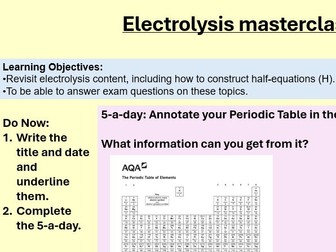
This 9-slide PowerPoint masterclass covers the fundamentals of electrolysis, including both molten and aqueous solutions. Designed for GCSE Chemistry students, the lesson clearly explains the movement of ions, electrode reactions, and the products formed during electrolysis. Students are guided through the construction of half-equations step-by-step, with worked examples and independent practice tasks to build confidence and exam technique. The resource also includes retrieval questions and opportunities for self-assessment, making it ideal for classroom teaching, revision, or cover lessons. Contents include: • Electrolysis of molten compounds • Electrolysis of aqueous solutions • Cations and anions • Electrode reactions • Writing balanced half-equations • Independent practice activities Suitable for GCSE Chemistry and Combined Science courses.
Chemical bonding revision: Ionic and simple covalentQuick View
tbatchford

Chemical bonding revision: Ionic and simple covalent

(0)
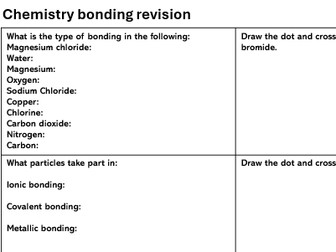
Grid-style revision activities covering ionic and covalent bonding. Students practise identifying bond types from compound names, completing dot and cross diagrams, and applying their understanding of intermolecular forces in simple covalent substances. Designed to promote retrieval, pattern recognition, and exam-style reasoning. Ideal for GCSE Chemistry or GCSE Trilogy Combined Chemistry revision, lesson starters, independent practice, close-the-gap tasks after assessments, or consolidation before end-of-topic tests.
AQA Chemistry/Trilogy GCSE, Bonding 6-mark question developmentQuick View
tbatchford

AQA Chemistry/Trilogy GCSE, Bonding 6-mark question development

(0)
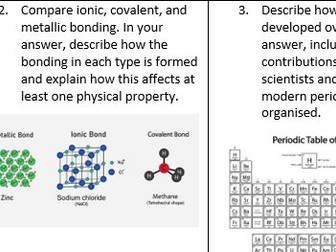
This resource is a self‑directed, learning activity designed to support students in developing high‑quality responses to a 6‑mark GCSE chemistry question on relating the bonding and structure of a substance to the melting point. The lesson centres on a classic exam question comparing magnesium oxide and carbon dioxide, guiding students to move from foundational knowledge to extended, evaluative responses. Students begin by self‑assessing their readiness to answer the question, promoting independence and metacognition. Those requiring support complete a structured sequence of tasks aligned to SOLO taxonomy, progressing through: identifying and defining different types of bonding, describing particles, structures and intermolecular forces, explaining links between bonding, structure and physical properties, applying knowledge to unfamiliar examples and predictions. Students then return to the original 6‑mark question to produce an improved, independent answer. An additional challenge evaluation question extends higher‑attaining students by requiring them to critique a simplified explanation, explicitly addressing the role of structure as well as bonding type, with model answers provided to support self‑assessment and teacher feedback. Key features: Exam‑style 6‑mark questions with model answers SOLO‑based progression to support stretch and scaffolding Encourages student independence and reflection Suitable for GCSE Chemistry and Trilogy Science Ideal for lessons, revision, or intervention Best used for: Developing extended responses, improving exam technique, and deepening understanding of bonding and structure through student‑led learning.
AQA Chemistry GCSE and AS level, Explaining equilibrium 6-mark question developmentQuick View
tbatchford

AQA Chemistry GCSE and AS level, Explaining equilibrium 6-mark question development

(0)
This student‑led worksheet is designed to support pupils in developing high‑quality responses to AQA GCSE Chemistry or AQA AS Chemistry equilibrium 6‑mark questions, with a clear focus on extended explanation, application and evaluation. Students first assess whether they are ready to answer an exam‑style question on industrial equilibrium. Those who need further support are guided through a structured sequence of tasks that carefully build from recall and description to analysis, prediction and justification. The worksheet explicitly links command words to required thinking skills, helping students understand what examiners are looking for in higher‑mark questions. Key features include: Exam‑style 6‑mark equilibrium question (yield, rate and cost) Clear links to Le Chatelier’s Principle Progressive tasks aligned to SOLO taxonomy levels Explicit focus on pressure, temperature and catalysts Command word support to improve exam technique Model answers provided for self‑assessment or teacher feedback Extension task using graph interpretation and industrial context Ideal for: GCSE Chemistry (AQA Trilogy or Separate, higher tier – Paper 1) Developing extended response and evaluation skills KS4 revision lessons KS5 lesson or homework Stretch and challenge Independent or paired learning Intervention or exam practice lessons Topics covered: Chemical equilibrium Le Chatelier’s Principle Effect of temperature, pressure and catalysts Equilibrium yield vs reaction rate vs cost Industrial chemistry Interpreting data and graphs Preparation: No additional resources required. Students complete responses in their exercise books.
AQA Trilogy Chemistry revision booklets for paper 1 and paper 2Quick View
tbatchford

AQA Trilogy Chemistry revision booklets for paper 1 and paper 2

(0)
This resource includes two comprehensive revision booklets covering the full AQA GCSE Trilogy Chemistry specification for Paper 1 and Paper 2. The specification content has been carefully transformed into structured questions, allowing students to actively engage with each topic rather than passively reading notes. This approach promotes deeper understanding, recall, and application of key chemical concepts. Each booklet is designed to: Support effective revision through active practice Help students identify gaps in their knowledge Build confidence with exam-style thinking and extended responses Provide full coverage of all required content for both papers These booklets are ideal for use in lessons, independent study, or as a structured revision programme in the lead-up to exams. By working through the questions, students can clearly pinpoint topics they need to revisit and improve before their GCSE exams. Perfect for both teachers and students looking for a focused, exam-aligned Chemistry revision resource.
AQA Trilogy Biology revision booklets for paper 1 and paper 2Quick View
tbatchford

AQA Trilogy Biology revision booklets for paper 1 and paper 2

(0)
This resource includes two comprehensive revision booklets covering the full AQA GCSE Trilogy Biology specification for Paper 1 and Paper 2. The specification content has been carefully transformed into structured questions, allowing students to actively engage with each topic rather than passively reading notes. This approach encourages deeper understanding, recall, and application of key biological concepts. Each booklet is designed to: Support effective revision through active practice Help students identify gaps in their knowledge Build confidence with exam-style thinking and questioning Provide clear coverage of all required content for both papers These booklets are ideal for use in lessons, independent study, or as a structured revision programme in the lead-up to exams. By working through the questions, students can clearly pinpoint topics they need to revisit and improve before their GCSE exams. Perfect for both teachers and students looking for a focused, exam-aligned revision resource.
Targeted revision for AQA Trilogy Science, Chemistry paper 1, Foundation TierQuick View
tbatchford

Targeted revision for AQA Trilogy Science, Chemistry paper 1, Foundation Tier

(0)
This resource is a set of targeted revision sheets for AQA GCSE Trilogy Chemistry Paper 1, designed to be printed on A3 for maximum clarity and student engagement. Each sheet helps students understand what is required at different grade levels, guiding them through the type of knowledge and skills needed to progress in exam questions. The resources are structured to support self-assessment and focused improvement, making them ideal for revision lessons or intervention sessions. Please note that these sheets do not cover the entire specification, but instead provide high-impact revision activities that can be used to break up lessons, reinforce key concepts, and support exam preparation. Perfect for helping students identify next steps and build confidence ahead of their exams.
AQA Trilogy Physics revision booklets for paper 1 and paper 2Quick View
tbatchford

AQA Trilogy Physics revision booklets for paper 1 and paper 2

(0)
This resource includes two comprehensive revision booklets covering the full AQA GCSE Trilogy Physics specification for Paper 1 and Paper 2. The specification content has been carefully transformed into structured questions, allowing students to actively engage with each topic rather than passively reading notes. This approach promotes deeper understanding, recall, and application of key physics concepts. Each booklet is designed to: Support effective revision through active practice Help students identify gaps in their knowledge Build confidence with exam-style thinking, calculations, and extended responses Provide full coverage of all required content for both papers These booklets are ideal for use in lessons, independent study, or as a structured revision programme in the lead-up to exams. By working through the questions, students can clearly pinpoint topics they need to revisit and improve before their GCSE exams. Perfect for both teachers and students looking for a focused, exam-aligned Physics revision resource.
Electrochemical Cells Masterclass AQA A-level Chemistry revision lessonQuick View
tbatchford

Electrochemical Cells Masterclass AQA A-level Chemistry revision lesson

(0)
Electrochemical Cells – PowerPoint and Exam Practice Resource This resource consists of a 9‑slide PowerPoint designed to guide students through the topic of electrochemical cells, covering all key content up to, but not including, fuel cells. It is intended for use as a revision and re‑teaching tool, before students attempt examination questions. The presentation supports students in consolidating their understanding, applying their knowledge accurately, and developing confidence in using the correct subject‑specific terminology when explaining electrochemical cells. Also included is a set of exam‑style questions with a corresponding mark scheme, suitable for independent practice or assessment for learning. The questions are aligned with typical Paper 1 demand and help familiarise students with the style and structure they are likely to encounter in examinations. The question document was AI‑inspired but fully edited and refined before being trialled with Year 13 students, and is effective in supporting exam preparation. As always, if you have access to Exampro, this should be used as the primary source of assessment material; however, this resource provides additional practice to supplement existing question banks. Ideal for A‑level Chemistry teaching, revision lessons, intervention sessions, or independent study.
Explaining the properties of substances with ionic and covalent bondingQuick View
tbatchford

Explaining the properties of substances with ionic and covalent bonding

(0)
This lesson PowerPoint begins with an enquiry-based exploration of dissolving, using a familiar real-world comparison where two substances (sugar and salt) both dissolve in water but at different rates. Students are encouraged to observe, discuss, and explain this difference, drawing on prior knowledge of particle arrangement, surface area, and forces within structures. The lesson assumes prior understanding of ionic, covalent, and metallic bonding, and builds on this by linking bonding and structure (e.g. giant ionic lattices, simple molecular substances, and giant metallic structures) to key physical properties. Students then apply their knowledge to exam-style questions focused on explaining differences in melting points. Teacher modelling is incorporated through “I DO” examples, followed by opportunities for guided and independent practice. Please note: model answers are not included, allowing teachers flexibility in how they deliver and scaffold responses. Suitable for: KS4 / GCSE Chemistry Focus: Structure and bonding, properties of substances Includes: Retrieval, guided practice, exam questions
Possible 6-mark questions for AQA GCSE Chemistry paper 1Quick View
tbatchford

Possible 6-mark questions for AQA GCSE Chemistry paper 1

(0)
This resource contains a collection of possible AQA GCSE Chemistry 6-mark exam-style questions covering key topics from Paper 1, including atomic structure, bonding, chemical changes, quantitative chemistry, and the periodic table. Each question is designed to reflect the style and level of demand seen in real GCSE exams. For every question, a model 6/6 answer is included to support students with understanding exactly what is required to achieve full marks. The model answers demonstrate clear structure, accurate scientific terminology, and logical explanations, helping students develop strong exam technique. This resource is ideal for: Revision and exam preparation Practising extended response questions Developing 6-mark answer structure and quality Supporting independent learning or classroom use It can be used by students for self-assessment or by teachers as ready-made exam practice materials.
Possible 6-mark questions for AQA GCSE Chemistry paper 2Quick View
tbatchford

Possible 6-mark questions for AQA GCSE Chemistry paper 2

(0)
This resource provides a carefully selected set of exam-style 6-mark questions for AQA GCSE Chemistry Paper 2, designed to support students in mastering extended response questions. Each question is written in a clear AQA style and is accompanied by a detailed model answer, helping students understand exactly what is required to achieve full marks. The model answers demonstrate how to structure responses, use key scientific terminology, and develop clear, logical explanations—skills that are essential for success in 6-mark questions. This resource is ideal for: Revision and independent study Homework or flipped learning Exam preparation and intervention sessions