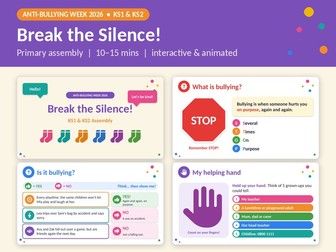
A bright, interactive 10–15 minute primary assembly for Anti-Bullying Week 2026. Children look at their socks for Odd Socks Day, then learn that everyone is different, what bullying is, and that telling is not telltaling.
What’s included:
15 colourful, animated slides with pictures on every slide and no school branding
A full presenter script in the notes, with tips for adapting it for KS1 and KS2
A thumbs up/down “Is it bullying?” game, feelings faces, Be a Super Friend and a “My helping hand” activity (five trusted grown-ups)
A quick quiz, a call-and-response chant and a hand-on-heart kind promise
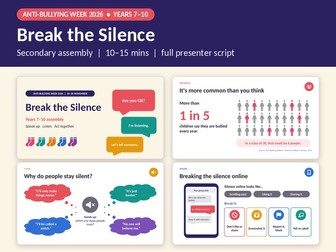
A powerful 10–15 minute secondary assembly for Anti-Bullying Week 2026. It opens with 10 seconds of silence to show what bullying can feel like when nobody speaks up. It then covers what bullying is, the five types, why people stay silent, and how to be an upstander face-to-face and online.
What’s included:
14 animated slides, with no school branding, so it’s easy to adapt
A full word-for-word presenter script with timings in the notes
A Myth or Fact show of hands, a “1 in 5” picture of a class of 30, and a slide on silence in group chats
A 30-second reflection and a challenge for the week (Odd Socks Day, start a conversation, check in on someone, report it)
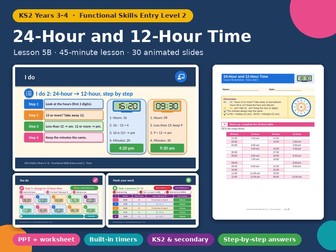
A complete, ready-to-teach 45-minute lesson on changing between 24-hour and 12-hour time. Follows on from Lesson 5A. Written in simple, child-friendly language, so it works for primary pupils (KS2 Year 4, or as revision in Years 5–6) as well as older learners working at primary level, SEND groups and Functional Skills Entry Level 2 (EL2.13). Covers the Year 4 objective on converting between 12-hour and 24-hour clocks.
Includes:
• 30 colourful, animated PowerPoint slides with teacher notes and timings
• Do now with answers, learning outcomes, 5 I do and 2 We do slides
• Step-by-step methods for both directions, including tricky times like 12:30 am and 12:00 pm
• Plenty of worked examples, with the working shown on every answer
• 3 timed tasks, each with a built-in countdown timer and a START NOW prompt
• Real-life questions (films, trains, football, shops, buses)
• Step-by-step answer slides to mark in red pen and correct in purple pen
• Hinge questions, true or false, two spot-the-mistake slides, challenge and exit ticket
• Matching Word worksheet with 40+ questions and a full answer page
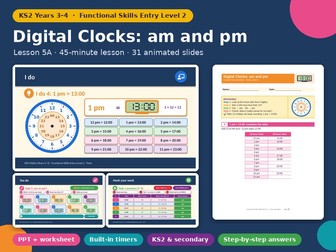
A complete, ready-to-teach 45-minute lesson on reading digital clocks and deciding whether a time is am or pm. Written in simple, child-friendly language, so it works for primary pupils (KS2 Years 3–4, or as revision in Years 5–6) as well as older learners working at primary level, SEND groups and Functional Skills Entry Level 2 (EL2.13). Covers the Year 3 and Year 4 objectives on am, pm, noon and midnight and on 12-hour and 24-hour clocks.
Includes:
• 31 colourful, animated PowerPoint slides with teacher notes and timings
• Do now with answers, learning outcomes, 5 I do and 2 We do slides
• A clear 4-step method for am or pm, used on every slide
• A “1 pm = 13:00” slide with a 24-hour clock face
• Lots of real-life examples (breakfast, school, bus, football, bedtime)
• 4 timed tasks, each with a built-in countdown timer and a START NOW prompt
• Step-by-step answer slides to mark in red pen and correct in purple pen
• Hinge questions, true or false, spot the mistake, challenge and exit ticket
• Matching Word worksheet with 40+ questions and a full answer page
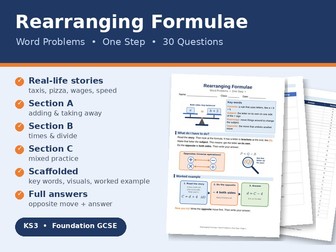
A 5-page worksheet with 30 questions. Pupils change the subject of one-step formulae, and every formula comes from a short real-life story: taxi fares, pizza slices, wages, speed and more.
Section A (Q1–10): adding and taking away
Section B (Q11–20): times and divide
Section C (Q21–30): mixed practice
Support built in: a key words box, a balance-scale picture, a chart of opposite operations and a three-step worked example. Each question asks pupils to write the “opposite move” before their answer, so the method is clear.
Full answers included, showing the opposite move and the rearranged formula for every question. Ready to print, with clear, simple wording. Good for KS3 and Foundation GCSE classes, including weaker readers.
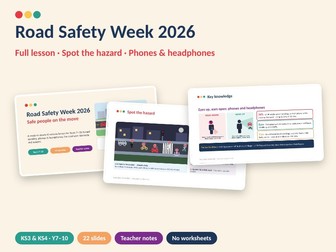
A complete 45-minute Road Safety Week lesson with no worksheets needed, built around this year’s theme, “Safe people on the move”. It includes four illustrated spot-the-hazard scenes (a dark evening, the school gate, a bus stop and a country lane) and a focused section on phones and headphones with up-to-date statistics and the law on drivers using phones. There’s also a multitasking challenge, the Highway Code road user hierarchy, myth busting, group discussion scenarios and a 10-question mini-whiteboard quiz. Detailed teacher notes on every slide; all you need is mini whiteboards and sticky notes.
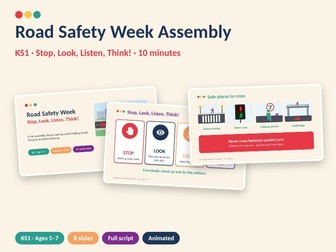
A lively, ready-to-present 10-minute Road Safety Week assembly for KS1. Children join in Stop, Look, Listen, Think actions, learn the safe places to cross, why to hold a grown-up’s hand and wear something bright, and “clunk, click” seat belts. It finishes with a thumbs-up quiz and a weekly challenge. 8 animated slides with a full presenter script in the notes.
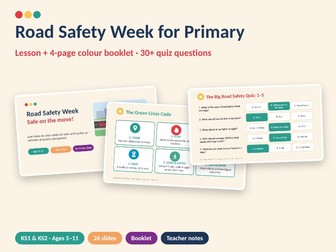
A ready-to-teach 26-slide Road Safety Week lesson for ages 5–11, with a 4-page colour booklet. It covers the Green Cross Code, safe places to cross, being bright and seen, seat belts and car seats, bikes and scooters, and phones and headphones. It includes two spot-the-danger scenes, action games, turn-and-talk scenarios and over 30 quiz questions with click-to-reveal answers. Teacher notes on every slide include timings and KS1/KS2 adaptations.
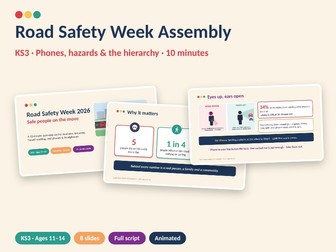
A powerful, ready-to-present 10-minute Road Safety Week assembly for KS3. Students take in Brake’s key statistics, learn the Highway Code road user hierarchy, and face up to phone and headphone habits using current survey data and the law for drivers. Then they spot six hazards at the school gate and test themselves with myth-busting and a quick-fire quiz. It ends with a reflection and a challenge for the week. 8 animated slides with a full presenter script.
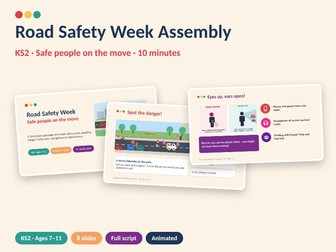
A ready-to-present 10-minute Road Safety Week assembly for KS2, built around the 2026 theme “Safe people on the move”. It covers the Green Cross Code, a spot-the-danger picture with six numbered hazards, being seen in the dark, and the risks of phones, headphones and quiet electric cars, followed by a hands-up quiz. 8 animated slides with a full presenter script.
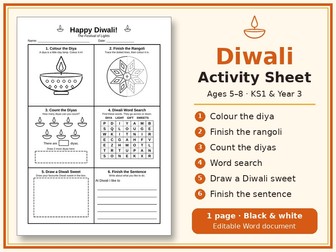
A printable, black-and-white Diwali activity sheet with six quick activities for ages 5–8. It’s great for celebrating the Festival of Lights in class or at home.
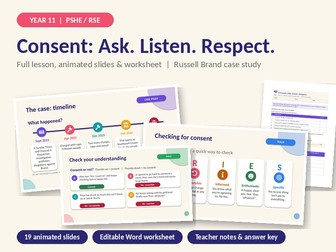
Consent: Ask. Listen. Respect. | Year 11 PSHE/RSE (Russell Brand case study)
This is a ready-to-teach 60-minute lesson on consent, updated with the Russell Brand verdict from November 2026.
Includes:
19 colourful, editable PowerPoint slides with animations and teacher notes
An editable Word worksheet, with a teacher answer key
Students will:
learn the legal definition of consent
use the FRIES model on real-life scenarios
tackle common myths
look at what a high-profile court case teaches about consent, power and delayed reporting
The lesson handles the topic sensitively. It has ground rules, a content warning, no graphic detail, and signposting to Childline and Rape Crisis.
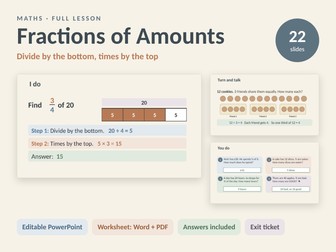
A ready-to-teach maths lesson that takes students from “what is a numerator?” to solving two-step word problems, all built around one simple rule: divide by the bottom, times by the top.
What’s included
22-slide editable PowerPoint in a calm cream design with muted colours that’s easy on the eyes
Matching worksheet in Word (editable) and PDF (print-ready)
Full answer sheet for quick marking
Lesson structure
Do now and review: six quick warm-up questions on division facts and shaded fractions, with answers revealed one click at a time
Learning outcomes and key words: numerator and denominator explained with a bar model
Turn and talk: sharing 12 cookies between 3 friends, which links unit fractions to division
I do, we do, you do: first with unit fractions (⅓ of 15), then non-unit fractions (¾ of 20), all modelled with bar models
Checking for understanding: a multiple-choice question where each wrong answer points to a common mistake
Plan for error: spot Sam’s mistake (dividing by the top)
Word problems: money, cake slices, hours in a day, and a two-step challenge
Stretch it: “Always, sometimes or never true?” reasoning task
Stamp it and exit ticket: a summary of the method and three questions to check what students have learned
Worksheet (4 parts, matched to the slides)
Part A: Key words and bar models
Part B: Unit fractions, with a stretch question
Part C: Two-step fractions, with a spot-the-mistake task
Part D: Word problems, with an always/sometimes/never challenge
Why teachers like it
Speaker notes on every teaching slide, with timings, prompts and common mistakes to watch for
Clicks reveal answers one step at a time
Fully editable, so you can change numbers, add your school’s branding or adapt it for your class
Clean and uncluttered, which suits students who are put off by busy slides
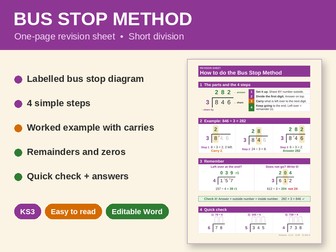
A clear one-page revision sheet that teaches pupils how to use the bus stop method for short division. It is written in short, simple sentences, so it works well for KS3 or Primary pupils with a lower reading age, SEND pupils, and anyone who needs to go over division again.
Colour coding is used throughout, so pupils can follow each step easily:
Purple: the number you share by
Orange: carries
Green: the answer
Ideal for: revision, homework, intervention groups, starters, sticking into exercise books, or displaying on the board.
Format: editable Word document (.docx), 1 A4 page, soft cream background to make reading easier. Print ready.
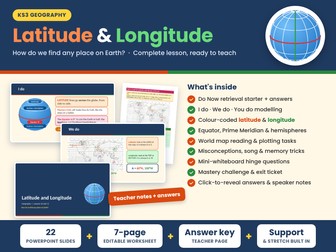
A ready-to-teach lesson on finding any place on Earth using latitude and longitude. Latitude is colour-coded orange and longitude green on every slide and worksheet page, which helps students who struggle with reading.
What’s included:
22-slide PowerPoint with speaker notes and click-to-reveal answers
7-page editable Word worksheet that matches the slides, with an answer key for the teacher
Lesson content:
Do Now retrieval starter
The Equator, the Prime Meridian and the four hemispheres, taught through labelled globe diagrams
Memory tricks and a catchy song to help students tell latitude from longitude
Worked examples and practice reading and plotting coordinates on a world map
Slides on common mistakes, plus mini-whiteboard questions to check understanding
A stretch challenge comparing places near to and far from the Equator
True/false exit ticket
The lesson works for mixed-ability classes, with word banks and sentence starters for support and a challenge task to stretch higher attainers.


 Quick View