Refugees in crisisQuick View
Frannyb92

Refugees in crisis

(0)
This lesson encourages students to engage with the experiences of refugees from different parts of the world. Through a range of activities, students explore individual case studies to develop empathy and a deeper understanding of forced migration. All necessary resources are included within the slides, making the lesson fully self-contained.
Migration mysteryQuick View
Frannyb92

Migration mystery

(0)
This is an interactive lesson that encourages students to use evidence to consider how a specific migration event occurred. Students will draw upon their understanding of push and pull factors to develop a justified and creative interpretation of the case study. The lesson is based on a true story, and the actual events are revealed to students at the end, allowing them to compare their hypotheses with what really happened.
Population pyramidsQuick View
Frannyb92

Population pyramids

(0)
This lesson introduces students to population pyramids. Students will use provided data to construct their own population pyramid, which they will then annotate and interpret. Based on the shape of the pyramid, they will determine whether the country is a high-income country (HIC) or a low-income country (LIC). The PowerPoint also includes extension tasks that build on this learning. These activities encourage students to analyse and compare different population pyramid shapes and apply their understanding to a range of countries.
AQA Geography GCSE revision clocksQuick View
Frannyb92

AQA Geography GCSE revision clocks

(0)
Revision clocks for AQA Geography students: Natural Hazards Rivers Glaciers Resource Management Urban Issues Changing Economic World Hot Deserts Coastal Landscapes Climate Change Tectonic hazards Tropical Rain forests Weather Hazards
Scheme of work: Health issuesQuick View
Frannyb92

Scheme of work: Health issues

(0)
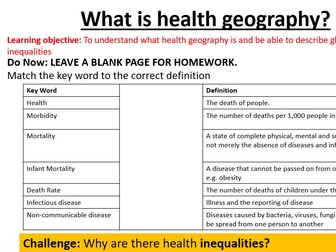
Health Geography Scheme of Work – GCSE / KS3 / KS4 A complete Scheme of Work covering health geography, global and UK health inequalities, and disease. Includes lessons on smoking, obesity, coronary heart disease (CHD), malaria, and Ebola, alongside an end-of-unit assessment. All lessons include worksheets, classroom activities, and homework tasks, providing a structured and coherent approach to teaching key Geography health topics.
Coastal erosion: HappisburghQuick View
Frannyb92

Coastal erosion: Happisburgh

(0)
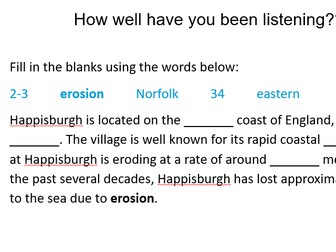
This is an extended lesson on coastal erosion. Happisburgh is used as a case study to demonstrate how a specific location can be subjected to erosion. The lesson begins with a thinking task about Happisburgh and then looks at erosion and stakeholders. There are resources throughout the powerpoint and a work sheet.
Depositional landformsQuick View
Frannyb92

Depositional landforms

(0)
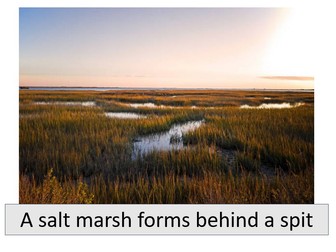
A year lesson on depositional landforms at the coastline. Tombolos, spits and bars are discussed. There is a starter and plenary to compliment learning.
Impacts of an ageing populationQuick View
Frannyb92

Impacts of an ageing population

(0)
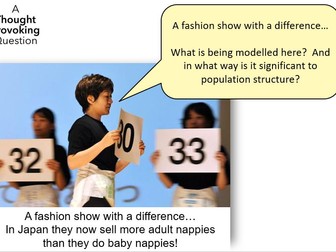
This is a KS3 resource about ageing populations. The powerpoint looks at Japan as an example. Included in the slides are activities and answers. There is a video based task with questions for students as well as a starter activity using the words for the lesson.
Youthful PopulationsQuick View
Frannyb92

Youthful Populations

(0)
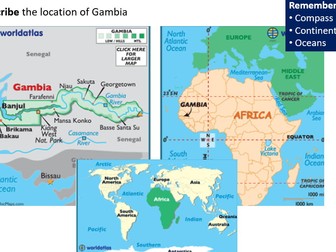
This is a lesson introducing youthful populations. The lesson looks at The Gambia as an example of a country with this demographic. The lesson has activities and writing tasks to help students think through this idea.
Demographic Transition ModelQuick View
Frannyb92

Demographic Transition Model

(0)
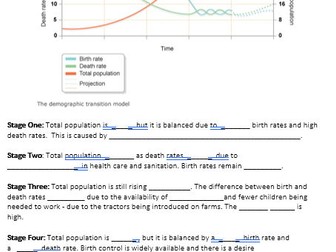
udents are introduced to the Demographic Transition Model and how it explains changes in birth rates, death rates, and population growth as countries develop. Through a series of guided activities, students build understanding of each stage before applying their knowledge to real-world style data. Tasks develop skills in interpretation, explanation, and use of demographic evidence. The lesson finishes with a scenario mapping activity, where students classify fictional countries by DTM stage and justify their decisions using what they have learned.