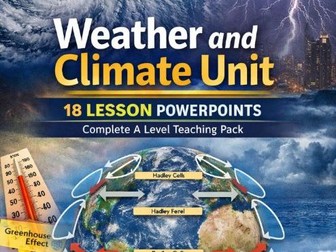
This 18-lesson A Level Geography Weather and Climate unit is fully designed for Cambridge International A Level, providing a complete, structured sequence of engaging PowerPoint presentations. Covering topics including atmospheric structure, global energy budgets, weather hazards, greenhouse effect the unit mirrors the academic depth, layout, and exam focus of existing lessons. Each presentation includes clear learning objectives, success criteria, starter tasks, detailed process explanations, case studies, and exam-style practice to build AO1 knowledge, AO2 understanding, and AO3 evaluation skills. Ideal for Year 12 delivery, this ready-to-teach series ensures comprehensive syllabus coverage while supporting strong exam preparation.
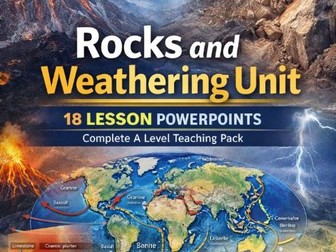
This A Level Geography Rocks and Weathering unit is a fully structured, exam-focused teaching pack designed for Cambridge International A Level. Covering topics such as tectonic processes, plate boundaries, mass movement, karst landscapes, and tropical weathering profiles, the unit mirrors the depth, clarity and academic rigour of the existing lessons. Each presentation includes clear learning objectives, success criteria, starter tasks, detailed process explanations, case studies, and structured exam practice to develop AO1 knowledge, AO2 understanding and AO3 evaluation. Ideal for Year 12 delivery, this ready-to-teach unit ensures strong conceptual understanding while building the analytical and essay-writing skills required for top A Level performance.
This Year 9 Psychology Knowledge Organiser provides a clear, visually structured overview of key introductory concepts in psychology, designed to support understanding, revision and independent learning. The organiser centres on Introduction to Psychology and branches into three core areas: Structure and Function of the Brain, Social Learning Theory, and the Cognitive Approach. It includes essential topics such as brain hemispheres, lobes of the brain, characteristics and roles of the brain, the Bobo Doll experiment, observational learning, key psychological processes, schema theory, the Stroop effect, and automatic vs controlled processing. With clearly labelled sections and space for students to complete notes, this resource is ideal for lesson consolidation, homework, retrieval practice, and exam preparation.
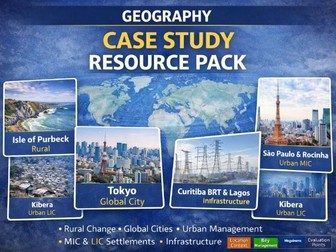
This comprehensive Geography Case Study Resource Pack provides detailed, exam-ready examples covering rural change (Isle of Purbeck), global cities (Tokyo), urban management in MICs and LICs (São Paulo, Rocinha, Kibera), infrastructure provision (Curitiba BRT, Lagos power), and settlement challenges. Each case study includes clear location context, key characteristics, problems, management strategies, and balanced evaluation points, making them ideal for 6–20 mark exam answers. Designed to support GCSE and A Level students, these resources help learners develop precise place-specific knowledge, strengthen AO1 recall, AO2 application, and AO3 evaluation skills, and confidently structure high-level exam responses.
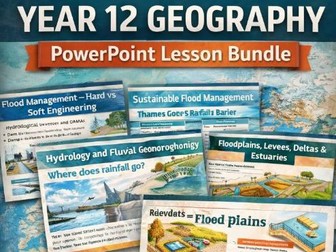
This bundle includes 18 fully resourced Year 12 Geography PowerPoint presentations designed to support the delivery of key A-Level physical and human geography content. Each lesson is structured with clear learning objectives, starter tasks, guided content, and opportunities for exam-style application. Introductory lessons establish course expectations and subject foundations, helping students transition into advanced geographical study while understanding assessment requirements and core themes across the year.
The presentations explore a wide range of hydrology and fluvial geomorphology topics, building detailed understanding of drainage basin systems, the hydrological cycle, and river processes. Students examine how water moves through stores and transfers, how open systems function, and how landforms such as floodplains, levees, deltas, and estuaries develop through erosion and deposition. Environmental change is also considered, including how climate change impacts delta environments, sediment supply, and flood risk in vulnerable regions.
Further lessons focus on flood management and sustainability, comparing hard and soft engineering strategies and evaluating their effectiveness through real-world case studies. Students investigate dams, embankments, and flood barriers alongside sustainable approaches such as afforestation, floodplain zoning, and river restoration. Advanced content examines integrated flood management in contrasting global contexts, including projects like the Thames Barrier, Bangladesh flood schemes, and the Netherlands’ “Room for the River” initiative, supporting higher-level evaluative and exam writing skills.
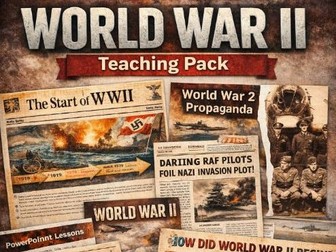
Complete WWII Teaching Resource Bundle – 6 PowerPoint Lessons + Worksheets + Flashcards + Homework + Quizzes + Extension Tasks
Bring World War II to life in your classroom with this comprehensive, ready-to-teach resource bundle covering key WWII topics, including The Battle of Britain and Pearl Harbor. Designed to save planning time while maximizing student engagement, this all-in-one package provides everything you need to deliver structured, high-impact history lessons.
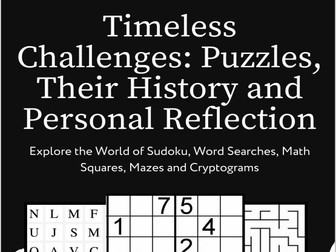
Welcome to a fun and engaging journey into the world of brain games! This puzzle book is designed for puzzlers of all skill levels—whether you’re just starting out or you’re a seasoned problem-solver looking for a fresh challenge.
Inside, you’ll find a diverse collection of classic puzzle types, including Sudoku, Word Searches, Magic Squares, Mazes, and Cryptograms. Each puzzle style offers a unique way to stretch your thinking:
Sudoku sharpens logic, memory, and concentration as you work to place numbers correctly.
Word Searches boost vocabulary and pattern recognition while you hunt for hidden words.
Magic Squares challenge your mathematical reasoning and strategic thinking.
Mazes test spatial awareness and problem-solving as you navigate paths from start to finish.
Cryptograms turn you into a codebreaker, decoding secret messages through letter substitution.
Beyond entertainment, this book supports cognitive growth—helping improve focus, memory, mental flexibility, and step-by-step problem-solving skills. Puzzles also offer a calming escape from everyday stress, making them a perfect way to relax while keeping your mind active.
As you progress, you’ll not only complete puzzles but also build confidence, discover new strategies, and watch your thinking skills evolve.
So grab a pencil, get comfortable, and dive in—hours of challenge, learning, and fun await. Happy puzzling!
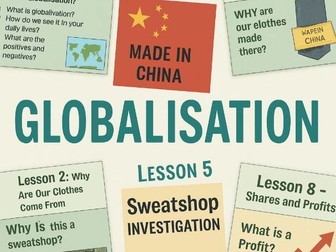
This fully resourced scheme of work explores the complex relationship between globalisation, production chains, and the clothing industry. Designed for KS3 Geography (adaptable for KS4), the pack provides everything you need to teach students about where their clothes come from, the impacts of consumer choices, and the realities of global trade.
What’s Included?
Eight complete, ready-to-teach PowerPoint lessons with engaging activities, case studies, and assessments:
Globalisation Introduction – What is globalisation? Positives and negatives in our daily lives.
Where Our Clothes Come From – Exploring the origins of clothing and mapping global trade links.
Why Are Our Clothes Made in…? – Investigating why production is concentrated in countries like China and Bangladesh.
Sweatshops – Understanding working conditions and ethical concerns in the garment industry.
Sweatshop Investigation – In-depth case study with evidence analysis and critical thinking tasks.
Made in China – Focusing on China’s role in the global clothing industry and its economic impact.
Production Chains – Tracing the journey of a t-shirt from raw material to shop floor.
Shares and Profits – Examining who benefits most from global clothing production.
Learning Objectives & Skills
Define and explain globalisation with real-world examples.
Analyse the geography of production chains and global trade flows.
Explore ethical issues in clothing manufacture, including sweatshops and fair trade.
Develop critical thinking and empathy through case studies (e.g., China, Bangladesh).
Strengthen map, data interpretation, and enquiry skills.
Teaching Features
Engaging starters & plenaries to spark discussion.
Differentiated activities for all ability levels (worksheets, debates, fact files, role-play).
Assessment opportunities built into each lesson.
Cross-curricular links with Economics, Business Studies, and Citizenship.
Encourages reflection on ethical consumerism and students’ own choices.
Perfect For:
KS3 Geography schemes of work.
Adaptation into KS4/GCSE Globalisation units.
Covering cross-curricular PSHE and Citizenship topics.
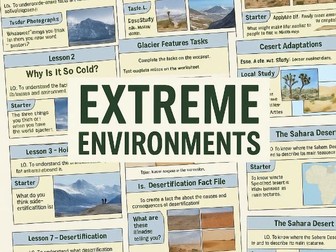
This fully resourced 11-lesson scheme of work explores some of the most fascinating and challenging environments on Earth. Designed for KS3 Geography but easily adaptable for KS4, the pack includes high-quality, ready-to-teach PowerPoints with activities, visuals, and assessments that build knowledge and skills progressively.
Lesson Breakdown
Introduction to Extreme Environments – What makes an environment “extreme”? Explore examples around the world.
Why Is It So Cold? – Investigating polar climates, temperature patterns, and the science behind extreme cold.
Glaciers – How glaciers form, move, and shape the landscape.
The Coldest Place on Earth – A case study on Antarctica and its unique challenges.
Hot Deserts – Characteristics, climate, and adaptations in some of the hottest places on Earth.
Desert Adaptations – How plants, animals, and people survive in desert climates.
Desertification – Understanding the causes and consequences of desertification.
Desertification Fact File – Guided research and consolidation task to apply learning.
Desertification Fill-in-the-Blanks Task – Literacy and retrieval practice for reinforcement.
Glacier Features Tasks – Activities and diagrams to explore glacial landforms.
The Sahara Desert – A detailed case study of the largest hot desert in the world.
Features of the Pack
Engaging starter and plenary tasks in every lesson.
Case studies (Antarctica, Sahara Desert) to bring topics to life.
Fully differentiated with scaffolds and extension tasks.
Variety of activities: retrieval practice, literacy support, diagram annotation, research, and exam-style questions.
Designed with assessment for learning (AfL) opportunities throughout.
Who Is It For?
Perfect for KS3 Geography classes (Years 7–9), with clear links to GCSE/IGCSE topics such as cold environments, hot deserts, and global climate systems.
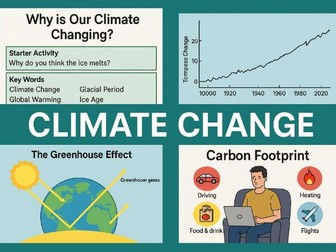
ring climate change to life in your classroom with this five-lesson, fully resourced teaching pack. Each PowerPoint is carefully designed with clear learning objectives, success criteria, engaging activities, and built-in opportunities for assessment. Perfect for KS3 and adaptable for KS4, these lessons cover the essential building blocks of climate change education while encouraging critical thinking and concern for society.
What’s Included:
Lesson 1 – Why is Our Climate Changing?
Introduces the difference between weather and climate.
Explains natural and historical climate changes (ice ages, medieval warm period).
Activities on temperature cycles and graph interpretation
Lesson 2 – Evidence of Climate Change
Uses fossils, ice cores, and tree rings to show how scientists measure past climates.
Explains greenhouse gases and the greenhouse effect with student-friendly diagrams.
Includes challenge questions and activities to deepen understanding
Lesson 3 – Carbon Footprint
Defines what a carbon footprint is and how daily life contributes to it.
Interactive quizzes and reflection tasks to calculate personal footprints.
Encourages learners to suggest realistic ways to reduce emissions
Lesson 4 – Impacts of Climate Change
Covers global impacts including stronger hurricanes, melting glaciers, rising sea levels, and biodiversity loss.
Real-world case studies (e.g., Arctic species, Bangladesh, Maldives).
Task-based learning with opportunities for group discussion and independent fact-files
Lesson 5 – Impacts of Rising Sea Levels
Focus on sea level change over time, with clear data interpretation tasks.
Case study: Kiribati – one of the first nations threatened with becoming uninhabitable.
Students explore social, economic, and environmental consequences of flooding
Features:
✔ Ready-to-teach PowerPoint slides (no additional planning required).
✔ Clear Learning Objectives and Success Criteria for every lesson.
✔ Activities ranging from starter quizzes and case studies to plenaries and fact-files.
✔ Stretch and challenge opportunities for higher ability students.
✔ Fully linked to geographical concepts such as climate cycles, human impacts, and societal consequences.
Who is it for?
KS3 Geography (Years 7–9) – ideal for introducing climate change.
KS4 Geography – adaptable for GCSE courses as foundation material.
Cross-curricular links with science and citizenship.


 Quick View