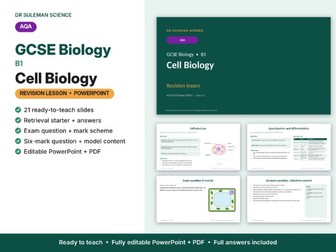
AQA GCSE Biology B1 Cell Biology Revision Lesson PowerPointQuick View
Drsamera

AQA GCSE Biology B1 Cell Biology Revision Lesson PowerPoint

(0)
Ready-to-teach AQA GCSE Biology B1 Cell Biology revision lesson: a 21-slide PowerPoint that takes students through the whole topic with retrieval practice, exam questions and full answers. No prep needed. Perfect for end-of-topic revision, mock preparation, intervention groups and final exam revision. Every slide is fully editable, so you can adapt it for your class. What’s in the lesson Learning outcomes and a retrieval starter with answers on the next slide Key content slides covering Cell structure, Specialisation and differentiation, Microscopy, Culturing microorganisms, Cell division, Stem cells, Diffusion, Osmosis and Active transport, each with key terms and “must know” points Quick checks with answers to test understanding mid-lesson Common mistakes to avoid (the errors that lose marks) Exam-style question with mark scheme for self- or peer-marking Six-mark extended-response question with a planning scaffold and indicative content Exit ticket and RAG self-assessment so students know what to revise next Files: editable PowerPoint (.pptx) plus a PDF copy for printing or sharing with students. Suitable for AQA GCSE Biology (8461) and AQA Combined Science Trilogy (8464), Foundation and Higher tier. Make it a full revision set: pair this lesson with my matching AQA GCSE Biology B1 Cell Biology revision pack (knowledge organiser, recall questions and topic test with mark scheme) in the Dr Suleman Science shop. About the author Written by Dr Samera Suleman (Dr Suleman Science): PhD in biosciences, qualified science teacher (PGCE, QTS) with over 11 years of secondary teaching and university lecturing experience. Last updated: October 2026. Not endorsed by any exam board. Please leave a review if this helps your students!
Cells Sensory Story PMLD SLD Science PackQuick View
Drsamera

Cells Sensory Story PMLD SLD Science Pack

(0)
An original cells sensory story and semi-formal pack for SEN learners with PMLD and SLD. It lets pupils in special schools and resource bases access the KS3 science topic of plant and animal cells. This cells sensory story pack follows pre-formal and semi-formal pathways. It includes Engagement Model recording sheets, so you can evidence exploration, realisation, anticipation, persistence and initiation. What’s included “Inside a Cell”: a 10-line original sensory story with a sensory experience for every line (jelly, vibration, warmth, water, pressure) and storytelling tips A repeatable 35 to 45 minute session plan Cell in a bag: food and non-food options, with a full safety section (choking risk, allergies, latex-free) Real-object exploration, choice making, and switch-based cause and effect activities Engagement Model observation record and a semi-formal progress checklist Six printable resources: story symbol cards, plant or animal sort, errorless matching, find the green, colour the nucleus, and a Now/Next board Editable Word file plus PDF Ideal for SLD and PMLD classes, autism bases, and learners not yet engaged in subject-specific study. Part of the Dr Suleman Science SEND cells collection. Also see the full KS3 plant and animal cells SEND lesson, the symbol-supported resources, the large print edition and the complete bundle. Last updated: October 2026.
Plant and Animal Cells Symbol Resources SENQuick View
Drsamera

Plant and Animal Cells Symbol Resources SEN

(0)
Symbol-supported plant and animal cells resources for SEN science. They are designed for pupils with communication needs, autism, SLCN, and early readers in KS3 and special schools. These symbol-supported plant and animal cells resources use an original, colour-coded symbol set. The colours follow the modified Fitzgerald key found on many AAC devices. No symbol licence is needed. What’s included Visual timetable and “finished” box 10 desk instruction cards (look, point, cut, stick, match, circle, colour, wait, help, finished) 25-symbol communication board for aided language modelling Fully symbolised animal cell worksheet: point, cut and stick, plant or animal, colour the nucleus Symbolised exit ticket with feelings check Staff notes, including Makaton key words to sign and how to re-symbolise in Widgit Answers included; editable Word file plus PDF Works alongside pupils’ own AAC systems. Pairs with the KS3 plant and animal cells SEND lesson and the cells sensory story pack from Dr Suleman Science. Last updated: October 2026.
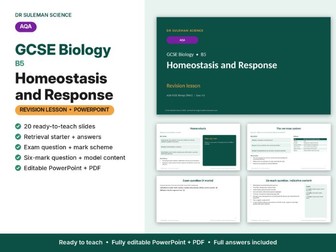
AQA GCSE Biology B5 Homeostasis & Response Revision Lesson PowerPointQuick View
Drsamera

AQA GCSE Biology B5 Homeostasis & Response Revision Lesson PowerPoint

(0)
Ready-to-teach AQA GCSE Biology B5 Homeostasis and Response revision lesson: a 20-slide PowerPoint that takes students through the whole topic with retrieval practice, exam questions and full answers. No prep needed. Perfect for end-of-topic revision, mock preparation, intervention groups and final exam revision. Every slide is fully editable, so you can adapt it for your class. What’s in the lesson Learning outcomes and a retrieval starter with answers on the next slide Key content slides covering Homeostasis, The nervous system, The brain and the eye, Control of body temperature, Hormonal control, Water and kidneys, Reproductive hormones and Plant hormones, each with key terms and “must know” points Quick checks with answers to test understanding mid-lesson Common mistakes to avoid (the errors that lose marks) Exam-style question with mark scheme for self- or peer-marking Six-mark extended-response question with a planning scaffold and indicative content Exit ticket and RAG self-assessment so students know what to revise next Files: editable PowerPoint (.pptx) plus a PDF copy for printing or sharing with students. Suitable for AQA GCSE Biology (8461) and AQA Combined Science Trilogy (8464), Foundation and Higher tier. Biology-only and Higher-tier content is labelled. Make it a full revision set: pair this lesson with my matching AQA GCSE Biology B5 Homeostasis and Response revision pack (knowledge organiser, recall questions and topic test with mark scheme) in the Dr Suleman Science shop. About the author Written by Dr Samera Suleman (Dr Suleman Science): PhD in biosciences, qualified science teacher (PGCE, QTS) with over 11 years of secondary teaching and university lecturing experience. Last updated: October 2026. Not endorsed by any exam board. Please leave a review if this helps your students!
AQA GCSE Biology B3 Infection & Response Revision Lesson PowerPointQuick View
Drsamera

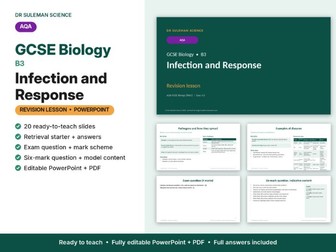
AQA GCSE Biology B3 Infection & Response Revision Lesson PowerPoint

(0)
Ready-to-teach AQA GCSE Biology B3 Infection and Response revision lesson: a 20-slide PowerPoint that takes students through the whole topic with retrieval practice, exam questions and full answers. No prep needed. Perfect for end-of-topic revision, mock preparation, intervention groups and final exam revision. Every slide is fully editable, so you can adapt it for your class. What’s in the lesson Learning outcomes and a retrieval starter with answers on the next slide Key content slides covering Pathogens and how they spread, Examples of diseases, Human defence systems, Vaccination, Antibiotics and painkillers, Discovery and development of drugs, Monoclonal antibodies and Plant disease, each with key terms and “must know” points Quick checks with answers to test understanding mid-lesson Common mistakes to avoid (the errors that lose marks) Exam-style question with mark scheme for self- or peer-marking Six-mark extended-response question with a planning scaffold and indicative content Exit ticket and RAG self-assessment so students know what to revise next Files: editable PowerPoint (.pptx) plus a PDF copy for printing or sharing with students. Suitable for AQA GCSE Biology (8461) and AQA Combined Science Trilogy (8464), Foundation and Higher tier. Make it a full revision set: pair this lesson with my matching AQA GCSE Biology B3 Infection and Response revision pack (knowledge organiser, recall questions and topic test with mark scheme) in the Dr Suleman Science shop. About the author Written by Dr Samera Suleman (Dr Suleman Science): PhD in biosciences, qualified science teacher (PGCE, QTS) with over 11 years of secondary teaching and university lecturing experience. Last updated: October 2026. Not endorsed by any exam board. Please leave a review if this helps your students!
AQA GCSE Biology B2 Organisation Revision Lesson PowerPointQuick View
Drsamera

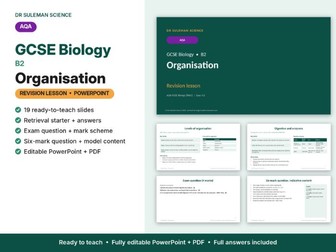
AQA GCSE Biology B2 Organisation Revision Lesson PowerPoint

(0)
Ready-to-teach AQA GCSE Biology B2 Organisation revision lesson: a 19-slide PowerPoint that takes students through the whole topic with retrieval practice, exam questions and full answers. No prep needed. Perfect for end-of-topic revision, mock preparation, intervention groups and final exam revision. Every slide is fully editable, so you can adapt it for your class. What’s in the lesson Learning outcomes and a retrieval starter with answers on the next slide Key content slides covering Levels of organisation, Digestion and enzymes, The heart and lungs, Blood, Coronary heart disease, Health and non-communicable disease and Plant tissues and transport, each with key terms and “must know” points Quick checks with answers to test understanding mid-lesson Common mistakes to avoid (the errors that lose marks) Exam-style question with mark scheme for self- or peer-marking Six-mark extended-response question with a planning scaffold and indicative content Exit ticket and RAG self-assessment so students know what to revise next Files: editable PowerPoint (.pptx) plus a PDF copy for printing or sharing with students. Suitable for AQA GCSE Biology (8461) and AQA Combined Science Trilogy (8464), Foundation and Higher tier. Make it a full revision set: pair this lesson with my matching AQA GCSE Biology B2 Organisation revision pack (knowledge organiser, recall questions and topic test with mark scheme) in the Dr Suleman Science shop. About the author Written by Dr Samera Suleman (Dr Suleman Science): PhD in biosciences, qualified science teacher (PGCE, QTS) with over 11 years of secondary teaching and university lecturing experience. Last updated: October 2026. Not endorsed by any exam board. Please leave a review if this helps your students!
AQA GCSE Biology B4 Bioenergetics Revision Lesson PowerPointQuick View
Drsamera

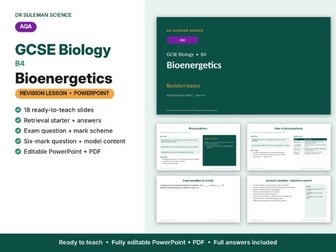
AQA GCSE Biology B4 Bioenergetics Revision Lesson PowerPoint

(0)
Ready-to-teach AQA GCSE Biology B4 Bioenergetics revision lesson: a 18-slide PowerPoint that takes students through the whole topic with retrieval practice, exam questions and full answers. No prep needed. Perfect for end-of-topic revision, mock preparation, intervention groups and final exam revision. Every slide is fully editable, so you can adapt it for your class. What’s in the lesson Learning outcomes and a retrieval starter with answers on the next slide Key content slides covering Photosynthesis, Rate of photosynthesis, Uses of glucose, Aerobic and anaerobic respiration, Response to exercise and Metabolism, each with key terms and “must know” points Quick checks with answers to test understanding mid-lesson Common mistakes to avoid (the errors that lose marks) Exam-style question with mark scheme for self- or peer-marking Six-mark extended-response question with a planning scaffold and indicative content Exit ticket and RAG self-assessment so students know what to revise next Files: editable PowerPoint (.pptx) plus a PDF copy for printing or sharing with students. Suitable for AQA GCSE Biology (8461) and AQA Combined Science Trilogy (8464), Foundation and Higher tier. Higher-tier content is labelled (HT). Make it a full revision set: pair this lesson with my matching AQA GCSE Biology B4 Bioenergetics revision pack (knowledge organiser, recall questions and topic test with mark scheme) in the Dr Suleman Science shop. About the author Written by Dr Samera Suleman (Dr Suleman Science): PhD in biosciences, qualified science teacher (PGCE, QTS) with over 11 years of secondary teaching and university lecturing experience. Last updated: October 2026. Not endorsed by any exam board. Please leave a review if this helps your students!
AQA GCSE Chemistry C10 Using Resources Revision Lesson PowerPointQuick View
Drsamera

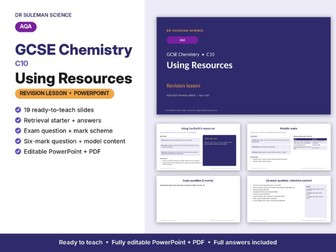
AQA GCSE Chemistry C10 Using Resources Revision Lesson PowerPoint

(0)
Ready-to-teach AQA GCSE Chemistry C10 Using Resources revision lesson: a 19-slide PowerPoint that takes students through the whole topic with retrieval practice, exam questions and full answers. No prep needed. Perfect for end-of-topic revision, mock preparation, intervention groups and final exam revision. Every slide is fully editable, so you can adapt it for your class. What’s in the lesson Learning outcomes and a retrieval starter with answers on the next slide Key content slides covering Using the Earth’s resources, Potable water, Waste water treatment, Alternative methods of extracting metals, Life cycle assessment and recycling, Corrosion, alloys and materials and The Haber process and fertilisers, each with key terms and “must know” points Quick checks with answers to test understanding mid-lesson Common mistakes to avoid (the errors that lose marks) Exam-style question with mark scheme for self- or peer-marking Six-mark extended-response question with a planning scaffold and indicative content Exit ticket and RAG self-assessment so students know what to revise next Files: editable PowerPoint (.pptx) plus a PDF copy for printing or sharing with students. Suitable for AQA GCSE Chemistry (8462) and AQA Combined Science Trilogy (8464), Foundation and Higher tier. HT = Higher tier only. Make it a full revision set: pair this lesson with my matching AQA GCSE Chemistry C10 Using Resources revision pack (knowledge organiser, recall questions and topic test with mark scheme) in the Dr Suleman Science shop. About the author Written by Dr Samera Suleman (Dr Suleman Science): PhD in biosciences, qualified science teacher (PGCE, QTS) with over 11 years of secondary teaching and university lecturing experience. Last updated: October 2026. Not endorsed by any exam board. Please leave a review if this helps your students!
Plant and Animal Cells SEND Lesson KS3 Year 7Quick View
Drsamera

Plant and Animal Cells SEND Lesson KS3 Year 7

(0)
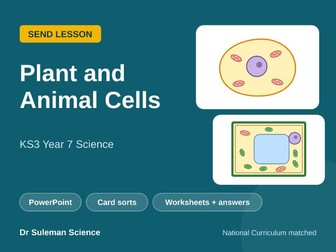
A complete, ready-to-teach plant and animal cells SEND lesson for KS3 Year 7 science. It includes a 22-slide PowerPoint, card sorts, tiered worksheets with answers, and a full teacher guide. This plant and animal cells lesson is written by a science teacher with a PhD in biosciences and 11+ years in the classroom. It is designed for SEN support pupils, nurture groups, lower-attaining KS3 classes and Entry Level Certificate (ELC) learners. It covers all three KS3 National Curriculum statements for cells: cells as the unit of life, the functions of the cell wall, cell membrane, cytoplasm, nucleus, vacuole, mitochondria and chloroplasts, and the similarities and differences between plant and animal cells. What’s included 22-slide PowerPoint with speaker notes: visual timetable, lesson tracker on every slide, one cell part per slide, syllable breakdowns, memory links and gestures Keyword mat with pictures Card Sort 1: match name, picture and job (21 cards) Card Sort 2: plant, animal or both? sorting mat Three tiered worksheets (1, 2 and 3 stars) with no “low ability” labels Picture-supported exit tickets Teacher guide: minute-by-minute lesson plan, adaptations for all four areas of need in the SEND Code of Practice, TA guide, misconceptions, and full answers and mark scheme Editable Word and PowerPoint files, plus PDF versions Why teachers like it Each cell part keeps the same colour on every slide, card and worksheet Dyslexia-friendly fonts, low text load and a soft background Tasks do not rely on colour alone Original, copyright-free cell diagrams Need more support? See the matching sensory story pack for SLD/PMLD learners, the symbol-supported resources and the large print edition from Dr Suleman Science, or save with the complete plant and animal cells SEND bundle. Last updated: October 2026.
AQA GCSE Chemistry C1 Atomic Structure & Periodic Table Revision LessonQuick View
Drsamera

AQA GCSE Chemistry C1 Atomic Structure & Periodic Table Revision Lesson

(0)
Ready-to-teach AQA GCSE Chemistry C1 Atomic Structure and the Periodic Table revision lesson: a 22-slide PowerPoint that takes students through the whole topic with retrieval practice, exam questions and full answers. No prep needed. Perfect for end-of-topic revision, mock preparation, intervention groups and final exam revision. Every slide is fully editable, so you can adapt it for your class. What’s in the lesson Learning outcomes and a retrieval starter with answers on the next slide Key content slides covering Atoms, Elements and Compounds, Mixtures and Separation, The Model of the Atom, Subatomic Particles, Isotopes and Relative Atomic Mass, Electronic Structure, The Periodic Table, Group 0 and Group 1, Group 7: The Halogens and The Transition Metals, each with key terms and “must know” points Quick checks with answers to test understanding mid-lesson Common mistakes to avoid (the errors that lose marks) Exam-style question with mark scheme for self- or peer-marking Six-mark extended-response question with a planning scaffold and indicative content Exit ticket and RAG self-assessment so students know what to revise next Files: editable PowerPoint (.pptx) plus a PDF copy for printing or sharing with students. Suitable for AQA GCSE Chemistry (8462) and AQA Combined Science Trilogy (8464), Foundation and Higher tier. Make it a full revision set: pair this lesson with my matching AQA GCSE Chemistry C1 Atomic Structure and the Periodic Table revision pack (knowledge organiser, recall questions and topic test with mark scheme) in the Dr Suleman Science shop. About the author Written by Dr Samera Suleman (Dr Suleman Science): PhD in biosciences, qualified science teacher (PGCE, QTS) with over 11 years of secondary teaching and university lecturing experience. Last updated: October 2026. Not endorsed by any exam board. Please leave a review if this helps your students!
AQA GCSE Biology B6 Inheritance, Variation & Evolution Revision LessonQuick View
Drsamera

AQA GCSE Biology B6 Inheritance, Variation & Evolution Revision Lesson

(0)
Ready-to-teach AQA GCSE Biology B6 Inheritance, Variation and Evolution revision lesson: a 18-slide PowerPoint that takes students through the whole topic with retrieval practice, exam questions and full answers. No prep needed. Perfect for end-of-topic revision, mock preparation, intervention groups and final exam revision. Every slide is fully editable, so you can adapt it for your class. What’s in the lesson Learning outcomes and a retrieval starter with answers on the next slide Key content slides covering Reproduction and meiosis, DNA and the genome, Genetic inheritance, Variation and evolution, Selective breeding and genetic engineering and Evidence for evolution and classification, each with key terms and “must know” points Quick checks with answers to test understanding mid-lesson Common mistakes to avoid (the errors that lose marks) Exam-style question with mark scheme for self- or peer-marking Six-mark extended-response question with a planning scaffold and indicative content Exit ticket and RAG self-assessment so students know what to revise next Files: editable PowerPoint (.pptx) plus a PDF copy for printing or sharing with students. Suitable for AQA GCSE Biology (8461) and AQA Combined Science Trilogy (8464), Foundation and Higher tier. Biology-only and Higher-tier content is labelled. Make it a full revision set: pair this lesson with my matching AQA GCSE Biology B6 Inheritance, Variation and Evolution revision pack (knowledge organiser, recall questions and topic test with mark scheme) in the Dr Suleman Science shop. About the author Written by Dr Samera Suleman (Dr Suleman Science): PhD in biosciences, qualified science teacher (PGCE, QTS) with over 11 years of secondary teaching and university lecturing experience. Last updated: October 2026. Not endorsed by any exam board. Please leave a review if this helps your students!
AQA GCSE Biology B7 Ecology Revision Lesson PowerPointQuick View
Drsamera

AQA GCSE Biology B7 Ecology Revision Lesson PowerPoint

(0)
Ready-to-teach AQA GCSE Biology B7 Ecology revision lesson: a 18-slide PowerPoint that takes students through the whole topic with retrieval practice, exam questions and full answers. No prep needed. Perfect for end-of-topic revision, mock preparation, intervention groups and final exam revision. Every slide is fully editable, so you can adapt it for your class. What’s in the lesson Learning outcomes and a retrieval starter with answers on the next slide Key content slides covering Communities, Abiotic and biotic factors, Organisation of an ecosystem, Cycling materials, Biodiversity and human impact and Trophic levels and food production, each with key terms and “must know” points Quick checks with answers to test understanding mid-lesson Common mistakes to avoid (the errors that lose marks) Exam-style question with mark scheme for self- or peer-marking Six-mark extended-response question with a planning scaffold and indicative content Exit ticket and RAG self-assessment so students know what to revise next Files: editable PowerPoint (.pptx) plus a PDF copy for printing or sharing with students. Suitable for AQA GCSE Biology (8461) and AQA Combined Science Trilogy (8464), Foundation and Higher tier. Biology-only and Higher-tier content is labelled. Make it a full revision set: pair this lesson with my matching AQA GCSE Biology B7 Ecology revision pack (knowledge organiser, recall questions and topic test with mark scheme) in the Dr Suleman Science shop. About the author Written by Dr Samera Suleman (Dr Suleman Science): PhD in biosciences, qualified science teacher (PGCE, QTS) with over 11 years of secondary teaching and university lecturing experience. Last updated: October 2026. Not endorsed by any exam board. Please leave a review if this helps your students!
AQA GCSE Chemistry C2 Bonding, Structure & Properties Revision LessonQuick View
Drsamera

AQA GCSE Chemistry C2 Bonding, Structure & Properties Revision Lesson

(0)
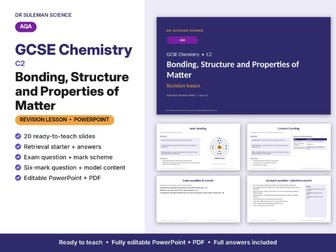
Ready-to-teach AQA GCSE Chemistry C2 Bonding, Structure and Properties of Matter revision lesson: a 20-slide PowerPoint that takes students through the whole topic with retrieval practice, exam questions and full answers. No prep needed. Perfect for end-of-topic revision, mock preparation, intervention groups and final exam revision. Every slide is fully editable, so you can adapt it for your class. What’s in the lesson Learning outcomes and a retrieval starter with answers on the next slide Key content slides covering Ionic bonding, Covalent bonding, Metallic bonding, States of matter, Properties of ionic and covalent substances, Metals and alloys, Structures of carbon and Nanoparticles, each with key terms and “must know” points Quick checks with answers to test understanding mid-lesson Common mistakes to avoid (the errors that lose marks) Exam-style question with mark scheme for self- or peer-marking Six-mark extended-response question with a planning scaffold and indicative content Exit ticket and RAG self-assessment so students know what to revise next Files: editable PowerPoint (.pptx) plus a PDF copy for printing or sharing with students. Suitable for AQA GCSE Chemistry (8462) and AQA Combined Science Trilogy (8464), Foundation and Higher tier. Make it a full revision set: pair this lesson with my matching AQA GCSE Chemistry C2 Bonding, Structure and Properties of Matter revision pack (knowledge organiser, recall questions and topic test with mark scheme) in the Dr Suleman Science shop. About the author Written by Dr Samera Suleman (Dr Suleman Science): PhD in biosciences, qualified science teacher (PGCE, QTS) with over 11 years of secondary teaching and university lecturing experience. Last updated: October 2026. Not endorsed by any exam board. Please leave a review if this helps your students!
Plant and Animal Cells Large Print VI KS3Quick View
Drsamera

Plant and Animal Cells Large Print VI KS3

(0)
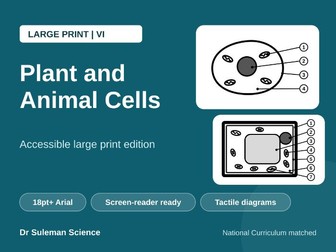
A large print, screen-reader friendly plant and animal cells worksheet pack for KS3 science. It is designed for pupils with visual impairment (VI), and for anyone who needs clear print or text-to-speech. This accessible plant and animal cells edition uses Arial at 18pt or larger, real headings for easy navigation, and a text description on every image. It works with Word Read Aloud, Immersive Reader, JAWS, NVDA and VoiceOver. What’s included Key words with pronunciation, jobs and memory links Five activities: parts and jobs, naming animal cell parts, naming plant cell parts, plant/animal/both, and stretch explain questions High-contrast thick-line diagrams, suitable for swell paper (tactile diagrams) A text description of every diagram, so tasks do not depend on sight Exit ticket and full answers Fully editable Word file: pupils can type straight into the document. PDF also included. A great fit for QTVI and VI services. Part of the Dr Suleman Science SEND cells collection, alongside the KS3 plant and animal cells SEND lesson, the sensory story pack and the symbol-supported resources. Last updated: October 2026.
AQA GCSE Chemistry C3 Quantitative Chemistry Revision Lesson PPTQuick View
Drsamera

AQA GCSE Chemistry C3 Quantitative Chemistry Revision Lesson PPT

(0)
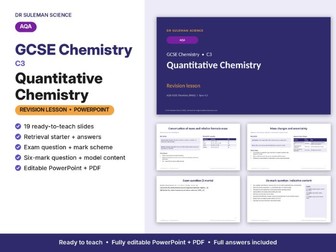
Ready-to-teach AQA GCSE Chemistry C3 Quantitative Chemistry revision lesson: a 19-slide PowerPoint that takes students through the whole topic with retrieval practice, exam questions and full answers. No prep needed. Perfect for end-of-topic revision, mock preparation, intervention groups and final exam revision. Every slide is fully editable, so you can adapt it for your class. What’s in the lesson Learning outcomes and a retrieval starter with answers on the next slide Key content slides covering Conservation of mass and relative formula mass, Mass changes and uncertainty, Moles (HT), Amounts in equations and limiting reactants (HT), Concentration of solutions, Yield and atom economy and Moles in solution and gases (HT), each with key terms and “must know” points Quick checks with answers to test understanding mid-lesson Common mistakes to avoid (the errors that lose marks) Exam-style question with mark scheme for self- or peer-marking Six-mark extended-response question with a planning scaffold and indicative content Exit ticket and RAG self-assessment so students know what to revise next Files: editable PowerPoint (.pptx) plus a PDF copy for printing or sharing with students. Suitable for AQA GCSE Chemistry (8462) and AQA Combined Science Trilogy (8464), Foundation and Higher tier. HT = Higher tier only. Make it a full revision set: pair this lesson with my matching AQA GCSE Chemistry C3 Quantitative Chemistry revision pack (knowledge organiser, recall questions and topic test with mark scheme) in the Dr Suleman Science shop. About the author Written by Dr Samera Suleman (Dr Suleman Science): PhD in biosciences, qualified science teacher (PGCE, QTS) with over 11 years of secondary teaching and university lecturing experience. Last updated: October 2026. Not endorsed by any exam board. Please leave a review if this helps your students!
AQA GCSE Chemistry C4 Chemical Changes Revision Lesson PowerPointQuick View
Drsamera

AQA GCSE Chemistry C4 Chemical Changes Revision Lesson PowerPoint

(0)
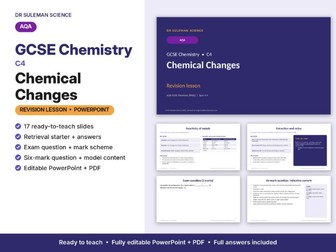
Ready-to-teach AQA GCSE Chemistry C4 Chemical Changes revision lesson: a 17-slide PowerPoint that takes students through the whole topic with retrieval practice, exam questions and full answers. No prep needed. Perfect for end-of-topic revision, mock preparation, intervention groups and final exam revision. Every slide is fully editable, so you can adapt it for your class. What’s in the lesson Learning outcomes and a retrieval starter with answers on the next slide Key content slides covering Reactivity of metals, Extraction and redox, Reactions of acids, pH and acid strength and Electrolysis, each with key terms and “must know” points Quick checks with answers to test understanding mid-lesson Common mistakes to avoid (the errors that lose marks) Exam-style question with mark scheme for self- or peer-marking Six-mark extended-response question with a planning scaffold and indicative content Exit ticket and RAG self-assessment so students know what to revise next Files: editable PowerPoint (.pptx) plus a PDF copy for printing or sharing with students. Suitable for AQA GCSE Chemistry (8462) and AQA Combined Science Trilogy (8464), Foundation and Higher tier. HT = Higher tier only. Titrations are Chemistry only. Make it a full revision set: pair this lesson with my matching AQA GCSE Chemistry C4 Chemical Changes revision pack (knowledge organiser, recall questions and topic test with mark scheme) in the Dr Suleman Science shop. About the author Written by Dr Samera Suleman (Dr Suleman Science): PhD in biosciences, qualified science teacher (PGCE, QTS) with over 11 years of secondary teaching and university lecturing experience. Last updated: October 2026. Not endorsed by any exam board. Please leave a review if this helps your students!
AQA GCSE Chemistry C6 Rate & Extent of Chemical Change Revision LessonQuick View
Drsamera

AQA GCSE Chemistry C6 Rate & Extent of Chemical Change Revision Lesson

(0)
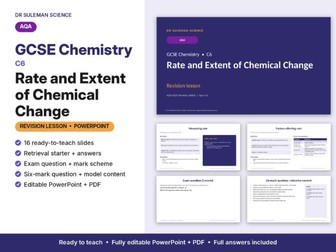
Ready-to-teach AQA GCSE Chemistry C6 Rate and Extent of Chemical Change revision lesson: a 16-slide PowerPoint that takes students through the whole topic with retrieval practice, exam questions and full answers. No prep needed. Perfect for end-of-topic revision, mock preparation, intervention groups and final exam revision. Every slide is fully editable, so you can adapt it for your class. What’s in the lesson Learning outcomes and a retrieval starter with answers on the next slide Key content slides covering Measuring rate, Factors affecting rate, Reversible reactions and Changing equilibrium conditions, each with key terms and “must know” points Quick checks with answers to test understanding mid-lesson Common mistakes to avoid (the errors that lose marks) Exam-style question with mark scheme for self- or peer-marking Six-mark extended-response question with a planning scaffold and indicative content Exit ticket and RAG self-assessment so students know what to revise next Files: editable PowerPoint (.pptx) plus a PDF copy for printing or sharing with students. Suitable for AQA GCSE Chemistry (8462) and AQA Combined Science Trilogy (8464), Foundation and Higher tier. HT = Higher tier only. Make it a full revision set: pair this lesson with my matching AQA GCSE Chemistry C6 Rate and Extent of Chemical Change revision pack (knowledge organiser, recall questions and topic test with mark scheme) in the Dr Suleman Science shop. About the author Written by Dr Samera Suleman (Dr Suleman Science): PhD in biosciences, qualified science teacher (PGCE, QTS) with over 11 years of secondary teaching and university lecturing experience. Last updated: October 2026. Not endorsed by any exam board. Please leave a review if this helps your students!
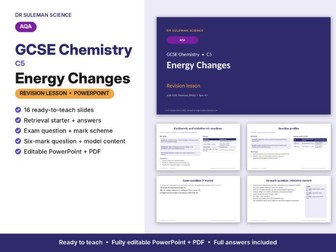
AQA GCSE Chemistry C5 Energy Changes Revision Lesson PowerPointQuick View
Drsamera

AQA GCSE Chemistry C5 Energy Changes Revision Lesson PowerPoint

(0)
Ready-to-teach AQA GCSE Chemistry C5 Energy Changes revision lesson: a 16-slide PowerPoint that takes students through the whole topic with retrieval practice, exam questions and full answers. No prep needed. Perfect for end-of-topic revision, mock preparation, intervention groups and final exam revision. Every slide is fully editable, so you can adapt it for your class. What’s in the lesson Learning outcomes and a retrieval starter with answers on the next slide Key content slides covering Exothermic and endothermic reactions, Reaction profiles, Bond energies and Chemical cells and fuel cells, each with key terms and “must know” points Quick checks with answers to test understanding mid-lesson Common mistakes to avoid (the errors that lose marks) Exam-style question with mark scheme for self- or peer-marking Six-mark extended-response question with a planning scaffold and indicative content Exit ticket and RAG self-assessment so students know what to revise next Files: editable PowerPoint (.pptx) plus a PDF copy for printing or sharing with students. Suitable for AQA GCSE Chemistry (8462) and AQA Combined Science Trilogy (8464), Foundation and Higher tier. HT = Higher tier only. Make it a full revision set: pair this lesson with my matching AQA GCSE Chemistry C5 Energy Changes revision pack (knowledge organiser, recall questions and topic test with mark scheme) in the Dr Suleman Science shop. About the author Written by Dr Samera Suleman (Dr Suleman Science): PhD in biosciences, qualified science teacher (PGCE, QTS) with over 11 years of secondary teaching and university lecturing experience. Last updated: October 2026. Not endorsed by any exam board. Please leave a review if this helps your students!
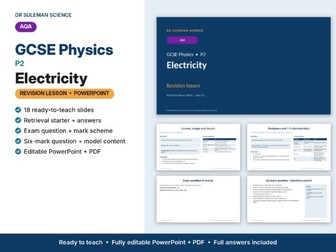
AQA GCSE Physics P2 Electricity Revision Lesson PowerPointQuick View
Drsamera

AQA GCSE Physics P2 Electricity Revision Lesson PowerPoint

(0)
Ready-to-teach AQA GCSE Physics P2 Electricity revision lesson: a 18-slide PowerPoint that takes students through the whole topic with retrieval practice, exam questions and full answers. No prep needed. Perfect for end-of-topic revision, mock preparation, intervention groups and final exam revision. Every slide is fully editable, so you can adapt it for your class. What’s in the lesson Learning outcomes and a retrieval starter with answers on the next slide Key content slides covering Current, charge and circuits, Resistance and I–V characteristics, Series and parallel circuits, Domestic electricity, Power, energy and the National Grid and Static electricity, each with key terms and “must know” points Quick checks with answers to test understanding mid-lesson Common mistakes to avoid (the errors that lose marks) Exam-style question with mark scheme for self- or peer-marking Six-mark extended-response question with a planning scaffold and indicative content Exit ticket and RAG self-assessment so students know what to revise next Files: editable PowerPoint (.pptx) plus a PDF copy for printing or sharing with students. Suitable for AQA GCSE Physics (8463) and AQA Combined Science Trilogy (8464), Foundation and Higher tier. Make it a full revision set: pair this lesson with my matching AQA GCSE Physics P2 Electricity revision pack (knowledge organiser, recall questions and topic test with mark scheme) in the Dr Suleman Science shop. About the author Written by Dr Samera Suleman (Dr Suleman Science): PhD in biosciences, qualified science teacher (PGCE, QTS) with over 11 years of secondary teaching and university lecturing experience. Last updated: October 2026. Not endorsed by any exam board. Please leave a review if this helps your students!
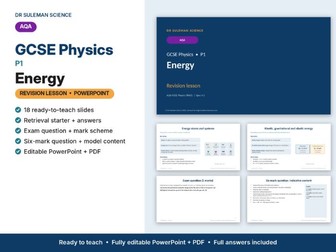
AQA GCSE Physics P1 Energy Revision Lesson PowerPointQuick View
Drsamera

AQA GCSE Physics P1 Energy Revision Lesson PowerPoint

(0)
Ready-to-teach AQA GCSE Physics P1 Energy revision lesson: a 18-slide PowerPoint that takes students through the whole topic with retrieval practice, exam questions and full answers. No prep needed. Perfect for end-of-topic revision, mock preparation, intervention groups and final exam revision. Every slide is fully editable, so you can adapt it for your class. What’s in the lesson Learning outcomes and a retrieval starter with answers on the next slide Key content slides covering Energy stores and systems, Kinetic, gravitational and elastic energy, Specific heat capacity, Power, Conservation, dissipation and efficiency and Energy resources, each with key terms and “must know” points Quick checks with answers to test understanding mid-lesson Common mistakes to avoid (the errors that lose marks) Exam-style question with mark scheme for self- or peer-marking Six-mark extended-response question with a planning scaffold and indicative content Exit ticket and RAG self-assessment so students know what to revise next Files: editable PowerPoint (.pptx) plus a PDF copy for printing or sharing with students. Suitable for AQA GCSE Physics (8463) and AQA Combined Science Trilogy (8464), Foundation and Higher tier. g = 9.8 N/kg in AQA questions. Make it a full revision set: pair this lesson with my matching AQA GCSE Physics P1 Energy revision pack (knowledge organiser, recall questions and topic test with mark scheme) in the Dr Suleman Science shop. About the author Written by Dr Samera Suleman (Dr Suleman Science): PhD in biosciences, qualified science teacher (PGCE, QTS) with over 11 years of secondary teaching and university lecturing experience. Last updated: October 2026. Not endorsed by any exam board. Please leave a review if this helps your students!
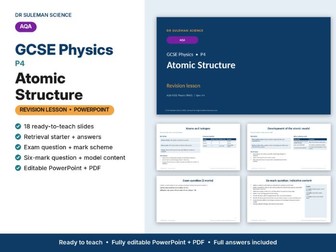
AQA GCSE Physics P4 Atomic Structure Revision Lesson PowerPointQuick View
Drsamera

AQA GCSE Physics P4 Atomic Structure Revision Lesson PowerPoint

(0)
Ready-to-teach AQA GCSE Physics P4 Atomic Structure revision lesson: a 18-slide PowerPoint that takes students through the whole topic with retrieval practice, exam questions and full answers. No prep needed. Perfect for end-of-topic revision, mock preparation, intervention groups and final exam revision. Every slide is fully editable, so you can adapt it for your class. What’s in the lesson Learning outcomes and a retrieval starter with answers on the next slide Key content slides covering Atoms and isotopes, Development of the atomic model, Radioactive decay and nuclear radiation, Half-life and hazards, Background radiation and uses and Nuclear fission and fusion, each with key terms and “must know” points Quick checks with answers to test understanding mid-lesson Common mistakes to avoid (the errors that lose marks) Exam-style question with mark scheme for self- or peer-marking Six-mark extended-response question with a planning scaffold and indicative content Exit ticket and RAG self-assessment so students know what to revise next Files: editable PowerPoint (.pptx) plus a PDF copy for printing or sharing with students. Suitable for AQA GCSE Physics (8463) and AQA Combined Science Trilogy (8464), Foundation and Higher tier. HT = Higher tier only. Make it a full revision set: pair this lesson with my matching AQA GCSE Physics P4 Atomic Structure revision pack (knowledge organiser, recall questions and topic test with mark scheme) in the Dr Suleman Science shop. About the author Written by Dr Samera Suleman (Dr Suleman Science): PhD in biosciences, qualified science teacher (PGCE, QTS) with over 11 years of secondary teaching and university lecturing experience. Last updated: October 2026. Not endorsed by any exam board. Please leave a review if this helps your students!