 Quick View
Position-Time Graph Traps + 5 Hinge MCQs
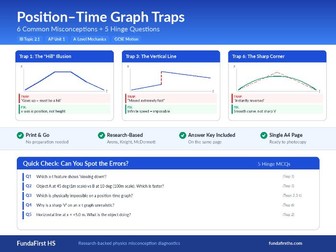
One-page diagnostic handout: 6 research-based position-time graph misconceptions with visual x–t examples, plus 5 multiple-choice hinge questions with answer key. Ready to print and use.
This single A4 resource is designed for IB Physics (Topic 2.1), AP Physics 1 (Unit 1), A-Level Mechanics, and GCSE Motion. It works as a lesson starter, revision prompt, or formative assessment tool — no preparation needed.
The top half presents six common traps students fall into when interpreting x–t graphs: the “Hill” Illusion (confusing graph shape with physical path), the Horizontal Line (thinking nothing is happening), the Vertical Line (not recognising infinite speed), the Teleportation Jump (accepting discontinuities), the Hidden Scales (judging speed by visual angle instead of axis values), and the Sharp Corner (missing the infinite acceleration implication). Each trap card includes a mini graph illustration, the specific student error in red, and the corrective insight in green.
The bottom half provides five targeted hinge questions, each mapped to a specific trap. Use them as a quick vote-and-reveal activity (2–3 minutes) to diagnose which misconceptions persist in your class. Options are laid out in two columns for easy reading. Answer key included at the bottom.
Grounded in physics education research (Arons, Knight, Trowbridge & McDermott) on persistent kinematics misconceptions.
Created by FundaFirst HS — research-backed physics misconception diagnostics for international schools. A free 25-question motion diagnostic is available at fundafirsths.com.