Free Safer Internet Day 2027 KS3 – Poster + Online Safety DemoQuick View
SimulationLessons

Free Safer Internet Day 2027 KS3 – Poster + Online Safety Demo

(0)
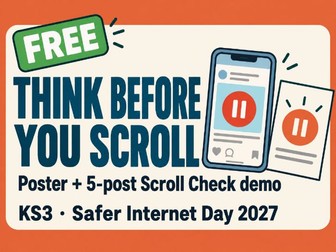
Free Safer Internet Day 2027 resource for KS3: a one-page Think Before You Scroll poster and a 5-post demo of Scroll Check, an offline online safety game. Scroll Check is an offline mock social feed where pupils decide to Post, Pause, Report or Block, with the reason for every choice. This free demo has 5 posts and a Room vote mode for the whole class. Safer Internet Day is an annual day that promotes the safe and positive use of technology for children and young people. In 2027 it falls on Tuesday 9 February, so now is a good time to plan an assembly, a tutor-time slot or a lesson. What’s included Scroll Check demo (1 offline HTML file): 5 fictional posts (a kind post, a fake ‘support’ message, a viral shark photo, an unkind comment and a pushy stranger), with the reason for every choice. Works on a whiteboard, laptop or phone. Think Before You Scroll poster (1 page, editable Word + PDF): the four choices, three questions (Is it true? Is it kind? Is it safe?) and where to get help. Who it’s for: KS3 tutors, PSHE and computing teachers, and online safety leads who want a quick, calm way in. Every person, account, app and post is invented, so nobody is asked about their own accounts. How to use it Tutor time (10 minutes): run Room vote on the board. Pupils show Post, Pause, Report or Block for each post, then you reveal the reason. Lesson starter (5 minutes): play two posts and ask which of the three questions helped. Display: print the poster for form rooms, the library or the computing suite. The poster is editable, so you can add your school’s own reporting route or the name of a trusted adult. It also works after the day itself, as a reminder in any online safety lesson. Want the full day? The full pack has 20 posts, a 15-minute assembly, a 60-minute lesson, five tutor-time activities, worksheets at three levels and a parent/carer letter, all built around the same game. The full version: Safer Internet Day 2027 KS3 – Assembly, Lesson + Online Game This is an independent resource, not made or endorsed by the UK Safer Internet Centre. Free to use with your own classes under the Tes licence. Please don’t post the files publicly or share them beyond that licence. Last updated: 12/11/2026. The full version is available from the same author on Tes.
Free Holocaust Memorial Day Assembly KS3/KS4 – HMD 2027 OutlineQuick View
SimulationLessons

Free Holocaust Memorial Day Assembly KS3/KS4 – HMD 2027 Outline

(0)
A free Holocaust Memorial Day assembly outline for KS3/KS4: one editable page for a 10–15 minute assembly on 27 January 2027, minute by minute. HMD is held every year on 27 January to remember the six million Jewish people murdered in the Holocaust, other groups persecuted and murdered by the Nazis, and those affected by genocides that followed. What the outline covers What to say, minute by minute An accurate definition of the Holocaust (USHMM) Why HMD is held on 27 January How prejudice became persecution between 1933 and 1938 A life story you choose from the HMD Trust’s website (it is linked, not reproduced in the download) A moment of silence Links to the HMD Trust, Holocaust Educational Trust, IWM, USC Shoah Foundation What’s included: one page in editable Word, with a PDF copy. There are no slides, so it works in any hall, with or without a projector. Who it’s for: heads of year, tutors and History or RE teachers asked to lead a short, respectful assembly for KS3 or KS4. It suits a year-group or key stage assembly, or a form-time reading on the day. How to use it Prepare (15 minutes): read the outline and choose a life story from the Trust’s site (the outline suggests Yisrael Abelesz). Lead the assembly (10–15 minutes): follow the timings on the page, read the life story and close with the silence. Follow up (optional): point pupils to the linked sites in tutor time or a History lesson. The outline keeps the language accurate and calm, so staff who are not History specialists can lead it with confidence. It reminds you to preview the life story (it includes distressing detail), tell staff the date and offer a quiet space. No historical photographs are needed. The theme for HMD 2027 is “No Place for Prejudice” (announced by the HMD Trust on 31 March 2026). See hmd.org.uk for the Trust’s own theme materials. Not produced or endorsed by the HMD Trust or the other organisations named. Want a full lesson too? The full pack adds a 60-minute KS3 source-enquiry lesson, a 15-minute assembly with slides and script, tutor time, three-level worksheets and the offline Sources Explorer, an interactive where pupils examine sources one by one. The full version: Holocaust Memorial Day 2027 KS3 – Assembly, Lesson + Sources Free to use with your own classes under the Tes licence. Please don’t post the files publicly or share them beyond that licence. Last updated: 12/11/2026. The full version is available from the same author on Tes.

Holocaust Memorial Day 2027 KS3 – Assembly, Lesson + SourcesQuick View
SimulationLessons

Holocaust Memorial Day 2027 KS3 – Assembly, Lesson + Sources

(0)
Holocaust Memorial Day 2027 for KS3 History: a 15-minute assembly, a 60-minute source-enquiry lesson, tutor-time reflection and a Sources Explorer. Includes the Sources Explorer: an offline timeline of 12 written sources, 1933–1946, each with provenance, context and two guided questions, plus a reflection journal. For HMD on Wednesday 27 January 2027 or the KS3 Holocaust topic at any time. Holocaust Memorial Day is held every year on 27 January to remember the six million Jewish people murdered in the Holocaust, other groups persecuted and murdered by the Nazis, and those affected by genocides that followed. Lesson question: “How did prejudice become persecution in Germany, 1933–1938?” Pupils work as historians with real documents, from 1933 diplomats’ reports and laws to the 1946 judgment, asking what each source can and can’t tell us. What’s included Assembly (7 editable slides, script in notes and printable; shorter option) and tutor-time reflection (15 min) Lesson: Teacher and Student slides; source pack (12 sources, A–L); chronology cards; Support, Core and Stretch worksheets; answer guide Teacher guide with a sensitivity and safeguarding note; Sources Explorer (offline, keyboard accessible, nothing saved) 9 Word files, 4 PowerPoint decks, 13 PDFs, 2 HTML pages Care: no historical or atrocity photographs, simulations, role-play or games. Recorded survivor testimony is linked to its official collections; the only testimony reproduced is the short court-record extract in Source H. Theme: The Holocaust Memorial Day Trust’s theme for HMD 2027 is “No Place for Prejudice”. Not produced or endorsed by the Trust. Curriculum: supports the national curriculum in England, History KS3, where the Holocaust is a required topic. Sources and rights: US government publications (not subject to US copyright); House of Commons Hansard, containing Parliamentary information licensed under the Open Parliament Licence v3.0; short extracts from the Nuremberg trial record and the USHMM Holocaust Encyclopedia, reproduced with acknowledgement under the fair-dealing exception for criticism, review and quotation (CDPA 1988, s.30). Please do not lengthen these quotations. The curriculum statement contains public sector information licensed under the Open Government Licence v3.0. Licence: supplied under the Tes licence you choose at checkout (standard, or Multi-User/School Licence where purchased). Please do not upload the files to any public website. Try it free first: Free Holocaust Memorial Day Assembly KS3/KS4 – HMD 2027 Outline Last updated: 12/11/2026. If this helped your class, an honest review on Tes helps other teachers find it. Thank you!
Chinese New Year EYFS 2027 – 5 Activity Plans + Great Race GameQuick View
SimulationLessons

Chinese New Year EYFS 2027 – 5 Activity Plans + Great Race Game

(0)
Chinese New Year EYFS week for 2027: five adult-led Lunar New Year activity plans for Reception, editable slides and the Great Race River Game. Great Race River Game included: children help the 12 zodiac animals cross the river in the order they finished (1st to 12th), with a clue from the story at every step, then answer “Who came 3rd?” questions, count lanterns (to 5, 10 or 20) and put pennies in red envelopes (1p, 2p, 5p, 10p; up to 10p). Big buttons, no timers, gentle hints, positive feedback only, optional read-aloud. One offline HTML file: no accounts, tracking or network calls; stars clear on refresh. A no-tech river mat is included. Lunar New Year (often called Chinese New Year) marks the start of the year in the traditional lunisolar calendar. Lunar New Year 2027 is on Saturday 6 February (the start of the Year of the Goat), checked against the Hong Kong Observatory’s 2027 table. This one-week topic for Reception (adaptable for Nursery and Year 1) names Chinese, Vietnamese (Tết) and Korean (Seollal) celebrations, uses no stereotyped images of people and invites families to share. Five 20-minute sessions: What is Lunar New Year? · The Great Race story · Who came 1st? (ordinals) · Lanterns and red envelopes (counting, pennies) · Dragon dance and animal moves. What’s included Great Race River Game (4 games, 12 animals, 6 questions, lanterns and coins at 3 levels) 5 activity plans (Word): objectives, quoted ELGs, timed steps, key questions, Support/Core/Stretch 2 editable PowerPoint decks with notes: Lunar New Year Explained (11 slides), The Great Race (17) Sequencing, ordinal 1st–12th, lantern and red envelope coin cards (3 levels); lantern craft and hunt 8 continuous provision cards, role-play restaurant kit, word mat, greetings card (pinyin tones) Practitioner guide, week plan with ELG map, parent note, home learning sheet, observation checklist START HERE page; PDFs of all 20 Word and PowerPoint files EYFS links (England): UW (People, Culture and Communities), Literacy, Mathematics, C&L, PD, EAD. ELGs quoted from the DfE EYFS statutory framework (effective 1 September 2026); Development Matters (2023) cited. Ordinal numbers and coins are flagged as building towards Year 1. Independent resource: not produced, checked or endorsed by the DfE or any other organisation named. Pictures are illustrations made with an image generator, then checked by us; they show no people. The Great Race is a traditional folk tale told in different ways; this retelling is our own. Licence: supplied under the Tes licence you choose at checkout (standard, or Multi-User/School Licence where purchased). Print, enlarge and edit for the children you teach; please do not share outside your school or setting or post publicly. Try it free first: Free Chinese New Year EYFS – Great Race Story Cards + Game Demo Last updated: 12/11/2026.
Allergy Awareness Staff Training – Benedict’s Law + SimulatorQuick View
SimulationLessons

Allergy Awareness Staff Training – Benedict’s Law + Simulator

(0)
Allergy awareness staff training for Benedict’s Law (2026): an editable 60-minute whole-school INSET, 35 slides and an Anaphylaxis Response Simulator. Anaphylaxis Response Simulator: staff face 6 school-day emergencies (lunch hall, trip, cookery with the spare AAI, supply cover, club, craft), 26 decisions with consequence branches. A simulated clock runs from the first Airway, Breathing or Circulation sign to adrenaline; wrong choices carry a time penalty, and an optional timed mode penalises hesitating. The story never assumes adrenaline was given when it wasn’t. Staff get a score summary and a printable, named, dated certificate (simulator completion only; not an accredited qualification). Room vote mode. Nothing typed is saved or sent. Emergency steps (checked against DfE Allergy safety in schools 2026, DHSC AAI guidance, Resuscitation Council UK 2025, the NHS and the MHRA): adrenaline without delay, call 999 and say “anaphylaxis”, lie the pupil down (never stand), a second dose after 5 minutes, hand over. What’s included 35 editable trainer slides with notes, sources and a local-arrangements slide Facilitator guide: the law, 60/30-minute plans, self-study route, three levels, answer key, map to every DfE training outcome Mild or Emergency? sort (20 cards, 2 headers), 8 scenario cards, Allergen Detective (14 allergens), Trainer-Pen Relay checklist 15-question knowledge check, 2-page staff handout, emergency poster with editable local blanks Policy Check Audit: 26 duties with status (law, statutory guidance, planned Regulations, good practice), source, evidence, RAG Training and drill record, START HERE page, 12 PDFs The law (checked 04/11/2026): “Benedict’s Law” is the campaign name for section 34 of the Children’s Wellbeing and Schools Act 2026. Since 01/09/2026, maintained schools, academies and PRUs in England must have, review yearly, publicise and publish online an allergy safety policy, having regard to DfE statutory guidance, which expects at least annual allergy awareness training for all staff and spare AAIs in every school. Regulations for specific duties were not yet made when checked. Important: awareness and emergency response training, not medical advice; it does not replace accredited first aid training. Follow your school’s allergy safety policy and each pupil’s IHP and Allergy Action Plan. Trainer pens not supplied. Not produced or endorsed by the DfE, the NHS or the Resuscitation Council UK. Contains public sector information licensed under the Open Government Licence v3.0. All scenario names are fictional. Licence: supplied under the Tes licence you choose at checkout (standard, or Multi-User/School Licence where purchased); sharing the files, including the Simulator, is governed by that licence. Try it free first: Free Allergy Awareness Staff Game – Mild or Emergency? + Poster Last updated: 12/11/2026.
Free Allergy Awareness Staff Game – Mild or Emergency? + PosterQuick View
SimulationLessons

Free Allergy Awareness Staff Game – Mild or Emergency? + Poster

(0)
Free allergy awareness game for school staff: Mild or Emergency? sorts 20 allergy symptom cards in 3–5 minutes, plus a one-page anaphylaxis steps poster. Mild or Emergency? is an offline game. Staff sort 20 allergy symptom cards into “mild to moderate” or “emergency” and get instant feedback on each card, with its source (DfE Allergy safety in schools 2026, NHS, MHRA). Each sign is sorted as if it appears on its own; the game reminds staff that a worsening reaction, any A, B or C sign, the pupil’s plan or any doubt means adrenaline and 999. It works on a whiteboard, laptop or phone. Anaphylaxis is a severe, potentially life-threatening allergic reaction that needs adrenaline and a 999 call without delay. What’s included Mild or Emergency? game (offline HTML): 16 symptom cards plus 4 twist cards (asthma with no rash, a reaction that gets worse, “not sure”, and “feels better and wants to stand up”). It ends with the six emergency steps “Anaphylaxis: act fast” one-page poster: the six steps, from spotting A-B-C to adrenaline, 999, positioning, a second dose after 5 minutes and handover (editable Word + PDF) Who it’s for: every adult who looks after pupils: teachers, teaching assistants, lunchtime and breakfast club staff, office staff and coaches. Leads for first aid, medical conditions or safeguarding can use it to open a training session. How to use it Staff briefing (5 minutes): run the game on the screen and let the room call out mild or emergency for each card before you reveal the answer. INSET starter (10 minutes): play in pairs on laptops or phones, then talk through the four twist cards together. Display: print the poster for the staffroom, the dining hall, the medical room and trip bags. The game is quick to repeat each term, so it also works as a refresher for new staff and supply staff. Want the full training? The full pack adds the Anaphylaxis Response Simulator: 6 branching emergencies with a simulated clock and a printable certificate. It also includes 35 editable INSET slides with notes, a facilitator guide, a card sort, scenario cards, Allergen Detective, a knowledge check, a room poster with local blanks, a Policy Check Audit for leaders and a training record. The full version: Allergy Awareness Staff Training – Benedict’s Law + Simulator This is awareness training, not medical advice, and it does not replace accredited first aid training. Follow your school’s allergy safety policy and each pupil’s IHP and Allergy Action Plan. Not produced or endorsed by the DfE or the NHS. Contains public sector information licensed under the Open Government Licence v3.0. Free to use under the Tes licence. Please don’t post the files publicly or share them beyond that licence. Last updated: 12/11/2026. The full version is available from the same author on Tes.

Diabetes and Blood Glucose AQA GCSE – 2 Lessons + InteractiveQuick View
SimulationLessons

Diabetes and Blood Glucose AQA GCSE – 2 Lessons + Interactive

(0)
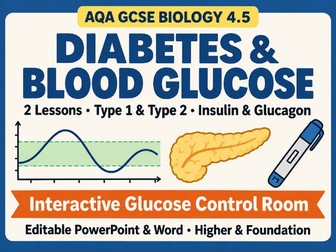
Diabetes and blood glucose lessons for AQA GCSE Biology 4.5: two editable 60-minute lessons, three-level worksheets, exam questions and an interactive. Includes the Glucose Control Room: an offline interactive where pupils run a day for a person with no diabetes, type 1 or type 2 diabetes, add meals, exercise and insulin, and watch blood glucose (mmol/L), insulin and glucagon change on a live graph. Diabetes causes high blood glucose: in type 1 the body makes little or no insulin; in type 2 insulin works less effectively and the body may make too little. What’s included Glucose Control Room (one offline HTML file): 3 people, 7 actions, a live mmol/L graph with insulin and glucagon lines, 6 missions that each score once (12 points), and a Higher-tier glucagon mission. A simplified teaching model, clearly labelled as not a clinical simulator and not medical advice. Lesson 1 (60 min): Homeostasis and controlling blood glucose. Teacher slides (21, with answers, notes and plan) and Student slides (16). Feedback Loop Relay, a live Control Room demo, and the Higher-tier glucagon and negative feedback section. Lesson 2 (60 min): Type 1 and type 2 diabetes. Teacher slides (20) and Student slides (14). Type 1 / Type 2 Continuum, four fictional Diabetes Case Files with graphs, treatment evaluation and obesity data (WS 1.3). 6 worksheets (Word) at three levels. Exam-style questions (37 marks Higher, 27 Foundation) with an AQA-style mark scheme, including graph reading, a percentage-change calculation and two 6-mark questions. Card pack: Feedback Loop Relay cards, Continuum statements and a For/Against Treatment Sort. Teacher guide with timings, misconceptions, a sensitivity note (pupils may have diabetes; no blame language) and a full answer key. START HERE page: every file in teaching order; 16 print-ready PDFs. Alignment: AQA GCSE Biology (8461) and Combined Science: Trilogy (8464) 4.5.1 Homeostasis; 4.5.3.1 (position of the pancreas); 4.5.3.2 Control of blood glucose concentration, including the Higher-tier glucagon and negative feedback content; WS 1.3 and MS 2c. Not endorsed by or affiliated with AQA, the NHS or Diabetes UK. Health facts are checked against NHS, NHS Blood and Transplant and Diabetes UK pages (saved November 2026). All case-file people are fictional and all data are invented for teaching. Glucose ranges are general teaching values based on NHS guidance, not medical advice. Cover-friendly: the Case Files and worksheets need no practical. Licence: supplied under the Tes licence you choose at checkout (standard, or Multi-User/School Licence where purchased); sharing with colleagues is governed by that licence. Try it free first: Free Type 1 vs Type 2 Diabetes AQA GCSE Biology – Sheet + Demo Last updated: 13/11/2026.
CV Writing Lessons KS4 Careers – UK CV Template + Example CVsQuick View
SimulationLessons

CV Writing Lessons KS4 Careers – UK CV Template + Example CVs

(0)
CV writing lessons for KS4 careers: two 60-minute lessons, an editable UK CV template in two styles, four example CVs and the interactive CV Doctor. Interactive CV Doctor included: students treat a weak Year 11 CV section by section, choosing the better version while an employer impression meter rises. Then, in Shortlist in 60 Seconds, they become the employer and sort 6 CVs for a Saturday café job and 6 for a Level 3 apprenticeship. One offline HTML file; scores count once; nothing stored or sent. A CV (curriculum vitae) is a short document that sets out a person’s skills, education and experience for an employer. What employers look for: a job advert, the seven sections of a UK CV, what to leave off, CV Line-Up, turning school, hobby and volunteering experience into evidenced skills, a personal profile. Build your CV and shortlist like an employer: tailoring to an advert, the template, a covering email, peer review, the Shortlist Panel role-play. What’s included 4 editable PowerPoint decks: Teacher (plan, answers, notes) and Student 6 editable Word worksheets at 3 levels CV template in 2 styles (Classic, Modern); covering email and letter template 4 fictional example CVs: strong, average, weak and apprenticeship Skills and verb bank, CV poster, Line-Up and Panel cards, observer checklist No-tech paper version, answer key, teacher guide, START HERE page, 20 PDFs UK details: what to leave off (age, date of birth, marital status and nationality, as the National Careers Service advises; a photo is commonly left off too), “References available on request”, a profile with no paid job (school roles, volunteering, DofE, sport), CV vs apprenticeship application form, and GOV.UK rules on under-16s’ part-time work. Accuracy: checked against the National Careers Service and GOV.UK (04/11/2026). All people, employers and adverts are invented. Apprenticeship, Gatsby and child-employment details relate to England; rules differ in Scotland, Wales and Northern Ireland, and councils set local rules. Careers education, not legal or recruitment advice: students should follow each real advert and talk to their careers adviser. Gatsby Benchmarks (DfE statutory careers guidance for England, updated 23 June 2026): supports Benchmark 1 (a sequenced unit with outcomes) and Benchmark 3 (three levels; a CV students keep); Benchmark 5 only when a real employer or employee volunteer co-leads the Shortlist Panel; Benchmark 6 as preparation for workplace experiences. The lesson alone does not meet any benchmark. Licence: supplied under the Tes licence you choose at checkout (standard, or Multi-User/School Licence where purchased). Print and edit for your pupils; do not share outside your school or post publicly. Try it free first: Free CV Writing KS4 – Anatomy of a UK CV Poster + CV Template Last updated: 13/11/2026.
Free CV Writing KS4 – Anatomy of a UK CV Poster + CV TemplateQuick View
SimulationLessons

Free CV Writing KS4 – Anatomy of a UK CV Poster + CV Template

(0)
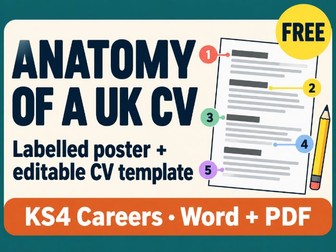
A free CV writing resource for KS4 careers: a one-page Anatomy of a UK CV poster and an editable Classic CV template, in Word and PDF. A one-page Anatomy of a UK CV poster: the seven sections, what to leave off, golden rules, a personal profile recipe and experience → skill → evidence examples. Plus an editable CV template (Classic style) with grey guidance notes that students delete as they go. A CV (curriculum vitae) is a short document that sets out a person’s skills, education and experience for an employer. What’s included Anatomy of a UK CV poster (editable Word + one-page PDF) CV template, Classic style (editable Word + one-page PDF) START_HERE_Open_Me.html Who it’s for: Year 10 and 11 students getting ready for work experience, a Saturday job, an apprenticeship or a college application, and the careers leads, tutors and PSHE teachers who support them. It also suits Year 12 students writing a first CV. How to use it Starter (10 minutes): show the poster and ask students to spot what a UK CV leaves off, such as a photo or date of birth, and why. Main task (30 minutes): students open the template and replace each grey guidance note with their own details, starting with the personal profile recipe. Plenary (10 minutes): pairs swap CVs and check them against the golden rules on the poster. Students can finish their CV at home and bring it back for a quick check in tutor time. The poster’s examples show how to turn everyday experience, such as a tuck shop rota, a football team or DofE, into a skill with evidence, so students who think they have nothing to write soon find something. The template is plain and easy to edit on a school laptop or a phone, and the PDF copy prints cleanly for display. Advice checked against the National Careers Service on 04/11/2026. Not produced or endorsed by the National Careers Service. Want the full lessons? The full resource adds the interactive CV Doctor and Shortlist in 60 Seconds, two complete 60-minute lessons with worksheets at three levels, a Modern CV template, a covering email and letter template and four example CVs to compare. The full version: CV Writing Lessons KS4 Careers – UK CV Template + Example CVs Free to use with your own classes under the Tes licence. Please don’t post the files publicly or share them beyond that licence. Last updated: 13/11/2026. The full version is available from the same author on Tes.
Free Specialised Cells AQA GCSE + KS3 – Card Sort + InteractiveQuick View
SimulationLessons

Free Specialised Cells AQA GCSE + KS3 – Card Sort + Interactive

(0)
A free specialised cells card sort for KS3 and AQA GCSE Biology (18 cards, Word + PDF), plus a three-job taster of the Cell Job Centre interactive. Try the Cell Job Centre free: three job adverts (sperm cell, root hair cell, red blood cell). Students build each cell from a parts bin and get feedback that explains every part they chose. Works offline on a whiteboard, laptop or phone. Specialised cells are cells whose structure is adapted to carry out a particular job, such as a root hair cell absorbing water. What’s included Cell Job Centre taster (offline HTML): 3 jobs with explained feedback Card sort (editable Word + 3-page PDF): 18 cards for the six AQA cells (cell → adaptation → job), a recording table and a teacher answer page START HERE page Who it’s for: Year 7 and 8 science classes meeting cells for the first time, and Year 9 to 11 students on AQA GCSE Biology or Combined Science. Students often name an adaptation but forget to say how it helps; the cards make them link the two. How to use it Starter (10 minutes): run the Job Centre on the board and build the sperm cell together, reading the feedback aloud. Card sort (20 minutes): pairs match each cell to its adaptation and its job, then fill in the recording table. Plenary (10 minutes): students build the root hair or red blood cell on their own, on laptops or phones. The sort also works as a retrieval task before a test, a homework or a cover lesson, with the answer page held back. Each card links one structure to one job, which is the pattern exam questions reward. The Word file is editable, so you can add a seventh cell or remove cards for a KS3 group. Alignment: AQA GCSE Biology / Combined Science 4.1.1.3 Cell specialisation; KS3 Cells and organisation. Not endorsed by or affiliated with AQA. Want the full lesson? The full resource adds all 10 jobs, Who Am I? with magnification maths, a Magnification Lab, Lesson 1 (GCSE and KS3 versions), an optional Lesson 2 on differentiation and microscopes, worksheets at three levels, exam-style questions and an AQA-style mark scheme. The full version: Specialised Cells AQA GCSE Biology + KS3 – Lesson + Interactive Free to use with your own classes under the Tes licence. Please don’t post the files publicly or share them beyond that licence. Last updated: 13/11/2026. The full version is available from the same author on Tes.
Specialised Cells AQA GCSE Biology + KS3 – Lesson + InteractiveQuick View
SimulationLessons

Specialised Cells AQA GCSE Biology + KS3 – Lesson + Interactive

(0)
Specialised cells lesson for AQA GCSE Biology 4.1 plus a KS3 version: editable slides, 3-level worksheets, exam questions and the Cell Job Centre. Includes the Cell Job Centre: students read a job advert (“Wanted: long-distance messenger…”), build the cell from a parts bin and get feedback that explains every part they picked. Then play Who Am I? (name the cell from clues and a drawing, then do the magnification calculation and standard form) and the Magnification Lab (unlimited practice with worked solutions). One offline file for whiteboard, laptop or phone. Specialised cells are cells whose structure is adapted to carry out a particular job, such as a root hair cell absorbing water. Every adaptation is taught with one exam frame, “structure → because → so that”, which also works for cells students have never met. An optional second lesson covers differentiation and magnification. What’s included Cell Job Centre (offline HTML): 10 job adverts, Who Am I? (10 rounds, each with a magnification calculation) and a Magnification Lab Lesson 1 (60 min, GCSE): sperm, nerve and muscle cells; root hair cells, xylem and phloem; the red blood cell as a new context in the Job Centre and Core worksheet. Teacher slides (plan, answers, notes) and Student slides, editable PowerPoint Lesson 1 KS3 version (60 min, Years 7–8): sperm, egg, nerve, red blood, ciliated, root hair and palisade cells. Teacher and Student slides Lesson 2 (optional, 60 min): differentiation, the stem-cell link, light vs electron microscopes, magnification with mm, µm and standard form. Teacher and Student slides 7 editable Word worksheets: Lesson 1 Support, Core and Stretch; KS3; Lesson 2 Support, Core and Stretch Exam-style questions (40 marks, about 40 minutes, including a 6-mark question) with an AQA-style mark scheme Card pack: 10 job adverts, 10 Cell Interview Panel cards with a score sheet (role-play), 15 Human Ladder line-up cards (cell → organism) Teacher guide (timings, prep, misconceptions, accuracy notes, cover-lesson route), full answer key and a START HERE page that links every file PDF copies of every Word and PowerPoint file Alignment: AQA GCSE Biology (8461) and Combined Science: Trilogy (8464) 4.1.1.3 Cell specialisation, 4.1.1.4 Cell differentiation and 4.1.1.5 Microscopy, with links to 4.1.2.3, 4.2.1 and 4.2.3.2. KS3 programme of study: Cells and organisation. Not endorsed by or affiliated with AQA. Licence: supplied under the Tes licence you choose at checkout (standard, or Multi-User/School Licence where purchased). You may print and edit the files for your pupils. Please do not share them outside your school or post them publicly. Try it free first: Free Specialised Cells AQA GCSE + KS3 – Card Sort + Interactive Last updated: 13/11/2026. If this helped your class, an honest review on Tes helps other teachers find it. Thank you!
Free First Aid PSHE KS3/KS4 – Calling 999 Poster + CPR DemoQuick View
SimulationLessons

Free First Aid PSHE KS3/KS4 – Calling 999 Poster + CPR Demo

(0)
Free first aid resource for KS3/KS4 PSHE: a one-page Calling 999 poster (Word + PDF) and the First on Scene collapse scenario with a CPR rate trainer. Try the First on Scene collapse scenario: an offline interactive where pupils decide what to do when a man collapses at a bus stop. They check for danger, call 999 on speaker, spot abnormal breathing, keep hands-only CPR in time with a tap-tempo rate trainer, follow a defibrillator’s prompts and hand over to the ambulance crew. Every choice is explained, with its source. It works on a whiteboard, laptop or phone. Basic first aid is the immediate help given to someone who is injured or suddenly ill until professional help arrives. What’s included “Calling 999: what to say”: a one-page poster (editable Word + PDF) with the questions the call handler asks and what to say, plus 112, NHS 111 and 999 BSL / Relay UK First on Scene demo (offline HTML): the full collapse scenario (12 decisions) and the CPR rate trainer Who it’s for: PSHE and RSHE teachers, tutors and heads of year in KS3 and KS4. Pupils need to know how to call for help and the basics of CPR and defibrillators, and this scenario lets them practise the order of steps without a manikin. How to use it Starter (10 minutes): show the poster and ask pupils what they think the call handler will ask first. Scenario (20 minutes): run First on Scene on the board. The class votes at each of the 12 decisions, then you reveal the feedback. Rate trainer (5 minutes): pupils tap along to find the right compression speed. Plenary (5 minutes): pupils say the three things they would do first, in order. It also works as a tutor-time session, a drop-down day activity or a cover lesson. The poster suits form rooms, the PE corridor and the sports hall, near any defibrillator sign. Want the full unit? The full unit adds three 60-minute lessons with editable slides, three more interactive scenarios (choking, bleeding, burns) with a participation record, levelled worksheets, a 7-station scenario circuit, role-play cards and a quiz in two forms. The full version: First Aid & CPR PSHE Lessons KS3/KS4 – Defibrillators + 999 Procedures follow the Resuscitation Council UK 2025 guidelines and NHS advice. This is awareness teaching, not a first-aid qualification. Not produced or endorsed by the DfE, Resuscitation Council UK, the NHS, the British Heart Foundation or St John Ambulance. Free to use with your own classes under the Tes licence. Please don’t post the files publicly or share them beyond that licence. Last updated: 13/11/2026. The full version is available from the same author on Tes.
Free Sextortion Help Card KS3/KS4 PSHE – 5 Steps + Red Flags DemoQuick View
SimulationLessons

Free Sextortion Help Card KS3/KS4 PSHE – 5 Steps + Red Flags Demo

(0)
A free sextortion help card for KS3/KS4 PSHE: If someone is threatening to share your images, with the five steps and where to get help, plus a short demo. Red Flags demo: try the first part of a fictional chat simulation. Tap the red flags as they appear and choose the safe next step. No image is ever shown and nothing is saved or sent. A one-page help card for pupils: If someone is threatening to share your images. It gives the five steps (don’t pay, stop contact and block, keep the evidence, tell a trusted adult, report it), says clearly that it is never their fault, and lists where to get help (trusted adult, Childline 0800 1111, CEOP Safety Centre, Report Remove, police). Editable Word and a print-ready PDF. Sextortion is blackmail involving threats to share real or fake intimate images unless someone pays or meets other demands. What’s included Help card (1 page, Word + PDF) Red Flags demo (offline HTML): Thread 1, first part (5 messages, 3 red flags, 1 decision) Who it’s for: PSHE leads, DSLs, heads of year and tutors in KS3 and KS4. The card is calm and practical: no explicit content, no real cases and no scare stories, just clear steps and the message that help is there. How to use it Tutor time (10 minutes): run the demo on the board and ask the class to call out each red flag. Then read the five steps together. Lesson plenary (5 minutes): hand out the card at the end of any online safety or relationships lesson. Display: put the card up in form rooms, toilets or the library, and add your own DSL’s name to the Word file. Give pupils notice of the topic and a way to talk privately afterwards. The card can also go home with a letter, so parents and carers know the same steps. Based on National Crime Agency, CEOP Education and Childline advice (checked November 2026). This resource supports, but does not replace, your school’s child protection policy, your designated safeguarding lead (DSL) and your local procedures. Want the full lessons? The full pack has a 60-minute lesson in KS3 and KS4 versions, an optional KS4 lesson on AI images, deepfakes and the law, editable slides with a safeguarding checklist, worksheets at three levels, and the full Red Flags simulation: 2 threads, 15 red flags and 8 decision points. The full version: Sextortion Lessons KS3/KS4 PSHE – Online Blackmail + AI Images Not produced or endorsed by the Department for Education, UKCIS, the National Crime Agency, CEOP, Childline/NSPCC or the Internet Watch Foundation. Free to use with your own classes under the Tes licence. Please don’t post the files publicly or share them beyond that licence. Last updated: 13/11/2026. The full version is available from the same author on Tes.
Communicable Diseases AQA GCSE Biology – 3 Lessons + InteractiveQuick View
SimulationLessons

Communicable Diseases AQA GCSE Biology – 3 Lessons + Interactive

(0)
Communicable diseases lessons for AQA GCSE Biology 4.3: three 60-minute lessons, three-level worksheets, an exam-style assessment and the Outbreak Desk. Outbreak Desk (offline investigation): Your class becomes the UKHSA health protection desk for Wrenford, an invented English town. Students sort case reports into a line list, name the pathogen type from the symptoms and how it spreads, watch the epidemic curve grow, then choose up to three control measures (MMR vaccination, isolation, contact tracing, hygiene, or antibiotics) and see the curve respond. A herd immunity explorer shows why vaccinating most people protects everyone. Only first answers and the first control plan score, so retries cannot raise it. A clearly labelled, simplified teaching model. Communicable diseases are diseases caused by pathogens (viruses, bacteria, fungi or protists) that can spread from one person or organism to another. For separate Biology and Combined Science: Trilogy. What’s included 3 lessons (60 min): 1) pathogens and spread, with all seven AQA diseases (measles, HIV, TMV, salmonella, gonorrhoea, rose black spot, malaria); 2) defences, vaccination and herd immunity; 3) antibiotics, resistance and the outbreak investigation 6 editable PowerPoint decks: Teacher (plan, answers, notes; 21/18/16 slides) and Student (no answers; 15/15/11 slides) 9 editable Word worksheets at 3 levels Disease Fact Files: a card per AQA disease (pathogen, symptoms, spread, prevention, treatment) plus a blank Outbreak Desk Case Log (also works as a cover lesson) Exam-style questions (43 marks, Foundation and Higher) with an AQA-style mark scheme, including a 6-mark levels-of-response question Full answer key: worksheets, Case Log, activities and all scored Outbreak Desk questions (21-point scoring) Movement cards: Handshake Trail (contact tracing), Pathogen Four Corners, Herd Immunity Stand-Up Teacher guide: sensitive-topic notes for HIV and gonorrhoea, misconceptions and how the teaching model works START HERE page and 22 print-ready PDFs Accuracy: mapped to the AQA specification wording, with NHS and UKHSA guidance cited separately. All outbreak data are invented and labelled as such, and the Outbreak Desk’s calculations are checked by automated tests against a separate copy of the model. Alignment: AQA GCSE Biology (8461) and Combined Science: Trilogy (8464): 4.3.1.1–4.3.1.8, with links to Resistant bacteria (8461 4.6.3.7; 8464 4.6.3.4). Not included: 4.3.1.9 Discovery and development of drugs, and the biology-only 4.3.2 and 4.3.3. Not endorsed by or affiliated with AQA. Licence: supplied under the Tes licence you choose at checkout (standard, or Multi-User/School Licence where purchased); sharing with colleagues is governed by that licence. Try it free first: Free Communicable Diseases AQA GCSE – Pathogen Sort + Demo Last updated: 13/11/2026.
Free Payslip Detective KS4 – Spot the Payroll Error + PosterQuick View
SimulationLessons

Free Payslip Detective KS4 – Spot the Payroll Error + Poster

(0)
Free Payslip Detective for KS4: two fictional UK payslips, each with one planted payroll error, plus a one-page labelled payslip poster with 2026/27 rates. Interactive demo (works offline): two fictional UK payslips, each with one planted payroll error. Students click the wrong line, then choose what the worker should do. Points are scored once per payslip, so the first answer counts. A payslip is the record an employer gives with each payment, showing gross pay, each deduction and net (take-home) pay. What’s included The detective demo (1 offline HTML file, 2 payslips) “Anatomy of a UK payslip”: a one-page labelled poster with 15 parts (editable Word + PDF), 2026/27 rates START_HERE_Open_Me.html Who it’s for: KS4 PSHE, careers and maths teachers, and tutors preparing Year 10 and 11 students for part-time work, work experience or an apprenticeship. Many young people get their first payslip without knowing what a tax code or NI deduction means, and payroll mistakes do happen. How to use it Starter (10 minutes): show the poster and ask students to find gross pay, net pay and the tax code. Detective (15 minutes): run the demo on the board. The class agrees which line is wrong, then votes on what the worker should do next. Plenary (5 minutes): students write down the one line on a payslip they would always check. It also suits a tutor-time money session, a maths lesson on percentages or a cover lesson. The poster is a useful display for a careers board or a sixth-form common room. Rates are for the 2026/27 tax year (England), checked on GOV.UK. This is finance education, not financial advice. Every name, employer and figure on the payslips is fictional. Recheck GOV.UK before using it in later tax years. Want the full lessons? The full resource has two 60-minute lessons on reading a payslip and working out deductions, worksheets at three levels, and the Payslip Builder & Detective: students choose a job, hours and age band and watch a payslip fill in, with PAYE, NI, pension and student loan explained step by step, then hunt for the error on all 8 payslips. The full version: Payslip Lesson KS4 – Tax Code, PAYE, NI, Pension + Student Loan Free to use with your own classes under the Tes licence. Please don’t post the files publicly or share them beyond that licence. Last updated: 13/11/2026. The full version is available from the same author on Tes.
Payslip Lesson KS4 – Tax Code, PAYE, NI, Pension + Student LoanQuick View
SimulationLessons

Payslip Lesson KS4 – Tax Code, PAYE, NI, Pension + Student Loan

(0)
Payslip lesson pack for KS4: two 60-minute lessons on reading a UK payslip and calculating deductions for 2026/27, with the Payslip Builder & Detective. Payslip Builder & Detective (interactive): students choose a job, hours and age band and watch a UK payslip fill in, with its tax code and deductions (PAYE income tax, National Insurance, workplace pension and student loan) explained step by step. Then they hunt for the planted error on 8 payslips. All figures are for the 2026/27 tax year (England), checked on GOV.UK. A payslip is the record an employer gives with each payment, showing gross pay, each deduction and net (take-home) pay. Reading a payslip: gross vs net pay, tax codes (1257L, BR, 0T, emergency), PAYE, NI, pension, student loan, payroll and NI numbers, year to date, and a Gross to Net human line. Calculating deductions and Payslip Detective: a worked example, a Deduction Relay, an 8-station error hunt (tax code, pension, hours, overtime rate, below minimum wage, NI, student loan plan, net pay sum) and what to do next (payroll, HMRC’s Check your Income Tax service, Acas, the Student Loans Company). What’s included Payslip Builder & Detective (1 offline HTML file: Builder, 8 Detective payslips scored once each, editable rates and sources panel; recheck GOV.UK before later years) 4 editable PowerPoint decks: Teacher (plan, answers, notes) and Student 6 editable Word worksheets at 3 levels Answer key with full workings, including the Relay and all 11 payslips 11-payslip set (Word), 8 Payslip Detective stations with a Detective Log, activity cards, an editable 2026/27 rates card and an “Anatomy of a UK payslip” poster Teacher guide: every rate with its GOV.UK source and date, misconceptions, sensitivity notes START HERE page; 17 PDFs Deductions often missed: workplace pension auto-enrolment (age 22+, £10,000 trigger, 5% employee / 3% employer on qualifying earnings, opting out) and student loans (Plan 2, Plan 5 and the Postgraduate Loan), plus National Living Wage and minimum wage rates from 1 April 2026. Accuracy: every rate checked on GOV.UK (HMRC, DWP and Student Loans Company pages) on 04/11/2026; sources are listed in the teacher guide and the interactive. People, employers and NI numbers are fictional. This is finance education, not financial advice. Curriculum: KS4 Citizenship (DfE national curriculum: income and expenditure, savings and pensions, how public money is raised and spent); KS4 PSHE economic wellbeing and careers. Also suits GCSE Maths percentages in context. Licence: supplied under the Tes licence you choose at checkout (standard, or Multi-User/School Licence where purchased). Print and edit for your pupils; do not share outside your school or post publicly. Try it free first: Free Payslip Detective KS4 – Spot the Payroll Error + Poster Last updated: 13/11/2026.
Gambling PSHE Lessons KS3/KS4 – Loot Boxes, Odds & Online BettingQuick View
SimulationLessons

Gambling PSHE Lessons KS3/KS4 – Loot Boxes, Odds & Online Betting

(0)
A gambling PSHE pack for KS3 and KS4: two editable 60-minute lessons on loot boxes, odds, online betting, adverts and the law, plus an Odds Lab simulator. Gambling means risking money or something of value on an uncertain outcome, hoping to win more than you stake. The Odds Lab, an offline simulator: pupils bet virtual tokens on an invented slot machine, scratchcard, loot box and football bet, then run 1,000 plays and a class of 30 players to watch the house edge win. Every game shows its odds and the maths. It ends with Spot the Hook (7 invented adverts). Nothing is saved or sent. No real brands, adverts or money, and a neutral, non-judgemental tone (some pupils’ families gamble). What’s included Lesson 1 Chance, Odds and Loot Boxes (KS3, Y7–9); Lesson 2 Online Betting, Adverts and the House Edge (KS4, Y10–11); 60 min each 4 editable PowerPoint decks: Teacher (plan, safeguarding checklist, answers, notes) and Student 6 Word worksheets at 3 levels (Support, Core, Stretch with expected-value maths) and answer key Activity cards: Chance or Skill? four corners, Beat the House dice game, Spot the Hook sort, continuum debate Teacher guide: safeguarding, timings, misconceptions, worked calculations, law sources, RSHE map, cover routes START HERE page; PDF copies of every document Every figure checked: each probability, expected value and house edge (slot 9.6%, scratchcard 15%, bookmaker’s margin 8.9%; a 1% item takes 100 crates on average, costing £99.80) is calculated by code from the invented odds. UK law (checked November 2026 against the Gambling Act 2005, Gambling Commission and DCMS): 18+ for most gambling and the National Lottery; online slots rules (stake limits, no auto-play); bonus wagering capped at 10× (January 2026); advertising rules; why most loot boxes are not legally gambling (2023 industry guidance). Legal points describe the law in Great Britain, where gambling is regulated by the Gambling Commission; Northern Ireland has its own gambling law. Scope and safeguarding: money, odds, design, adverts, law and help (trusted adult, Childline, National Gambling Helpline); not health effects. This supports, but does not replace, your safeguarding policy, your DSL and local procedures. Alignment: DfE statutory RSHE guidance (July 2025, from 1 September 2026): Wellbeing online points 4 and 5; Teaching about the law (para 63, which lists gambling). Not produced or endorsed by the DfE, the Gambling Commission, DCMS, GamCare, Childline/NSPCC or any games or gambling company. Licence: supplied under the Tes licence you choose at checkout (standard, or Multi-User/School Licence where purchased); sharing the Odds Lab with pupils is governed by that licence. Do not post the files on a public website. Try it free first: Free Gambling PSHE KS3/KS4 – Loot Box Interactive + Odds Sheet Last updated: 13/11/2026.
Food Safety and Hygiene AQA GCSE + KS3 – 3 Lessons + InteractiveQuick View
SimulationLessons

Food Safety and Hygiene AQA GCSE + KS3 – 3 Lessons + Interactive

(0)
Food safety and hygiene lessons for AQA GCSE Food Preparation and Nutrition and KS3: 3 one-hour lessons, worksheets, exam questions and an interactive. Includes Danger Zone Kitchen: an offline interactive where pupils follow a batch of chicken curry from delivery to leftovers while a bacteria growth meter responds to every choice and an inspector reviews the shift. Food safety means storing, preparing and cooking food in ways that prevent food poisoning, summed up as the 4 Cs: cleaning, cooking, chilling and avoiding cross-contamination. Ideal for non-practical lessons, cover or revision: no cooking, tasting or handling of food is needed. What’s included Danger Zone Kitchen (offline HTML): 5 stations incl. an 11-item fridge puzzle, probe challenge, date labels, hot holding, an allergen question, cooling and reheating; an inspector report naming the 4 Cs, with a separate safety check (any critical error means the food could not be served). 28 points, each decision scored once. Cooking follows the FSA rule (75 °C for 30 seconds); the growth meter is a labelled simplified model. 3 lessons (60 min each; Teacher/Student slides 20/16, 17/14, 18/15): 1 Bacteria, food poisoning and the danger zone (the five AQA bacteria, high risk foods, Danger Zone Line); 2 The 4 Cs in practice (storage, defrosting, probing, hot holding, reheating, a 16-card 4 Cs Sort); 3 Allergens and practical-room safety (the 14 allergens, Label Check, knife grips, a 12-picture Practical Room Inspection). 9 worksheets (Word) at three levels, including 6-mark exam-style questions. Exam-style questions (47 marks, 45 minutes) with an AQA-style mark scheme, including a levels-of-response 6-mark question. 16 practical room safety cards, a card pack, and a teacher guide (where AQA and FSA figures differ; full answer key). START HERE page; 22 print-ready PDFs. Alignment: AQA GCSE Food Preparation and Nutrition (8585) 3.4.1.1, 3.4.1.4, 3.4.2.1 and 3.4.2.2, the allergies in 3.5.1.1, and Skills 1 (temperature probe) and 2 (bridge hold, claw grip). KS3: supports the DfE design and technology programme of study, cooking and nutrition. Not endorsed by or affiliated with AQA, the Food Standards Agency, the NHS or the DfE. Check the current specification at aqa.org.uk. UK figures (AQA 8585 and FSA GOV.UK pages, saved November 2026): fridge 0 to 5 °C; freezer about -18 °C; danger zone 5 to 63 °C (AQA; the FSA’s consumer pages say 8 to 63 °C); core 75 °C for cooking and reheating (AQA; FSA: 75 °C for 30 seconds or 70 °C for 2 minutes); hot holding at 63 °C or above. Licence: supplied under the Tes licence you choose at checkout (standard, or Multi-User/School Licence where purchased); sharing with colleagues is governed by that licence. Try it free first: Free Food Hygiene AQA GCSE + KS3 – 4 Cs Poster + Fridge Demo Last updated: 13/11/2026.
Free Food Hygiene AQA GCSE + KS3 – 4 Cs Poster + Fridge DemoQuick View
SimulationLessons

Free Food Hygiene AQA GCSE + KS3 – 4 Cs Poster + Fridge Demo

(0)
Free food hygiene poster for AQA GCSE Food Preparation and Nutrition and KS3: the 4 Cs on one A4 page (Word + PDF), plus a fridge-loading interactive demo. Includes a free fridge-loading demo from Danger Zone Kitchen: pupils put a café delivery into the fridge, freezer and dry store, then check the fridge thermometer. Each choice scores once and explains the rule. Works offline. Food hygiene means storing, preparing and cooking food in ways that prevent food poisoning, summed up as the 4 Cs: cleaning, cooking, chilling and avoiding cross-contamination. What’s included The 4 Cs poster (Word + PDF, one A4 page): cleaning, cooking, chilling and cross-contamination, with the key AQA temperatures and a note on the FSA’s current wording. Fridge-loading demo (one offline HTML file): 11 delivery items and the fridge thermometer question (12 points). Works on an interactive whiteboard, laptop or phone. Answers stay while the page is open; closing or refreshing clears them. Who it’s for: food teachers at KS3 and GCSE, and anyone teaching a first practical. It helps pupils learn the rules before they handle raw meat, chilled food or leftovers in the food room. How to use it Starter (10 minutes): run the fridge demo on the board. Pupils call out where each item goes before you place it. Poster task (15 minutes): pupils use the poster to write one rule for each of the 4 Cs in their own words. Before a practical (5 minutes): recap the temperatures on the poster as a quick quiz. Put the poster up next to the fridge or by the sinks so pupils see it in every practical. The Word file is editable, so you can add your own room rules. Alignment: AQA GCSE Food Preparation and Nutrition (8585) 3.4.2; supports KS3 D&T cooking and nutrition. Not endorsed by or affiliated with AQA, the Food Standards Agency, the NHS or the Department for Education. Check the current specification at aqa.org.uk. Want the full unit? The full three-lesson unit adds four more Danger Zone Kitchen stations (probe challenge, hot holding, allergens, cooling and reheating) with a bacteria growth meter and inspector report, slides, three-level worksheets, a 12-picture Practical Room Inspection, safety cards and an exam-style assessment. The full version: Food Safety and Hygiene AQA GCSE + KS3 – 3 Lessons + Interactive Free to use with your own classes under the Tes licence. Please don’t post the files publicly or share them beyond that licence. Last updated: 13/11/2026. The full version is available from the same author on Tes.

Free Gambling PSHE KS3/KS4 – Loot Box Interactive + Odds SheetQuick View
SimulationLessons

Free Gambling PSHE KS3/KS4 – Loot Box Interactive + Odds Sheet

(0)
A free gambling PSHE resource for KS3/KS4: an offline Loot Box Opener interactive plus a one-page odds explainer (Word and PDF) for one lesson. What is a loot box? A mystery item in a video game, paid for with real money or in-game currency, where you don’t know what you’ll get until you open it. Loot Box Opener: pupils open invented Mystery Crates (1, 10, 50, or until a Legendary appears) and compare what they got with the drop rates. A live counter turns gems into packs and pounds: 50 crates cost £49.90 in the invented shop, and a 1% item takes 100 crates on average (buying 100 crates costs £99.80). Pupils quickly see why “1%” means most players won’t get the rare item in 50 tries, and how gem packs hide the real price. What’s included Loot Box Opener (offline HTML; whiteboard, laptop or phone; practice gems only, nothing saved or sent; keyboard accessible, light and dark mode) One-page odds explainer (Word + PDF): chance as fractions and percentages, the real cost of loot boxes, the house edge, and the law in Great Britain, with where to get help Who it’s for: PSHE leads, tutors and maths teachers in Years 7 to 11. Many pupils meet loot boxes in games long before they meet betting, so this is a good way in. How to use it: a 10–15 minute starter or tutor-time activity on gambling and gaming, a maths link to probability, or a cover task. Ask pupils to predict how many crates a Legendary takes before they open any, then open 10, then 50, and compare. Finish with the explainer: what does the house edge mean for the player over time? All games, items and odds are invented; no real games or brands, and no real money. Neutral, non-judgemental tone. Legal points describe the law in Great Britain (England, Scotland and Wales), where gambling is regulated by the Gambling Commission. Northern Ireland has its own law. Not produced or endorsed by the Department for Education, the Gambling Commission, the Department for Culture, Media and Sport, GamCare, Childline/NSPCC or any games or gambling company. The full version: Gambling PSHE Lessons KS3/KS4 – Loot Boxes, Odds & Online Betting Free to use with your own classes under the Tes licence. Please don’t post the files publicly or share them beyond that licence. Last updated: 13/11/2026. The full version is available from the same author on Tes.
Prevent Duty Staff Training 2026 – INSET + Branching SimulatorQuick View
SimulationLessons

Prevent Duty Staff Training 2026 – INSET + Branching Simulator

(0)
Prevent duty staff training for 2026: an editable INSET for all school staff with 37 trainer slides, a facilitator guide and a branching simulator. Prevent Pathway Simulator: staff work through 10 branching school cases (28 decisions) along the pathway (notice, record, tell the DSL, the DSL’s decision, the outcome), with feedback that names its source, ‘put it right’ steps after some wrong turns, a score summary and a printable, named, dated certificate. Room vote mode; nothing typed is saved or sent. The certificate records participation in a practice activity, not an accredited qualification. The Prevent duty is the duty in the Counter-Terrorism and Security Act 2015 for schools to have due regard to the need to prevent people from being drawn into terrorism. Checked on GOV.UK on 04/11/2026: the statutory Home Office guidance is still the 2023 version (in force since 31/12/2023). New this autumn, and covered here with KCSIE 2026 Annex A: DfE practical guidance for DSLs (24/09/2026, updated 02/10/2026: weapons/explosives fixation, antisemitism) and “Notice, check, share” (28/08/2026). What’s included 37 editable trainer slides with notes and sources: the law, ideologies, online radicalisation, what is NOT an indicator, notice-record-tell, referral, Channel, local arrangements, leaders’ slide Facilitator guide: 60/45/20-minute plans, self-study route, leaders’ layer, source map, answers Simulator cases written around behaviour, not identity, e.g. violent misogyny, a primary pupil, SEND, a parent’s worry, and when Prevent is not the route 10 scenario cards, Myth or fact? sort (16 cards), What next? four corners 15-question knowledge check with sourced answers Staff handout and “Who do I tell?” poster with editable local blanks Leaders’ compliance checklist (16 sourced items), training record, START HERE, 11 PDFs Accuracy and tone: every key point names its source. Safeguarding, not suspicion: no single profile; faith, ethnicity, background and SEND are not indicators; staff don’t investigate, they record and tell the DSL. No real attack images or extremist material. Important: this supports, but does not replace, your safeguarding policy, your DSL, your local Prevent referral arrangements and the statutory guidance. Not produced or endorsed by the Home Office or the DfE. Written for England (KCSIE); schools in Wales should use “Keeping learners safe”. Contains public sector information licensed under the Open Government Licence v3.0. All names and situations are fictional. Licence: supplied under the Tes licence you choose at checkout (standard, or Multi-User/School Licence where purchased); sharing copies, including the Simulator, is governed by that licence. No sharing with other schools (including in a trust). Try it free first: Free Prevent Duty Staff Check – Myth or Fact? Quiz + Poster Last updated: 13/11/2026.