Raising Standards, Reducing Workload: A Practical Guide to FeedbackQuick View
Clare5e

Raising Standards, Reducing Workload: A Practical Guide to Feedback

(0)
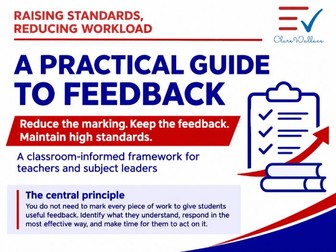
Do you need to mark every piece of work to give students effective feedback? This practical guide explores how teachers can reduce unnecessary marking while maintaining high standards and supporting student learning. Rather than simply telling teachers to mark less, it provides practical alternatives to routine written marking, including live feedback, self-assessment, whole-class feedback and targeted assessment marking. Drawing on classroom practice across Maths, Computer Science and Geography, the guide demonstrates how feedback can be purposeful, manageable and responsive to students’ learning needs. Inside the guide: Rethinking the purpose of marking and feedback Practical strategies for giving live feedback during lessons Using self-assessment and peer assessment effectively Giving whole-class feedback instead of repeating the same comments Using question-level analysis to identify learning gaps Helping students reflect on assessment and act on feedback Subject-specific examples from Maths, Computer Science and Geography Guidance for Heads of Department and school leaders A practical framework for reviewing the impact on learning and workload Who is it for? This guide is suitable for classroom teachers, Heads of Department, middle leaders and school leaders who want to improve feedback practices and reduce unnecessary marking workload. It is designed to support professional reflection and practical changes to classroom routines. It does not suggest that all marking is unnecessary; instead, it encourages teachers to choose feedback methods that best meet the learning need. Part of the Raising Standards, Reducing Workload practical guide series.
Raising Standards, Reducing Workload: A Practical Guide to HomeworkQuick View
Clare5e

Raising Standards, Reducing Workload: A Practical Guide to Homework

(0)
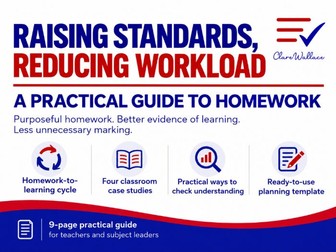
How can we set homework that genuinely supports learning without creating unnecessary marking? This practical guide helps teachers and subject leaders plan purposeful homework, check students’ independent understanding and make better use of their time. What’s included? A repeatable homework-to-learning cycle. Practical strategies for choosing homework tasks and appropriate follow-up activities. Guidance on self-marking, using AI as a learning resource and checking independent understanding. Four classroom case studies covering Year 7 Maths, Year 11 Maths, KS3 Geography and KS5 Computer Science. A decision-making table to help teachers choose appropriate ways to check learning. Practical guidance on responding to misconceptions and maintaining accountability. A simple evaluation process to review learning, accessibility and teacher workload. A ready-to-use homework planning template and student self-check. Who is it for? Classroom teachers, Heads of Department and subject leaders across primary and secondary education who want to make homework more purposeful and feedback more manageable. The examples are drawn from classroom practice and are intended to be adapted to different subjects, age groups and school contexts.
FREE Raising Standards, Reducing Workload: A Sample Guide to FeedbackQuick View
Clare5e

FREE Raising Standards, Reducing Workload: A Sample Guide to Feedback

(0)
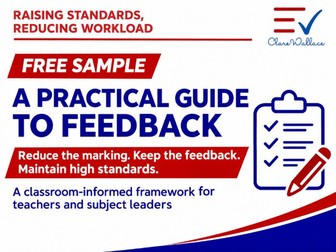
Free Sample: A Practical Guide to Feedback Reduce the marking. Keep the feedback. Maintain high standards. Are you spending hours marking students’ work, but wondering how much of that feedback is actually helping them improve? This free 3-page sample from A Practical Guide to Feedback introduces practical ways to make feedback more purposeful, manageable and focused on student learning. Inside, you’ll find: The feedback-to-learning cycle: a simple framework for identifying what students understand, responding effectively and checking whether learning has improved. Live feedback in the classroom: practical examples of how to respond to misconceptions while students are working, rather than relying on lengthy written comments afterwards. A manageable self-check routine: helping students use answers, model solutions and mark schemes to identify and understand their mistakes. Practical examples across key stages: ideas for supporting students in KS3, KS4 and KS5. This sample is designed for teachers who want to reduce unnecessary marking without lowering expectations or compromising the quality of feedback. It offers a starting point for reviewing your own classroom routines and considering how students can take a more active role in responding to feedback. Want to explore these ideas further? The full A Practical Guide to Feedback includes additional strategies for whole-class feedback, targeted marking, subject-specific examples and guidance for Heads of Department and school leaders. Find the full guide on TES: https://www.tes.com/teaching-resource/-13637428
FREE Raising Standards, Reducing Workload: Sample Guide to HomeworkQuick View
Clare5e

FREE Raising Standards, Reducing Workload: Sample Guide to Homework

(0)
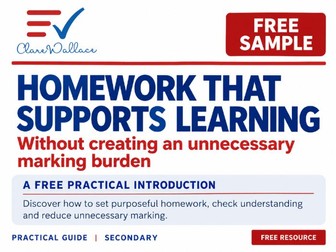
Want to make homework more purposeful without creating hours of additional marking? This free practical sample from Raising Standards, Reducing Workload introduces a classroom-informed approach to setting homework that supports learning while keeping teacher workload manageable. Inside, you’ll find: How to identify a clear learning purpose before setting homework. A practical homework-to-learning cycle. How to match homework tasks to different learning objectives. Ways to check understanding without routinely marking every piece of work. A practical checklist to help you plan more effective homework. The resource is suitable for teachers and subject leaders across KS3, KS4 and KS5, and can be adapted for different subjects. This is a free introduction to the full Practical Guide to Homework, which includes detailed classroom examples from Maths, Geography and Computer Science, guidance on responding to student needs, an evaluation framework and a ready-to-use planning template. Part of the Raising Standards, Reducing Workload resource collection. Practical ideas. Purposeful learning. Sustainable workload.