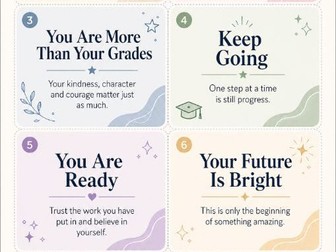
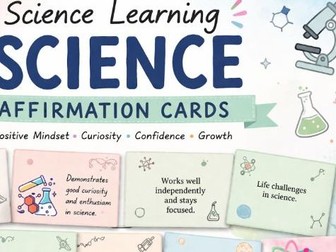
This resource is a set of pastel science-themed affirmation cards designed to encourage students’ confidence, curiosity and resilience in science learning.
The resource supports a growth mindset approach by helping students see mistakes, challenges and curiosity as important parts of learning science. It is suitable for KS2, KS3 or GCSE science classrooms.
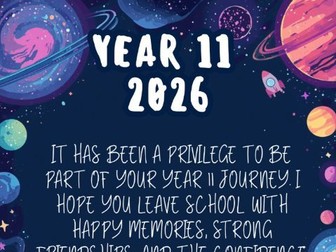
A printable Year 11 2026 space-themed leavers card/poster featuring a positive farewell message and motivational affirmation. Perfect as a keepsake for GCSE students, tutor groups, leavers gifts, end-of-year celebrations and Class of 2026 displays.
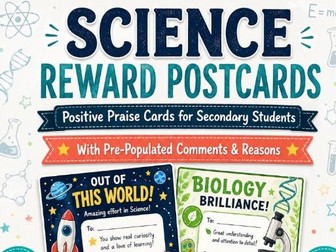
Science Reward Postcards / Praise Cards
Printable Science Reward Postcards with pre-populated praise comments and reasons to help teachers quickly celebrate student effort, progress and achievement. Ideal for KS3 and GCSE Science lessons, these ready-to-use cards are perfect for rewarding practical work, homework, resilience, participation, positive attitude and success in Biology, Chemistry and Physics.
Pre-populated praise to choose from:
Excellent scientific thinking and problem-solving!
Your curiosity and questions show true scientific spirit!
Outstanding lab work and attention to detail!
Keep up the brilliant observations and analysis!
You’re developing into a wonderful scientist
A thoughtful little keepsake for students as they prepare to leave school, sit their GCSEs, and begin their next chapter.
Each card includes a positive affirmation to remind students that they are capable, resilient, valued, and ready for what comes next. Perfect for form tutors, subject teachers, pastoral teams, or end-of-year leavers gifts.
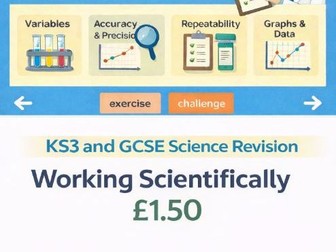
A science skills revision and practice booklet for secondary students, especially useful for reinforcing practical-science vocabulary and investigation skills.
Teaches students how to plan investigations, collect reliable data, and interpret results
It is structured like a student workbook. It explain the key concepts in short notes and tables, then follow with checklists and practice questions
The middle section develops data quality and measurement skills. It distinguishes repeatable from reproducible results, explains accuracy versus precision, and shows how scientists deal with random errors, systematic errors, outliers, range, and mean.
Include a glossary, review questions, and exam-style practice with answers.
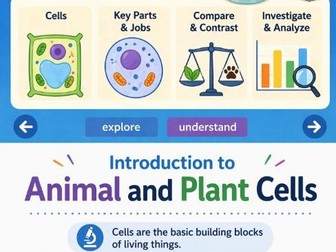
This is a Year 7 science booklet that introduces students to animal and plant cells using simple language, labelled diagrams, and short activities. It is designed to help pupils learn the parts of each cell, the job of each part, and how animal and plant cells are similar and different.
It also uses supportive features such as Turn & Talk, Look-Cover-Learn, simple reflection prompts like “I feel good / I feel okay / I need help,” and colourful visuals, which make it especially suitable for Year 7 learners, including SEN, EAL pupils, LA students and students who benefit from extra vocabulary, repetition, and visual support.
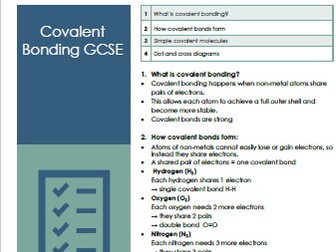
This GCSE Chemistry resource covers Covalent Bonding in a clear, engaging, and exam-focused format, ideal for Higher Tier, Standard and Foundation tier students following the AQA, OCR, or Edexcel specifications.
One-page summary, flashcards, and hinge questions covering covalent bonding, molecules,how covalent bonds are formed, and dot and cross diagrams.
What’s included:
What is covalent bonding
How covalent bonds form
Simple covalent molecules
Dot and cross diagrams
Flashcards for quick recall of essential facts
Hinge questions to check deep understanding and address misconceptions
Perfect for:
GCSE Chemistry
Revision sessions and intervention groups
Independent student study
Retrieval practice and lesson starters
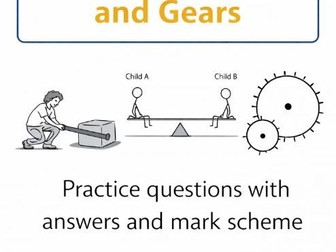
This resource is a GCSE Physics exam practice booklet focused on moments, levers and gears. The questions use a mix of different exam questions, including multiple choice, calculations, short explanations and application questions.
It contains 17 exam-style questions covering key ideas such as calculating moments, balanced moments, force multipliers, stability, gears, and everyday applications like spanners, crowbars, seesaws and wheelbarrows. It matches the style of GCSE exam papers and has answers.
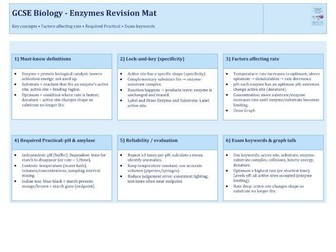
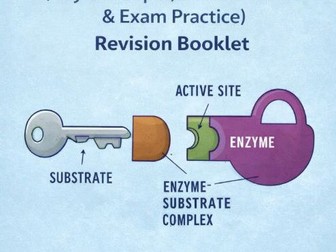
This is a GCSE Biology Enzymes Revision Mat designed as a quick, exam-focused learning and recall resource. It combines core knowledge, practical-required content, and exam practice in a clear form.
This resource is a GCSE Biology enzymes revision booklet designed to help students secure the key marks in the enzymes topic. It includes
Core knowledge and definitions (enzyme, substrate, active site, products, optimum, denature) and the lock-and-key model of specificity.
Clear explanations of factors affecting enzyme activity: temperature, pH, substrate concentration, and enzyme concentration.
A full Required Practical on the effect of pH on amylase using the iodine test, with equipment, method, variables, safety, reliability, results table template, and graph expectations.
Brief guidance on other common enzyme practicals (catalase with hydrogen peroxide, lipase with milk/indicator).
A 4-day 10-minute revision plan
Multiple-choice exam practice questions with answers.
A final checklist to check progress.
This resource is a Physics revision and practice question set on Density, suitable for GCSE or IGCSE students.
It includes:
Definitions and equations (density, mass, and volume relationships).
Worked examples with clear step-by-step solutions.
Multiple-choice questions testing understanding of:
States of matter and their relative densities.
Units and rearrangements of the density equation.
Practical calculations using given data.
Real-life examples (e.g., syringes, cubes, metals).
This resource is a complete revision and exam-preparation tool designed for the “Pressure in Fluids” unit of the GCSE/IGCSE Physics syllabus (OCR Gateway, Edexcel, or Cambridge IGCSE compatible).
It supports students aiming for Grades 7–9 by balancing core understanding, reasoning skills, and calculation-based questions.
This resource is a comprehensive flashcard set designed to help GCSE Physics and Combined Science students revise and understand specific heat capacity of a substance and the Required Practical which focuses on investigating the Specific Heat Capacity. Each flashcard presents a key question and answer to support active recall, retrieval practice, and exam preparation.
This resource is a set of standard-level flashcards designed to help GCSE Physics students revise key concepts from the P1: Matter and Heat topic. Each flashcard presents a question and answer format to reinforce understanding and support retrieval practice.
The flashcards cover atomic structure, density, specific heat capacity, latent heat, changes of state, and gas pressure. All aligned with the GCSE Physics specification.
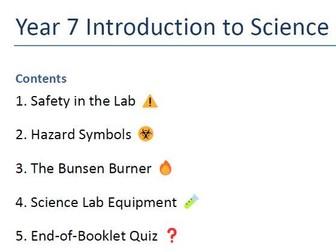
This ready-to-use booklet is designed to support Year 7 students as they begin their science journey. It introduces essential lab safety rules, hazard symbols, Bunsen burner use, and common science equipment. The resource also includes engaging activities and an end-of-booklet quiz to reinforce learning.
Perfect for:
✔ First lessons in secondary school science
✔ Independent classwork or homework
✔ Revision and recap of key safety knowledge
Contents:
Lab safety rules and hazard spotting activity
Hazard symbols matching task
Safe use of the Bunsen burner with flame colour guide
Matching lab equipment to names and uses
End-of-booklet multiple-choice quiz
Encourages active learning, reinforces key vocabulary, and ensures students build secure foundations for practical science.
This GCSE Chemistry resource covers Ionic Bonding in a clear, engaging, and exam-focused format, ideal for Higher Tier, Standard and Foundation tier students following the AQA, OCR, or Edexcel specifications.
One-page summary, flashcards, and hinge questions covering ionic bonding, charges from group numbers, formula writing, and dot and cross diagrams.
What’s included:
One-page summarised notes explaining:
Definition of ionic bonding
Charges from periodic table group numbers
Working out ionic formulas
Dot and cross diagram model
Flashcards for quick recall of essential facts and formulae
Hinge questions to check deep understanding and address misconceptions
Perfect for:
GCSE Chemistry
Revision sessions and intervention groups
Independent student study
Retrieval practice and lesson starters
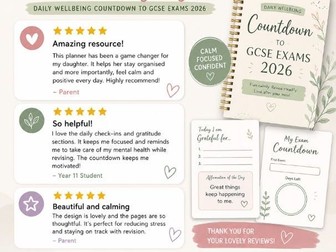
A calming and supportive GCSE Exams 2026 Daily Wellbeing Countdown Planner designed to help students prepare for their exams while managing stress, anxiety, and overwhelm.
This resource encourages students to take revision one day at a time through simple daily reflection, gratitude, positive affirmations, small wins, and gentle planning. It helps learners feel more organised, confident, and emotionally supported during the GCSE exam countdown.
Includes space for students to record:
what they are grateful for today
what they learned or understood better
one small win
how they are feeling
revision focus for the day
calming reminders and affirmations such as “Great things keep happening to me".
Ideal for Year 10 and Year 11 students, tutors, teachers, parents, form time, intervention sessions, or independent revision at home.


 Quick View