

 Quick View
OCR A A-level photosynthesis and chemiosmosis
This resource is a detailed A Level Biology teaching PowerPoint designed to support students with one of the most challenging areas of the OCR A Biology specification: energy for biological processes, the light-dependent reaction, chemiosmosis, ATP synthesis and photophosphorylation.
The lesson introduces the key idea that energy is transferred by electrons, stored briefly as a proton gradient, and then captured in ATP through ATP synthase. It links this mechanism clearly to both photosynthesis and respiration, helping students see that chemiosmosis is a shared biological process rather than a stand-alone topic. The resource is particularly useful for Year 13 Biology students revising or learning energy cycles, oxidative phosphorylation, the light-dependent stage of photosynthesis, ATP, reduced NAD, reduced NADP, electron transport chains and proton gradients.
The editable PowerPoint includes:
A clear lesson sequence for a 60 to 75 minute lesson, with suggested timings and built-in checks for understanding.
A retrieval starter covering ATP, reduced NAD, membrane locations and chemiosmosis.
Teacher explanations of ATP hydrolysis, phosphorylation, energy coupling and the role of ATP as an energy currency.
Step-by-step coverage of oxidative phosphorylation in mitochondria, including the role of reduced NAD and FAD, the electron transport chain, proton pumping, ATP synthase and oxygen as the final electron acceptor.
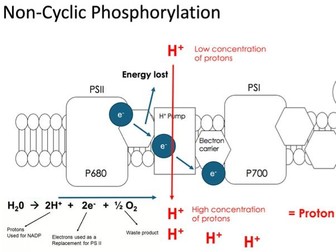
A detailed explanation of the light-dependent reaction in chloroplasts, including photosystems, chlorophyll, photolysis, non-cyclic photophosphorylation, cyclic photophosphorylation, reduced NADP and ATP production.
Comparison material linking mitochondria and chloroplasts, supporting students with high-mark exam questions.
Mini whiteboard hinge questions, sequencing tasks, retrieval practice, application questions and exit ticket questions.
Model answers and exam-style practice, including 6-mark questions on oxidative phosphorylation and photophosphorylation.
The resource also contains key terminology for students, including electrons, chlorophyll, light energy, photosystem, electron transport chain, photolysis, protons, oxygen, proton pumps, proton gradient, concentration gradient, ATP synthase, ATP and reduced NADP.
Supporting resouce:
this dagram is used in conjunction with the powerpoint allowing s
This resource can be used as a full taught lesson, a revision session, an intervention lesson for students struggling with bioenergetics, or as part of an A Level Biology flipped learning sequence. It would also work well for exam preparation, as the slides repeatedly model the causal chain students need in written answers: electrons transfer energy, energy pumps hydrogen ions, a proton gradient forms, hydrogen ions diffuse through ATP synthase, and ATP is produced.
Designed with OCR A Biology in mind, but also suitable for other A Level Biology courses covering photosynthesis, respiration, ATP synthesis and chemiosmosis.