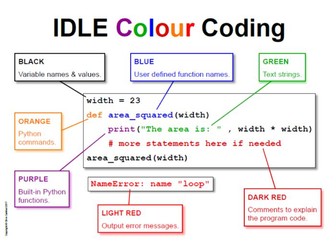
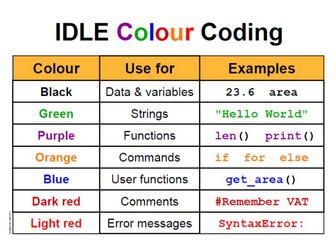
This poster shows the default colour codes used in the Python IDLE that most students will be familiar with when first coding in Python. It is designed as a quick reference to help students interpret their code and check for errors. Designed to print to A1 or whatever size you want.
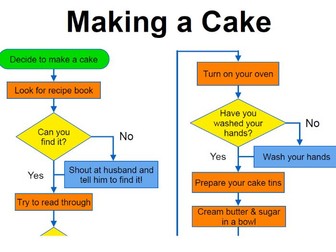
A poster of the flowchart showing how to make a cake. This is a colourful and humorous diagram of one cake making algorithm. It has been professionally produced and will print out up to A1. Exposing students to a wide range of flowcharts helps them to understand the process and produce their own.
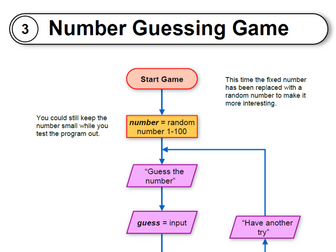
A series of six colourful posters or printouts to showing the logical flowcharts for a simple number guessing game that can be easily made in Python but is just as useful in any language. These start off very simply and get more complex. This was produced for KS3 but is usable at KS4 to show the basic sequence, inputs/outputs and flow control before students attempt to code the game. Students need to see as many examples of practical flowcharts as they can especially ones that can then be written in code. Professionally produced and will scale to A1 if required.
Also included are the separate sample Python code pages for each game and the Python .py files as well.
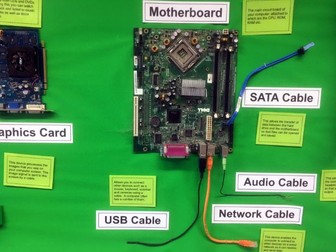
A complete set of labels, display title and explanations that can be used to make an interactive wall display to show the internal components of a desktop computer. Apart from the labels you will need an old computer that can be taken to pieces and mounted on a classroom wall which makes an interesting activity for a group of techie students. The display explanations that are light green in the image have had self adhesive velcro tape stuck to the reverse. These are then stuck onto the display in the appropriate locations. Why on velcro? I give the labels out to students on the way into the classroom and they have to work out where their label has to be stuck. This is a simple way of getting students to associate the explanations and components.
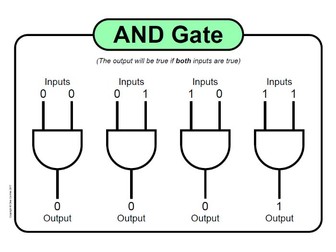
A set of seven high quality posters that explain each of the logic gates used in GCSE and A level Computer Science. Each gate is displayed along with the possible logical input and outputs. These are professionally produced and will scale to A1 or whatever size you want.
Also for use in GCSE and A level electronics.
These just have to be learnt and displaying them prominently is a good way of doing this.
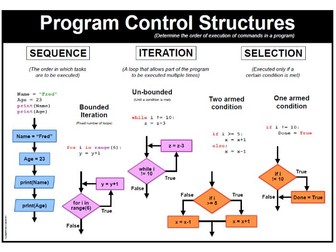
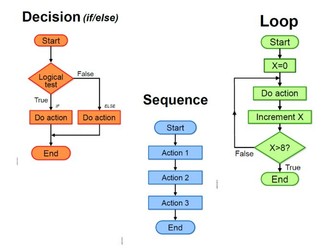
A colourful poster that gives simple examples of program control structures as flow charts and very simple Python code. Sequence, iteration (bounded and non bounded) as well as selection (one armed and two armed) are looked at. The poster is professionally produced and will scale to A1 if required. A simple visual for students to confirm understanding.
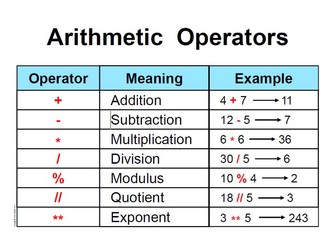
A poster of the arithmetic operators used in Python coding. These are often forgotten by students so a poster is always a handy reminder to have on the wall while coding. Produced so that it can be scaled to A1 or whatever size you want to use it at.
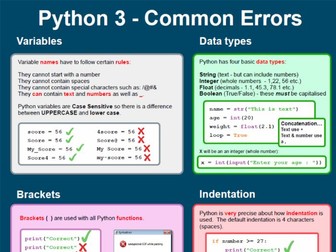
Originally designed as a poster to show the most common coding errors while using Python 3. There are sections on variables, data types, brackets, indentation, quotes and capitalisation. Each section explains where the errors may occur along with with IDLE colour coded example code snippets. This makes a great wall poster but it is even more effective to print them out on A4 and laminate them. Get students to collect one at the start of the lesson and then use it to help identify where they might have made a coding error. This encourages students to take responsibility for their own coding and save you a great deal of time as well.
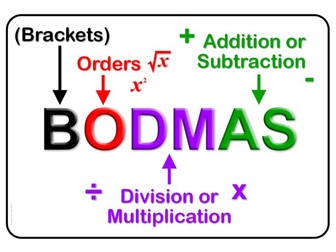
A colourful poster to show the mathematical order operator precedence in a calculation. Produced for GCSE computer Science but appropriate for Mathematics as well.
Professionally produced and fully scalable - will print to A1.
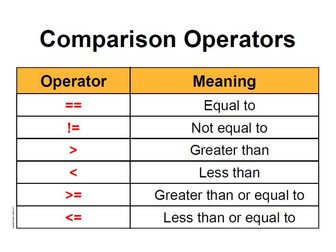
Poster to remind students of the comparison operators for use with conditional statements and while loops etc. The idea is very simple but it is always surprising how often students forget the comparator symbols or what they mean. Professionally produced to print to A1 or whatever size you prefer.
A complete set of ten colourful posters showing the flow diagrams for a variety of flow control and program decision making structures. These have been kept simplistic on purpose so they can easily be understood by younger students but are useful to confirm understanding at KS4. They are professionally designed and print nicely at A3 but will go up to A1 if required.
A poster that explains the default colour codes used in the standard Python integrated development environment that most students will be familiar with when first coding in Python. Understanding the colour codes helps students interpret their code and knowing the colours helps with error checking when things don't work as expected. Professionally produced to print up to A1 if required.
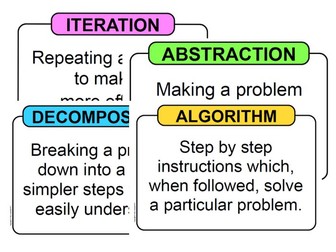
A set of four colourful posters that define the key terms Algorithm, Abstraction, Decomposition and Iteration. These professionally produced landscape posters are fully scalable to A1 if required.
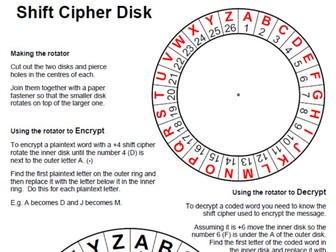
This resource can be used to look at one method of encryption where letters of the alphabet are shifted by a number of characters to give a simple "shift cipher". The two disks need to be cut out and the smaller one mounted centrally on the larger one so that it freely rotates. The plain text outer letters can then be read off as coded letters from the corresponding inner disk of letters. All instructions are included on the resource sheet. Makes a fun activity whereby students can code up a plain text message and pass it on to a friend as a coded message along with the shift cipher +4, +23 or whatever who then decodes it. It also get over the idea of an encryption "key" being passed from one user to another to allow decryption.
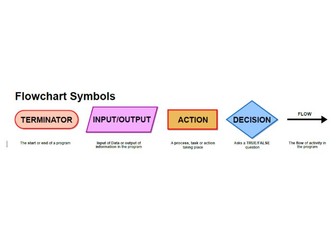
A very large (150cm X 30cm) poster to show the basic flowchart symbols used in Computer Science. This has been professionally designed to print out at a large size for maximum impact. You need a large format printer or you can poster print out on smaller paper and join together. Use to reinforce the use of standard symbols when drawing out program algorithms as flow charts.
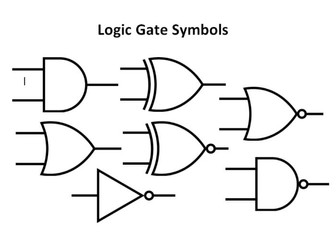
A collection of seven vector images of the logic gates that may be used in GCSE and A Level Computer Science and Electronics. These can be used to make your own posters or resources or by you students to create multiple logic gate circuits. I couldn't find good quality images so I drew them myself in a graphics package.
These are stored in a Word document from which they can be copied and pasted as required.
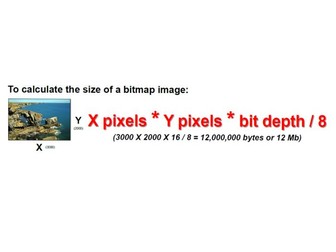
A large poster to show how to calculate the file size of a bitmap image based on its size and bit depth. This is a basic idea of binary representation and is shown by an example calculation.
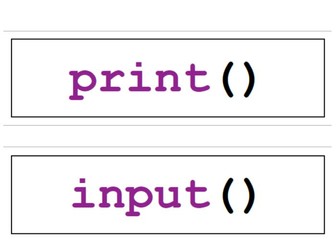
A classroom ceiling is an underused resource. This is a set of common functions and reserved words used in Python and are designed to be displayed on your classroom ceiling. The sheets are printed, cut and folded so that a flap is secured to the ceiling. The actual words hang down and are visible throughout the room either for reference or to reinforce the terms. Makes a good talking point. Professionally produced graphics for printing at A4.
Simple ideas often work the best. A template poster that you print out and laminate. You then write in the box the chosen Computer Science word of the week depending on the topic being studied that week. Choose the right felt tip pen and it will wipe of the plastic laminate with no problem. Good for highlighting the keywords/terms. I normally select a student to write up an appropriate word on a rotation basis which is useful as most have better handwriting than me!
Simple poster that makes it clear that intolerance is not OK. A bit of a play on words that generates discussion. I saw a low resolution version of this a while ago but could never find anything that would print above A5 so I made my own. This has been professionally produced as a vector to scale to any size that you require with no loss of quality.


 Quick View