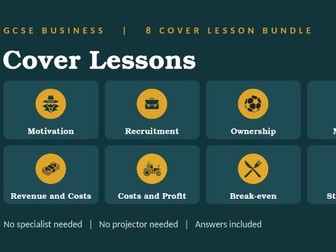
Eight complete GCSE Business cover lessons that any teacher can run, with no Business knowledge, projector or preparation needed. Each lesson has a one-page instructions sheet for the cover teacher, a 6-page student booklet with timed steps, and an answer sheet so students can mark their own work. Topics: motivation (Undercover Boss), recruitment and selection (Suits), Ltd and PLC (Manchester United), marketing and branding (Wrexham), revenue and costs (Premier League), costs, revenue and profit, break-even and stakeholders (Clarkson’s Farm). Includes exam practice and a 9 mark stretch question in every lesson. Suits AQA, Edexcel, OCR and Cambridge IGCSE.
GCSE Business recruitment and selection lesson using the TV drama Suits. PowerPoint, case study, card sort, worksheet, support sheet and answers.
What happens when a firm skips the checks? In Suits, Harvey hires a brilliant candidate who never went to law school, and it nearly destroys the firm. This lesson uses that story to teach the recruitment process, job descriptions and person specifications, internal and external recruitment, selection methods and the real cost of hiring the wrong person.
What’s included
16 slide PowerPoint with answers in the speaker notes, plus an A3 display slide
One page case study
Job description or person specification card sort
Editable worksheet (Word and PDF) with a “fix the firm’s recruitment” planning task
Support sheet with sentence starters and a word bank
Teacher guide with a 60 minute lesson outline, full answers, common mistakes to watch for and an exam mark scheme, including a 9 mark question
Suits AQA, Edexcel, OCR and Cambridge IGCSE. No clips needed. Not connected to or endorsed by Suits or its makers.
GCSE Business marketing lesson: the marketing mix, promotion and branding through Wrexham AFC. PowerPoint, case study, card sort, worksheet and answers.
How does a fifth-tier football club end up with fans all over the world? After Ryan Reynolds and Rob McElhenney bought Wrexham in 2021, a TV documentary, celebrity owners and big-name sponsors turned it into a global brand, and revenue grew about 28 times. This lesson uses the real story to teach the four Ps, promotion, sponsorship and branding.
What’s included
17 slide PowerPoint with answers in the speaker notes, plus an A3 display slide
One page case study with real figures from the club’s accounts
Marketing mix card sort
Editable worksheet (Word and PDF)
Support sheet with sentence starters and a word bank
Teacher guide with a 60 minute lesson outline, full answers, common mistakes to watch for and an exam mark scheme, including a 9 mark question
Links to Ltd vs PLC: The Glazer Takeover of Man Utd. Suits AQA, Edexcel, OCR and Cambridge IGCSE. No clips needed. Not connected to or endorsed by Wrexham AFC or Welcome to Wrexham.
Three GCSE Business lessons built around football: ownership (Man Utd), marketing (Wrexham) and revenue and costs (Premier League finances).
Each lesson uses real figures and events, from the Glazers’ borrowed-money takeover to Wrexham’s rise to a global brand and Chelsea’s £262m loss. Every lesson includes a PowerPoint, an editable worksheet, a case study or data table, a card sort, a support sheet and a teacher guide with full answers and a 9 mark exam question.
GCSE Business motivation lesson: Taylor, Maslow and Herzberg through Undercover Boss. PowerPoint, card sort, worker case studies, worksheet and answers.
Will a one-off $10,000 gift make a worker try harder? This lesson uses real episodes of Undercover Boss to teach financial and non-financial motivation and the theories of Taylor, Maslow and Herzberg, then asks students to diagnose what six workers really need.
What’s included
16 slide PowerPoint with answers in the speaker notes, plus an A3 display slide
Four real examples from the show
Financial and non-financial reward card sort
Editable worksheet (Word and PDF)
Support sheet with theory prompts, a sentence frame and a worked example
Teacher guide with a 60 minute lesson outline, full answers, common mistakes to watch for and an exam mark scheme, including a 9 mark question
Suits AQA, Edexcel, OCR and Cambridge IGCSE. No clips needed. Not connected to or endorsed by Undercover Boss or any company named.
GCSE ownership lesson: Ltd vs PLC, told through the Glazer takeover of Manchester United. PowerPoint, case study, card sort, worksheet and answers.
How do you buy a football club that doesn’t want to be sold? In 2005 the Glazer family took control of Manchester United by buying its shares on the stock market. This lesson uses the real story to teach the difference between private and public limited companies, takeovers, and why owning shares is not the same as having control.
What’s included
17 slide PowerPoint with answers in the speaker notes
Two slides that print as A3 classroom displays
One page case study with real dates and figures
Ltd, PLC or both card sort
Editable worksheet (Word and PDF)
Support sheet with sentence starters and a word bank
Teacher guide with a 60 minute lesson outline, full answers, common mistakes to watch for and an exam mark scheme, including a 9 mark question
Suits AQA, Edexcel, OCR and Cambridge IGCSE. No clips needed. Not connected to or endorsed by Manchester United.
GCSE Business stakeholders lesson using Clarkson’s Farm and the Diddly Squat planning wars. PowerPoint, case study, card sort, worksheet and answers.
It’s Jeremy’s land, so why couldn’t he build a bigger car park? This lesson uses the real planning battle between Diddly Squat Farm, the council and local residents to teach internal and external stakeholders, stakeholder objectives and conflict, and the power and interest grid.
What’s included
15 slide PowerPoint with answers in the speaker notes, plus an A3 display slide
One page case study with real dates and events
Stakeholder card sort
Editable worksheet (Word and PDF) with a power and interest grid
Support sheet with a word bank and gap-fill frames
Teacher guide with a 60 minute lesson outline, full answers, common mistakes to watch for and an exam mark scheme, including a 9 mark question
Suits AQA, Edexcel, OCR and Cambridge IGCSE. No clips needed. Not endorsed by or connected to the makers of Clarkson’s Farm.
GCSE Business break-even lesson using Clarkson’s Farm and The Farmer’s Dog pub. PowerPoint, worksheet, break-even chart task, support sheet and answers.
Jeremy Clarkson’s pub is fully booked every day, yet he admitted losing about £10 on every customer. How? This lesson uses real figures from the show to teach contribution, break-even output, margin of safety and break-even charts.
What’s included
15 slide PowerPoint with answers in the speaker notes
Two slides that print as A3 classroom displays
Editable worksheet (Word and PDF) with a printed grid for drawing the chart
Support sheet with step-by-step scaffolding and a partly drawn chart
Teacher guide with a 60 minute lesson outline, full answers, common mistakes to watch for and an exam mark scheme, including a 9 mark question
Follows on from Costs, Revenue and Profit: Clarkson’s Farm. Suits AQA, Edexcel, OCR and Cambridge IGCSE. No clips needed. Not endorsed by or connected to the makers of Clarkson’s Farm.
GCSE Business costs, revenue and profit lesson using Clarkson’s Farm. PowerPoint, worksheet, cost cards, support sheet and teacher guide with full answers.
How can a 1,000 acre farm make just £144 profit in a whole year? That’s what Jeremy Clarkson made from his first year of farming at Diddly Squat. This lesson uses the question to teach fixed and variable costs, revenue, total costs and profit, with real figures from the show.
What’s included
15 slide PowerPoint: starter, key terms, the four formulas, worked example, three tasks plus an extension, exam practice and an exit ticket. Answers are in the speaker notes
Two slides that print as A3 classroom displays
Editable student worksheet (Word and PDF)
Printable cost cards for a card sort activity
Support sheet with step-by-step scaffolding for lower attainers
Teacher guide with a 60 minute lesson outline, full answers, common mistakes to watch for and an exam mark scheme, including a 9 mark question
Learning objectives
Identify the difference between fixed and variable costs
Calculate revenue, total costs and profit or loss
Explain why a business can have high revenue and still make almost no profit
Real figures: the Series 1 profit (£144) and the Series 3 results (Jeremy £27,614 and Kaleb £44,987) come from the show. The other calculations use illustrative figures based on the show and are clearly labelled.
Suits AQA, Edexcel, OCR and Cambridge IGCSE Business. No clips needed. Not endorsed by or connected to the makers of Clarkson’s Farm.
Resources based on the movie ‘The Founder’ The PowerPoint can also be used as a display. It also has a worksheet, teacher guide and lesson outline plan.
A preparation booklet for International Baccalaureate Business Management students to prepare and structure their research for their CUEGIS concept based 20 mark questions.
I have successfully used this as an independent learning task for students to prepare their businesses for their Paper 2. It’s also been useful as a shared document with small groups on preparing for the Paper 1 case study.
Any student who fully completes this booklet will have to have considered how the concepts relate to their chosen business along with the stakeholders as groups and of course internal and eternal stakeholders which is where so many students drop marks on the ‘Individuals and Societies’ criteria.
This can be worked on in class or as part of independent study.
10 examples of character strengths (VIA) that are found in well known entrepreneurs. Good for starting discussion, raising aspirations/re-enforcement of positive approaches and the basis for further work for students from 11-18. The display is in Publisher format and prints in A3.
Unlock the secrets of effective business management with our engaging lesson, “Organisational Structures and Span of Control: A Dunder Mifflin Case Study.” This single, comprehensive lesson leverages the beloved TV show “The Office” (US version) to teach key concepts such as hierarchical structures, departmental functions, and span of control. With interactive activities, Bloom’s Taxonomy-aligned learning objectives, a professionally designed PowerPoint presentation, and practical case study analysis, this lesson bridges the gap between theory and real-world application. Perfect for A Level, GCSE, and IB Business Studies, this resource makes learning fun, relatable, and deeply insightful. Transform your classroom experience with this dynamic and practical lesson!
This resource presents a detailed cash flow forecast case study for a young entrepreneur named Emily, who runs a handmade jewellery business. Covering the period from January to April, it includes a month-by-month breakdown of income from jewellery sales and custom orders, as well as expenditures on materials, marketing, wages, and transport. The resource identifies cash shortfalls and provides practical tasks for students to analyse these financial challenges. It encourages students to calculate total income and expenditure, suggest cash flow management strategies, and explore ways to increase future income. This case study offers a real-world application of cash flow analysis, enhancing students’ understanding of financial management and business strategy within a small entrepreneurial context.
Eight ready-to-use starters for GCSE Business, each built around a real business decision: an Undercover Boss cash gift, a hire from Suits, who controls Manchester United, Wrexham’s rise, where Liverpool’s money comes from, and three from Clarkson’s Farm (profit, break-even and stakeholders). Each starter is a quick A to D vote followed by an answer slide and a question to carry into the lesson. Covers motivation, recruitment, ownership, marketing, revenue and costs, profit, break-even and stakeholders. Suits AQA, Edexcel, OCR and Cambridge IGCSE.
Michael Scott quits Dunder Mifflin, sets up his own paper company and wins ten of its major clients. Then his accountant tells him the business will be bankrupt within a month. This is a complete 60 minute GCSE Business lesson on cash flow, built around one of the best storylines in The Office.
What’s included
PowerPoint (18 slides) with teacher notes and answers on every slide
Student worksheet (Word and PDF)
Option cards and support sheet (Word and PDF)
Teacher guide with lesson outline, answers and mark scheme (Word and PDF)
What students do
Explain why cash matters and how it’s different from profit
Complete and read a four-month cash flow forecast for Michael’s company
Work out what hiring a delivery driver would do to the cash balance
Weigh up six ways to fix a cash flow problem, then find out what Michael actually did
Also in the pack: exam practice up to a 9 mark question with a levelled mark scheme, a 3-2-1 exit ticket, a support sheet with a step-by-step worked example, and two slides that print as A3 wall displays.
Specification links: AQA 8132 3.6 Finance (cash flow) and Edexcel 1BS0 1.3.3 Cash and cash-flow. Also suits OCR and Cambridge IGCSE.
No clips needed, though the episode Broke (Season 5) works well alongside it. The forecast figures are illustrative and labelled as such.
Also in this series: Organisational Structures through The Office (US).
The Office is an NBC series. This resource is not endorsed by or connected to its makers.
Head office is about to close the Scranton branch. By the end of the day it’s Stamford that’s closing, and its staff are moving in. A few years later, Dunder Mifflin’s shares crash and a printer company from Florida buys the lot. This is a complete 60 minute GCSE Business lesson on business growth, built around two of The Office’s biggest storylines.
What’s included
PowerPoint (17 slides) with teacher notes and answers on every slide
Student worksheet (Word and PDF)
Event cards and support sheet (Word and PDF)
Teacher guide with lesson outline, answers and mark scheme (Word and PDF)
What students do
Tell organic growth from external growth, and a merger from a takeover
Calculate average unit cost to see whether the Stamford merger cut costs
Sort events from the show into communication, coordination and motivation problems
Decide, as Sabre’s CEO, whether buying Dunder Mifflin was a good idea
Also in the pack: exam practice up to a 9 mark question with a levelled mark scheme, a 3-2-1 exit ticket, a support sheet with step-by-step help for the calculations, and two slides that print as A3 wall displays.
Specification links: AQA 8132 3.1.7 Expanding a business and Edexcel 1BS0 2.1.1 Business growth. Also suits OCR and Cambridge IGCSE.
No clips needed, though the episodes The Merger (Season 3) and Sabre (Season 6) work well alongside it. Cost figures are illustrative and labelled as such.
Also in this series: Cash Flow (The Michael Scott Paper Company) and Organisational Structures through The Office (US).
The Office is an NBC series. This resource is not endorsed by or connected to its makers.


 Quick View