Día de los Muertos Conti-Style: 2 Spanish Lessons + Worksheet (upper KS3/early GCSE)Quick View
hevo

Día de los Muertos Conti-Style: 2 Spanish Lessons + Worksheet (upper KS3/early GCSE)

(0)
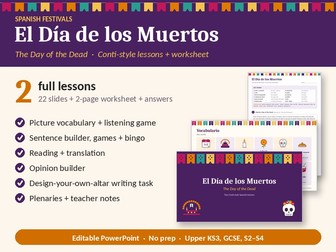
Two full Day of the Dead Spanish lessons (Día de los Muertos), plus a matching worksheet with answers. Pupils learn the festival’s traditions and key vocabulary, say what families do, give their opinion, then design and write about their own altar. A 22-slide PowerPoint with colourful illustrations, plus a 2-page worksheet that prints double-sided, with a separate answer page. Fully editable. Enough material for two lessons, with the worksheet as a follow-up, homework or cover lesson. No prep: just open and teach. Answers are on the slides and on the worksheet answer page. Suitable for upper KS3, early GCSE, S2–S4 and National 4/5 Spanish. LESSON 1: LEARN THE LANGUAGE True or false starter on the festival, with explanations 12 key words with illustrations, and a picture listening game ¿Qué hay en el altar? Describing an altar with hay Sentence builder: what families do, in the present tense Conti games: Lee la mente (Mind reading) and Eco defectuoso (Faulty echo) Sentence bingo, with the Spanish in the teacher notes 3-2-1 plenary LESSON 2: READ, WRITE AND CREATE Picture retrieval starter Reading text with Find the Spanish and comprehension questions Translation into Spanish and an opinion builder Diseña tu altar: pupils draw their own altar and write a paragraph, with a colour-coded model answer Exit ticket THE WORKSHEET A new reading text (Valeria in Oaxaca), true or false, gap-fill, put the words in order, translation both ways and a writing challenge + separate answer page. WHY THIS ONE’S DIFFERENT Built on Gianfranco Conti’s Extensive Processing Instruction (EPI) methodology. Pupils meet the language through pictures, a sentence builder, games and bingo before they write anything, so every pupil can succeed. It teaches real Hispanic culture, not a Halloween-themed vocabulary list. Pupils learn why the festival matters as well as how to talk about it. FORMAT Fully editable PowerPoint with teacher notes, plus an A4 worksheet with a separate answer page. Teaching younger or less confident classes? Try Día de los Muertos for Beginners (2 lessons), with simpler language for Y7–8 and S1–S2. Also teaching Halloween? Try Halloween en España: 2 Lessons for KS3/GCSE. Not sure whether my resources are right for you? TRY A FREE WORKSHEET FIRST: download my Present Tense Regular Verbs worksheet free to see the format and style. Last updated: 8 October 2026.
Día de los Muertos Conti-Style Spanish Lessons (x2) for S1/2, Y7/8 + WorksheetQuick View
hevo

Día de los Muertos Conti-Style Spanish Lessons (x2) for S1/2, Y7/8 + Worksheet

(0)
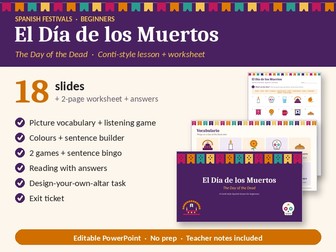
Day of the Dead Spanish teaching materials for early KS3 / BGE 3rd level (Día de los Muertos), plus a matching worksheet with answers, which will easily provide enough content for two lessons. Pupils learn what goes on an altar, describe it with hay and colours, give an opinion, then design and describe their own altar. An 18-slide PowerPoint plus a 2-page worksheet that prints double-sided, with a separate answer page. Fully editable. Enough material for two lessons, with the worksheet as a follow-up, homework or cover lesson. No prep: just open and teach. Answers are on the slides and on the worksheet answer page. Suitable for KS3, Y7–8, S1–S2 Spanish classes. LESSON 1: LEARN THE LANGUAGE Starter: true or false quiz on the festival, with explanations 10 key words with colourful illustrations Picture-only “listen and write the letter” game Colours, with a clear note on agreement Sentence builder: En el altar hay… Conti games: Lee la mente (Mind reading) and Eco defectuoso (Faulty echo) Sentence bingo, with the Spanish in the teacher notes LESSON 2: READ, WRITE AND CREATE Short reading text with Find the Spanish and comprehension questions Opinion builder: me gusta, me encanta, porque es Diseña tu altar: pupils draw their own altar and describe it in Spanish, with a model answer Exit ticket: 3-2-1 THE WORKSHEET (2 PAGES + ANSWERS) Label the pictures, read Diego’s text, true or false, colour agreement, count and write (Hay dos calaveras), translation both ways and a draw-and-describe challenge. WHY THIS ONE’S DIFFERENT Built on Gianfranco Conti’s Extensive Processing Instruction (EPI) methodology. Pupils hear and read the language many times through pictures, games and bingo before they write anything, so even complete beginners succeed. The language is kept genuinely simple (hay, colours and opinions), while pupils still learn real Hispanic culture and why the festival matters. The design-your-own-altar task makes a great classroom display. FORMAT Fully editable PowerPoint. 16:9 lesson slides, plus an A4 worksheet with a separate answer page. Teaching older or more confident classes? Try Día de los Muertos: 2 Lessons for KS3/GCSE, with more challenging language for Y8–10 / S2–S4, or TRY A FREE WORKSHEET FIRST. Last updated: 8 October 2026.
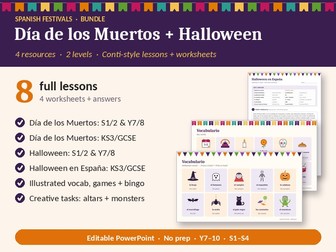
Día de los Muertos + Halloween Spanish Bundle, Conti Style: 8 LessonsQuick View
hevo

Día de los Muertos + Halloween Spanish Bundle, Conti Style: 8 Lessons

4 Resources
Eight Spanish festival lessons in one bundle: Día de los Muertos and Halloween, each at two levels, with four worksheets and full answers. Everything your department needs for the end of October and the start of November. Four complete resources, each with two lessons and a matching worksheet. Fully editable PowerPoint with colourful illustrations and teacher notes. No prep: just open and teach. Answers are on the slides and on the worksheet answer pages. Suitable for KS3 and GCSE (Y7–10), S1–S4 and National 4/5 Spanish. WHAT’S INCLUDED Día de los Muertos: 2 Lessons for S1/2 & Y7/8 Things on an altar, colours, hay and simple opinions, with a design-your-own-altar task. Día de los Muertos: 2 Lessons for KS3/GCSE What families do in the present tense, a reading on the festival’s traditions, opinions and a design-and-write altar task. Halloween: 2 Lessons for KS3, S1/2 & Y7/8 Halloween words, Me disfrazo de…, parts of the body and Crea tu monstruo. Halloween en España: 2 Lessons for KS3/GCSE How Spain celebrates and its own traditions, then the preterite: ¿Qué hiciste en Halloween? IN EVERY RESOURCE True or false starter, illustrated vocabulary and a picture listening game Sentence builders with Conti games: Lee la mente and Eco defectuoso Sentence bingo, reading with answers, model answers and exit tickets A 2-page worksheet with a separate answer page WHY THIS BUNDLE WORKS Two festivals, two levels, one consistent approach. Built on Gianfranco Conti’s Extensive Processing Instruction (EPI) methodology, every lesson moves pupils from pictures and sentence builders, through games and bingo, to their own creative writing. Pupils learn real Hispanic culture, and the difference between Halloween and the Day of the Dead. FORMAT Fully editable PowerPoint with teacher notes, plus four A4 worksheets with separate answer pages. Only need one festival? Try the Día de los Muertos Bundle or the Halloween Bundle. Not sure whether my resources are right for you? TRY A FREE WORKSHEET FIRST: download my Present Tense Regular Verbs worksheet free to see the format and style. Last updated: 8 October 2026.
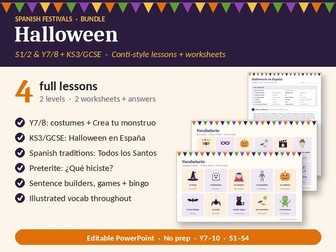
Halloween Spanish Bundle, Conti Style: 4 Lessons + 2 Worksheets (KS3/GCSE)Quick View
hevo

Halloween Spanish Bundle, Conti Style: 4 Lessons + 2 Worksheets (KS3/GCSE)

2 Resources
Four Halloween Spanish lessons at two levels, plus two worksheets with full answers. Teach Halloween to every class: monsters and costumes for S1/2 and Y7/8, and Halloween in Spain with the preterite for older pupils. Two complete resources in one bundle, each with two lessons and a matching worksheet. Fully editable PowerPoint with colourful illustrations and teacher notes. No prep: just open and teach. Answers are on the slides and on the worksheet answer pages. Suitable for KS3 and GCSE (Y7–10), S1–S4 and National 4/5 Spanish. WHAT’S INCLUDED Halloween: 2 Lessons for KS3, S1/2 & Y7/8 Halloween in Spain starter, Halloween words, Me disfrazo de…, parts of the body and Crea tu monstruo: pupils draw and describe their own monster. Worksheet: label the pictures, a reading text, label the monster, read and draw, and translation. Halloween en España: 2 Lessons for KS3/GCSE How Spain celebrates Halloween and its own traditions (Todos los Santos, la castañada, Samaín), then ¿Qué hiciste en Halloween? with the preterite and a comparison of celebrations. Worksheet: a reading text on Samaín in Galicia, present or past, the preterite, translation and a writing challenge. IN BOTH RESOURCES True or false starter on Halloween in Spain Illustrated vocabulary and a picture listening game Sentence builders with Conti games: Lee la mente (Mind reading) and Eco defectuoso (Faulty echo) Sentence bingo, with the Spanish in the teacher notes Model answers, plenaries and exit tickets WHY THIS BUNDLE WORKS Use the S1/2 & Y7/8 lessons with younger classes and Halloween en España with older pupils, so the whole department teaches Halloween with one consistent, scaffolded approach. Both are built on Gianfranco Conti’s Extensive Processing Instruction (EPI) methodology: pupils meet the language through pictures, sentence builders and games before they write anything. FORMAT Fully editable PowerPoint with teacher notes, plus two A4 worksheets with separate answer pages. Also teaching the Day of the Dead? Get the Día de los Muertos Spanish Bundle: 4 Lessons + 2 Worksheets. Want both festivals? Get the Día de los Muertos + Halloween Bundle: 8 Lessons and save even more. Not sure whether my resources are right for you? TRY A FREE WORKSHEET FIRST: download my Present Tense Regular Verbs worksheet free to see the format and style. Last updated: 8 October 2026.
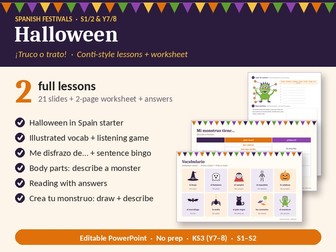
Halloween, Conti Style: 2 Spanish Lessons + Worksheet (KS3, S1/2 & Y7/8)Quick View
hevo

Halloween, Conti Style: 2 Spanish Lessons + Worksheet (KS3, S1/2 & Y7/8)

(0)
Two full Halloween Spanish lessons for S1/2 and Y7/8, plus a matching worksheet with answers. Pupils find out how Halloween is celebrated in Spain, learn Halloween words, say what they dress up as, then create and describe their own monster. A 21-slide PowerPoint with colourful illustrations, plus a 2-page worksheet that prints double-sided, with a separate answer page. Fully editable. Enough material for two lessons, with the worksheet as a follow-up, homework or cover lesson. No prep: just open and teach. Answers are on the slides and on the worksheet answer page. Suitable for KS3 (Y7–8) and S1–S2 Spanish. LESSON 1: HALLOWEEN WORDS True or false starter: Halloween in Spain, Todos los Santos, Samaín and la castañada 10 Halloween words with illustrations, and a picture listening game Sentence builder: Me disfrazo de… (I dress up as…) Conti games: Lee la mente (Mind reading) and Eco defectuoso (Faulty echo) Sentence bingo, with the Spanish in the teacher notes 3-2-1 plenary LESSON 2: CREATE A MONSTER Picture retrieval starter Parts of the body with a labelled monster Sentence builder: Mi monstruo tiene tres ojos verdes… Short reading text with Find the Spanish and comprehension questions Opinion builder: me gusta, me encanta, porque es Crea tu monstruo: pupils draw and describe their own monster, with a model answer THE WORKSHEET Label the pictures, read Sara’s text, true or false, label the monster, read and draw, translation both ways and a describe-your-monster challenge. WHY THIS ONE’S DIFFERENT Built on Gianfranco Conti’s Extensive Processing Instruction (EPI) methodology. Pupils hear and read the language many times through pictures, games and bingo before they write anything, so every pupil can succeed. The finished monsters make a great classroom display. FORMAT Fully editable PowerPoint (with teacher notes, plus an A4 worksheet with a separate answer page. Teaching older classes? Try Halloween en España: 2 Lessons for KS3/GCSE. Also teaching the Day of the Dead? Try Día de los Muertos for S1/2 & Y7/8 (2 lessons). Not sure whether my resources are right for you? TRY A FREE WORKSHEET FIRST: download my Present Tense Regular Verbs worksheet free to see the format and style. Last updated: 8 October 2026.
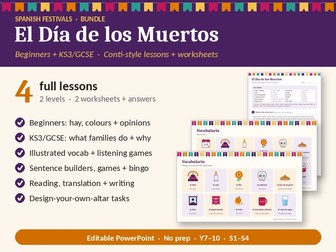
Día de los Muertos Conti-Style Bundle: 4 Spanish Lessons (at 2 levels) + 2 WorksheetsQuick View
hevo

Día de los Muertos Conti-Style Bundle: 4 Spanish Lessons (at 2 levels) + 2 Worksheets

2 Resources
Four Day of the Dead Spanish lessons (Día de los Muertos) at two levels, plus two worksheets with full answers. Teach the festival to every class: simple, picture-led lessons for beginners and more challenging lessons for older or more confident pupils. Two complete resources in one bundle, each with two lessons and a matching worksheet. Fully editable PowerPoint with colourful illustrations and teacher notes. No prep: just open and teach. Answers are on the slides and on the worksheet answer pages. Suitable for KS3 and GCSE (Y7–10), S1–S4 and National 4/5 Spanish. WHAT’S INCLUDED Día de los Muertos for Beginners (Y7–8, S1–S2) Two lessons: illustrated vocabulary, colours, describing an altar with hay, simple opinions and a design-your-own-altar task. Worksheet: label the pictures, a short reading text, colour agreement, count and write, translation and a draw-and-describe challenge. Día de los Muertos: 2 Lessons for KS3/GCSE (Y8–10, S2–S4) Two lessons: what families do in the present tense, a reading text on the festival’s traditions, translation, an opinion builder and a design-your-own-altar writing task. Worksheet: a reading text, true or false, gap-fill, put the words in order, translation both ways and a writing challenge. IN BOTH RESOURCES True or false starter on the festival Picture listening game Sentence builder with Conti games: Lee la mente (Mind reading) and Eco defectuoso (Faulty echo) Sentence bingo, with the Spanish in the teacher notes Model answers and exit tickets** WHY THIS BUNDLE WORKS Use the beginners’ lessons with younger or lower-confidence classes (S1/2, Y7/8) and the upper-KS3/GCSE lessons with older pupils, so the whole department teaches the festival with one consistent, scaffolded approach. Both are built on Gianfranco Conti’s Extensive Processing Instruction (EPI) methodology: pupils meet the language through pictures, sentence builders and games before they write anything. They teach real Hispanic culture, not a Halloween-themed vocabulary list. FORMAT Fully editable PowerPoint with teacher notes, plus two A4 worksheets with separate answer pages. Also teaching Halloween? Get the Halloween Spanish Bundle: 4 Lessons + 2 Worksheets. Want both festivals? Get the Día de los Muertos + Halloween Bundle: 8 Lessons and save even more. Not sure whether my resources are right for you? TRY A FREE WORKSHEET FIRST: download my Present Tense Regular Verbs worksheet free to see the format and style. Last updated: 8 October 2026.
Halloween en España Conti Style: 2 Spanish Lessons + Worksheet (KS3/GCSE)Quick View
hevo

Halloween en España Conti Style: 2 Spanish Lessons + Worksheet (KS3/GCSE)

(0)
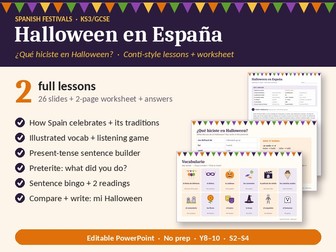
Two full Halloween Spanish lessons, plus a matching worksheet with answers. Zero preparation required. Pupils find out how Halloween and Spain’s own traditions are celebrated, then use the preterite to describe their own Halloween and compare celebrations. A 26-slide PowerPoint with colourful illustrations, plus a 2-page worksheet that prints double-sided, with a separate answer page. Fully editable. Enough material for two lessons, with the worksheet as a follow-up, homework or cover lesson. It works just as well in the week after Halloween. No prep: just open and teach. Answers are on the slides and on the worksheet answer page. Suitable for upper KS3, GCSE, S2–S4 and National 4/5 Spanish. LESSON 1: HALLOWEEN EN ESPAÑA True or false starter: Todos los Santos, la castañada, Samaín and Don Juan Tenorio 12 key words with illustrations, and a picture listening game Reading text on how Spain celebrates, with Find the Spanish and comprehension questions Sentence builder in the present tense, with Conti games (Mind reading and Faulty echo) 3-2-1 plenary LESSON 2: ¿QUÉ HICISTE EN HALLOWEEN? Picture retrieval starter Key preterite verbs, with a clear explanation of the endings and irregulars Preterite sentence builder and sentence bingo Reading text: Lucía’s Halloween and All Saints’ Day, with tasks Translation into Spanish Comparing celebrations: Prefiero… porque es más… Guided writing with a checklist and colour-coded model answer THE WORKSHEET A new reading text (Pablo’s Samaín in Galicia), true or false, present or past, complete in the preterite, translation both ways and a writing challenge. WHY THIS ONE’S DIFFERENT Built on Gianfranco Conti’s Extensive Processing Instruction (EPI) methodology. Pupils meet the language through pictures, sentence builders, games and bingo before they write anything. It teaches real Spanish culture alongside Halloween, and gives pupils genuine preterite practice in a motivating context. FORMAT Fully editable PowerPoint (16:9) with teacher notes, plus an A4 worksheet with a separate answer page. Also teaching the Day of the Dead? Try Día de los Muertos: 2 Lessons for KS3/GCSE. Teaching younger classes? Try Halloween: 2 Lessons for KS3, S1/2 & Y7/8. Not sure whether my resources are right for you? TRY A FREE WORKSHEET FIRST: download my Present Tense Regular Verbs worksheet free to see the format and style. Last updated: 8 October 2026.
Spanish Perfect Tense (haber + Participle): Conti-Style WorksheetQuick View
hevo

Spanish Perfect Tense (haber + Participle): Conti-Style Worksheet

(0)
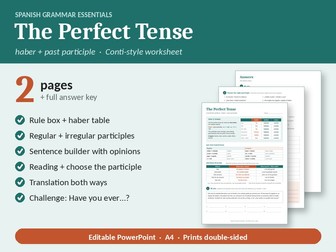
Not sure whether this worksheet is right for you? TRY A FREE WORKSHEET FIRST Download my Present Tense Regular Verbs Spanish grammar worksheet FREE to see the format and style before purchasing. THIS RESOURCE A ready-to-print, Conti-style Spanish perfect tense worksheet (haber + past participle), including irregular participles, with full answers. The perfect tense lets students say what they have done, and it adds an extra tense to their speaking and writing with very little effort. This worksheet makes the two-part structure clear, then takes students step by step from noticing the perfect tense in a short text to using it in their own answers. Two pages that print double-sided, plus a separate answer page. Use it as a lesson, starter, homework, cover lesson or revision task. WHAT’S INSIDE Page 1: Reference and reading How the perfect tense works, explained in plain English, including word order with no and reflexive pronouns Table showing haber with past participles, so students see that only haber changes Key past participles, sorted into regular and irregular (hecho, visto, escrito, vuelto) Sentence builder with time phrases and opinions (y me ha gustado mucho) Task 1: Short reading text. Students find the verbs and write each infinitive Page 2: Practice Task 2: Choose the right participle, with the common invented forms as distractors (hacido / hecho) Task 3: Complete the verb with haber + past participle Task 4: Translate into English Task 5: Translate into Spanish Task 6: Challenge. “Have you ever…?” questions answered in full sentences Answer page Answers for every task, plus model answers for the challenge WHY THIS ONE’S DIFFERENT Built on Gianfranco Conti’s Extensive Processing Instruction (EPI) methodology. Students process the structure receptively before they produce it, moving from reading and noticing, to choosing and completing, to translation in both directions, to personalised answers. Regular and irregular participles are taught side by side, so students know which ones to learn by heart. The challenge doubles as speaking practice: “¿Alguna vez has…?” questions come up regularly in conversation tasks. The English-to-Spanish sentences only use language students have already met on the sheet. FORMAT Fully editable PowerPoint, A4 portrait. Two worksheet pages designed for double-sided printing, plus a separate answer page. No prep: just print and go. The full answer key saves you marking time. Suitable for GCSE, S3–S4 and National 5 Spanish, and for revision at Higher / A-Level. Part of a Conti-style Spanish grammar worksheet series. Also available: Preterite vs Imperfect and The Near Future. Last updated: 7 October 2026.
Spanish Future Tense (Futuro Simple): Conti-Style WorksheetQuick View
hevo

Spanish Future Tense (Futuro Simple): Conti-Style Worksheet

(0)
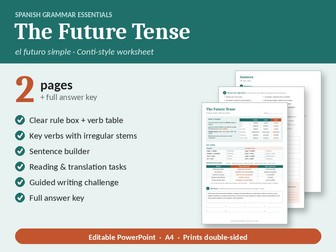
Not sure whether this worksheet is right for you? TRY A FREE WORKSHEET FIRST Download my Present Tense Regular Verbs Spanish grammar worksheet FREE to see the format and style before purchasing. THIS RESOURCE A ready-to-print, Conti-style Spanish future tense worksheet (futuro simple) covering regular endings and irregular stems, with a rule box, sentence builder and full answers. The future tense lets students talk about their plans, hopes and predictions, and it is quick to learn: one set of endings added to the whole infinitive. This worksheet takes students step by step from noticing it in a text to using it in their own writing. Two pages that print double-sided, plus a separate answer page. Use it as a lesson, starter, homework, cover lesson or revision task. No prep: just print and go. The full answer key saves you marking time. Suitable for GCSE, S3–S4 and National 5 Spanish, and for revision at Higher / A-Level. WHAT’S INSIDE Page 1: Reference and reading How the future tense works, explained in plain English Conjugation table for hablar, comer and tener Key verbs, including the irregular stems tendr-, har-, podr- and saldr- Sentence builder with time phrases, plus cuando sea mayor taught as a chunk Task 1: Short reading text, “Mi futuro”. Students underline the future verbs and write each infinitive Page 2: Practice Task 2: Choose the right form Task 3: Complete the verb Task 4: Translate into English Task 5: Translate into Spanish Task 6: Challenge. Guided writing about plans for the future Answer page Answers for every task, plus a model answer for the challenge WHY THIS ONE’S DIFFERENT Built on Gianfranco Conti’s Extensive Processing Instruction (EPI) methodology. Students process the structure receptively before they produce it, moving from noticing, to choosing and completing, to translation, to independent writing. Task 2 sets each correct form against the typical student mistake (tendré / teneré, haremos / haceremos), so students learn to spot errors in their own work. The English-to-Spanish sentences only use language students have already met on the sheet. FORMAT Fully editable PowerPoint, A4 portrait. Two worksheet pages designed for double-sided printing, plus a separate answer page. Part of a Conti-style Spanish grammar worksheet series. Also available: The Conditional and The Near Future. Last updated: 7 October 2026.
Spanish Grammar Bundle (Conti-style): Ser vs Estar, Gustar & AdjectivesQuick View
hevo

Spanish Grammar Bundle (Conti-style): Ser vs Estar, Gustar & Adjectives

4 Resources
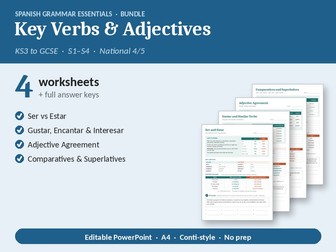
Not sure whether this bundle is right for you? TRY A FREE WORKSHEET FIRST Download my Present Tense Regular Verbs Spanish grammar worksheet FREE to see the format and style before purchasing. THIS BUNDLE Four Conti-style Spanish grammar worksheets covering the structures students use in almost every sentence: ser and estar, gustar-type verbs, adjective agreement, and comparatives and superlatives. Each worksheet is two pages that print double-sided, plus a separate answer page. Use them as lessons, starters, homework, cover lessons or revision tasks. No prep: just print and go. Full answer keys save you marking time. Suitable for KS3, GCSE, S1–S4 and National 4/5 Spanish. WHAT’S INCLUDED Ser vs Estar Gustar, Encantar & Interesar Adjective Agreement Comparatives & Superlatives WHY THIS BUNDLE WORKS These are the structures students need to describe people, places and things and to give opinions, and they are behind many of the most common errors in writing. Each sheet tackles one sticking point and gives students plenty of practice before they write independently. Built on Gianfranco Conti’s Extensive Processing Instruction (EPI) methodology. Students process each structure receptively before they produce it, through a sentence builder, a reading text, scaffolded practice, translation in both directions and a guided writing challenge. FORMAT Fully editable PowerPoint, A4 portrait. Last updated: 7 October 2026.
Spanish Present Tense Bundle (Conti-style): Regular, Irregular & ReflexiveQuick View
hevo

Spanish Present Tense Bundle (Conti-style): Regular, Irregular & Reflexive

4 Resources
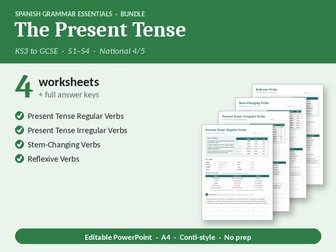
Not sure whether this bundle is right for you? TRY A FREE WORKSHEET FIRST Download my Present Tense Regular Verbs Spanish grammar worksheet FREE to see the format and style before purchasing. THIS BUNDLE Four Conti-style Spanish grammar worksheets covering the whole present tense: regular -ar, -er and -ir verbs, key irregular verbs, stem-changing verbs and reflexive verbs. Each worksheet is two pages that print double-sided, plus a separate answer page. Use them as lessons, starters, homework, cover lessons or revision tasks. No prep: just print and go. Full answer keys save you marking time. Suitable for KS3, GCSE, S1–S4 and National 4/5 Spanish. WHAT’S INCLUDED Present Tense Regular Verbs (-ar, -er, -ir) Present Tense Irregular Verbs Stem-Changing Verbs (e→ie, o→ue, e→i, u→ue) Reflexive Verbs WHY THIS BUNDLE WORKS The sheets build in a logical order: students secure the regular pattern first, then learn where it changes, with irregular verbs, stem-changers and reflexives. Each sheet highlights exactly which letters change, so students see the pattern rather than memorising whole forms. Built on Gianfranco Conti’s Extensive Processing Instruction (EPI) methodology. Students process each structure receptively before they produce it, through a sentence builder, a reading text, scaffolded practice, translation in both directions and a guided writing challenge. FORMAT Fully editable PowerPoint, A4 portrait. Last updated: 7 October 2026.
Spanish Preterite Tense Irregular Verbs: Conti-Style WorksheetQuick View
hevo

Spanish Preterite Tense Irregular Verbs: Conti-Style Worksheet

(0)
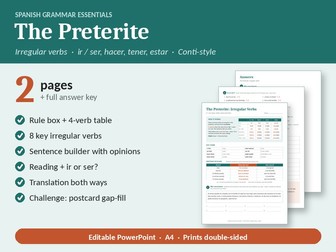
Not sure whether this worksheet is right for you? TRY A FREE WORKSHEET FIRST Download my Present Tense Regular Verbs Spanish grammar worksheet FREE to see the format and style before purchasing. THIS RESOURCE A ready-to-print, Conti-style Spanish preterite tense irregular verbs worksheet covering ir/ser, hacer, tener and estar, with full answers. The most useful verbs for talking about the past (fui, hice, tuve, estuve) are all irregular, and students mix them up constantly. This worksheet groups them by pattern, tackles the fui / fue confusion head on, then takes students step by step from noticing the verbs in a short text to using them accurately in translation. Two pages that print double-sided, plus a separate answer page. Use it as a lesson, starter, homework, cover lesson or revision task. WHAT’S INSIDE Page 1: Reference and reading How irregular preterite verbs work, explained in plain English, including why ir and ser look the same Conjugation table for ir/ser, hacer, tener and estar, with the irregular stems highlighted Key verbs: eight high-frequency irregular verbs, each shown with its yo form Sentence builder with past time phrases and opinions Task 1: Short holiday text. Students find the verbs and write each infinitive, including telling fui (ir) from fue (ser) Page 2: Practice Task 2: Ir or ser? Students decide whether each fui / fue / fueron means went or was Task 3: Complete the verb Task 4: Translate into English Task 5: Translate into Spanish Task 6: Challenge. A postcard gap-fill mixing regular and irregular verbs Answer page Answers for every task WHY THIS ONE’S DIFFERENT Built on Gianfranco Conti’s Extensive Processing Instruction (EPI) methodology. Students process the structure receptively before they produce it, moving from reading and noticing, to choosing and completing, to translation in both directions, to mixed regular and irregular practice. The irregular stems are highlighted in the table, so students see that most of these verbs follow one shared pattern. A dedicated task deals with ir and ser sharing the same forms, so students learn to use context instead of guessing. The English-to-Spanish sentences only use language students have already met on the sheet. FORMAT Fully editable PowerPoint, A4 portrait. Two worksheet pages designed for double-sided printing, plus a separate answer page. Part of a Conti-style Spanish grammar worksheet series. Also available: The Preterite: Regular Verbs and Ser and Estar. Last updated: 7 October 2026.
Spanish Preterite vs Imperfect: Conti-Style Grammar WorksheetQuick View
hevo

Spanish Preterite vs Imperfect: Conti-Style Grammar Worksheet

(0)
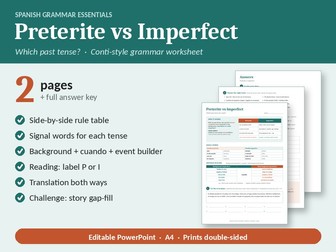
Not sure whether this worksheet is right for you? TRY A FREE WORKSHEET FIRST Download my Present Tense Regular Verbs Spanish grammar worksheet FREE to see the format and style before purchasing. THIS RESOURCE A ready-to-print, Conti-style Spanish preterite vs imperfect worksheet that shows students which past tense to use, with a rule box and full answers. Choosing between the preterite and the imperfect is one of the hardest decisions students make in Spanish. This worksheet gives them a clear way to decide (completed action or background?), then takes them step by step from labelling tenses in a short text to choosing correctly in their own sentences. Two pages that print double-sided, plus a separate answer page. Use it as a lesson, starter, homework, cover lesson or revision task. WHAT’S INSIDE Page 1: Reference and reading When to use each tense, set out side by side, with the classic “was …-ing when …” pattern Signal words that usually trigger each tense (ayer, de repente / siempre, mientras) Sentence builder: background (imperfect) + cuando + what happened (preterite) Task 1: Short reading text. Students label each past verb P or I Page 2: Practice Task 2: Choose the right tense Task 3: Which tense? Students write the verb in the tense they choose Task 4: Translate into English Task 5: Translate into Spanish Task 6: Challenge. A story gap-fill where students decide between scene-setting and events Answer page Answers for every task, with the reason for each choice in Task 1 WHY THIS ONE’S DIFFERENT Built on Gianfranco Conti’s Extensive Processing Instruction (EPI) methodology. Students process the structure receptively before they produce it, moving from labelling tenses in context, to choosing, to translation in both directions, to applying the rule in a short story. The two tenses are colour-coded throughout, so students see the background and the event as two separate jobs. The answer key explains the reason for each tense in Task 1, so teachers can use it to discuss the decision, not just mark it. The English-to-Spanish sentences only use language students have already met on the sheet. FORMAT Fully editable PowerPoint, A4 portrait. Two worksheet pages designed for double-sided printing, plus a separate answer page. Part of a Conti-style Spanish grammar worksheet series. Also available: The Imperfect Tense and The Preterite: Irregular Verbs. Last updated: 7 October 2026.
Spanish Adjective Agreement: Conti-Style Grammar WorksheetQuick View
hevo

Spanish Adjective Agreement: Conti-Style Grammar Worksheet

(0)
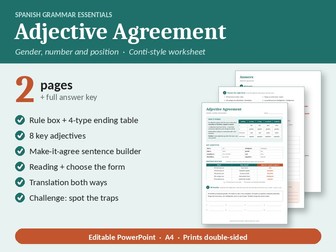
Not sure whether this worksheet is right for you? TRY A FREE WORKSHEET FIRST Download my Present Tense Regular Verbs Spanish grammar worksheet FREE to see the format and style before purchasing. THIS RESOURCE A ready-to-print, Conti-style Spanish adjective agreement worksheet covering gender, number and position, with a rule box and full answers. Adjective agreement is one of the most common errors in students’ Spanish writing, and one of the easiest marks to lose. This worksheet makes the patterns clear, then takes students step by step from noticing agreement in a short text to getting it right in translation. Two pages that print double-sided, plus a separate answer page. Use it as a lesson, starter, homework, cover lesson or revision task. WHAT’S INSIDE Page 1: Reference and reading How adjective agreement works, explained in plain English, including position Ending table for -o, -e, consonant and nationality adjectives, with the changing endings highlighted Key adjectives: eight high-frequency describing words Sentence builder where students make each adjective agree Task 1: Short reading text. Students find each adjective and identify the noun it describes, its gender and number Page 2: Practice Task 2: Choose the right form Task 3: Make it agree Task 4: Translate into English Task 5: Translate into Spanish Task 6: Challenge. Four translations, each with a common trap (mixed groups, z to c, word order, accents) Answer page Answers for every task, with the reason for each challenge answer WHY THIS ONE’S DIFFERENT Built on Gianfranco Conti’s Extensive Processing Instruction (EPI) methodology. Students process the structure receptively before they produce it, moving from reading and noticing, to choosing and adapting forms, to translation in both directions, to tackling the most common traps. The sentence builder gives adjectives in their base form, so students have to make them agree rather than copy them. The ending table shows all four adjective types side by side, so students see which change four ways and which only change for plural. The English-to-Spanish sentences only use language students have already met on the sheet. FORMAT Fully editable PowerPoint, A4 portrait. Two worksheet pages designed for double-sided printing, plus a separate answer page. Part of a Conti-style Spanish grammar worksheet series. Also available: Ser and Estar and Stem-Changing Verbs. Last updated: 6 October 2026.
Spanish Comparatives & Superlatives: Conti-Style WorksheetQuick View
hevo

Spanish Comparatives & Superlatives: Conti-Style Worksheet

(0)
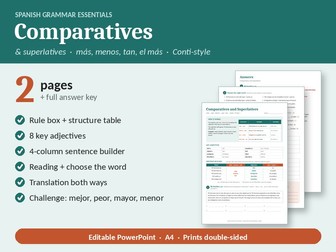
Not sure whether this worksheet is right for you? TRY A FREE WORKSHEET FIRST Download my Present Tense Regular Verbs Spanish grammar worksheet FREE to see the format and style before purchasing. THIS RESOURCE A ready-to-print, Conti-style Spanish comparatives and superlatives worksheet (más, menos, tan, el más), with a rule box and full answers. Comparatives and superlatives let students move beyond simple descriptions and start comparing people, places and school subjects, which is exactly what they need for giving and justifying opinions. This worksheet makes each structure clear, then takes students step by step from noticing comparisons in a short text to using them accurately in translation. Two pages that print double-sided, plus a separate answer page. Use it as a lesson, starter, homework, cover lesson or revision task. WHAT’S INSIDE Page 1: Reference and reading How comparatives and superlatives work, explained in plain English, including the irregular forms Structure table for más … que, menos … que, tan … como and el/la más … de, with examples Key adjectives: eight high-frequency describing words Four-column sentence builder where students choose the structure and make the adjective agree Task 1: Short reading text. Students find each comparison, identify its type and translate it Page 2: Practice Task 2: Choose the right word (que, como, de, mejor) Task 3: Complete the comparison using symbols (+, –, =, S) Task 4: Translate into English Task 5: Translate into Spanish Task 6: Challenge. Translations using mayor, menor, mejor and peor Answer page Answers for every task WHY THIS ONE’S DIFFERENT Built on Gianfranco Conti’s Extensive Processing Instruction (EPI) methodology. Students process the structure receptively before they produce it, moving from reading and noticing, to choosing and completing, to translation in both directions, to the irregular forms. Each structure is colour-coded so students see that más goes with que and tan goes with como. Task 3 uses symbols instead of English prompts, so students have to choose the structure themselves. The English-to-Spanish sentences only use language students have already met on the sheet. FORMAT Fully editable PowerPoint, A4 portrait. Two worksheet pages designed for double-sided printing, plus a separate answer page. Part of a Conti-style Spanish grammar worksheet series. Also available: Ser and Estar and Gustar, Encantar and Interesar. Last updated: 6 October 2026.
Spanish Imperfect Tense (Used To): Conti-Style Grammar WorksheetQuick View
hevo

Spanish Imperfect Tense (Used To): Conti-Style Grammar Worksheet

(0)
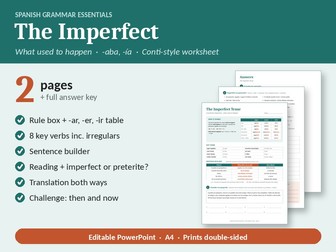
Not sure whether this worksheet is right for you? TRY A FREE WORKSHEET FIRST Download my Present Tense Regular Verbs Spanish grammar worksheet FREE to see the format and style before purchasing. THIS RESOURCE A ready-to-print, Conti-style Spanish imperfect tense worksheet for describing what used to happen, with a rule box, sentence builder and full answers. The imperfect lets students talk about their childhood, describe the past and say what they used to do, and it is one of the easiest tenses to form. This worksheet makes the endings clear, then takes students step by step from noticing imperfect verbs in a short text to using them in their own writing. Two pages that print double-sided, plus a separate answer page. Use it as a lesson, starter, homework, cover lesson or revision task. WHAT’S INSIDE Page 1: Reference and reading How the imperfect works, explained in plain English, including the only three irregular verbs (ser, ir, ver) Conjugation table for jugar, comer and vivir, with every ending highlighted Key verbs: eight high-frequency verbs, each shown with its imperfect form Sentence builder with childhood openers and frequency phrases (cuando era pequeño/a, de niño/a, a menudo) Task 1: Short reading text about childhood. Students find the verbs and write each infinitive Page 2: Practice Task 2: Imperfect or preterite? A first look at habit versus single completed action Task 3: Complete the verb Task 4: Translate into English Task 5: Translate into Spanish Task 6: Challenge. Then and now: students compare their past and present using the imperfect and the present (Antes jugaba…, pero ahora…) Answer page Answers for every task, plus a model answer for the challenge WHY THIS ONE’S DIFFERENT Built on Gianfranco Conti’s Extensive Processing Instruction (EPI) methodology. Students process the structure receptively before they produce it, moving from reading and noticing, to choosing and completing, to translation in both directions, to personalised writing. The sentence builder gives students ready-made childhood openers, so they can talk about their own past straight away. The challenge combines the imperfect with the present tense, which is exactly the kind of tense contrast that makes writing stand out. The English-to-Spanish sentences only use language students have already met on the sheet. FORMAT Fully editable PowerPoint, A4 portrait. Two worksheet pages designed for double-sided printing, plus a separate answer page. Part of a Conti-style Spanish grammar worksheet series. Also available: The Preterite: Regular Verbs and The Preterite: Irregular Verbs. Last updated: 7 October 2026.
Spanish Future & Conditional Bundle: Conti-Style WorksheetsQuick View
hevo

Spanish Future & Conditional Bundle: Conti-Style Worksheets

3 Resources
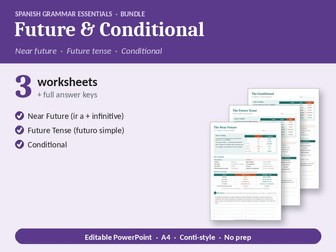
Not sure whether this bundle is right for you? TRY A FREE WORKSHEET FIRST Download my Present Tense Regular Verbs Spanish grammar worksheet FREE to see the format and style before purchasing. THIS BUNDLE Three Conti-style Spanish grammar worksheets covering how to talk about the future and what you would do: the near future, the future tense and the conditional. Each worksheet is two pages that print double-sided, plus a separate answer page. Use them as lessons, starters, homework, cover lessons or revision tasks. No prep: just print and go. Full answer keys save you marking time. Suitable for KS3 through GCSE, S1–S4 and National 4/5 Spanish, and for revision at Higher / A-Level. WHAT’S INCLUDED Near Future (ir a + infinitive) Future Tense (futuro simple) Conditional WHY THIS BUNDLE WORKS Students start with the near future, the easiest way to talk about plans, then move on to the future tense and the conditional. These two share the same irregular stems (tendr-, har-, podr-, saldr-), so learning one makes the other much easier, and together they lift students’ speaking and writing straight away. Built on Gianfranco Conti’s Extensive Processing Instruction (EPI) methodology. Students process each structure receptively before they produce it, through a sentence builder, a reading text, scaffolded practice, translation in both directions and a guided writing challenge. FORMAT Fully editable PowerPoints, A4 portrait. Last updated: 7 October 2026.
Spanish Grammar Worksheets: Complete Conti-Style Series BundleQuick View
hevo

Spanish Grammar Worksheets: Complete Conti-Style Series Bundle

16 Resources
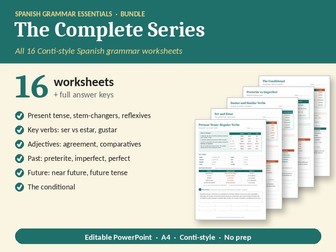
Not sure whether this bundle is right for you? TRY A FREE WORKSHEET FIRST Download my Present Tense Regular Verbs Spanish grammar worksheet FREE to see the format and style before purchasing. THIS BUNDLE All 16 Conti-style Spanish grammar worksheets in one bundle: a complete, consistent grammar resource from the present tense through to the conditional, ready for every class from beginner to exam level. Each worksheet is two pages that print double-sided, plus a separate answer page. Use them as lessons, starters, homework, cover lessons or revision tasks. No prep: just print and go. Full answer keys save you marking time. Suitable for KS3 through GCSE, S1–S4 and National 4/5 Spanish, with the advanced sheets also ideal for Higher / A-Level revision. WHAT’S INCLUDED Present tense: Regular Verbs, Irregular Verbs, Stem-Changing Verbs, Reflexive Verbs Key verbs and adjectives: Ser vs Estar, Gustar, Encantar & Interesar, Adjective Agreement, Comparatives & Superlatives Past tenses: Preterite Regular, Preterite Irregular, Imperfect, Preterite vs Imperfect, Perfect Tense Future and conditional: Near Future, Future Tense, Conditional EVERY WORKSHEET FOLLOWS THE SAME STRUCTURE A clear rule box and verb table, key language and a sentence builder, a short reading text, then scaffolded practice: choose the right form, complete the sentence, translation in both directions and a guided writing challenge. Students know exactly what to expect, so less time goes on explaining tasks and more on learning. WHY TEACHERS USE THESE SHEETS Built on Gianfranco Conti’s Extensive Processing Instruction (EPI) methodology. Students process each structure receptively before they produce it, moving from noticing, to choosing and completing, to translation, to independent writing. Ideal for a whole department sharing one consistent approach. FORMAT Fully editable PowerPoint, A4 portrait. Last updated: 7 October 2026.
Spanish Past Tenses Bundle (Conti-style): Preterite, Imperfect & PerfectQuick View
hevo

Spanish Past Tenses Bundle (Conti-style): Preterite, Imperfect & Perfect

5 Resources
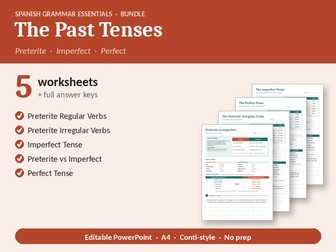
Not sure whether this bundle is right for you? TRY A FREE WORKSHEET FIRST Download my Present Tense Regular Verbs Spanish grammar worksheet FREE to see the format and style before purchasing. THIS BUNDLE Five Conti-style Spanish grammar worksheets covering every past tense students need: the regular and irregular preterite, the imperfect, when to use each, and the perfect tense. Each worksheet is two pages that print double-sided, plus a separate answer page. Use them as lessons, starters, homework, cover lessons or revision tasks. No prep: just print and go. Full answer keys save you marking time. Suitable for GCSE, S3–S4 and National 5 Spanish, and for revision at Higher / A-Level. WHAT’S INCLUDED Preterite Regular Verbs Preterite Irregular Verbs Imperfect Tense Preterite vs Imperfect Perfect Tense (haber + past participle) WHY THIS BUNDLE WORKS The sheets build in a logical order: students secure the preterite first, then the imperfect, then learn to choose between them, before adding the perfect tense. Past tenses are where many students lose marks, and this sequence tackles each one separately before combining them. Built on Gianfranco Conti’s Extensive Processing Instruction (EPI) methodology. Students process each tense receptively before they produce it, through a sentence builder, a reading text, scaffolded practice, translation in both directions and a guided writing challenge. FORMAT Fully editable PowerPoint, A4 portrait. Last updated: 7 October 2026.
Spanish Conditional Tense (me gustaría): Conti-Style WorksheetQuick View
hevo

Spanish Conditional Tense (me gustaría): Conti-Style Worksheet

(0)
Not sure whether this worksheet is right for you? TRY A FREE WORKSHEET FIRST Download my Present Tense Regular Verbs Spanish grammar worksheet FREE to see the format and style before purchasing. THIS RESOURCE A ready-to-print, Conti-style Spanish conditional tense worksheet covering regular endings, irregular stems and me gustaría, with a rule box, sentence builder and full answers. The conditional lets students say what they would do, and it lifts their speaking and writing straight away. This worksheet shows how simple the pattern is, then takes students step by step from noticing it in a text to using it in their own writing. Two pages that print double-sided, plus a separate answer page. Use it as a lesson, starter, homework, cover lesson or revision task. No prep: just print and go. The full answer key saves you marking time. Suitable for GCSE, S3–S4 and National 5 Spanish, and for revision at Higher / A-Level. WHAT’S INSIDE Page 1: Reference and reading How the conditional works, including me gustaría + infinitive Conjugation table for hablar, comer and tener Key verbs, including the irregular stems tendr-, har-, podr- and saldr- Sentence builder, with si ganara, si pudiera and si fuera taught as chunks Task 1: Short reading text. Students underline the conditional verbs and write each infinitive Page 2: Practice Task 2: Choose the right form Task 3: Complete the verb Task 4: Translate into English Task 5: Translate into Spanish Task 6: Challenge. Guided writing: what would you do if you won the lottery? Answer page Answers for every task, plus a model answer for the challenge WHY THIS ONE’S DIFFERENT Built on Gianfranco Conti’s Extensive Processing Instruction (EPI) methodology. Students process the structure receptively before they produce it, moving from noticing, to choosing and completing, to translation, to independent writing. Task 2 sets each correct form against the typical student mistake (tendría / tenería), so students learn to spot errors in their own work. The English-to-Spanish sentences only use language students have already met on the sheet. FORMAT Fully editable PowerPoint, A4 portrait. Two worksheet pages designed for double-sided printing, plus a separate answer page. Part of a Conti-style Spanish grammar worksheet series. Also available: The Perfect Tense and The Near Future. Last updated: 7 October 2026.
Spanish Preterite Tense Regular Verbs: Conti-Style WorksheetQuick View
hevo

Spanish Preterite Tense Regular Verbs: Conti-Style Worksheet

(0)
Not sure whether this worksheet is right for you? TRY A FREE WORKSHEET FIRST Download my Present Tense Regular Verbs Spanish grammar worksheet FREE to see the format and style before purchasing. THIS RESOURCE A ready-to-print, Conti-style Spanish preterite tense worksheet for regular -ar, -er and -ir verbs, with a rule box, sentence builder and full answers. The preterite is the tense students need to talk about what they did, and it is where accents start to change meaning (hablé / hablo). This worksheet makes the endings clear, then takes students step by step from noticing preterite verbs in a short text to using them accurately in translation. Two pages that print double-sided, plus a separate answer page. Use it as a lesson, starter, homework, cover lesson or revision task. WHAT’S INSIDE Page 1: Reference and reading How the preterite works, explained in plain English, including accents and the jugué spelling change Conjugation table for hablar, comer and vivir, with every ending highlighted Key verbs: eight high-frequency regular verbs Sentence builder with past time phrases and opinions (y fue genial, pero fue un desastre) Task 1: Short reading text. Students find the verbs, write each infinitive and say who did the action Page 2: Practice Task 2: Choose the right form Task 3: Complete the verb Task 4: Translate into English Task 5: Translate into Spanish Task 6: Challenge. Students rewrite present tense sentences in the preterite Answer page Answers for every task WHY THIS ONE’S DIFFERENT Built on Gianfranco Conti’s Extensive Processing Instruction (EPI) methodology. Students process the structure receptively before they produce it, moving from reading and noticing, to choosing and completing, to translation in both directions, to transforming tenses independently. Task 2 sets present against preterite forms, so students learn to use the time phrase and the accent to decide. The challenge includes a nosotros form that is identical in both tenses, so students learn to rely on the time phrase. The English-to-Spanish sentences only use language students have already met on the sheet. FORMAT Fully editable PowerPoint, A4 portrait. Two worksheet pages designed for double-sided printing, plus a separate answer page. Part of a Conti-style Spanish grammar worksheet series. Also available: The Near Future and Present Tense Irregular Verbs. Last updated: 6 October 2026.