An engaging French grammar lesson teaching pupils how to conjugate the verb habiter with different subjects, including names, nouns and groups of people.
Pupils learn how to identify the subject, link it to the correct pronoun and choose the correct form of habiter.
Includes:
PowerPoint lesson with modelling and practice
Mini-whiteboard activities
Spot-the-mistake tasks
Differentiated Lower and Medium/High worksheets
Challenges and Super Challenges
Homework
Answer slides
A fun and engaging French lesson for beginners teaching pupils how to ask and answer “How are you?” – “Comment ça va ?” in French.
Perfect for KS2 Primary French, beginner learners or pupils in their first year of learning French.
Pupils will learn to:
Ask Comment ça va ? – How are you?
Understand and use different responses, including:
Ça va très bien.
Ça va bien.
Comme ci, comme ça.
Ça ne va pas.
Ça va mal.
Use greetings such as Bonjour and Salut alongside Comment ça va ?
Take part in a simple French conversation.
Develop confidence in French speaking, reading and writing.
This resource includes:
A clear and child-friendly PowerPoint lesson
Vocabulary and pronunciation practice
Speaking and partner activities
Reading and understanding activities
Differentiated worksheets to support different abilities
Independent written practice
Homework activity
Challenge activities for more confident learners
Suitable for:
KS2 | Years 3–6 | Primary French | MFL | French Beginners | First French Lessons
This lesson is designed to be easy to pick up and teach, making it ideal for both French specialists and non-specialist primary teachers.
It can be used as a standalone lesson or as part of the Primary French for Beginners series.
No prior knowledge is required, although it works particularly well after pupils have learnt basic French greetings such as Bonjour, Salut and Au revoir.
A fun and engaging French lesson for beginners teaching pupils different ways to say goodbye in French and helping them choose the most appropriate expression for different situations.
This is Lesson 4 of the Primary French for Beginners series and is perfect for KS2 pupils and children beginning their French-learning journey.
Pupils will learn different ways to say goodbye:
Au revoir ! – Goodbye!
Salut ! – Bye!
À bientôt ! – See you soon!
À demain ! – See you tomorrow!
À plus tard ! – See you later!
À lundi ! – See you on Monday!
Bonne journée ! – Have a good day!
Bonne soirée ! – Have a good evening!
Bonne nuit ! – Good night!
Pupils will learn to:
Recognise and understand different French goodbye expressions.
Choose the correct expression for different situations.
Understand the difference between formal and informal ways of saying goodbye.
Use goodbye expressions confidently in short conversations.
Develop their French speaking, reading and writing skills.
This resource includes:
A clear and engaging PowerPoint lesson
Vocabulary and pronunciation practice
Speaking and partner activities
Reading and matching activities
Differentiated worksheets
Independent writing activities
Homework
Challenge activities for more confident learners
Perfect for:
KS2 French | Primary French | MFL | French Beginners | Years 3–6 | French Greetings | First French Lessons
The lesson is designed to be simple, visual and easy to teach, making it suitable for French specialists as well as non-specialist primary teachers.
It can be taught as a standalone French lesson or as Lesson 4 of the Primary French for Beginners series.
No advanced French knowledge is required. Pupils can quickly begin using the expressions in real classroom conversations.
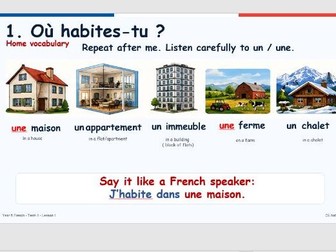
French Houses, Locations & Verb HABITER | 2-Lesson Bundle
A ready-to-teach 2-lesson French bundle on the topic “Où habites-tu ?” (Where do you live?), ideal for KS2 / Primary French.
Pupils learn how to talk about where they live, describe different types of homes and locations, and use the verb habiter (to live) in the present tense.
The bundle includes:
2 complete PowerPoint lessons
Differentiated worksheets for different ability levels
Homework for both lessons
Vocabulary on different types of houses/homes
Vocabulary to describe where someone lives
Present tense of habiter
Sentence-building activities
Reading and comprehension tasks
Translation and writing activities
Challenges for more confident learners
The activities gradually build pupils’ confidence from learning key vocabulary to producing their own French sentences.
All worksheets and homework activities are ready to print, making this a useful, time-saving resource for French teachers.
Suitable for: KS2 French / Primary French / Year 5 / Year 6 / Beginner French
Give your pupils the perfect introduction to French with this 4-lesson Primary French for Beginners bundle, designed especially for KS 2 pupils starting French from scratch.
This ready-to-teach bundle takes pupils step by step from their very first French greeting to having a simple introductory conversation with confidence.
4 Complete French Lessons Included
Lesson 1 Greetings in French
Pupils learn essential greetings such as Bonjour, Salut and Bonsoir, as well as Monsieur, Madame and Mademoiselle.
Lesson 2 Introducing My Name
Pupils learn to ask and answer:
Comment tu t’appelles ?
Je m’appelle…
They practise introducing themselves and asking someone their name.
Lesson 3 Comment ça va ? / How Are You?
Pupils learn to ask Comment ça va ? and respond in different ways, including:
Ça va très bien !
Ça va bien !
Comme ci, comme ça.
Ça ne va pas.
Ça va mal.
Lesson 4 Saying Goodbye in French
Pupils discover different ways to say goodbye and learn when to use expressions such as:
Au revoir !
Salut !
À bientôt !
À demain !
À plus tard !
Bonne journée !
Bonne soirée !
Bonne nuit !
AUDIO INCLUDED
Audio support is included to help pupils hear authentic French pronunciation and give teachers additional confidence when introducing new vocabulary.
This makes the bundle particularly useful for non-specialist primary teachers as well as French/MFL specialists.
The Bundle Includes
4 complete Power Point lessons
Audio pronunciation support
Differentiated worksheets
Homework activities
Speaking and partner activities
Reading and writing practice
Vocabulary practice
Challenges for more confident learners
Engaging activities suitable for young beginners
Perfect For
KS 2 French | Primary French | Years 3 6 | French Beginners | MFL | French Greetings | Introduction to French | Home school French
The lessons have been designed to follow a clear progression, with each lesson building naturally on the language learn t previously.
By the end of the four lessons, pupils should be able to take part in a simple introductory exchange in French using greetings, their name, asking how someone is and saying goodbye.
The resources are designed to be clear, engaging and easy to teach, with no complicated preparation required.
No prior French knowledge required.
Part of the Primary French for Beginners series , more lessons can be added to continue building pupils confidence and vocabulary.**
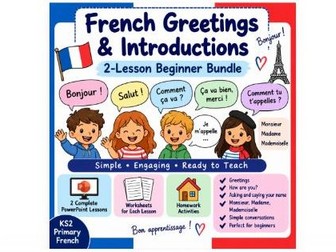
A complete 2-lesson French bundle for beginners, perfect for pupils starting to learn French for the first time.
These lessons introduce essential French greetings, introductions and simple conversational language, giving pupils the confidence to take part in their first short conversations in French.
Pupils will learn to:
Use common greetings such as Bonjour, Salut, Bonsoir, Bonne nuit and Au revoir
Understand and use Monsieur, Madame and Mademoiselle
Ask someone’s name: Comment tu t’appelles ?
Introduce themselves: Je m’appelle…
Ask how someone is: Comment ça va ?
Respond appropriately, including Ça va bien, merci
Ask and answer simple questions in French
Take part in a short introductory conversation
Develop beginner speaking, reading and writing skills
This bundle includes:
2 complete PowerPoint lessons
Worksheets linked to each lesson
Homework activities
Clear vocabulary support for beginners
Matching, completing and writing activities
Simple dialogue and conversation practice
Activities designed to build pupils’ confidence gradually
The lessons are clear, structured and beginner-friendly, making them ideal as pupils’ first French lessons or as an introduction to a greetings and introductions unit.
All resources are ready to teach and print, providing an easy-to-use and time-saving resource for teachers.
Suitable for: Beginner French / KS2 French / Primary French / Year 3 / First French Lessons
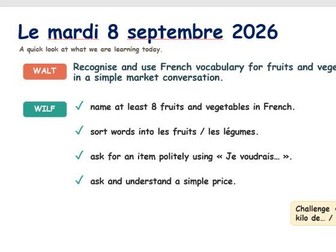
Complete KS 2 French fruits and vegetables lesson pack with Power Point, differentiated worksheets and homework. Ideal for Year 5 and beginner French.
A colorful, engaging and ready-to-teach French lesson introducing fruits and vegetables )
This complete resource pack is designed to save teachers planning time while providing pupils with a range of activities to practice and consolidate key French vocabulary.
This resource includes:
A colorful and pupil-friendly Power Point presentation
Introduction and practice of key fruit and vegetable vocabulary in French
Visual activities to support vocabulary recognition and recall
A differentiated worksheet for classroom practice
A separate homework worksheet to consolidate learning
A variety of activities including matching, labeling, vocabulary recognition and written practice
Challenge opportunities for more confident learners
The lesson is suitable for KS 2 French, particularly Year 5, but can easily be adapted for other primary year groups or beginner French learners.
Perfect for:
Primary French / M F L lessons
Non-specialist French teachers
Vocabulary introduction and consolidation
Cover lessons
Homework
Revision activities
The resources are designed to be clear, colorful and easy to use, with minimal additional preparation required.
Simply download, display the Power Point and print the accompanying worksheets ; ready to teach!
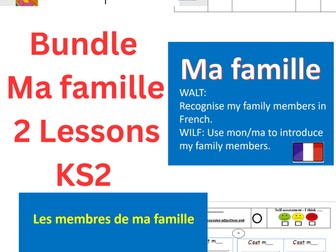
2 Full lessons of 50 min with:
-Powepoints
-differenciated worksheets
-lesson plans details
-intercative games
-flipchat
Objectives:
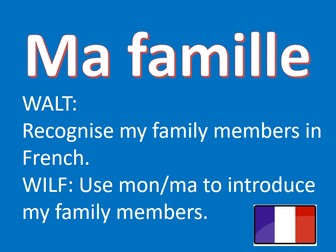
family vocab
Use c’est mon / ma
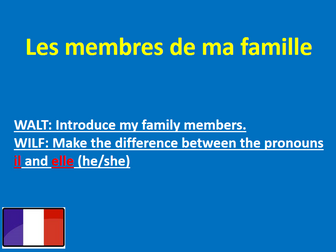
Use il /elle s’appelle
Full lesson Introduce family members using il s’appelle / elle s’appelle
Powerpoint Lesson presentation
Differenciated Worksheets with challenge / extension
Lesson plan detailed
DRICE used explicitly
Excellent for lesson observations
Year 3-4
Full lesson suitable for year 3.
Powerpoint presentation
Differenciated worksheets with challenge
Full lesson plan - excellent for lesson observations
interactive plenary with a virtual dice
DRICE used explicitly.