Reverse Percentages – Exam Practice & Multi-Step Problems (GCSE Maths)Quick View
lam218

Reverse Percentages – Exam Practice & Multi-Step Problems (GCSE Maths)

(0)
This lesson focuses on applying reverse percentages in exam-style contexts, helping students move from basic understanding to independent problem solving. Students will tackle a range of multi-step percentage problems, including price changes, salary adjustments, and real-life contexts involving both increases and decreases. Designed as the final lesson in a 3-part sequence, this resource builds confidence with less structured, exam-style questions where students must choose and apply the correct method independently. What’s included: Full lesson PowerPoint Exam-style worksheet (with Sections A, B, and C) “5-a-day” starter for retrieval practice Complete mark scheme and answers Learning Objectives: Calculate original values using reverse percentages Apply percentage increases and decreases in multi-step problems Interpret and solve exam-style questions independently Perfect for: GCSE Foundation / Higher crossover Revision lessons Building exam confidence and independence Why teachers love this: Clear progression from fluency → application → exam-style reasoning Minimal scaffolding to promote deeper thinking Ready-to-use with no prep required
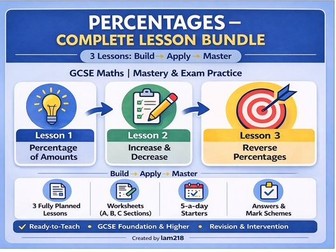
Percentages - Complete Lesson Pack (3 Lessons, Worksheets and Exam Practice) GCSE MathsQuick View
lam218

Percentages - Complete Lesson Pack (3 Lessons, Worksheets and Exam Practice) GCSE Maths

3 Resources
This complete 3-lesson pack covers everything students need to confidently understand and apply reverse percentages, progressing from core skills to full exam-style problem solving. Carefully structured to build confidence step-by-step, this bundle moves students from basic percentage understanding through to multi-step exam questions, making it ideal for both teaching and revision. Each lesson is fully resourced and ready to teach, with a consistent format that supports both teachers and students. What’s included: Lesson 1: Introduction to Reverse Percentages Understanding percentage multipliers Finding original values from simple contexts Scaffolded practice Lesson 2: Reverse Percentages – Application Applying reverse percentages in real-life contexts Increasing and decreasing percentages Building problem-solving confidence Lesson 3: Reverse Percentages – Exam Practice Multi-step exam-style questions Mixed percentage problems (increase & decrease) Independent problem solving Each lesson includes: Full lesson PowerPoint Differentiated worksheet (Sections A, B, C) “5-a-day” starter Answers and mark schemes 🎯 Skills covered: Using multipliers for percentage change Calculating original values (reverse percentages) Solving multi-step percentage problems Interpreting exam-style questions Perfect for: GCSE Maths (Foundation & Higher crossover) Revision lessons or intervention groups Building exam confidence and independence
GCSE Maths Percentage Increase & Decrease FULL LESSON + Worksheets | Foundation (Grade 3–5)Quick View
lam218

GCSE Maths Percentage Increase & Decrease FULL LESSON + Worksheets | Foundation (Grade 3–5)

(0)
Overview A complete, ready-to-teach lesson on percentage increase and decrease, designed for GCSE Maths Foundation students (Grades 3–5). This resource builds on prior knowledge of percentages and helps students confidently calculate increases and decreases using both step-by-step methods and simple multipliers. Perfect for saving planning time while developing exam-ready skills. Included Full lesson PowerPoint (starter → teach → guided practice → independent practice → exam question → plenary) 3 differentiated worksheets with exam-style questions (easy, medium, hard) 3 5-a-day retrieval starters Answers provided throughout Learning Focus Students will learn how to: Calculate percentage increase and decrease Apply percentage changes to real-life contexts Use multipliers (e.g. ×1.2, ×0.8) Solve multi-step and exam-style problems Who It’s For GCSE Maths Foundation (Grades 3–5) Students working towards a Grade 4 pass Ideal for: Whole class teaching Intervention groups Revision lessons
GCSE Maths Percentages of Amounts FULL LESSON + Worksheets | Foundation (Grade 3–5)Quick View
lam218

GCSE Maths Percentages of Amounts FULL LESSON + Worksheets | Foundation (Grade 3–5)

(0)
Overview A complete, ready-to-teach lesson on percentages of amounts, designed for GCSE Maths Foundation students (Grades 3 to 5). Perfect for saving planning time while building confidence and understanding through clear explanations, structured practice, and exam-style questions. Included Full lesson (starter -> teach -> practice -> exam questions -> plenary) 3 differentiated worksheets (easy, medium, hard) 3 5-a-day retrieval starters Exam-style questions included Answers provided throughout Learning Focus Students will learn how to: Find percentages of amounts using the 10% method Use multipliers (decimals) to calculate percentages Apply skills to real-life and exam-style problems Who it is For Maths Foundation (Grades 3 to 5) Students working towards a Grade 4 pass Ideal for: Whole class teaching Intervention groups Revision sessions Why Teachers Love This Resource No prep required, ready to teach immediately Clear step-by-step structure Differentiated for mixed ability classes Designed to build confidence and exam readiness
Planning a holidayQuick View
lam218

Planning a holiday

(1)
An investigation into planning a holiday for the Doe family, it can be used as a functional Maths lesson which requires skills from other topics. The first question was adapted from a GCSE Maths paper. Could be used as group work, individual projects or whole class discussion. The skills that it works on are: Exchange rates Reading off graphs Problem Solving Percentage decrease Bearings and Loci Reading off graphs Time Volume and surface area Although it works on all of these areas, it may be possible to solve most using common sense.
Maths Investigation - Wimbledon Strawberry sellerQuick View
lam218

Maths Investigation - Wimbledon Strawberry seller

(1)
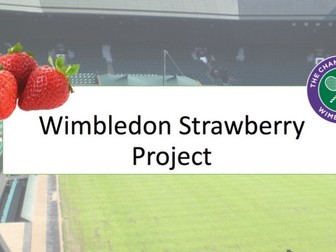
Maths investigation with interactive cost calculation spreadsheet. To easily check their working. Can be suitable for high ability Year 7s to Year 11s. This involves; Area, metric unit conversion, money calculations, 3D shapes and nets. A project to start a business as a " strawberry seller" in Wimbledon. The students are required to find their profit of starting this business, by choosing what type of strawberries to buy and setting a price for sale taking demand into account. They need to also make a net for a 3D box for their strawberries and find the area. This can be set as a single lesson with by just focussing on calculations or can be extended into a longer project. When made into a homework project, I would suggest splitting the class into teams and ask each team to make a final "presentation" possibly with a prize for the winning team. In the past, I have bought strawberries and chocolate as a prize. This includes; a PowerPoint to introduce the project a summary info sheet to make marking easier a worksheet handout with information on the project a spreadsheet with profit calculations for each type of strawberry and cost to check calculations quickly.
Easter Maths Treasure HuntQuick View
lam218

Easter Maths Treasure Hunt

(1)
A treasure hunt with worded problems as well as more simple calculations. - 20 questions. The topics include: Fractions, Area of shapes, Sequences, Problem solving questions, Conversion of units, Use of money, Speed, Distance, Time, Percentage change, Angle questions and a JMC question.
Differentiated expanding single brackets lesson and homeworkQuick View
lam218

Differentiated expanding single brackets lesson and homework

(1)
A lesson with differentiated worksheets. In the lesson, there is a starter to recap collecting like terms and once teaching expanding brackets, there are multiple choice questions for the class to assess understanding. The homework is separated in shallow deep and profound sections with feedback box.
Mixed Problems - Harkness StyleQuick View
lam218

Mixed Problems - Harkness Style

(1)
Students complete the two problems on the preparation sheet before class, discuss in the first 10-15 minutes. Then complete other problems for the rest of class. Questions increase in difficulty and touch on a range of topics, from enlargement to reciprocal sequences and graphs. Adapted from an investigation I found in "Six investigations" pdf
Easter quiz with a maths roundQuick View
lam218

Easter quiz with a maths round

(0)
Easter quiz for KS3 or KS4 for use at the end of term. Round 1 - General Easter Knowledge Round 2 - Picture round Round 3 - Maths Round Round 4 - Music Round Round 5 - Word Scramble Now includes an answer sheet. Maths round includes: Speed, Distance, Time; Sequence; Ratio
Vector WorksheetQuick View
lam218

Vector Worksheet

(5)
By the end of the lesson they should o Be able to understand what a vector is, using the correct notation o Be able to multiply a vector by a scalar o Be able to add and subtract vectors
Introduction to VectorsQuick View
lam218

Introduction to Vectors

(0)
This resource includes a fill-in worksheet with short exercises, answers and extension. The accompanying PowerPoint has a starter, and plenary as well as going step-by-step through the worksheet. By the end of the lesson students will: o Be able to understand what a vector is, using the correct notation o Be able to multiply a vector by a scalar o Be able to add and subtract vectors
D1/ D2 - Travelling Salesperson gameQuick View
lam218

D1/ D2 - Travelling Salesperson game

(1)
A Powerpoint game that can be used to help engage students in D1 and D2. Although it is made with the travelling salesperson algorithm in mind, it can also be used for Kruskal's, Prim's on a distance matrix and the nearest neighbour algorithm.
Mathematical reasoning bundleQuick View
lam218

Mathematical reasoning bundle

3 Resources
A collection of "real-life" examples of where we use Maths, providing an opportunity for students to work on problem solving and reasoning skills. Practicing speed, money, time, area, percentages and more! All include answers.
D1 - AlgorithmsQuick View
lam218

D1 - Algorithms

(0)
Lesson plans for Chapter 2 and workbook for whole D1 module with answers.