Independent basketball vocabulary work for a full period — dribble, pivot, rebound, layup, travel, foul. Seven puzzles across six pages: word search, crossword, anagrams, odd one out, missing vowels, a code-breaking secret message and a design challenge that keeps fast workers busy. Written so a non-specialist can run it with no explanation and no marking pressure. Cover-teacher instructions on the front page, complete answers with both grids solved at the back.
A period of dance terminology work that runs itself. Seven puzzles over six pages covering the vocabulary of choreography, motif, formation and performance, ending with a creative design task. Word search, crossword, anagrams, odd one out, missing vowels and a secret-message code. Front page briefs the cover teacher with timings; answers page at the back has both grids solved. Genuinely no PE knowledge required.
Football vocabulary work for a full period — header, winger, offside, corner, pressing, formation. Six pages, seven puzzles: word search, crossword, anagrams, odd one out, missing vowels, a secret-message code and a match programme design task for early finishers. Cover-teacher instructions with suggested timings, plus a complete answer page with the grids solved.
Rugby vocabulary work for a whole period — ruck, maul, scrum, lineout, conversion, offload, knock-on, fly-half. Six pages, seven puzzles ending with a match programme design task. Written for a cover teacher with no rugby background: front page says exactly what to do and how long to spend, back page has every answer including both solved grids.
Fitness vocabulary work for a whole period, built around the components of fitness and training terminology pupils meet in S3. Seven puzzles across six pages, from word search and crossword through to a code-breaking secret message and a design task. No teaching, no equipment, no PE background needed — instructions and timings on the front page, full answer key at the back.
Racquet sports vocabulary for a full period — forehand, shuttle, rally, tramlines, doubles, smash. Covers badminton and tennis terminology together, so it fits whichever racquet block the class is on. Seven puzzles over six pages, cover-teacher briefing on the front, complete answers at the back. No PE knowledge needed to run it.
Gymnastics terminology work covering shapes, balances and apparatus — straddle, pike, tuck, counter-balance. Seven puzzles across six pages, finishing with a creative design challenge. Designed for a non-specialist to hand out and supervise, with front-page instructions and timings and a full answer key including both solved grids.
Swimming terminology work for a full period — butterfly, poolside, treading, tumble turn, stroke. Particularly useful when the pool is unexpectedly closed and the class needs a classroom period at no notice. Seven puzzles across six pages, front-page cover-teacher instructions with timings, and a complete answer key.
A full period of independent athletics work for a cover teacher who knows nothing about PE. Six pages, seven puzzles: a 14x14 word search with twelve hidden athletics terms, a crossword built from the key words, anagrams, odd one out, missing vowels, a secret-message code breaker and a creative design task for early finishers. Front page tells the cover teacher exactly what to do with suggested timings, and a full answer page is included at the back. Print and hand out. Ideal for wet weather, a room change or unplanned absence.
Volleyball vocabulary work for a whole period — dig, set, spike, block, rotation, transition. Seven puzzles over six pages, from word search and crossword to a secret-message code and a design challenge. Runs with no teaching input at all. Cover-teacher instructions on the front, full answers with both grids solved at the back.
Water polo vocabulary work for a full period — treading, eggbeater, driver, centre forward, exclusion. A genuinely hard activity to find cover resources for. Seven puzzles across six pages with a creative design task at the end, front-page briefing for the cover teacher and a complete answer key.
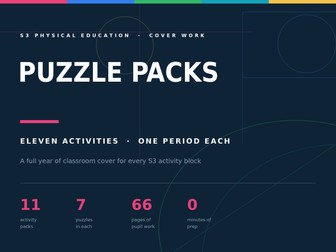
Eleven print-and-go cover lessons, one for each S3 activity block: athletics, basketball, dance, fitness, football, gymnastics, racquets, rugby, swimming, volleyball and water polo. Every pack is six pages with seven puzzles and a full answer key, and every one can be handed to a cover teacher with no PE background and no preparation. Whatever block a class is on, there is a matching pack ready to print. 66 pages of pupil work in total.
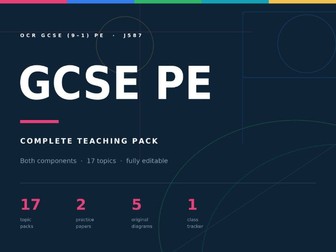
Everything you need to teach OCR GCSE (9–1) Physical Education J587 from first lesson to final exam. Over 150 files covering both written components, the NEA, planning and tracking — all fully editable, all original.
17 topic packs — 7 files in every one
• Teaching PowerPoint (25–31 slides) with learning intentions, tiered success criteria, a starter, a think-pair-share discussion, a whiteboard challenge, retrieval activities and exam practice
• Pupil workbook and a matching answer booklet
• Topic test worth 20 marks, with a full mark scheme
• A3 revision poster, plus a gap-fill version for retrieval practice
Assessment
• 17 topic tests — 340 marks of assessment in total
• Two full practice papers (J587/01 and J587/02, 60 marks each) with mark schemes, using unseen questions rather than repeating the topic tests
• Levels-of-response criteria on every extended-response question
Non-exam assessment
• J587/05 AEP coursework booklet — evidence-gathering tables, a worked model, scaffolded analysis and action plan, and a self-check page
• J587/04 practical performance record sheets for all three activities, plus a class summary
Planning and tracking
• Two-year block plan — every week of Years 10 and 11 with theory content, practical activity and assessment, colour coded
• A3 course timeline showing both years at a glance
• Class tracker spreadsheet — type names once and they pull through all seven tabs, with topic tests, mocks, NEA, AEP and an overall summary out of 200 with RAG colouring and working grades
Original diagrams
Labelled and blank skeleton, the heart and the pathway of blood, antagonistic muscle action at the elbow, the three classes of lever, and gas exchange at the alveoli. Every diagram is drawn from scratch — no stock images.
Written against specification version 2.0. Supplied as editable Word, PowerPoint and Excel files, with print-ready PDFs for the posters and diagrams.
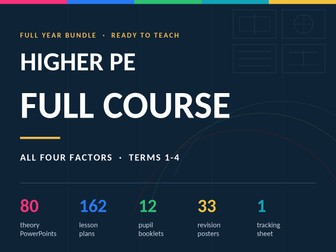
A full year of Higher PE — all four factors, every lesson planned, every pupil resource written.
This bundle is an entire Higher Physical Education course: four teaching blocks covering the physical, social, mental and emotional factors, each set in a different activity, plus the revision posters and the tracking spreadsheet that run alongside them.
It’s built and taught in a Scottish secondary PE department on a six-lesson week, splitting theory and practical so the classroom work and the practical work stay locked together — pupils analyse, then apply, then evaluate, four times over, in four different contexts.
The four blocks
Term 1 — Physical factor in badminton (8 weeks). Fartlek for cardio-respiratory endurance, repetition practice for accuracy of the overhead clear. 17 theory PowerPoints, 48 lesson plans.
Term 2 — Social factor in basketball (8 weeks). Communication and team dynamics, developed through a no-call-no-ball communication drill and team building. 24 theory PowerPoints, 48 lesson plans. Ends with the December mock.
Term 3 — Mental factor in swimming (5 weeks). Concentration and motivation, developed through simulation training and positive self-talk. 15 theory PowerPoints, 30 lesson plans.
Term 4 — Emotional factor in volleyball (6 weeks). Anger and fear, developed through deep breathing and visualisation, built to fit the 8–12 second gap between points. 24 theory PowerPoints, 36 lesson plans, with the final two weeks given over to whole-course revision on all four factors.
What’s included
80 theory PowerPoints in a single consistent slide format: learning journey, learning intentions and success criteria with the meta-skill named explicitly, colour-coded task zones, mid-lesson and end-of-lesson learning reviews, and a Teal Zone whiteboard challenge in every deck — no repeats across the whole year.
162 lesson plans — a written plan for every theory and practical lesson across all four blocks.
Four block plans, colour-coded by lesson type, so you can see the whole year at a glance.
Four pupil workbooks — one per block, matched to the theory lessons, with model answers and blanked sections.
Four PDP booklets on a deliberate fading scaffold: Term 1 fully modelled, Term 2 part-planned, Term 3 faster still, Term 4 with only one worked example so pupils write a full PDP themselves. By the exam they can do it unaided.
Four training diaries, each measuring what actually matters to that factor — RPE and session load in Term 1, calls and uncalled passes in Term 2, stroke counts and splits in Term 3, emotional triggers and routines in Term 4.
33 revision posters — a four factors overview plus a poster for every sub-factor and test, each running definition, method of gathering data, approach to develop performance, advantages and disadvantages, monitoring and evaluating, and a command words strip. Editable PowerPoint, so you can change the print size.
Tracking and monitoring spreadsheet to follow the class across the year.
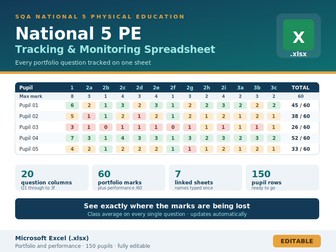
A ready-to-use Excel tracking and monitoring workbook for National 5 Physical Education — with every portfolio question tracked on a single sheet.
Type your pupil names in once and every sheet updates automatically.
Includes:
Portfolio sheet with a column for all 20 assessment items, Q1 through to 3f, with marks available shown for each
Performance sheet for both single performance events
Pupil overview — portfolio and performance combined out of 120, working grade and progress against target
Question analysis — class average on every individual question, so you can see exactly where marks are being lost
Class summary with grade distribution and section-by-section performance
Editable grade boundaries
“How to Use” sheet
Cells won’t accept a mark higher than the question is worth, and every mark shades itself green, amber or red against the marks available — so a weak answer stands out whether it’s a 1-mark or a 6-mark question.
Fully editable and built for up to 150 pupils. Ideal for tracking meetings, parents’ evenings, estimate submissions and faculty reporting.
Question wording follows the current portfolio assessment task.
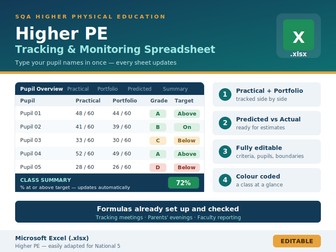
A ready-to-use Excel workbook for tracking a Higher Physical Education class across the full year. Type your pupil names in once and every sheet updates automatically.
Includes:
Pupil overview — all marks, current working grade and progress against target on one row
Practical performance tracking broken down by criteria
Portfolio tracking by section
Predicted vs actual grade comparison for estimates and reporting
Class summary with % at or above target
Editable rubric / grade boundaries
“How to Use” sheet
Fully editable — change activities, criteria, pupil numbers and boundaries to suit your department. Dropdowns and colour coding make a class at a glance take seconds. Ideal for tracking meetings, parents’ evenings and faculty reporting.
Suitable for SQA Higher PE, easily adapted for National 5.
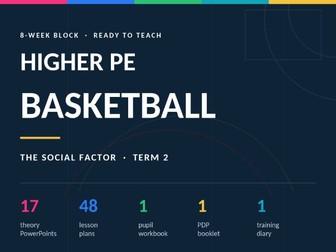
The social factor, start to finish — eight weeks of Higher PE, fully planned and fully resourced.
This bundle covers an entire Higher Physical Education block on the social factor in basketball, taking pupils from their first gathering of data on team dynamics, cooperation and communication, through a six-week Personal Development Plan, to a written evaluation of its impact on whole-team performance.
It’s built and taught in a Scottish secondary PE department on a six-lesson week, splitting theory and practical so the classroom work and the court work stay locked together — pupils analyse, then apply, then evaluate.
What’s included
17 theory PowerPoints covering the full eight weeks, in a consistent slide format: learning journey, learning intentions and success criteria with the meta-skill named explicitly, colour-coded task zones, mid-lesson and end-of-lesson learning reviews, and a Teal Zone whiteboard challenge task in every single deck — no repeats.
48 lesson plans — a written plan for every theory and practical lesson across Weeks 1–8.
Term 2 pupil workbook — matched to the theory lessons so pupils leave the block with a complete written record, including model answers and blanked sections for them to complete.
6-week PDP booklet (social factor, basketball) — a full development programme using conditioned small-sided games to develop team cooperation and rotating-role practice to develop communication and contribution to team. Includes SMARTER goal setting, worked models before pupil sections, and exam-link boxes throughout.
Team dynamics diary — worked model entries, a team contribution rating scale, a weekly PDP progression strip, a progress tracker and a full Week 8 evaluation task.
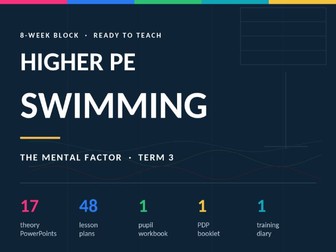
The mental factor, start to finish — eight weeks of Higher PE, fully planned and fully resourced.
This bundle covers an entire Higher Physical Education block on the mental factor in swimming, taking pupils from their first gathering of data on concentration, level of arousal and mental toughness, through a six-week Personal Development Plan, to a written evaluation of its impact on performance.
It’s built and taught in a Scottish secondary PE department on a six-lesson week, splitting theory and practical so the classroom work and the pool work stay locked together — pupils analyse, then apply, then evaluate.
What’s included
17 theory PowerPoints covering the full eight weeks, in a consistent slide format: learning journey, learning intentions and success criteria with the meta-skill named explicitly, colour-coded task zones, mid-lesson and end-of-lesson learning reviews, and a Teal Zone whiteboard challenge task in every single deck — no repeats.
48 lesson plans — a written plan for every theory and practical lesson across Weeks 1–8.
Term 3 pupil workbook — matched to the theory lessons so pupils leave the block with a complete written record, including model answers and blanked sections for them to complete.
6-week PDP booklet (mental factor, swimming) — a full development programme using mental rehearsal to develop concentration through the turn and finish, and positive self-talk to develop mental toughness over the final length. Includes SMARTER goal setting, worked models before pupil sections, and exam-link boxes throughout.
Training diary — worked model entries, a concentration and arousal rating scale, a weekly PDP progression strip, a progress tracker and a full Week 8 evaluation task.
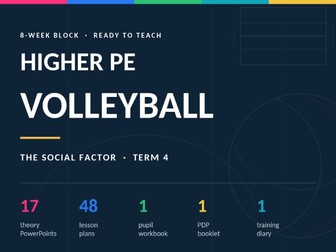
The social factor, start to finish — eight weeks of Higher PE, fully planned and fully resourced.
This bundle covers an entire Higher Physical Education block on the social factor in volleyball, taking pupils from their first gathering of data on team dynamics, communication and role-related behaviour, through a six-week Personal Development Plan, to a written evaluation of its impact on whole-team performance.
It’s built and taught in a Scottish secondary PE department on a six-lesson week, splitting theory and practical so the classroom work and the court work stay locked together — pupils analyse, then apply, then evaluate.
What’s included
17 theory PowerPoints covering the full eight weeks, in a consistent slide format: learning journey, learning intentions and success criteria with the meta-skill named explicitly, colour-coded task zones, mid-lesson and end-of-lesson learning reviews, and a Teal Zone whiteboard challenge task in every single deck — no repeats.
48 lesson plans — a written plan for every theory and practical lesson across Weeks 1–8.
Term 4 pupil workbook — matched to the theory lessons so pupils leave the block with a complete written record, including model answers and blanked sections for them to complete.
6-week PDP booklet (social factor, volleyball) — a full development programme using team-building and problem-solving tasks to develop cooperation, and structured calling routines in conditioned rallies to develop communication and cover. Includes SMARTER goal setting, worked models before pupil sections, and exam-link boxes throughout.
Training diary — worked model entries, a team contribution and communication rating scale, a weekly PDP progression strip, a progress tracker and a full Week 8 evaluation task.
S1 PE tracking that does the arithmetic for you.
One complete Excel workbook covering a full S1 year. You type your class lists in once and assess from dropdowns. Everything else — overall scores, levels, progress against target, whole-cohort figures — calculates itself.
How it works
Each activity has its own tab with the tracking criteria that genuinely fit it: balance and control for gymnastics, stamina and speed for fitness, decision making and leadership for team games, rhythm and timing for swimming. You select a level from a dropdown for each criterion and the workbook returns an overall score and level for that pupil in that block.
Assessment runs on a 9-point scale from Level 2 Bronze through to Level 4 Gold, so a pupil moving from Silver to Gold within a level registers as progress rather than standing still — which matters enormously in S1, where most of the year is spent inside a single level.
Seven activity tabs: badminton, basketball, fitness, gymnastics, swimming, team games and athletics.
What’s in the workbook
How to Use — a short guide, so a new member of staff can pick it up without a briefing
Rubric — the full 9-point scale, with the year target level as a single input cell
Seven activity tabs — dropdowns on the criteria columns, conditional Bronze/Silver/Gold colour, frozen headers, hidden working columns, space for 200 pupils
Pupil Overall — every pupil’s results across all seven blocks on one screen, with an “against target” column
Summary — whole-cohort view including the percentage of pupils at or above target
Criteria Breakdown — what each criterion actually means, in pupil-friendly descriptors, for every activity
Pitched for S1
Set for second into third level, with the target at Level 2 Silver–Gold — realistic for pupils arriving from a dozen different primaries with wildly different experience. If your department pitches differently, change the target cell on the Rubric tab and every calculation across the workbook follows it.
Why teachers use it
Reporting stops being a weekend job. The summary figures are already there when the deadline lands.
It standardises a department. Everyone assessing against the same named criteria and the same descriptors, rather than four teachers’ four readings of “good”.
Criteria are visible to pupils. The breakdown sheet is written to be shown, not filed.
Fully editable — rename activities, swap criteria, reword descriptors or adjust the scale to match your own tracking policy.
Who it’s for
Scottish secondary PE departments tracking S1 Broad General Education — particularly departments building a tracking system from scratch, or replacing one that’s grown unwieldy.
Please note: the matching S1 lesson slides and S1 lesson plans are listed separately. The slide set shows pupils which criterion is being tracked in each lesson, so the two work well together.
Everything you need to teach S1 PE for a full session — planning, delivery and tracking in one download.
Three resources built to work together, not three resources that happen to cover the same year:
What’s included
84 lesson plans — a complete, timed plan for every lesson. Lesson title, facility, equipment, CfE outcome and prior learning; learning intention with good / great / even better criteria; three named meta-skills; a six-phase timed structure from arrival through to plenary, with the teaching activity and the teaching points and questioning alongside it; concrete support and challenge adaptations; activity-specific safety points; plenary questions written out; and a one-line link forward to the next lesson.
84 lesson slides — one per lesson, in a two-column layout designed to be read from the back of a games hall. Starter, learning intention, the three tiered criteria, the meta-skills for that lesson, and the criterion being tracked that day. Each block also has a title slide, a six-week journey overview and a “how you are tracked” ladder slide.
1 tracking workbook — assess from dropdowns against the criteria for each activity and the overall scores and levels calculate themselves. A 9-point scale from Level 2 Bronze to Level 4 Gold, a Pupil Overall sheet with an against-target column, a whole-cohort Summary including the percentage at or above target, and a Criteria Breakdown written in pupil-friendly language.
Seven activity blocks: badminton, basketball, fitness, gymnastics, swimming, team games and athletics — six weeks each, two lessons a week.
The six-week arc
Every block follows the same progression, so pupils recognise the shape of a unit whichever activity they’re in: Week 1 fundamentals, Week 2 core skills, Week 3 practise and consolidate, Week 4 combine and apply, Week 5 cooperate and compete, Week 6 perform and evaluate.
Why buy the bundle
The three parts reference each other. Same criteria, same language, same week structure.
It survives being handed over — detailed enough for a probationer, a non-specialist or a supply teacher to pick up and run without a briefing.
Reporting is already done by the time the deadline lands.
Third-level HWB outcomes mapped throughout.
Fully editable — Word, PowerPoint and Excel. Swap activities, reword intentions, change the target level.
Who it’s for
Scottish secondary PE departments delivering S1 Broad General Education, especially those rebuilding S1 from scratch, standardising practice across a team, or mentoring probationers.