This is a resource created for Year 5 children to have a bit of fun and practice their factors and multiples. There are 4 different challenge cards that help them retrieve a digit to unlock a code.
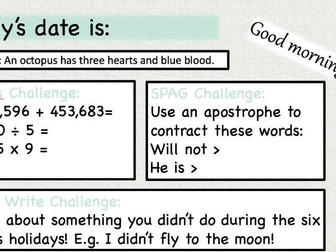
his editable Week 1 morning work resource is designed for Year 6 and includes a range of short activities to settle pupils, encourage independent learning and reinforce key skills.
Each daily slide includes:
Space for the date
A fun fact of the day
A maths challenge
A SPaG challenge
A quick writing prompt
Perfect for the first week back, morning registration, early finishers or as a calm start to the school day. Simply display the slides on your interactive whiteboard and let pupils get started as they arrive.
This is the fourth lesson in the Mayans sequence. It explores both the Mayan civilisation and compares it with the Roman civilisation.
It was initially created for Y5/6 students.
This is the third lesson in a sequence of Mayans. It explores Chichen Itza and its significance under 4 different themes.
It was originally created for Y5/6 students.
This is the fifth lesson in the Ancient Maya sequence. It uses sources to compare the Maya, Greek and Egyptian civilisations.
It was originally created for Y5/6 students.
This is the sixth and final lesson of the Maya sequence of learning. It explores the reasons why the Maya civilisation collapsed. It also includes a source analysis.
It was originally created for Y5/6 children.
This lesson is the first in a series. It starts by recapping prior knowledge in other civilisations. Then it identifies were the Mayans sit within the chronology. It then talks about the Mayans and who they were briefly to be deepened across the topic. It was initially designed for Y5/6 students.
This is the 2nd lesson in the Mayan’s scheme of work. It explores 3 famous Mayan cities and how they were ruled. The task is to identify the individualities and similarities between all 3 Mayan cities.
It was originally made for Year 5/6 students.
A slideshow and worksheet based around the UK national curriculum objective for place value in year 6 - identifying numbers to 1,000,000. It includes basic retrieval, an active maths activity, main teaching slides and a worksheet. Fluency, reasoning and problem solving questions are included.
A reading comprehension all about the climate and weather in the UK created as a part of our recovery curriculum. It aids reading comprehension in the foundation subject Geography. The text comes with 4 questions linked to VIPERS. There is also a simpler version for LA/SEN.
A resource I created in my training year as a self-assessment tool. Editable to allow you to type in the success criteria. Stick in the children’s books and let them tick once they’ve achieved that aim.
A brilliant resource to help communicate with your TA when you’re both mega busy! I made this in my training year to help communicate with my teaching assistant who had 1 million and 1 responsibilities and often didn’t have time for that sit down chat.
A brilliant resource for the coordinating conjunctions; and, but, or
An activity worksheet aimed at year 1/2 level but created for a year 3 intervention.
A resource I made in my training year to evidence several standards/sub-standards. Perfect assessment tool to make notes and evaluate the end of your lessons.
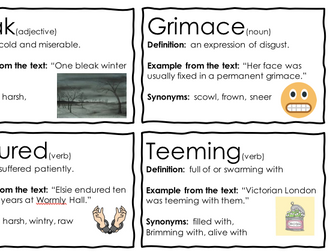
I have made vocabulary cards for the book “The Ice Monster” written by David Walliams. I use these to teach the vocabulary prior to reading each chapter or as we come across the word. The children can then add to them as and when they hear new vocabulary within the book.
It includes the word, the example of it in the text and some synonyms for the word. This is then left as a resource that children can use to help them with their writing.
A VIPERS based reading comprehension activity created as a part of the “catch up curriculum” in our school. Aims to develop reading comprehension skills of the children in foundation subjects. Used as a starter before the main teaching. Includes questions based around VIPERS:
Vocabulary
Inference
Prediction
Explanation
Retrieval
Summary
Has a main class one as well as a differentiated version for those who need extra support.
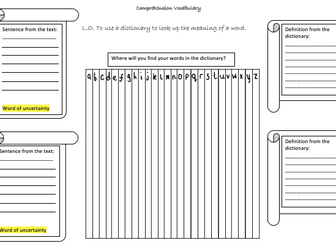
Covers the Year 3 Reading domain for Comprehension - Vocabulary. Content domain: give/explain the meaning of words in context.
This can be used as a whole class starter, a guided reading activity or simply just an English lesson. It covers the reading comprehension vocabulary content domain for the Year 3 national curriculum. 3 activities/ worksheets scaffolding the vocabulary skills. Can be edited and adapted for differentiation.