
BTEC Applied Science Unit 1 Physics: Features of waves (C01) - worksheet + answersQuick View
rocheaji

BTEC Applied Science Unit 1 Physics: Features of waves (C01) - worksheet + answers

(0)
A complete, ready-to-teach lesson for Unit 1 (Principles and Applications of Science I), physics section: amplitude, wavelength, frequency, period, speed and phase. Learning objectives: Define amplitude, wavelength, frequency, period and wave speed. Use f = 1/T with correct units and prefixes. Explain what phase and phase difference mean. Explain that waves transfer energy without transferring matter. What’s included: Student worksheet (PDF and editable Word) Teacher version with model answers and mark schemes (PDF and editable Word) Teacher notes: lesson flow, common misconceptions and practical/safety notes Retrieval starter (5 marks) Structured tasks with key-idea boxes and clear diagrams Check for Understanding quiz (10 marks) with a confidence self-assessment Exam-style practice (15 marks), ending with a levels-marked 6-mark question with indicative content Specification coverage: C1 - Features of waves: amplitude, wavelength, frequency, period, speed, displacement and phase. About 60 minutes of teaching; the exam-style section works in class or as homework. All questions are original. Written for the Pearson BTEC Level 3 Nationals in Applied Science. Not endorsed by Pearson. Single-school licence.

BTEC Applied Science Unit 1 Physics: Wave graphs (C02) - worksheet + answersQuick View
rocheaji

BTEC Applied Science Unit 1 Physics: Wave graphs (C02) - worksheet + answers

(0)
A complete, ready-to-teach lesson for Unit 1 (Principles and Applications of Science I), physics section: displacement-distance and displacement-time graphs of waves. Learning objectives: Distinguish between displacement-distance and displacement-time graphs. Read amplitude and wavelength from a displacement-distance graph. Read amplitude, period and frequency from a displacement-time graph. Combine both graphs to calculate wave speed. What’s included: Student worksheet (PDF and editable Word) Teacher version with model answers and mark schemes (PDF and editable Word) Teacher notes: lesson flow, common misconceptions and practical/safety notes Retrieval starter (5 marks) Structured tasks with key-idea boxes and clear diagrams Check for Understanding quiz (10 marks) with a confidence self-assessment Exam-style practice (15 marks), ending with a levels-marked 6-mark question with indicative content Specification coverage: C1 - Features of waves: graphical representations of waves: displacement against distance and displacement against time. About 60 minutes of teaching; the exam-style section works in class or as homework. All questions are original. Written for the Pearson BTEC Level 3 Nationals in Applied Science. Not endorsed by Pearson. Single-school licence.
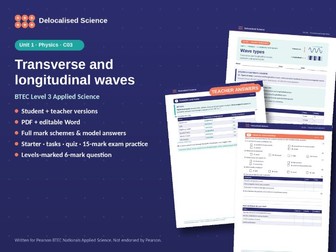
BTEC Applied Science Unit 1 Physics: Transverse and longitudinal waves (C03) - worksheet + answersQuick View
rocheaji

BTEC Applied Science Unit 1 Physics: Transverse and longitudinal waves (C03) - worksheet + answers

(0)
A complete, ready-to-teach lesson for Unit 1 (Principles and Applications of Science I), physics section: transverse and longitudinal waves, examples and polarisation. Learning objectives: Describe the difference between transverse and longitudinal waves. Identify compressions and rarefactions in a longitudinal wave. Classify examples of waves, including mechanical and electromagnetic. Explain polarisation as evidence that a wave is transverse. What’s included: Student worksheet (PDF and editable Word) Teacher version with model answers and mark schemes (PDF and editable Word) Teacher notes: lesson flow, common misconceptions and practical/safety notes Retrieval starter (5 marks) Structured tasks with key-idea boxes and clear diagrams Check for Understanding quiz (10 marks) with a confidence self-assessment Exam-style practice (15 marks), ending with a levels-marked 6-mark question with indicative content Specification coverage: C1 - Types of wave: transverse and longitudinal waves, with examples; mechanical and electromagnetic waves. About 60 minutes of teaching; the exam-style section works in class or as homework. All questions are original. Written for the Pearson BTEC Level 3 Nationals in Applied Science. Not endorsed by Pearson. Single-school licence.
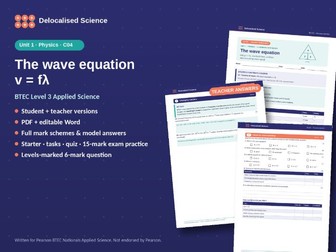
BTEC Applied Science Unit 1 Physics: The wave equation v = fλ (C04) - worksheet + answersQuick View
rocheaji

BTEC Applied Science Unit 1 Physics: The wave equation v = fλ (C04) - worksheet + answers

(0)
A complete, ready-to-teach lesson for Unit 1 (Principles and Applications of Science I), physics section: using the wave equation, standard form, prefixes and measuring wave speed. Learning objectives: Use the wave equation v = fλ, including rearranging. Use standard form and prefixes correctly. Describe how to measure the speed of water waves and of sound. Explain what happens to frequency, wavelength and speed when a wave enters a new medium. What’s included: Student worksheet (PDF and editable Word) Teacher version with model answers and mark schemes (PDF and editable Word) Teacher notes: lesson flow, common misconceptions and practical/safety notes Retrieval starter (5 marks) Structured tasks with key-idea boxes and clear diagrams Check for Understanding quiz (10 marks) with a confidence self-assessment Exam-style practice (15 marks), ending with a levels-marked 6-mark question with indicative content Specification coverage: C1 - Features of waves: the wave equation v = fλ. About 60 minutes of teaching; the exam-style section works in class or as homework. All questions are original. Written for the Pearson BTEC Level 3 Nationals in Applied Science. Not endorsed by Pearson. Single-school licence.
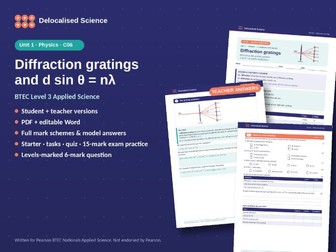
BTEC Applied Science Unit 1 Physics: Diffraction gratings (C06) - worksheet + answersQuick View
rocheaji

BTEC Applied Science Unit 1 Physics: Diffraction gratings (C06) - worksheet + answers

(0)
A complete, ready-to-teach lesson for Unit 1 (Principles and Applications of Science I), physics section: diffraction, the grating equation and its applications. Learning objectives: Describe diffraction and the effect of gap size. Use the grating equation d sin θ = nλ, including finding d from lines per mm. Find the maximum order visible. Describe how to measure the wavelength of laser light with a grating. What’s included: Student worksheet (PDF and editable Word) Teacher version with model answers and mark schemes (PDF and editable Word) Teacher notes: lesson flow, common misconceptions and practical/safety notes Retrieval starter (5 marks) Structured tasks with key-idea boxes and clear diagrams Check for Understanding quiz (10 marks) with a confidence self-assessment Exam-style practice (15 marks), ending with a levels-marked 6-mark question with indicative content Specification coverage: C1 - Diffraction: diffraction of waves and the use of diffraction gratings. C1 - Diffraction: the grating equation d sin θ = nλ. About 60 minutes of teaching; the exam-style section works in class or as homework. All questions are original. Written for the Pearson BTEC Level 3 Nationals in Applied Science. Not endorsed by Pearson. Single-school licence.

BTEC Applied Science Unit 1 Physics: Superposition (C05) - worksheet + answersQuick View
rocheaji

BTEC Applied Science Unit 1 Physics: Superposition (C05) - worksheet + answers

(0)
A complete, ready-to-teach lesson for Unit 1 (Principles and Applications of Science I), physics section: superposition, interference, coherence, path difference and phase difference. Learning objectives: State the principle of superposition. Explain constructive and destructive interference. Define coherence and explain why it is needed for a stable pattern. Use path difference to predict maxima and minima. What’s included: Student worksheet (PDF and editable Word) Teacher version with model answers and mark schemes (PDF and editable Word) Teacher notes: lesson flow, common misconceptions and practical/safety notes Retrieval starter (5 marks) Structured tasks with key-idea boxes and clear diagrams Check for Understanding quiz (10 marks) with a confidence self-assessment Exam-style practice (15 marks), ending with a levels-marked 6-mark question with indicative content Specification coverage: C1 - Superposition: the principle of superposition; constructive and destructive interference. C1 - Superposition: coherence, path difference and phase difference. About 60 minutes of teaching; the exam-style section works in class or as homework. All questions are original. Written for the Pearson BTEC Level 3 Nationals in Applied Science. Not endorsed by Pearson. Single-school licence.
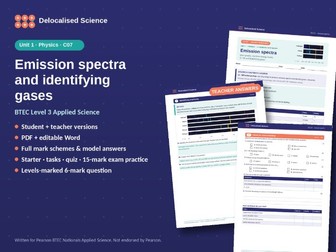
BTEC Applied Science Unit 1 Physics: Emission spectra (C07) - worksheet + answersQuick View
rocheaji

BTEC Applied Science Unit 1 Physics: Emission spectra (C07) - worksheet + answers

(0)
A complete, ready-to-teach lesson for Unit 1 (Principles and Applications of Science I), physics section: line spectra, electron energy levels, photon energy and identifying gases. Learning objectives: Explain how line emission spectra are produced. Use E = hf and E = hc/λ. Use spectra to identify elements in a gas. Explain uses of spectroscopy, for example in astronomy and street lighting. What’s included: Student worksheet (PDF and editable Word) Teacher version with model answers and mark schemes (PDF and editable Word) Teacher notes: lesson flow, common misconceptions and practical/safety notes Retrieval starter (5 marks) Structured tasks with key-idea boxes and clear diagrams Check for Understanding quiz (10 marks) with a confidence self-assessment Exam-style practice (15 marks), ending with a levels-marked 6-mark question with indicative content Specification coverage: C1 - Diffraction gratings: use of gratings to produce emission spectra and identify gases / elements. About 60 minutes of teaching; the exam-style section works in class or as homework. All questions are original. Written for the Pearson BTEC Level 3 Nationals in Applied Science. Not endorsed by Pearson. Single-school licence.
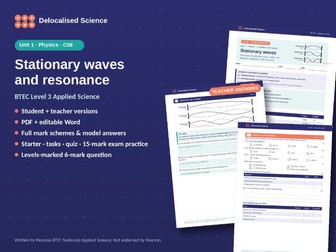
BTEC Applied Science Unit 1 Physics: Stationary waves and resonance (C08) - worksheet + answersQuick View
rocheaji

BTEC Applied Science Unit 1 Physics: Stationary waves and resonance (C08) - worksheet + answers

(0)
A complete, ready-to-teach lesson for Unit 1 (Principles and Applications of Science I), physics section: formation of stationary waves, nodes and antinodes, harmonics and resonance. Learning objectives: Explain how a stationary wave forms by superposition. Identify nodes and antinodes and state the distance between them. Relate string length to wavelength and frequency for harmonics. Explain resonance with examples. What’s included: Student worksheet (PDF and editable Word) Teacher version with model answers and mark schemes (PDF and editable Word) Teacher notes: lesson flow, common misconceptions and practical/safety notes Retrieval starter (5 marks) Structured tasks with key-idea boxes and clear diagrams Check for Understanding quiz (10 marks) with a confidence self-assessment Exam-style practice (15 marks), ending with a levels-marked 6-mark question with indicative content Specification coverage: C1 - Stationary waves: formation of stationary waves; nodes and antinodes; harmonics. C1 - Stationary waves: resonance and its applications. About 60 minutes of teaching; the exam-style section works in class or as homework. All questions are original. Written for the Pearson BTEC Level 3 Nationals in Applied Science. Not endorsed by Pearson. Single-school licence.

BTEC Applied Science Unit 1 Physics: Musical instruments (C09) - worksheet + answersQuick View
rocheaji

BTEC Applied Science Unit 1 Physics: Musical instruments (C09) - worksheet + answers

(0)
A complete, ready-to-teach lesson for Unit 1 (Principles and Applications of Science I), physics section: stationary waves in strings and pipes, wave speed on a string, pitch and timbre. Learning objectives: Use v = √(T/μ) to find the speed of a wave on a string. Calculate the fundamental frequency of a string. Explain how string length, tension and mass per unit length affect pitch. Describe stationary waves in pipes and explain timbre. What’s included: Student worksheet (PDF and editable Word) Teacher version with model answers and mark schemes (PDF and editable Word) Teacher notes: lesson flow, common misconceptions and practical/safety notes Retrieval starter (5 marks) Structured tasks with key-idea boxes and clear diagrams Check for Understanding quiz (10 marks) with a confidence self-assessment Exam-style practice (15 marks), ending with a levels-marked 6-mark question with indicative content Specification coverage: C1 - Stationary waves: stationary waves in musical instruments; the speed of a wave on a string. About 60 minutes of teaching; the exam-style section works in class or as homework. All questions are original. Written for the Pearson BTEC Level 3 Nationals in Applied Science. Not endorsed by Pearson. Single-school licence.

BTEC Applied Science Unit 1 Biology Bundle | 17 Complete LessonsQuick View
rocheaji

BTEC Applied Science Unit 1 Biology Bundle | 17 Complete Lessons

15 Resources
Every paid biology lesson for BTEC Level 3 Applied Science Unit 1 (Principles and Applications of Science I) in one download: 17 complete, ready-to-teach lessons, saving over half compared with buying them individually. Lessons included: B01 Cell theory and animal cell ultrastructure B02 Plant cells B03 Prokaryotic cells B04 Gram staining and antibiotics B05 Microscopy: light, TEM and SEM B07 Specialised plant cells B08 Specialised animal cells B09 Squamous epithelium, alveoli and COPD B10 Ciliated columnar epithelium and goblet cells B11 Endothelium and atherosclerosis B12 Skeletal muscle and sliding filament theory B13 Fast and slow twitch muscle fibres B14 Neurones, reflex arcs and myelination B15 Action potentials and saltatory conduction B16 Interpreting nerve, ECG and EEG traces B17 Synapses and acetylcholine B18 Dopamine, serotonin, Parkinson’s and depression (B06 Magnification calculations is available free in the shop.) Every lesson includes: Student and teacher versions in PDF and editable Word Teacher notes with lesson flow, misconceptions and practical/safety notes Retrieval starter, structured tasks and a Check for Understanding quiz 15-mark exam-style practice ending with a levels-marked 6-mark question and indicative content Consistent layout across every lesson, so students always know what to expect. All questions are original. Written for the Pearson BTEC Level 3 Nationals in Applied Science. Not endorsed by Pearson. Single-school licence.

Dopamine, Serotonin, Parkinson's and Depression | BTEC Applied ScienceQuick View
rocheaji

Dopamine, Serotonin, Parkinson's and Depression | BTEC Applied Science

(0)
A complete, ready-to-teach lesson for Unit 1 (Principles and Applications of Science I), biology section: neurotransmitters, Parkinson’s disease, depression and drug treatments. Learning objectives: Describe the roles of dopamine and serotonin. Explain how Parkinson’s disease is linked to a lack of dopamine and how L-Dopa helps. Explain how depression may be linked to low serotonin and how SSRIs work. Evaluate drug treatments, including side effects. What’s included: Student worksheet (PDF and editable Word) Teacher version with model answers and mark schemes (PDF and editable Word) Teacher notes: lesson flow, common misconceptions and practical/safety notes Retrieval starter (5 marks) Structured tasks with key-idea boxes and clear diagrams Check for Understanding quiz (10 marks) with a confidence self-assessment Exam-style practice (15 marks), ending with a levels-marked 6-mark question with indicative content Specification coverage: B2 · Nervous tissue: the roles of dopamine and serotonin in the brain. B2 · Nervous tissue: imbalances in neurotransmitters in Parkinson’s disease and depression, and the use of L-Dopa and other drugs. About 60 minutes of teaching; the exam-style section works in class or as homework. All questions are original. Written for the Pearson BTEC Level 3 Nationals in Applied Science. Not endorsed by Pearson. Single-school licence.
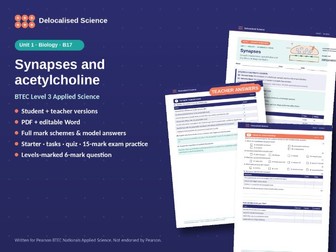
Synapses, Acetylcholine, Drugs and Toxins | BTEC Applied ScienceQuick View
rocheaji

Synapses, Acetylcholine, Drugs and Toxins | BTEC Applied Science

(0)
A complete, ready-to-teach lesson for Unit 1 (Principles and Applications of Science I), biology section: synaptic transmission, acetylcholine and the effects of drugs and toxins. Learning objectives: Describe the structure of a synapse. Describe the sequence of events in transmission at a cholinergic synapse. Explain the role of acetylcholinesterase. Explain why synapses are unidirectional, and how drugs and toxins affect them. What’s included: Student worksheet (PDF and editable Word) Teacher version with model answers and mark schemes (PDF and editable Word) Teacher notes: lesson flow, common misconceptions and practical/safety notes Retrieval starter (5 marks) Structured tasks with key-idea boxes and clear diagrams Check for Understanding quiz (10 marks) with a confidence self-assessment Exam-style practice (15 marks), ending with a levels-marked 6-mark question with indicative content Specification coverage: B2 · Nervous tissue: the structure of a cholinergic synapse and the role of acetylcholine. B2 · Nervous tissue: the sequence of events in synaptic transmission. About 60 minutes of teaching; the exam-style section works in class or as homework. All questions are original. Written for the Pearson BTEC Level 3 Nationals in Applied Science. Not endorsed by Pearson. Single-school licence.

Interpreting Nerve, ECG and EEG Traces | BTEC Applied ScienceQuick View
rocheaji

Interpreting Nerve, ECG and EEG Traces | BTEC Applied Science

(0)
A complete, ready-to-teach lesson for Unit 1 (Principles and Applications of Science I), biology section: nerve impulse recordings, ECG traces and EEG brain-wave patterns. Learning objectives: Interpret recordings of action potentials to compare stimulus strength. Identify the P wave, QRS complex and T wave of an ECG and link them to the heart. Calculate heart rate from an ECG and recognise abnormal traces. Interpret EEG traces to identify brain states. What’s included: Student worksheet (PDF and editable Word) Teacher version with model answers and mark schemes (PDF and editable Word) Teacher notes: lesson flow, common misconceptions and practical/safety notes Retrieval starter (5 marks) Structured tasks with key-idea boxes and clear diagrams Check for Understanding quiz (10 marks) with a confidence self-assessment Exam-style practice (15 marks), ending with a levels-marked 6-mark question with indicative content Specification coverage: B2 · Nervous tissue: interpreting recordings of nerve impulses. B2 · Nervous tissue: interpreting electrocardiogram (ECG) and electroencephalogram (EEG) traces. About 60 minutes of teaching; the exam-style section works in class or as homework. All questions are original. Note: some questions ask students to measure from the page, so print at 100% scale (not “fit to page”). Written for the Pearson BTEC Level 3 Nationals in Applied Science. Not endorsed by Pearson. Single-school licence.
Action Potentials and Saltatory Conduction | BTEC Applied ScienceQuick View
rocheaji

Action Potentials and Saltatory Conduction | BTEC Applied Science

(0)
A complete, ready-to-teach lesson for Unit 1 (Principles and Applications of Science I), biology section: resting potential, action potentials and saltatory conduction. Learning objectives: Explain how the resting potential is maintained. Describe the stages of an action potential and the ion movements involved. Explain the all-or-nothing principle and the refractory period. Explain how an impulse is propagated, including saltatory conduction. What’s included: Student worksheet (PDF and editable Word) Teacher version with model answers and mark schemes (PDF and editable Word) Teacher notes: lesson flow, common misconceptions and practical/safety notes Retrieval starter (5 marks) Structured tasks with key-idea boxes and clear diagrams Check for Understanding quiz (10 marks) with a confidence self-assessment Exam-style practice (15 marks), ending with a levels-marked 6-mark question with indicative content Specification coverage: B2 · Nervous tissue: the resting potential and the generation of an action potential. B2 · Nervous tissue: propagation of the impulse and saltatory conduction. About 60 minutes of teaching; the exam-style section works in class or as homework. All questions are original. Written for the Pearson BTEC Level 3 Nationals in Applied Science. Not endorsed by Pearson. Single-school licence.
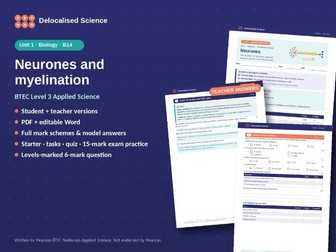
Neurones, Reflex Arcs and Myelination | BTEC Applied Science Unit 1Quick View
rocheaji

Neurones, Reflex Arcs and Myelination | BTEC Applied Science Unit 1

(0)
A complete, ready-to-teach lesson for Unit 1 (Principles and Applications of Science I), biology section: the structure of neurones, types of neurone, reflex arcs and the role of myelination. Learning objectives: Identify the parts of a motor neurone. Compare sensory, relay and motor neurones. Describe a reflex arc. Explain how myelination increases the speed of conduction, and the effects of demyelination. What’s included: Student worksheet (PDF and editable Word) Teacher version with model answers and mark schemes (PDF and editable Word) Teacher notes: lesson flow, common misconceptions and practical/safety notes Retrieval starter (5 marks) Structured tasks with key-idea boxes and clear diagrams Check for Understanding quiz (10 marks) with a confidence self-assessment Exam-style practice (15 marks), ending with a levels-marked 6-mark question with indicative content Specification coverage: B2 · Nervous tissue: the structure and function of sensory, relay and motor neurones. B2 · Nervous tissue: the role of the myelin sheath and Schwann cells. About 60 minutes of teaching; the exam-style section works in class or as homework. All questions are original. Written for the Pearson BTEC Level 3 Nationals in Applied Science. Not endorsed by Pearson. Single-school licence.
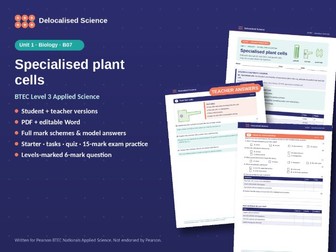
Specialised Plant Cells: Palisade, Root Hair, Guard | BTEC Applied ScienceQuick View
rocheaji

Specialised Plant Cells: Palisade, Root Hair, Guard | BTEC Applied Science

(0)
A complete, ready-to-teach lesson for Unit 1 (Principles and Applications of Science I), biology section: palisade mesophyll, root hair and guard cells, and how their structure relates to function. Learning objectives: Explain what is meant by cell specialisation. Describe how palisade cells are adapted for photosynthesis. Describe how root hair cells are adapted for absorbing water and mineral ions. Explain how guard cells control gas exchange. What’s included: Student worksheet (PDF and editable Word) Teacher version with model answers and mark schemes (PDF and editable Word) Teacher notes: lesson flow, common misconceptions and practical/safety notes Retrieval starter (5 marks) Structured tasks with key-idea boxes and clear diagrams Check for Understanding quiz (10 marks) with a confidence self-assessment Exam-style practice (15 marks), ending with a levels-marked 6-mark question with indicative content Specification coverage: B1 · Specialised cells: the structure and function of specialised plant cells, e.g. palisade mesophyll and root hair cells. About 60 minutes of teaching; the exam-style section works in class or as homework. All questions are original. Written for the Pearson BTEC Level 3 Nationals in Applied Science. Not endorsed by Pearson. Single-school licence.
Squamous Epithelium, Alveoli and COPD | BTEC Applied Science Unit 1Quick View
rocheaji

Squamous Epithelium, Alveoli and COPD | BTEC Applied Science Unit 1

(0)
A complete, ready-to-teach lesson for Unit 1 (Principles and Applications of Science I), biology section: squamous epithelium in the alveoli, gas exchange and the effects of COPD. Learning objectives: Describe the structure of squamous epithelium. Explain how the alveoli are adapted for gas exchange. Use Fick’s law qualitatively to explain the rate of diffusion. Explain how COPD reduces gas exchange and its effects on the body. What’s included: Student worksheet (PDF and editable Word) Teacher version with model answers and mark schemes (PDF and editable Word) Teacher notes: lesson flow, common misconceptions and practical/safety notes Retrieval starter (5 marks) Structured tasks with key-idea boxes and clear diagrams Check for Understanding quiz (10 marks) with a confidence self-assessment Exam-style practice (15 marks), ending with a levels-marked 6-mark question with indicative content Specification coverage: B2 · Epithelial tissue: the structure and function of squamous epithelium in the alveoli. B2 · Epithelial tissue: the effect of chronic obstructive pulmonary disease (COPD) on gas exchange. About 60 minutes of teaching; the exam-style section works in class or as homework. All questions are original. Written for the Pearson BTEC Level 3 Nationals in Applied Science. Not endorsed by Pearson. Single-school licence.
Specialised Animal Cells: Sperm, Egg, RBC, Neutrophil | BTEC Applied ScienceQuick View
rocheaji

Specialised Animal Cells: Sperm, Egg, RBC, Neutrophil | BTEC Applied Science

(0)
A complete, ready-to-teach lesson for Unit 1 (Principles and Applications of Science I), biology section: sperm, egg cells, red blood cells and neutrophils, and how their structure relates to function. Learning objectives: Describe how sperm and egg cells are adapted for reproduction. Explain how red blood cells are adapted to carry oxygen. Explain how neutrophils are adapted to destroy pathogens. Link organelle numbers to cell function. What’s included: Student worksheet (PDF and editable Word) Teacher version with model answers and mark schemes (PDF and editable Word) Teacher notes: lesson flow, common misconceptions and practical/safety notes Retrieval starter (5 marks) Structured tasks with key-idea boxes and clear diagrams Check for Understanding quiz (10 marks) with a confidence self-assessment Exam-style practice (15 marks), ending with a levels-marked 6-mark question with indicative content Specification coverage: B1 · Specialised cells: the structure and function of specialised animal cells, e.g. sperm, egg, erythrocytes and neutrophils. About 60 minutes of teaching; the exam-style section works in class or as homework. All questions are original. Written for the Pearson BTEC Level 3 Nationals in Applied Science. Not endorsed by Pearson. Single-school licence.
Ciliated Columnar Epithelium and Goblet Cells | BTEC Applied ScienceQuick View
rocheaji

Ciliated Columnar Epithelium and Goblet Cells | BTEC Applied Science

(0)
A complete, ready-to-teach lesson for Unit 1 (Principles and Applications of Science I), biology section: ciliated columnar epithelium and goblet cells in the airways, and the effects of smoking. Learning objectives: Describe the structure of ciliated columnar epithelium. Explain the roles of goblet cells and ciliated cells. Explain how the mucociliary escalator protects the lungs. Explain how smoking damages this tissue. What’s included: Student worksheet (PDF and editable Word) Teacher version with model answers and mark schemes (PDF and editable Word) Teacher notes: lesson flow, common misconceptions and practical/safety notes Retrieval starter (5 marks) Structured tasks with key-idea boxes and clear diagrams Check for Understanding quiz (10 marks) with a confidence self-assessment Exam-style practice (15 marks), ending with a levels-marked 6-mark question with indicative content Specification coverage: B2 · Epithelial tissue: the structure and function of ciliated columnar epithelium, including goblet cells, in the trachea and bronchi. B2 · Epithelial tissue: the effects of smoking and disease on the mucociliary escalator. About 60 minutes of teaching; the exam-style section works in class or as homework. All questions are original. Written for the Pearson BTEC Level 3 Nationals in Applied Science. Not endorsed by Pearson. Single-school licence.

Skeletal Muscle and Sliding Filament Theory | BTEC Applied ScienceQuick View
rocheaji

Skeletal Muscle and Sliding Filament Theory | BTEC Applied Science

(0)
A complete, ready-to-teach lesson for Unit 1 (Principles and Applications of Science I), biology section: muscle fibre structure, the sarcomere and the sliding filament theory. Learning objectives: Describe the structure of a skeletal muscle from whole muscle to sarcomere. Identify the bands and zones of a sarcomere. Explain the sliding filament theory, including the roles of calcium ions and ATP. Predict changes in band lengths during contraction. What’s included: Student worksheet (PDF and editable Word) Teacher version with model answers and mark schemes (PDF and editable Word) Teacher notes: lesson flow, common misconceptions and practical/safety notes Retrieval starter (5 marks) Structured tasks with key-idea boxes and clear diagrams Check for Understanding quiz (10 marks) with a confidence self-assessment Exam-style practice (15 marks), ending with a levels-marked 6-mark question with indicative content Specification coverage: B2 · Muscle tissue: the structure of skeletal muscle fibres, myofibrils and sarcomeres. B2 · Muscle tissue: the sliding filament theory of contraction. About 60 minutes of teaching; the exam-style section works in class or as homework. All questions are original. Written for the Pearson BTEC Level 3 Nationals in Applied Science. Not endorsed by Pearson. Single-school licence.
Endothelium and Atherosclerosis | BTEC Applied Science Unit 1Quick View
rocheaji

Endothelium and Atherosclerosis | BTEC Applied Science Unit 1

(0)
A complete, ready-to-teach lesson for Unit 1 (Principles and Applications of Science I), biology section: endothelial tissue in blood vessels and the development of atherosclerosis. Learning objectives: Describe the structure and function of endothelium. Describe the stages in the development of atherosclerosis. Explain how atherosclerosis can lead to coronary heart disease, heart attack and stroke. Evaluate risk factors using data. What’s included: Student worksheet (PDF and editable Word) Teacher version with model answers and mark schemes (PDF and editable Word) Teacher notes: lesson flow, common misconceptions and practical/safety notes Retrieval starter (5 marks) Structured tasks with key-idea boxes and clear diagrams Check for Understanding quiz (10 marks) with a confidence self-assessment Exam-style practice (15 marks), ending with a levels-marked 6-mark question with indicative content Specification coverage: B2 · Endothelial tissue: the structure and function of endothelium lining blood vessels. B2 · Endothelial tissue: the development of atherosclerosis and its consequences. About 60 minutes of teaching; the exam-style section works in class or as homework. All questions are original. Written for the Pearson BTEC Level 3 Nationals in Applied Science. Not endorsed by Pearson. Single-school licence.