This pack includes:
-Inference of what a character might say (speech)
-Pictures to sequence
-A plan for a character description (with stone age border)
-Writing page with success criteria for writing character description
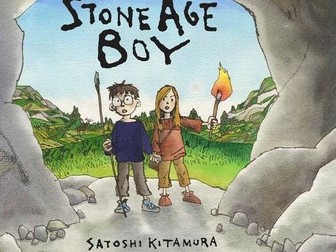
All using Stone Age boy
This is a set of 5 lessons.
It looks at where France is, comparing it to your country, discussing greetings and how French people greet each other. It enables children to practise greeting each other in French, as well as asking how they are and responding in different ways.
Fun activities with lots of games, songs and interactive activities.
Based on the story, Lila and the Secret of Rain
Mind map for setting description
Writing about past events
Writing a diary template with sentence stems
Infer how a character feels (with thought bubble/pictures)
Find hidden phrases
On fire background/with fire border, you have a template for the children to write their instructions.
Great link for stone age boy / other stone age texts.
This lesson explores reasons why we learn French.
It begins with answers - and pupils must think of the QUESTIONS.
It then explains some valid reasons why we learn French (statistics are up to date).
Children must present their ideas (and opinions) in a video (if possible) for younger children.
This Powerpoint gives children the opportunity to:
-Predict what is in the box (reminding them of expanded noun phrases)
-Look at the features (and it goes through some of them)
-Has a focus on alliteration (with a practice opportunity to finish)
Fun, creative lessons. The children love describing the monster's face and then using each other's work as a reading comprehension to work out how to colour in the monster's face.
Practises face vocabulary, reading together (joining in with a story), listening for key words, knowing that colours go after the noun in French, masculine/feminine/plural - all explored in a fun way.
Last lesson focuses on the children acting as monsters using the new vocabulary.
This could be a baseline assessment for the start of the year, or used for a termly one dependent on what you teach.
Appropriate for years 5, 6, 7, 8 - assesses understanding of short sentences, greetings, colours etc.
Reading section, writing section and labelling
Encourages children to practise saying/writing sentences about themselves.
Could be used as a revision topic (name, age, where i live) etc.
The dictation text has all of the useful vocabulary - children will write this down (racing against each other to do so). They must try to understand it and to find the vocabulary they need.
Then practise asking and answering simple questions (and answering in full sentences).
-Describe the setting sheet with photo and adjectives/adverbs word bank
-Infer the character’s thoughts (with thought bubbles)
-Persuade the reader to stay at camp (persuasive techniques)
-Complete sentences with adverbs
-Design and describe own cave character
-Infer the meanings of cave pictures (real examples)
Includes:
-2 comprehension activities (prediction, inference, sequencing, retrieval)
-Timeline activity
-Emotions graph
-Diary template
-Design a Christmas present for someone special
-Sequencing activity (writing can be done alongside)
-Lots of teachers notes/ideas written on p3
-Inference activity (from clip from the video)
All activities relate to the Disney Christmas advert 2020
All sorts in this bundle - from sequencing, inference (thought bubbles), speech bubbles, design a cave person, infer what the cave pictures are about, setting descriptions and more.
Plenty for a few weeks of the Stone Age Boy.
Adaptable to be Yr 2/3/4 activities linked to the story ‘Little Wolf’s Book of Badness’
-Prediction
-Persuasive letter example
-Think like a character (wolf) sheet
-Retrieval questions
This would be the first lesson for introducing zoo animals (bear, camel, monkey etc).
It goes through vocabulary (you can play games such as beat the teacher, children can repeat, do a oui/non).
It then moves onto asking children if it is a big giraffe? A small bear etc?
Listening activity on what animals the characters have (with descriptions)
And then children have a speaking activity practising saying what animals they have/don't have.
Daily activites (for 10 days) with L.O
Prediction (with sheet)
Inference for thoughts (with thought bubbles sheet)
Instruction writing
Diary writing - with WAGOLL included
Song lyrics to understand and infer
and more
10 lessons worth, plus some extra ideas
PPT with various materials - looking at and discussing properties; why do we use them for…? Why don’t we?
Task - for children to build a chair for ‘Fred the Frog’ (or another teddy in your class) with WORKSHEET attached (differentiated x 3)
Can allocate materials (e.g. Tissue, cardboard, wool, wood) or children choose own.


 Quick View